
Light a gas stove under a pot of water for dal, and the burning LPG warms the water; leave the pot, and the water cools back to the warmth of the kitchen. Nobody has ever seen a cold pot of water warm itself up by cooling the kitchen around it, though energy would be conserved just the same. Why not? And why do some reactions, like rusting and the burning of wood, go by themselves, while others, like splitting water into hydrogen and oxygen, have to be driven?
Chemical thermodynamics answers both questions with a few quantities and two laws. This unit follows the energy that goes in and out of a reaction: internal energy and the first law, enthalpy (the heat of a reaction at constant pressure), the heats of formation, combustion and solution, Hess’s law and bond enthalpies, which let you work out heats nobody can measure. Then comes the direction of change: entropy, the second law, and Gibbs free energy, the one number that says whether a reaction can go, and at what temperature it starts to.
4.1 Introduction
When you leave a glass of hot water on the table, it cools after some time. Why? The hot water gives heat to the air and the table around it, and they take that heat up. Put the glass on a stove and the reverse happens: the water takes heat in and gets hot. Thermodynamics is the study of energy and how it is changed from one form to another and passed between a system and its surroundings (thermo, heat; dynamics, movement).
To follow energy we must first say what we are watching:
- The system is the part of the universe we are studying: the water in a flask, the reactants and products of a reaction, a gas in a cylinder.
- The surroundings are everything outside the system that can exchange energy or matter with it: the flask, the burner, the air of the room.
- The boundary is the real or imaginary surface that separates the system from its surroundings: the flask’s glass wall, or the surface of the water open to the air.
System + surroundings = universe, in the language of thermodynamics.
Types of system
Systems are sorted by what can cross their boundary (Figure 4.1):
- Open system: both matter and energy can pass between the system and its surroundings. Example: tea in an open cup. It loses heat to the air, steam leaves it, and you can pour in more tea or warm it again.
- Closed system: energy can pass, but not matter. Example: tea in a cup with a tight lid, or a gas sealed in a cylinder with a piston. It can still gain or lose heat, and the gas can push the piston, but no matter gets in or out until it is opened.
- Isolated system: neither matter nor energy can pass. Example: hot tea in a closed vacuum flask, which stays hot for hours. No real system is perfectly isolated (the flask’s tea is cool by the next morning), but a good flask comes close.
Most reactions in a laboratory are done in open beakers and test tubes, so they are open systems; a reaction in a sealed bomb calorimeter is a closed system; the whole universe is the one truly isolated system.
A pressure cooker of dal is on the stove with its weight (whistle) in place, before it whistles. As a thermodynamic system, the dal and steam inside are:
Pick an answer to see why.
4.1.1 Properties of a system
A glass of water has a mass, a volume, a temperature, a density, a pressure, an internal energy. Stated together, these properties describe the state of the system. They come in two kinds.
Pour water from a bucket into a glass: the water in the glass has the same temperature as the water in the bucket, but much less mass. Properties that don’t depend on the amount of matter are intensive properties: temperature, pressure, density, boiling point, melting point, color, refractive index, specific heat capacity, concentration. Properties that do depend on the amount are extensive properties: mass, volume, internal energy, enthalpy, entropy, Gibbs energy, heat capacity.
A quick test: cut the system in half. An intensive property is the same in each half; an extensive property is halved. The ratio of two extensive properties is intensive: mass ÷ volume is density, heat capacity ÷ mass is specific heat capacity, and enthalpy per mole, in kJ/mol, is intensive too. That is why tables give enthalpies per mole.
Intensive properties don’t depend on the amount of substance in the system; extensive properties do.
Which of these is an intensive property?
Pick an answer to see why.
4.1.2 State function and path function
Heat water from 25 °C to 100 °C, quickly on a big flame or slowly on a small one: the change in temperature is 75 °C either way. It depends only on where the water started and where it ended. But the gas burnt, and the heat lost to the air on the way, are different for the two ways of heating.
A state function is a property that depends only on the initial and final states of the system, not on the path taken between them. Pressure (P), volume (V), temperature (T), internal energy (E or U), enthalpy (H), entropy (S) and Gibbs energy (G) are state functions. For a state function we can speak of a change, written with Δ (delta): ΔP, ΔV, ΔT, ΔE, ΔH, ΔS, ΔG, each “final value − initial value”.
A path function is a quantity that depends on the path, the way the system goes from one state to another. Heat (q) and work (w) are path functions: a gas taken from state 1 to state 2 along different paths does different amounts of work and takes in different amounts of heat. We never write Δq or Δw: there is no “heat of a system” to change, only the heat that flowed during a particular process.
The widget shows both kinds at once: the work and the heat change with the path, but the change in internal energy is the same for all three. (It comes from the physics book, so it writes internal energy as U and counts the work done by the gas; Section 4.4 compares this with the chemists’ way.) It is like walking up from Bhaktapur’s Durbar Square to Nagarkot: the height you gain is fixed by the start and the end (a state function), but the distance you walk and the tea you need depend on the road you choose (path functions).
Which of these is a path function?
Pick an answer to see why.
4.1.3 Thermodynamic processes
When a system changes from one state to another, some of its properties change: its volume, pressure, temperature. The way it changes is called a thermodynamic process. The processes below are named after what is kept constant.
- a.Isothermal process (ΔT = 0): the temperature stays constant. Heat flows in or out as needed to keep it so. Example: a gas expanded or compressed slowly in a cylinder that sits in a large water bath.
- b.Adiabatic process (q = 0): no heat passes between the system and its surroundings, so any work done changes the system’s internal energy (and usually its temperature). Example: a gas compressed or expanded quickly, or in an insulated container. Pump up a bicycle tyre fast and the pump’s barrel gets hot: an almost adiabatic compression.
- c.Isobaric process (ΔP = 0): the pressure stays constant. Heat taken in changes the volume and the temperature. Example: any reaction in an open beaker, which stays at the pressure of the air; water boiling in an open pot.
- d.Isochoric process (ΔV = 0): the volume stays constant, so the system does no work of expansion. Heat changes its temperature and pressure. Example: heating a gas in a sealed, rigid container; a reaction in a steel bomb calorimeter.
- e.Cyclic process: the system goes through a series of changes and returns to its initial state. Every state function is then back where it started, so ΔE = 0 (and ΔH = 0) for a whole cycle. Engines and refrigerators work in cycles.
- f.Reversible and irreversible processes, below.
A reversible process is an idealized process carried out so slowly, in such tiny steps, that the system is in equilibrium with its surroundings at every stage; at any moment a tiny change in the conditions would make it go back the other way, retracing every state, and leaving no change in the system or the surroundings. Because the system always pushes against an outside pressure only very slightly smaller than its own, the work it does in a reversible expansion is the largest possible, and the work needed for a reversible compression is the smallest possible.
An irreversible process is a real process that goes at a finite speed: a gas rushing into a vacuum, a rapid compression, any reaction in a beaker. It can’t be reversed without leaving some change behind (friction and turbulence turn part of the energy into heat), its intermediate states are not equilibrium states, and the entropy of the universe increases. The work an irreversible expansion gives out is always less than the reversible maximum. All real processes are irreversible; the reversible process is the ideal limit they approach when done more and more slowly.
In which process does the gas do no work of expansion?
Pick an answer to see why.
4.2 Energy in a chemical reaction
Energy is conserved in a reaction, as everywhere. When a reaction goes on, energy passes between the system (the reacting chemicals: reactants, products and any solvent they are in) and the surroundings (the flask, the thermometer, the air of the laboratory).
Where does a reaction’s energy come from? Reactants turn into products by breaking bonds and making new ones. Pulling two bonded atoms apart always takes energy, so bond breaking is endothermic; when atoms join, energy is given out, so bond making is exothermic. If the new bonds are stronger than the old ones, more energy is given out than taken in, and the reaction warms its surroundings: it is exothermic (combustion). If the bonds broken are stronger, the reaction takes energy in: it is endothermic (photosynthesis, which uses light). Section 4.7.1 puts numbers on this.
Breaking the bonds in a molecule:
Pick an answer to see why.
4.3 Internal energy (E or U)
A cup of hot coffee holds more energy than the same cup cold: its molecules move faster. As it cools, heat passes to the surroundings and its energy falls. A torch battery holds energy too, in the arrangement of the atoms and electrons in its chemicals, and gives it out as electrical energy.
All the energy stored inside a system is its internal energy, written E (or U). It is the sum of:
- the kinetic energy of its particles: translational (moving from place to place), rotational (spinning) and vibrational (the atoms in a molecule moving to and fro along their bonds);
- the potential energy of its particles: the attractions and repulsions between molecules, the energy of the chemical bonds within them, and the energy of the electrons and nuclei in the atoms.
Internal energy is the total energy contained in a system, from the motion of its particles and the forces between them.
Nobody can measure the absolute internal energy of a system (we would need to know all of these, down to the energy in the nuclei), but we don’t need to: what matters is the change, which can be measured. Internal energy is a state function, so its change depends only on the initial and final states:
ΔE is positive when the system gains energy and negative when it loses energy. In an isolated system, no heat or work crosses the boundary, so its internal energy stays constant: ΔE = 0.
Internal energy is extensive: a 100 kg block of iron at a given temperature has twice the internal energy of a 50 kg block at the same temperature. When a substance is heated, its particles move and vibrate faster, and its internal energy increases.
Two blocks of iron, 50 kg and 100 kg, are both at 30 °C. Which statement is true?
Pick an answer to see why.
4.4 First law of thermodynamics
The food we eat holds chemical energy, and our bodies turn it into the work of our muscles and the heat that keeps us at 37 °C. A microwave oven turns electrical energy into heat; a car engine turns the heat of burning petrol into the work that drives the wheels. Energy changes form again and again, but it is never made out of nothing, and it never disappears.
The first law of thermodynamics is the law of conservation of energy: energy can be neither created nor destroyed, only changed from one form to another; the total energy of an isolated system (and of the universe) is constant.
Mathematical form of the first law
Take a closed system with internal energy . Let a quantity of heat flow into it, and a quantity of work be done on it. Both bring energy in, so its internal energy becomes :
The change in the internal energy of a system equals the heat added to it plus the work done on it.
The signs, as chemists use them (IUPAC’s convention), are set from the system’s point of view: anything that brings energy into the system is positive.
| Quantity | Positive (+) when | Negative (−) when |
|---|---|---|
| heat is absorbed by the system | heat is released by the system | |
| work is done on the system (it is compressed) | work is done by the system (it expands) | |
| the internal energy increases | the internal energy decreases |
Work of expansion
The work that matters most in chemistry is the work a gas does when it expands against the pressure outside, for example the CO₂ from a reaction pushing back the air. Let a gas expand against a constant outside pressure , its volume growing from to (Figure 4.7). The force on a piston of area is ; if the piston moves out a distance , the work done by the gas is . Since this work is done by the system,
On a P–V graph this work is the area of the rectangle under the line at pressure , from to (Figure 4.8). For an expansion ΔV is positive and negative (the system loses energy as work); for a compression ΔV is negative and positive.
If instead the gas expands reversibly and isothermally (the outside pressure always only a little below the gas’s own, the temperature kept constant), the pressure falls as the gas expands and the work is the area under the curve . Calculus gives, for moles of an ideal gas,
This is the most work the gas can do in going from to at that temperature.
Special cases of the first law
| System or process | What is fixed | First law becomes | Meaning |
|---|---|---|---|
| Isolated system (a closed thermos flask) | no heat, no work cross | the internal energy stays constant | |
| Cyclic process | returns to the start | the net heat taken in equals the net work done by the system | |
| Isothermal, ideal gas (slow expansion in a cylinder in a bath) | ΔT = 0, so ΔE = 0 | all the heat taken in is given out as work (or all the work done on the gas leaves as heat) | |
| Adiabatic (rapid compression of the air in a diesel engine’s cylinder) | q = 0 | work done on the gas raises its internal energy (it heats up); work done by the gas lowers it (it cools) | |
| Isochoric (heating a gas in a rigid sealed container) | ΔV = 0, so w = 0 | all the heat added goes into internal energy | |
| Isobaric (boiling water in an open pot) | ΔP = 0 | the heat added is partly stored as internal energy and partly given out as the work of expansion |
The last two lines matter most in chemistry. A reaction in a sealed steel bomb is isochoric, so the heat measured there is ΔE. A reaction in an open beaker is isobaric, so the heat measured there is something else, the enthalpy change (Section 4.5).
A system releases 200 J of heat and does 100 J of work. Its change in internal energy is:
Pick an answer to see why.
4.5 Enthalpy and enthalpy changes: endothermic and exothermic processes
Hold an ice cube and your hand goes cold: the ice takes heat from your hand. That energy makes its water molecules vibrate harder until they break out of the crystal and the ice melts. The liquid water holds more energy than the ice it came from. The heat content of a substance, measured at constant pressure, is called its enthalpy (H, from the Greek enthalpein, to warm within). Water has more enthalpy than ice, so the change in enthalpy on melting, ΔH, is positive, and melting is an endothermic process.
A wood fire works the other way. The wood and oxygen turn into carbon dioxide and water with less enthalpy than they had, and the difference comes out as heat: ΔH is negative, and burning is an exothermic process.
Enthalpy is a thermodynamic property of a system, its heat content: the sum of its internal energy and the product of its pressure and volume, .
Enthalpy change, ΔH
Like internal energy, enthalpy can’t be measured on its own, only its change. The enthalpy change is the heat absorbed or released in a process at constant pressure:
- If ΔH < 0 (negative), the products have less enthalpy than the reactants: the reaction is exothermic and releases heat.
- If ΔH > 0 (positive), the products have more enthalpy: the reaction is endothermic and absorbs heat.
- Reversing a reaction or process changes the sign of ΔH (but not its size):
| Exothermic | Endothermic | |
|---|---|---|
| Heat | released to the surroundings | absorbed from the surroundings |
| Sign of ΔH | negative | positive |
| Enthalpy of products | lower than reactants | higher than reactants |
| Surroundings | get warmer | get colder |
| Examples | burning, respiration, neutralization, freezing, condensation | photosynthesis, melting, evaporation, dissolving NH₄NO₃, decomposing CaCO₃ |
Why enthalpy? ΔH = q at constant pressure
Enthalpy is defined as
where is the internal energy, the pressure and the volume of the system. Since E, P and V are all state functions, so is H. Now follow a change at constant pressure:
- The change in enthalpy is , since P doesn’t change.
- By the first law, , where is the heat absorbed at constant pressure.
- The only work is that of expansion against the constant pressure, . So .
- Put this into step 1: , that is
The enthalpy change of a process equals the heat absorbed (or released) at constant pressure. Most reactions happen at constant pressure, open to the air, so ΔH is the heat we actually measure, and the one tables give. (At constant volume, likewise, .)
ΔH and ΔE: the difference is the gas
For reactions of solids and liquids, ΔV is tiny and ΔH ≈ ΔE. When gases are made or used up, the volume can change a lot. For ideal gases, , so at constant temperature and pressure , where is the moles of gaseous products minus the moles of gaseous reactants. Then
- (more gas made): ΔH > ΔE, since part of the energy goes into pushing back the air.
- (gas used up): ΔH < ΔE.
- : ΔH = ΔE. Example: , with 2 mol of gas on each side.
Standard enthalpy change
ΔH depends a little on the temperature and pressure, and on the physical states of the substances (water as liquid or vapor), so values are compared under fixed standard conditions: each substance in its standard state, its pure, most stable form at a pressure of 1 bar (or 1 mol/L for a solution), at a stated temperature, nearly always 298 K (25 °C). The enthalpy change under these conditions is the standard enthalpy change, (“delta H standard”, the ° often written as a small circle or ⦵).
For , which is true?
Pick an answer to see why.
4.6 Enthalpy of reaction
The enthalpy change of a reaction depends on how much reacts, so it is given per mole of a named substance, or per mole of the equation as written. The kind of reaction gives it its name.
a. Standard enthalpy of solution ()
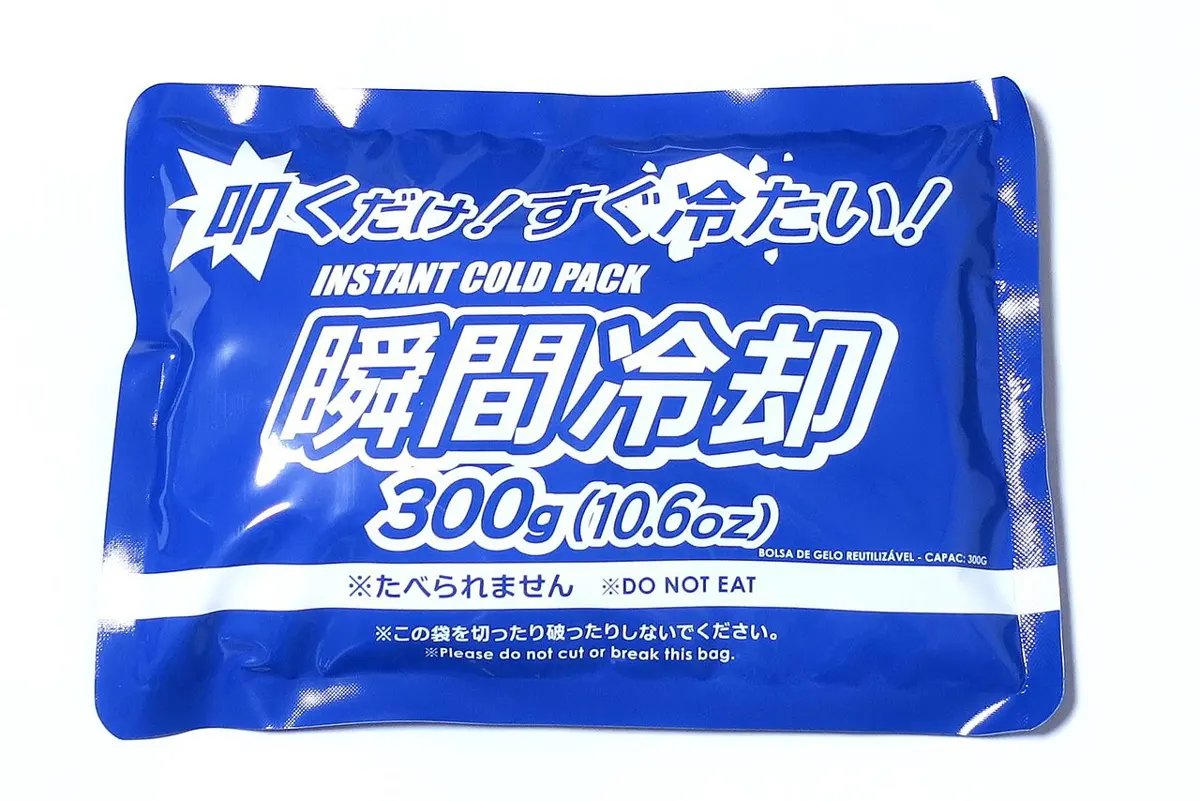
Have you used an instant cold pack from a first-aid kit, on a sprained ankle at a football match? It holds solid ammonium nitrate and a separate inner bag of water. Squeeze or strike the pack hard, the inner bag bursts, the salt dissolves, and the pack turns ice-cold in seconds. Dissolving ammonium nitrate absorbs heat from its surroundings:
25.7 kJ of heat is absorbed when 1 mol (80 g) of ammonium nitrate dissolves in plenty of water: this is its enthalpy of solution. Other substances, such as sodium hydroxide (−44.5 kJ/mol) and anhydrous calcium chloride (−82.8 kJ/mol), give out heat as they dissolve, and are used in self-heating packs.
The standard enthalpy of solution () is the enthalpy change when one mole of a solute dissolves in so much solvent that adding more causes no further heat change (infinite dilution), under standard conditions.
b. Standard enthalpy of reaction ()
Look at two reactions of nitrogen’s oxides:
The first takes in 181 kJ for each mole of nitrogen that reacts (as written, making 2 mol of NO); the second gives out 114 kJ for each 2 mol of NO. These values are the enthalpies of reaction for the equations as written. The standard enthalpy of reaction, (or ), is the enthalpy change when the amounts of reactants shown in the equation react completely, every substance in its standard state, usually at 298 K. Double the equation and ΔH doubles.
Enthalpies of reaction are worked out from the standard enthalpies of formation (below) of the products and reactants:
For a general reaction :
Each ΔH°f is multiplied by its coefficient in the balanced equation. Why this works is shown in Section 4.7.
c. Standard enthalpy of formation ()
Hydrogen burns in oxygen to make water:
285.8 kJ is released when 1 mol of liquid water is formed from hydrogen and oxygen in their standard states. Because the water is made from its elements, this is the standard enthalpy of formation of water, −285.8 kJ/mol; the minus sign says heat is released. Likewise for carbon dioxide and carbon monoxide:
The standard enthalpy of formation () of a compound is the enthalpy change when one mole of the compound is formed from its elements in their standard states, under standard conditions (1 bar, usually 298 K).
Two consequences:
- ΔH°f of an element in its standard state is zero: O₂(g), N₂(g), H₂(g), C(graphite), Fe(s), Br₂(l). Forming oxygen gas from oxygen gas is no change at all, so no heat is involved. An element in another form is not zero: C(diamond) is +1.9 kJ/mol, O₃(g) +142.7 kJ/mol.
- ΔH°f is a guide to stability. The more negative ΔH°f, the more energy was given out in forming the compound, and the more energy it would take to break it back into its elements: it is more stable relative to its elements. CO₂ (−393.5) is more stable than CO (−110.5). A compound with a positive ΔH°f, such as ethyne (acetylene, +227.4 kJ/mol) or nitrogen monoxide (+90.3), holds more energy than its elements; ethyne can even decompose explosively under pressure, which is why it is stored dissolved in acetone.
d. Standard enthalpy of combustion ()
Methane, the gas in natural gas and in the biogas plants of many Terai villages, burns in oxygen to give carbon dioxide and water, with a great deal of heat:
890.3 kJ of heat is released when 1 mol of methane burns completely: −890.3 kJ/mol is the standard enthalpy of combustion of methane. Ethanol, a biofuel made by fermenting sugarcane and maize, burns too:
The standard enthalpy of combustion () is the enthalpy change when one mole of a substance burns completely in oxygen under standard conditions (its carbon to CO₂(g), its hydrogen to H₂O(l)).
Enthalpies of combustion are always negative: burning is always exothermic. In a family of hydrocarbons, each extra CH₂ adds about 660 kJ/mol (methane −890, ethane −1560, propane −2219, butane −2877 kJ/mol): a bigger molecule has more bonds to turn into CO₂ and H₂O. A molecule with fewer hydrogen atoms gives out less: ethene (−1411) less than ethane (−1560).
Calorific value
The equation above says 890.3 kJ is released when 1 mol of methane burns. How much is released when 1 g burns?
1 mol of methane, CH₄ = 12.01 + 4 × 1.008 = 16.04 g, releases 890.3 kJ.
This is the calorific value of methane: 55.5 kJ/g, or 55,500 kJ/kg. The calorific value of a fuel or food is the heat released when 1 g (or 1 kg) of it burns completely in oxygen, given in kJ/g or kJ/kg (as a positive number). It is what matters when you pay for fuel by the kilogram, or carry it up a mountain: the higher the calorific value, the more heat from each kilogram.
- Fossil fuels (petrol, diesel, LPG, coal) have high calorific values, which makes them convenient, but burning them adds carbon dioxide from ancient carbon to the air, and soot and sulphur oxides too.
- Biofuels (ethanol, wood, dung cakes, biogas) have lower calorific values (ethanol 29.7 kJ/g, dry wood about 18 kJ/g, since part of their mass is already oxygen) but are renewable: the carbon they release was taken from the air by plants a short time ago.
The enthalpy of combustion of ethane is −1560 kJ/mol (C₂H₆ = 30.07 g/mol). Its calorific value is about:
Pick an answer to see why.
4.7 Laws of thermochemistry
a. Lavoisier and Laplace law (first law of thermochemistry)
The heat of formation of water and the heat of its decomposition are equal in size and opposite in sign: forming a mole of water releases 285.8 kJ, and the same 285.8 kJ must be supplied to split it. The French chemists Antoine Lavoisier and Pierre-Simon Laplace stated this in 1780, after measuring heats with an ice calorimeter (the heat was found from the mass of ice it melted). The Lavoisier–Laplace law, the first law of thermochemistry, states:
The heat needed to split a compound into its elements equals the heat given out when the compound is formed from them, but with the opposite sign.
More generally, the ΔH of any reaction reversed is the negative of the ΔH of the forward reaction. If it weren’t, you could form a compound and then split it, round and round, and come out with energy made from nothing, which the first law forbids. Uses: it lets us find the heat of a decomposition, which is often hard to measure, from the heat of formation, and it is the rule used every time a reaction is reversed in a Hess’s law calculation.
b. Hess’s law (second law of thermochemistry)
Carbon can burn to carbon dioxide in one step, or in two, first to carbon monoxide and then to the dioxide:
What is the heat of formation of carbon dioxide, ? Add the two equations: CO appears on both sides and cancels, and the two halves of O₂ make one. Add the ΔH values in the same way:
exactly the value measured when carbon burns straight to CO₂.
Hess’s law of constant heat summation: the total enthalpy change of a reaction is the same, whether it takes place in one step or in several, as long as the initial and final states are the same.
It follows from enthalpy being a state function: ΔH depends only on the start and the end, so any route between the same two states must give the same total. If route A → Z gave out more heat than route A → B → C → Z, you could go one way and come back the other and gain energy each time round, against the first law.
An enthalpy level diagram shows the same thing. Methane burning to give water vapor releases 802 kJ; the vapor condensing to liquid releases 88 kJ more:
Added, with 2H₂O(g) canceling:
The rules for Hess’s law calculations (each follows from the laws above):
- Equations can be added and subtracted like algebra; their ΔH values are added and subtracted in the same way.
- Reversing an equation changes the sign of its ΔH (Lavoisier–Laplace).
- Multiplying an equation by a number multiplies its ΔH by the same number.
- Physical states must match: H₂O(l) and H₂O(g) are different substances for this purpose.
Uses of Hess’s law
Hess’s law lets us find enthalpy changes that can’t be measured directly. Carbon and hydrogen can’t be made to combine to give benzene alone (they would make a mixture of hydrocarbons, and very slowly), so the enthalpy of formation of benzene can’t be measured. But carbon, hydrogen and benzene all burn readily, and their enthalpies of combustion can be measured. Hess’s law does the rest.
The same answer comes straight from the combustion data. Since every combustion product is shared, for any compound made of C, H and O:
Other uses: the enthalpies of formation of almost every compound in the tables were found this way; enthalpies of transition (graphite to diamond, Exercise 40); enthalpies of hydration of salts (Exercise 37), and lattice energies (the Born–Haber cycle, which uses Hess’s law to find the energy holding an ionic crystal together).
Given , ΔH = −296.8 kJ, what is ΔH for ?
Pick an answer to see why.
4.7.1 Bond energy or bond enthalpy
Not all covalent bonds are equally strong. It takes 612 kJ to break a mole of C=C bonds, but only 347 kJ to break a mole of C–C bonds: the double bond is stronger. These values are bond enthalpies (or bond energies), measured in kJ/mol.
The bond enthalpy is the energy needed to break one mole of a given bond, the molecules and the atoms formed being in the gas phase. The same amount is released when one mole of the bond is formed. Breaking is always endothermic, so bond enthalpies are always positive.
The four C–H bonds in methane don’t need quite the same energy to break one after another, and a C–H bond in ethanol is a little different from one in methane, so tables give average bond enthalpies over many compounds. The values in this unit:
| Bond | Average bond enthalpy (kJ/mol) | Bond | Average bond enthalpy (kJ/mol) |
|---|---|---|---|
| H–H | 436 | C–O | 358 |
| C–H | 413 | C=O (in CO₂) | 805 |
| C–C | 347 | O–H | 464 |
| C=C | 612 | O=O | 498 |
| C≡C | 837 | N≡N | 945 |
| Cl–Cl | 239 | H–Cl | 427 |
| C–Cl | 339 | F–F | 158 |
| C–F | 485 | C–I | 240 |
Factors affecting bond enthalpy
- a.Bond order. The more pairs of electrons shared between two atoms, the stronger the bond: single < double < triple. C–C 347, C=C 612, C≡C 837 kJ/mol. (A double bond is not twice as strong as a single bond: its second pair, the π bond, overlaps less well than the first.)
- b.Bond length. Shorter bonds are generally stronger, since the shared electrons are closer to both nuclei. N≡N (110 pm) is 945 kJ/mol, among the strongest bonds known, which is why the nitrogen of the air is so unreactive. (F–F, 142 pm, is unusually weak, 158 kJ/mol, because the lone pairs on the two small fluorine atoms crowd and repel each other.)
- c.Size of the atoms and electronegativity. Smaller atoms form shorter, stronger bonds, and a difference in electronegativity adds an ionic attraction to a covalent bond. C–F (485 kJ/mol) is much stronger than C–I (240 kJ/mol): fluorine is small and very electronegative, iodine large and only slightly so.
Bond enthalpies and the enthalpy of reaction
In a reaction, the bonds in the reactants are broken (energy taken in) and the bonds of the products formed (energy given out). The difference is the enthalpy of reaction:
If the bonds formed are stronger in total than those broken, ΔH is negative and the reaction is exothermic. That is why hydrocarbons are good fuels: C=O and O–H bonds are strong.
Which bond is the hardest to break?
Pick an answer to see why.
4.8 Entropy and spontaneity
4.8.1 Spontaneous and non-spontaneous processes
A ball set on a hilltop rolls down by itself; to get it back up, you have to push it. Some processes happen by themselves once started, with no continuing help from outside; others need outside help all the way.
A spontaneous process is one that, once started, goes on by itself without a continuing input of energy from outside. A non-spontaneous process goes only while energy is supplied from outside; stop the supply and it stops.
| Spontaneous (by themselves) | Non-spontaneous (need outside help) |
|---|---|
| water flowing downhill | pumping water uphill |
| ice melting at room temperature | water freezing at room temperature |
| rusting of iron | electrolysis of water into H₂ and O₂ |
| diffusion of gases (a smell spreading through a room) | photosynthesis (needs a steady supply of light) |
| respiration in living things | charging a phone battery |
| heat flowing from hot tea to the air | a refrigerator moving heat from its cold inside to the warm kitchen |
A process that is spontaneous in one direction is non-spontaneous in the other.
What do spontaneous processes have in common? Many give out energy, like the ball rolling down or a fire burning, but not all: ice melts at room temperature by itself while taking in heat. Something else is at work. In each spontaneous process, things become more spread out: the gas from a cylinder of LPG left open spreads through the whole room and never gathers back by itself; ink dropped in water spreads until the glass is evenly colored; the heat of a hot cup spreads into the cooler room. When the tap between a flask of gas and an empty flask is opened, the gas spreads evenly between the two, by itself; it never all gathers back into one flask (Figure 4.19). This spreading of matter and energy, the growth of disorder or randomness, is measured by entropy.
Which of these processes is non-spontaneous?
Pick an answer to see why.
4.8.2 Entropy
Ice keeps its shape, but water doesn’t: in ice the molecules are held in a fixed arrangement by hydrogen bonds. When a solid melts, its particles become free to move about; when a liquid boils, they fly apart and fill the whole container. At each step there are many more ways of arranging the particles and sharing out their energy: the system becomes more disordered, or more random. Thermodynamics measures this by entropy, written S. A highly ordered system has low entropy; a disordered one has high entropy.
Entropy is a measure of the disorder (randomness) of a system: more precisely, of how spread out its energy is, among how many arrangements of its particles.
Like enthalpy and internal energy, entropy is a state function, so we can speak of its change:
Unlike enthalpy, entropy has an absolute zero: a perfect crystal at 0 K has zero entropy (the third law of thermodynamics). So tables give the actual entropy of each substance, its standard molar entropy S°, not only changes.
Entropy change and heat
When heat is added to a system it spreads its particles over more energy states, so its entropy rises; the same heat raises the entropy more at a low temperature (where there was little disorder to begin with) than at a high one. For an isothermal process, the change in entropy is the heat that would be absorbed if the process were done reversibly, divided by the absolute temperature:
where ΔS is the entropy change, the heat absorbed (or released) reversibly, and the absolute temperature in kelvin. So entropy is measured in units of heat ÷ temperature: J/K (or cal/K), and for a mole of substance, J/(mol K).
The entropy of the universe (system + surroundings) decides whether a process can go by itself:
| The process is | |
|---|---|
| > 0 | spontaneous (irreversible) |
| = 0 | at equilibrium (reversible) |
| < 0 | non-spontaneous (its reverse is spontaneous) |
Types of entropy change
a. Entropy of fusion (). At its melting point, ice and water are in equilibrium, , so melting there is reversible, and the heat absorbed is the enthalpy of fusion. The entropy of fusion is the entropy change when one mole of a solid changes into liquid at its melting point:
where is the molar enthalpy (latent heat) of fusion and the melting point in kelvin.
b. Entropy of vaporization (). Likewise, at its boiling point a liquid is in equilibrium with its vapor, . The entropy of vaporization is the entropy change when one mole of a liquid changes into vapor at its boiling point:
where is the molar enthalpy (latent heat) of vaporization and the boiling point in kelvin. For water, J/(mol K), about five times the entropy of fusion: a gas is far more disordered than a liquid, while a liquid is only a little more disordered than a solid.
c. Entropy of sublimation () is the entropy change when one mole of a solid changes directly into vapor (below its melting point), as dry ice or camphor does.
Entropy changes in a chemical reaction
During a reaction the entropy of the system can rise or fall, depending on the products. From the standard molar entropies in the tables,
For a general reaction :
(Note: S° of an element is not zero, unlike its ΔH°f: oxygen gas has S° = 205.2 J/(mol K).) The sign can usually be predicted:
- a.A change of phase from solid to liquid to gas: ΔS > 0, entropy increases.
- b.A reaction that makes more moles of gas than it uses: ΔS > 0. One that uses up gas: ΔS < 0.
- c.A solid or liquid dissolving: usually ΔS > 0. A precipitate forming: usually ΔS < 0.
- d.One molecule splitting into several: ΔS > 0.
Example: , a solid giving 2½ mol of gas: ΔS > 0.
Which process has a negative entropy change?
Pick an answer to see why.
4.9 Second law of thermodynamics
Put a hot object (80 °C) in contact with a cold one (20 °C). The first law says only that the heat lost by one equals the heat gained by the other:
It would be just as satisfied if heat flowed from the cold object to the hot one, making the hot one hotter. That never happens. The first law is the law of energy’s amount; it says nothing about the direction of change. Its limitations:
- a.It doesn’t say whether a process will go by itself, or in which direction.
- b.It says nothing about entropy or irreversibility.
- c.It doesn’t limit the efficiency of machines: by the first law alone, an engine could turn all its heat into work.
- d.It can’t predict whether a chemical reaction is feasible.
The second law gives the direction. When heat flows from hot to cold, the cold object gains entropy (it takes in heat) and the hot object loses entropy (it gives heat out). But the same heat makes a bigger change in entropy at a lower temperature (ΔS = q/T), so the cold object gains more entropy than the hot object loses. For 1000 J flowing from 353 K (80 °C) to 293 K (20 °C):
The entropy of the universe increases, so the flow is spontaneous. Heat flowing the other way would make it decrease, so it doesn’t happen by itself.
In general, processes that are spontaneous in one direction are non-spontaneous in the other. The entropy of the system plus that of the surroundings is the entropy of the universe, and the second law of thermodynamics can be stated in terms of it:
The second law of thermodynamics: in every spontaneous process the total entropy of the universe increases. It never decreases.
Note that the entropy of the system alone can decrease in a spontaneous process (water freezing in a freezer, a seed growing into an ordered tree), provided the entropy of the surroundings increases by more.
Applications of the second law
- a.No engine can be 100% efficient. A car engine, a jet engine, a thermal power station must give out some of their heat to cooler surroundings, or the entropy of the universe would fall. (The Carnot limit is in Grade 12 Physics, Unit 5.)
- b.Refrigerators and air conditioners move heat from a cold place to a warm one, the non-spontaneous direction, only by using work from outside (the electricity running the compressor), and they give out more heat to the room than they take from inside.
- c.It explains why melting ice, sugar dissolving in tea or perfume spreading through a room happen by themselves, and can’t be undone without outside work.
- d.Photosynthesis builds ordered sugar molecules from simple CO₂ and water, lowering entropy inside the plant; the sunlight it uses comes from the very hot Sun and ends up as heat spread out at the Earth’s temperature, an increase in entropy much larger than the decrease in the plant. Living things don’t break the second law; they feed on the flow of energy through them.
Which statement best describes the second law of thermodynamics?
Pick an answer to see why.
4.10 Gibbs free energy and prediction of spontaneity
An electric drill takes in electrical energy, but not all of it turns the drill bit. Some is lost as heat (the motor gets warm) and as sound. The energy that does the useful work of drilling is available energy; the energy lost as heat and sound, which can do no useful work, is unavailable energy.
The second law says the same about every change: entropy increases, so not all the energy of a process can be turned into useful work; part must go to increase the disorder of the system and its surroundings. The part of the energy that can be turned into useful work is called available energy or free energy; the part that can’t is unavailable energy:
Gibbs combined enthalpy and entropy into one function, the Gibbs free energy (or Gibbs energy, or just free energy), G:
H is the system’s heat content, and TS its “unavailable” part, tied up in disorder. G is a state function (H, T and S all are), so we can speak of its change. At constant temperature,
Many books call this the Gibbs–Helmholtz equation, and an exam answer may use that name (strictly, the name belongs to a related equation for how ΔG changes with temperature). Under standard conditions,
where ΔG° is the standard free energy change.
Gibbs free energy is the energy of a system available to do useful work at constant temperature and pressure, ; it is measured in joules (kJ/mol for a reaction).
ΔG is the maximum useful work
When petrol burns in an engine, its free energy falls, and that fall, −ΔG, is the most useful work the engine could ever get from it. Here is why. At constant temperature and pressure, for a reversible change:
- , and , so .
- By the first law, . Split the work into the work of expansion, , and any other (useful) work, , such as electrical work: .
- For a reversible change, .
- Put these in: .
So for a reversible change ΔG is the useful work done on the system. In a spontaneous change the system does work on its surroundings, and the most it can do, achieved only if the change is reversible, is
The decrease in free energy of a process at constant temperature and pressure equals the maximum useful work the system can do on its surroundings. A real (irreversible) process does less, and the rest of the energy enters the surroundings as heat. In a battery, −ΔG of its reaction is the most electrical work it can give Grade 12: Unit 5; in your muscles, −ΔG of burning glucose is the most work they could do with it.
4.10.1 Predicting spontaneity using free energy
Most spontaneous processes give out heat (ΔH negative) and increase the system’s entropy (ΔS positive). But not all: water freezes spontaneously below 0 °C though its entropy falls, and water evaporates spontaneously though it takes in heat. Neither ΔH nor ΔS of the system alone can decide. ΔS of the universe can, and ΔG turns that into quantities of the system alone.
At constant temperature and pressure, the heat released by the system, , is absorbed by the surroundings, so the entropy of the surroundings changes by
Then
Multiply by −T:
By the second law, a spontaneous process has . Since T is always positive, that means ΔG < 0. So, at constant temperature and pressure:
| ΔG | The reaction |
|---|---|
| ΔG < 0 (negative) | is spontaneous in the forward direction |
| ΔG = 0 | is at equilibrium: no net change either way |
| ΔG > 0 (positive) | is non-spontaneous forward (work must be done to make it go), and the reverse reaction is spontaneous |
In every spontaneous process at constant temperature and pressure, the free energy of the system decreases. The system goes on changing until G is as low as it can be: that is equilibrium.
Enthalpy, entropy and temperature
ΔG = ΔH − TΔS has two terms, the enthalpy term ΔH and the entropy term −TΔS. At low temperature the enthalpy term counts most; at high temperature the entropy term, multiplied by T, takes over. So a process with any signs of ΔH and ΔS can be spontaneous, depending on the temperature:
- a.Melting of ice, : endothermic (ΔH = +6.01 kJ/mol) with an increase in entropy (ΔS = +22.0 J/(mol K)). In ΔG = ΔH − TΔS, the signs are (+) − T(+): ΔG is negative only when TΔS is larger than ΔH, that is, at high temperature, above 6010/22.0 = 273 K. Below 0 °C ice doesn’t melt.
- b.Condensation of steam, : ΔH negative and ΔS negative. ΔG = (−) − T(−) is negative only at low temperature: below 100 °C (at 1 atm), steam condenses by itself.
In a cycle of changes of state (Figure 4.21), the changes that go towards the gas (melting, boiling, sublimation) are spontaneous at high temperature; the changes that go towards the solid (freezing, condensation, deposition) are spontaneous at low temperature.
| ΔH | ΔS | −TΔS | ΔG = ΔH − TΔS | The reaction is | Example |
|---|---|---|---|---|---|
| − | + | − | always − | spontaneous at all temperatures | |
| + | − | + | always + | non-spontaneous at all temperatures | |
| − | − | + | − at low T, + at high T | spontaneous at low T, non-spontaneous at high T | |
| + | + | − | + at low T, − at high T | spontaneous at high T, non-spontaneous at low T |
In the last two cases, the change turns over at the temperature where ΔG = 0:
At this temperature the forward and reverse processes are in equilibrium (for ice and water at 1 atm, 273 K, the melting point).
A reaction has ΔH = +40 kJ/mol and ΔS = +100 J/(mol K). It is spontaneous:
Pick an answer to see why.
4.11 Standard Gibbs free energy and equilibrium constant
For a general reaction at equilibrium,
the equilibrium constant is Grade 11: Grade 11, Unit 8
(with partial pressures, in bar, for gases). K says how far a reaction goes; ΔG° says how far downhill the products lie from the reactants under standard conditions. They are two measures of the same thing, related by
and, with common logarithms,
where ΔG° is the standard Gibbs free energy change (J/mol), R the gas constant (8.314 J/(mol K)), T the absolute temperature (K) at which K is measured, and K the equilibrium constant. The relation holds at any temperature, with the ΔG° and K for that temperature.
So:
| ΔG° | K | At equilibrium |
|---|---|---|
| ΔG° < 0 | K > 1 | the products are favored (the reaction goes well forward) |
| ΔG° = 0 | K = 1 | neither side is favored |
| ΔG° > 0 | K < 1 | the reactants are favored (little reaction) |
Because the relation is a logarithm, a modest ΔG° makes an enormous K. At 298 K each 5.7 kJ/mol of ΔG° changes K tenfold: ΔG° = −57 kJ/mol gives K = 10¹⁰, a reaction that goes practically to completion; +57 kJ/mol gives 10⁻¹⁰, one that hardly goes at all.
If K > 1 for a reaction, its ΔG° is:
Pick an answer to see why.
Project work
Exercise
A. Multiple choice questions
- Which of the following best describes thermodynamics?
Pick an answer to see why.
- What happens to a closed room when the door of a running refrigerator in it is left open?
Pick an answer to see why.
- If ΔH is the enthalpy change and ΔE the change in internal energy of a reaction, which statement about them is correct?
Pick an answer to see why.
- The adsorption of a gas on a solid surface is spontaneous and exothermic. Which of the following best explains this?
Pick an answer to see why.
- From the data, what is ΔH in kcal/mol for ?
The textbook prints “in kJ/mol”, but its data and its options are in kcal/mol, so the book’s units don’t fit; the question asks for kcal/mol here. The book also prints 117 twice; one of them is changed.
, ΔH = −94.3 kcal/mol; , ΔH = −67.4 kcal/mol; , ΔH = +117.4 kcal/mol; , ΔH = +230.6 kcal/mol.
Pick an answer to see why.
- For , ΔH = −453 cal/mol. Which statement about these allotropes is correct?
Pick an answer to see why.
- Which statement correctly describes the energy change in a chemical reaction?
Pick an answer to see why.
- What is the significance of the activation energy of a reaction?
The textbook prints four options none of which is true, so the book’s options don’t work; one of them is put right here.
Pick an answer to see why.
- The internal energy of a system increases by 50 J when 20 J of work is done on it. What is the heat absorbed?
Pick an answer to see why.
- Which process violates the first law of thermodynamics?
Pick an answer to see why.
- The enthalpy change when 1 mole of carbon (graphite) burns completely to form 1 mole of carbon dioxide is −393.5 kJ/mol. This value is:
The textbook prints “carbon monoxide” in one option where carbon dioxide is meant, which leaves no true option, so the book’s options don’t work; that option is put right here.
Pick an answer to see why.
- The enthalpy of solution of a substance is negative. Which condition favors its dissolving?
Pick an answer to see why.
- Hess’s law is also called the second law of thermochemistry. According to it, the enthalpy change of a reaction depends on:
Pick an answer to see why.
- Which of the following states the Lavoisier–Laplace law?
The textbook prints “combustion” in one option where decomposition is meant, which leaves no true option, so the book’s options don’t work; that option is put right here.
Pick an answer to see why.
- Which of the following processes results in an increase in entropy and a decrease in enthalpy?
The textbook prints four options none of which both raises entropy and lowers enthalpy, so the book’s options don’t work; one of them is replaced here.
Pick an answer to see why.
- Which of the following best illustrates the second law of thermodynamics?
Pick an answer to see why.
- For a reaction to be spontaneous, its Gibbs free energy change, ΔG, should be:
Pick an answer to see why.
- A reaction has ΔH = −200 kJ/mol and ΔS = −500 J/(mol K). Above what temperature does it become non-spontaneous?
The textbook gives ΔS = −50 J/(mol K), but then the reaction becomes non-spontaneous only above 200,000 ÷ 50 = 4,000 K, which is none of the options. So the book’s numbers don’t work; with −500 J/(mol K) the answer is one of them.
Pick an answer to see why.
- The equation relating the standard Gibbs free energy change to the equilibrium constant is ΔG° = −RT ln K. If K > 1, then ΔG° is:
Pick an answer to see why.
- Which process in the P–V diagram (Figure 4.26) is isobaric?
Pick an answer to see why.
- A reaction has an enthalpy change of −150 kJ and an entropy change of −0.2 kJ/K. At which of these temperatures is it spontaneous?
The textbook prints the temperatures 200, 500, 800 and 1000 K, and the reaction is spontaneous at two of them, so the book’s options don’t work; one of them is changed here.
Pick an answer to see why.
- Which of the following explains the spontaneous conversion of diamond into graphite?
Pick an answer to see why.
- If a system releases 200 J of heat and does 100 J of work, what is the change in its internal energy?
Pick an answer to see why.
- Which property or properties of a system mainly decide whether a reaction is spontaneous?
Pick an answer to see why.
- Which factor does not affect the enthalpy change of a reaction?
Pick an answer to see why.
B. Short answer questions
Define the following, with their units:
- a.internal energy
- b.enthalpy
- c.entropy
- d.Gibbs free energy
Answer
Differentiate between:
- a.exothermic and endothermic processes
- b.extensive and intensive properties
- c.enthalpy of formation and enthalpy of combustion
- d.state function and path function
- e.isobaric and isochoric processes
Answer
State the following laws, with their mathematical form and an explanation:
- a.the first law of thermodynamics
- b.the second law of thermodynamics
- c.the Lavoisier–Laplace law
- d.Hess’s law of constant heat summation
Answer
Define a state function. Explain why enthalpy and entropy are state functions.
Answer
What is internal energy? Write the relation between internal energy and enthalpy. Use it to show that the change in internal energy and the change in enthalpy are equal for the formation of HCl from H₂ and Cl₂.
Answer
The enthalpy change of the reaction between nitrogen and oxygen is
- a.What is meant by the enthalpy of reaction?
- b.What is the meaning of ΔH = +180 kJ?
- c.Find the enthalpy change of .
- d.Calculate the enthalpy of formation of NO.
Answer
State the Lavoisier–Laplace law and give its applications.
Answer
Figure 4.27 shows six changes of state.
- a.Which changes are endothermic and which exothermic?
- b.Which changes increase the entropy of the system?
- c.Using ΔH and ΔS, say which changes are spontaneous at low temperature, with an explanation.
Answer
Using the data, calculate ΔH for .
Hint
Answer
Calculate the enthalpy change of the reaction
from the data:
Hint
Answer
From the data, calculate the enthalpy change, in kJ/mol, of .
Hint
Answer
Figure 4.28 shows an enthalpy cycle for barium chloride.
- a.How does it illustrate Hess’s law?
- b.What is the enthalpy of solution of barium chloride?
- c.Calculate the enthalpy of hydration of BaCl₂(s) from the cycle.
Answer
Figure 4.29 shows the enthalpy of the reactants and products of a reaction.
- a.Is the reaction endothermic or exothermic? Why?
- b.Give two common examples of such reactions.
Answer
The first law of thermodynamics relates internal energy, heat and work.
- a.Write the relation and explain its meaning.
- b.How does it change for an isothermal process and for an adiabatic process?
- c.In what ways can the internal energy of a closed system be increased?
- d.Under what conditions are q and w negative?
Answer
The enthalpies of combustion of two allotropes of carbon are:
- a.What are allotropes?
- b.Which allotrope is the more stable, and why?
- c.Calculate the enthalpy changes for converting graphite to diamond, and diamond to graphite.
Answer
Given:
- a.Which of reactions (2) and (3) takes place more easily, and why?
- b.Calculate the enthalpy change for .
Answer
Predict the sign of the entropy change for each process, with a reason:
- a.
- b.the freezing of liquid water
- c.
- d.
Answer
Using the data, calculate the temperature at which is at equilibrium (at 1 bar), above which it becomes spontaneous.
| Substance | ΔH°f (kJ/mol) | S° (J/(mol K)) |
|---|---|---|
| H₂O(l) | −285.83 | 70.0 |
| H₂O(g) | −241.82 | 188.8 |
Hint
Answer
Use the bond enthalpies in the table to answer:
| Bond | C–C | C–H | O=O | O–H | C=O (in CO₂) | C–O | H–H | C=C |
|---|---|---|---|---|---|---|---|---|
| Bond enthalpy (kJ/mol) | 347 | 413 | 498 | 464 | 805 | 358 | 436 | 612 |
- a.Which bond is the hardest to break?
- b.What does a C–H bond enthalpy of 413 kJ/mol mean?
- c.Calculate the enthalpy of combustion of methane from the bond enthalpies.
Answer
Figure 4.30 shows four thermodynamic processes on a P–V diagram. Define each, with an example.
Answer
C. Long answer questions
Answer using Figure 4.31.
- a.Define enthalpy.
- b.Write the balanced chemical equation for the reaction.
- c.What is the meaning of −890 kJ/mol?
- d.Calculate the calorific value of methane in kJ/g.
- e.How does this reaction increase the entropy of the universe?
Answer
Define entropy and give its unit. Predict the sign of the entropy change of the system in each reaction:
- a.molten gold solidifies
- b.gaseous Cl₂ dissociates in the stratosphere into gaseous Cl atoms
- c.gaseous CO reacts with gaseous H₂ to form liquid methanol, CH₃OH
- d.the precipitation reaction between Ca(NO₃)₂(aq) and (NH₄)₃PO₄(aq)
Answer
Enthalpies of combustion are given:
| Reaction | ΔH°c (kJ/mol) |
|---|---|
| −393.5 | |
| −285.8 | |
| −1559.7 |
- a.Define enthalpy of combustion.
- b.Calculate the calorific value of ethane.
- c.Using Hess’s law, calculate the enthalpy of formation of ethane.
Answer
For the combustion of graphite, , ΔH° = −393 kJ and ΔS° = +2.9 J/K.
- a.Define standard enthalpy change and standard entropy change.
- b.What is the enthalpy of formation of carbon dioxide from this process? Justify.
- c.Under what conditions is the process spontaneous?
- d.Calculate the temperature at which ΔG° = −394 kJ.
- e.Melting and freezing are reverse processes, yet both are spontaneous. Explain their spontaneity at different temperatures.
Answer
Standard enthalpies of formation are given:
| Substance | ΔH°f (kJ/mol) |
|---|---|
| NH₃(g) | −45.9 |
| O₂(g) | 0.0 |
| NO(g) | +90.3 |
| H₂O(g) | −241.8 |
| H₂O(l) | −285.8 |
- a.What is meant by standard enthalpy of formation?
- b.Why is the value zero for oxygen?
- c.Which substance is the most difficult to form, and why?
- d.Which substance is the most stable, and which the least stable?
- e.Calculate the calorific value of ammonia and of nitric oxide.
Answer
The standard enthalpies of formation of acetylene (ethyne), ethene and ethane are:
The textbook gives only acetylene’s and ethane’s values, but the reaction it asks about is of ethene, so the book’s data don’t fit the question; ethene’s value is added here, and the answer is given for acetylene too.
- a.What is meant by standard enthalpy of formation?
- b.How can these values be used to compare the stability and reactivity of the substances?
- c.Using Hess’s law, calculate the enthalpy change of the reaction
Answer
Bond enthalpies are given:
| Bond | Enthalpy (kJ/mol) |
|---|---|
| C–H | 413 |
| C–C | 347 |
| Cl–Cl | 239 |
| H–Cl | 427 |
| C–Cl | 339 |
- a.Define bond enthalpy.
- b.What factors affect the value of a bond enthalpy?
- c.Which of these bonds is the most difficult to break, and why?
- d.Calculate the enthalpy change of the reaction
Answer
Gibbs free energy change is the final test of whether a process is spontaneous.
- a.Define spontaneity and Gibbs free energy.
- b.How is the free energy change related to the enthalpy change and the entropy change?
- c.Under what condition of free energy change is a process spontaneous?
- d.Say whether each process is spontaneous, and at what temperatures:
- i.evaporation of a liquid
- ii.dissolving NaCl in water
- iii.crystallization of copper sulphate from its solution
Answer
Printable PDFs
- Study notes 3 pages
- Worksheet 4 pages Answer key
Quiz yourself: Matter, Atoms and Reactions, Grades 5–12 →
Practice every question in the book, and keep track of the ones you miss →
A companion to your textbook, not a replacement for it: study from the book your school uses, and where the two differ, follow your teacher. Found a mistake? Please tell us.