
On a winter morning in Bhaktapur, the steel chair on the veranda feels icy and the wooden bench beside it doesn’t, though both have sat in the same cold air all night and are at the same temperature. Pour boiling water into a steel tumbler and you can’t hold it; pour it into a clay cup and you can. Something about each material decides how fast heat moves through it.
The last unit measured heat: how much it takes to warm or melt something. This one asks how fast heat flows, and by which road. You will meet the three roads, conduction, convection and radiation; put a number on how well a material conducts, and measure it with Searle’s apparatus; see why a quilt keeps you warm and why a thermos flask has a vacuum and silvered walls; and finish with the fourth-power law of radiation, which let a physicist in Vienna work out the temperature of the Sun without leaving his room.
12.1 Introduction
Heat flows from a hotter body to a colder one as long as there is a difference of temperature between them, and nothing can stop it completely: the best insulator only slows it down. The hotter body loses energy and cools, the colder one gains it and warms, until both are at the same temperature (Unit 9).
Heat travels by three roads:
- Conduction. Put one end of a steel spoon in hot tea and soon the other end is warm. The metal itself doesn’t move; heat passes from particle to particle through it.
- Convection. Heat a pot of water from the bottom and the top soon warms too. The warm water itself rises, carrying its heat with it, and cooler water sinks to take its place.
- Radiation. Sit near a fire, or in the sun, and you feel warm, though the air between may be cold. Heat crosses the space as electromagnetic waves, needing no material at all; that is how the Sun’s heat reaches us across the vacuum of space.
In short: conduction passes heat by the vibrations and collisions of particles in a solid (or a still fluid), with no particle traveling; convection carries heat by the bulk movement of a fluid itself; radiation sends heat as electromagnetic waves, with no medium at all.
12.2 Conduction
Heat one end of a metal rod. The atoms there vibrate about their places more and more strongly: they have more kinetic energy than their neighbors in the colder part. Each atom is held to its neighbors by forces like springs, so its harder vibrations jostle the next atoms, which jostle the next, and energy passes along the rod from the hot end towards the cold one. No atom leaves its place; only the energy of vibration travels. This is conduction.
In metals there is a second, faster carrier. A metal has free electrons that move about among its atoms. In the hot region they move faster, and as they wander into the colder region they share that energy with it. This is why metals, which have many free electrons, conduct heat far better than wood, glass or plastic, which have none, and why good conductors of electricity (copper, silver, aluminium) are also good conductors of heat.
Conduction is the transfer of heat from a hotter part of a body to a colder part, or between bodies in contact, by the vibrations and collisions of its particles (and, in metals, by free electrons), without the particles themselves moving from place to place.
- Conduction needs a material medium: there is none in a vacuum.
- It happens mainly in solids. Liquids and gases conduct too, but poorly, and in them convection usually carries far more heat.
- A material’s ability to conduct heat is measured by its thermal conductivity (Section 12.4). Metals are good conductors; materials that conduct heat poorly, such as wood, paper, plastic, cotton, wool and air, are bad conductors or insulators.
Why do metals conduct heat much better than wood?
Pick an answer to see why.
Conduction in daily life
Most of the examples below use one fact: still air is a very poor conductor, about five times poorer than wood and 15 000 times poorer than copper. Trap air in small pockets, so that it can’t move and carry heat by convection, and you have an insulator.
- Two thin jackets are warmer than one thick jacket of the same total thickness: the layer of air trapped between them adds to the insulation.
- Double walls in cold places. The ice houses of the Arctic, and many houses in cold countries, have two walls with air between them: the trapped air slows the loss of heat from inside to outside.
- Double-glazed windows in cold countries have two panes of glass with a thin layer of air (or gas) between them.
- Cold-storage rooms have thick walls of insulating material, so that heat from outside leaks in slowly.
- A tight glass stopper can be loosened by dipping the bottle’s neck in warm water. Glass is a poor conductor, so the neck warms and expands before the heat reaches the stopper, and the stopper comes free.
- Pans, kettles and pressure cookers are made of metal, so that heat passes quickly to the food, but their handles are wood, Bakelite or plastic, so that the heat doesn’t reach your hand.
- Woolen clothes are full of tiny pockets of air. Wool and air are both poor conductors, so heat from the body escapes slowly, and wool keeps you warm in winter.
- A thermos flask has a vacuum between its double walls: with no medium, there is no conduction (or convection) across the gap (Figure 12.2; Exercise 18).
- An iron chair feels colder than a wooden one in winter, though both are at the same temperature: iron conducts heat away from your skin quickly, wood hardly at all.
- Ice packed in sawdust inside a double-walled ice box, wrapped in sacking, melts slowly: sawdust, the air in it, and the sacking are all poor conductors.
- A quilt (सिरक) is filled with fluffy cotton, which traps air in its spaces. A newly made quilt, its cotton freshly carded, holds much more air than an old, pressed-down one, and is warmer. That is why the cotton of an old quilt is taken out and fluffed up again by a cotton carder before winter.
Sample questions
12.3 Temperature gradient
Hold one end of a metal rod in a flame. Close to the flame the rod is very hot; a little farther along it is warm; at the far end it may still be cool. The temperature changes along the rod, and how quickly it changes, degree by degree, with distance, is what drives the heat along.
The temperature gradient at a point is the rate at which the temperature changes with distance along a given direction:
where is the small change of temperature over a small distance . Its SI unit is the kelvin per meter, K/m (the same as °C/m, since a change of 1 K is a change of 1 °C). Like a slope, it has a direction: the direction in which the temperature changes fastest. Heat flows down the gradient, from hot to cold, the way water runs down a slope.
Temperature along a conducting rod
Put one end of a rod of length in a hot reservoir kept at (a box of steam, say) and the other in a cold reservoir kept at (melting ice). At first the rod warms up all along its length. After a while each point settles to a steady temperature that no longer changes: the rod has reached its steady state. Every point then passes on exactly as much heat as it receives; none is stored.
- A lagged rod. Wrap the rod’s curved surface in a thick layer of insulation (lagging: felt, cotton wool, foam), so that no heat leaks from its sides. In the steady state, all the heat that enters at the hot end flows through every cross-section and out at the cold end. Then the temperature falls uniformly along the rod: a graph of temperature against distance is a straight line, and the temperature gradient is the same everywhere:
- An unlagged rod. Leave its sides bare, and the rod loses heat to the air all along its length, most where it is hottest. Each section passes on less heat than it receives, so the temperature falls steeply near the hot end and more gently farther on: the graph is a curve, and the gradient is not uniform. For a long rod in air, the curve is close to an exponential fall.
In the steady state, the hot end of a well-lagged rod 40 cm long is at 90 °C and the cold end at 10 °C. What is the temperature at the middle?
Pick an answer to see why.
12.4 Thermal conductivity
How much heat flows through a wall or a pan bottom each second? Take a slab of material with parallel faces, each of area , a thickness apart. One face is kept at a higher temperature , the other at a lower temperature , and no heat is lost from its sides (Figure 12.4). In the steady state, experiments show that the rate of flow of heat, , through the slab is:
- directly proportional to the temperature gradient across it, (twice the difference, or half the thickness, twice the flow):
- directly proportional to the area of each face (two equal slabs side by side carry twice as much):
Combining (12.1) and (12.2), , and with a constant of proportionality :
The constant depends only on the material of the slab. It is the material’s thermal conductivity (also called its coefficient of thermal conductivity). Rearranging,
so if m² and the temperature gradient K/m, then . Hence:
The thermal conductivity of a material is the rate of flow of heat per unit area of cross-section through it, in the steady state, when the temperature gradient across it is one unit. Equivalently, it is the heat flowing per second, in the steady state, between opposite faces of a unit cube of the material kept at a unit difference of temperature.
Unit. From :
(W m⁻¹ K⁻¹ in negative powers).
Dimensions. .
The thermal conductivities of some common materials, near room temperature:
| Material | k (W/(m K)) | Material | k (W/(m K)) | |
|---|---|---|---|---|
| Silver | 429 | Ice | 2.2 | |
| Copper | 401 | Glass | about 1 | |
| Aluminium | 237 | Brick | about 0.6 | |
| Brass | 109 | Water | 0.6 | |
| Iron | 80 | Wood | 0.1–0.2 | |
| Steel | about 50 | Cork, wool | about 0.04 | |
| Stainless steel | about 16 | Still air | 0.026 |
Silver and copper conduct about 15 000 times as well as still air. The good conductors are all metals; the poor ones are non-metals, and the best insulators (cork, wool, cotton, foam, snow) are mostly trapped air.
A slab conducts heat at 40 W. If its thickness is doubled and its area is doubled, with the same temperatures on its faces, the rate of flow becomes:
Pick an answer to see why.
Sample questions
12.5 Thermal conductivity of a good conductor: Searle’s method
Measuring for a metal is not easy: heat flows through a metal so readily that it escapes from its sides almost as easily as along it, and a short, thick piece shows only a tiny temperature difference. The English physicist George F. C. Searle (1864–1954), of the Cavendish Laboratory in Cambridge, designed an apparatus that solves both problems: a long, thick bar, well lagged, heated at one end and cooled at the other by flowing water, whose heat can be measured.
The apparatus (Figure 12.5).
- A metal bar AB of uniform cross-section (a thick copper rod), packed inside a box of insulating material (felt or cotton wool) so that no heat escapes from its sides.
- At end A, a steam box: steam passes through it continuously, keeping that end at about 100 °C.
- Near end B, a copper coil wound tightly round the bar. Cold water flows steadily through it from a constant-pressure supply, takes up the heat arriving at B, and flows out warmed. Thermometer T₄ reads the temperature of the water flowing in and T₃ the temperature of the warm water flowing out; the warm water is collected in a beaker and weighed.
- Two holes P and Q drilled into the bar, a distance apart, each filled with a little mercury for good thermal contact, hold thermometers T₁ and T₂, which read and .
Method. Start the steam and the water. At first all four thermometers change as the bar warms. Wait, often an hour or more, until all four readings are steady: the bar has reached its steady state, so every cross-section passes on the same heat each second, and all of it reaches the water. Then record , collect the water flowing out for a measured time , and weigh it: mass . Measure , and the bar’s diameter to find .
Theory. In the steady state:
- Heat flows through the bar between P and Q at the rate
- The water, of specific heat capacity , takes up heat at the rate
- No heat is lost from the lagged bar and none is stored, so the two rates are equal:
- Solving for :
Every quantity on the right is measured, so is found.
Why this design works:
- The bar is thick, so plenty of heat flows through it and the water’s rise in temperature is large enough to measure well.
- It is long, with P and Q far apart, so is several degrees, not a fraction of one.
- It is lagged, so the heat that passes P also passes Q and reaches the water: the gradient is uniform (Section 12.3).
- The mercury in the holes makes good contact between bar and thermometer bulb.
For a poor conductor (glass, cardboard, ebonite) this method fails: so little heat gets through a long bar that the water hardly warms. A poor conductor is measured as a thin, wide disc instead (Lee’s disc method), so that is large and small.
Two layers: a composite wall
Real walls are often made of layers: wood lined with cork, brick plastered on both sides, two panes with air between. In the steady state the same heat flows through each layer every second: heat can’t pile up at the boundary between them. That one fact solves every layered-wall problem.
12.6 Convection
Liquids and gases are poor conductors, yet a pot of water on a stove is soon hot all through. The water at the bottom, warmed by the flame, expands, so it becomes less dense than the cooler water above it. The cooler, denser water sinks and pushes the warm water up, just as a cork is pushed up through water. At the top the warm water spreads out and cools; cooler water sinks at the sides, is warmed at the bottom, and rises in its turn. This steady circulation is a convection current, and it carries heat through the whole pot far faster than conduction could.
Convection is the transfer of heat in a fluid (a liquid or a gas) by the actual movement of the heated fluid itself, from a hotter region to a colder one, the colder fluid moving the other way to take its place.
- Convection happens only in fluids, liquids and gases, whose particles are free to move. It can’t happen in a solid, and it can’t happen in a vacuum, which has no particles to move.
- Water and air are heated from below by convection: that is why the burner is under the pot, and a room heater on the floor.
Natural and forced convection
Natural (free) convection is driven by gravity alone. Heated fluid expands, becomes less dense, and the buoyant force (upthrust) of the denser fluid round it pushes it up. Without gravity there is no upthrust, and so no natural convection: in an orbiting space station a candle flame is a dim blue ball, not a tall flame, because its hot gases don’t rise and fresh air doesn’t flow in. The circulation of the atmosphere that makes our daily weather, land and sea breezes, the trade winds and the monsoon are all natural convection.
Forced (artificial) convection is driven by a pump, a fan or a blower, which pushes the fluid round whatever its temperature. Examples:
- the heart pumping blood round the body, carrying heat from the busy organs inside to the skin, where it is lost, and keeping the whole body near 37 °C;
- the fan inside a computer, a laptop or a projector, which blows air past the hot chips to cool them;
- the pump in a car’s cooling system, and the fan behind its radiator;
- a hair dryer, a fan heater, and the blower of a room air conditioner.
Factors affecting convection
The rate at which a surface gives heat to (or takes heat from) the fluid around it is found by experiment to be
- directly proportional to the temperature difference between the surface and the fluid: ;
- directly proportional to the area of the surface exposed to the fluid: .
Combining them, with a constant of proportionality :
is the convection coefficient (heat transfer coefficient), in W/(m² K). It depends on the fluid and on how fast it moves past the surface: still air gives only about 5–25 W/(m² K), a wind or a fan several times more, and flowing water hundreds to thousands. That is why a fan cools you, why a breeze makes a cold day feel colder (the wind-chill), and why your hand feels colder in cold water than in air at the same temperature. Equation (12.5) is also Newton’s law of cooling (Unit 11), written for heat lost by convection.
In a space station orbiting the Earth, which way of passing heat no longer works?
Pick an answer to see why.
Convection in nature and at home
a. The trade winds. The Sun heats the Earth most strongly near the equator. Air there is warmed, rises, and flows away towards the poles high up; cooler air flows in along the ground to take its place. These steady winds, blowing towards the equator over the oceans, were used by sailing ships for centuries, which is how they got their name. They don’t blow due south or due north: the Earth spins from west to east beneath the moving air, so the winds are turned to come from the north-east in the northern hemisphere and from the south-east in the southern.
b. Sea breezes and land breezes. Water has a much higher specific heat capacity than soil and rock, and the sea mixes its heat through a deep layer. So in the daytime, under the same sunshine, the land warms up much more than the sea. The air over the land is warmed, expands and rises; cooler air from over the sea flows in to take its place: a sea breeze, blowing from the sea to the land. At night the land cools faster than the sea, the air over the sea is the warmer and rises, and air flows from the land out to sea: a land breeze.
c. Ocean currents. Warm surface currents, such as the Gulf Stream, carry warm water from the tropics towards the poles, and cold water returns towards the equator, some of it deep below the surface. The surface currents are driven mostly by the winds; the deep return flow is driven by density, natural convection: near the poles the water is cooled (and made saltier as sea ice forms), becomes denser, and sinks. The Gulf Stream is why north-western Europe is mild for its latitude.
d. Ventilation. Rooms have ventilators near the ceiling. Warm, damp, used air from our breathing rises and leaves through them, and cooler fresh air comes in through the windows and doors below.
e. Chimneys. Hot gases from a fire rise up the chimney, and fresh air, with the oxygen the fire needs, is drawn in at the bottom. The taller the chimney, the stronger the draught. Smoke-free cooking stoves (सुधारिएको चुलो) use a chimney to carry the smoke out of the kitchen.
f. Monsoons. In summer the land of South Asia becomes much hotter than the Indian Ocean. Air rises over the land, and moist air from the ocean flows in to replace it, rising over the hills and the Himalaya and dropping its rain: the summer monsoon, which brings Nepal about four-fifths of its yearly rain. In winter the flow reverses.
Sample questions
12.7 Radiation
Stand in the winter sun and you feel its warmth on your face at once, though the air round you may be cold. The heat has crossed 150 million kilometers of almost empty space to reach you. It can’t have come by conduction or convection, which need a material medium. It came as radiation.
Other examples: the warmth on your face from a fire, a heater’s glowing coil, the hot bricks of a kiln; the heat from the coals of an open hearth that warms the whole room.
Radiation is the transfer of heat from one place to another in the form of electromagnetic waves, without needing any material medium. Radiation:
- travels through a vacuum, at the speed of light, m/s;
- does not heat the medium it passes through (the air between you and a fire stays cool; the Sun’s rays don’t warm the air much on their way to the ground);
- travels in straight lines, so a screen between you and the fire cuts it off at once, and it casts shadows.
The energy given out by a hot body as radiation is radiant energy or thermal radiation. The word radiation is used both for the energy and for the process of sending it out.
Thermal radiation
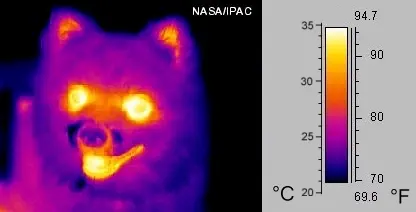
Every body above absolute zero radiates energy all the time, as electromagnetic waves, just because of its temperature: an ice cube, your hand, the walls of the room. This is thermal radiation. A body that is hotter than its surroundings radiates more than it receives from them, and cools; one that is colder receives more than it gives out, and warms.
- How much a body radiates, and at which wavelengths, depends on its temperature and on the nature of its surface.
- At everyday temperatures, almost all thermal radiation is infrared, invisible to us, though our skin feels it as warmth. A body must reach about 500 °C before it gives out enough visible light to glow a dull red; hotter still, it glows orange, yellow, then white. The Sun, at about 5800 K, gives out most of its energy as visible light and near infrared.
- Thermal radiation is electromagnetic, like light, so it shows all the properties of light: it is reflected, refracted, shows interference and diffraction, and can be polarized.
Radiation in daily life
- a.Electric heaters have polished reflectors behind the glowing element, which reflect its radiation out into the room instead of letting the back of the heater absorb it.
- b.White clothes in summer, dark clothes in winter. White cloth reflects most of the Sun’s radiation and keeps you cooler; dark cloth absorbs it and warms you.
- c.Room radiators and hot-water pipes. A pipe or radiator meant to heat a room is best dull and dark, so that it radiates well; pipes that carry hot water through cold places, where heat must not be lost, are lagged and covered in shiny foil.
- d.Thermometers and thermocouples used to measure radiation have their bulb or junction blackened, so that they absorb as much of it as possible.
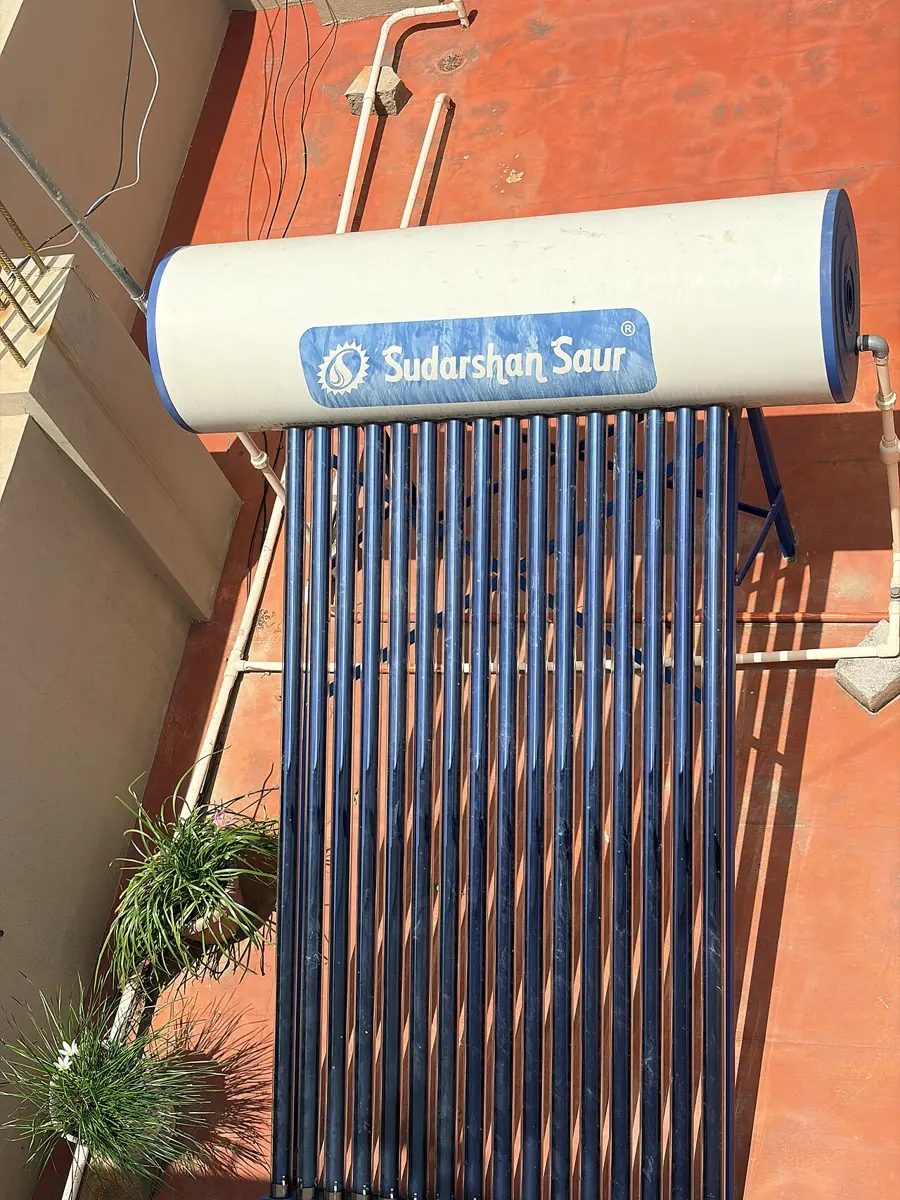
- e.Solar water heaters on the roofs of Nepal have black tubes or plates to absorb the sunshine, behind glass that keeps the heat in.
12.8 Reflection, transmission and absorption of heat radiation
When thermal radiation falls on a body, three things can happen to it: part is reflected from the surface, part is absorbed by the body (warming it), and the rest is transmitted through it (Figure 12.10).
Let be the energy of the radiation falling on the surface in a given time, and , and the parts reflected, absorbed and transmitted. Energy is conserved, so
Three ratios describe the surface:
- Reflectance (coefficient of reflection) : the ratio of the radiant energy reflected to the total falling on the surface in the same time, .
- Absorptance (coefficient of absorption) : the ratio of the radiant energy absorbed to the total falling on it, .
- Transmittance (coefficient of transmission) : the ratio of the radiant energy transmitted to the total falling on it, .
Dividing (12.6) by :
The three fractions always add up to 1. Each lies between 0 and 1, and each depends on the material, its surface, its thickness and the wavelength of the radiation: window glass lets most visible light through, but hardly any of the long-wavelength infrared from warm bodies.
What (12.7) tells us:
- a.An opaque body (one that transmits nothing, ) has . The more it reflects, the less it absorbs: a good reflector is a poor absorber, and a poor reflector is a good absorber. A polished silver surface () absorbs only about 3%; dull black soot () absorbs about 97%.
- b.A perfectly black body reflects nothing and transmits nothing (, ), so : it absorbs all the radiation that falls on it. At room temperature such a body looks perfectly black, since no light comes back from it.
A sheet transmits 10% and reflects 30% of the radiation falling on it. What fraction does it absorb?
Pick an answer to see why.
Sample questions
12.9 Black body and black-body radiation
A perfectly black body is an ideal body that absorbs all the radiation falling on it, of every wavelength and from every direction, reflecting none and transmitting none (). At room temperature it would look perfectly black, since it sends back no light.
The same body is also the best possible emitter. Heated, a perfectly black body gives out radiation of every wavelength, more at each wavelength than any other body at the same temperature. Its radiation, black-body radiation, depends on nothing but its temperature. A good absorber is a good emitter (Kirchhoff’s law, 1859: at the same temperature, a surface emits each wavelength in the same proportion as it absorbs it). A body that is a poor absorber, such as polished silver, is a poor emitter too.
“Black” describes how it absorbs, not how it looks when hot: a black body hot enough glows. A lump of charcoal looks black when cold and glows orange-red in a fire. The Sun’s surface absorbs almost all radiation falling on it and radiates very nearly as a black body at about 5800 K, yet it is the brightest thing in our sky. Every body above absolute zero gives out thermal radiation: the stars, a hot stove, your own body, and even an ice cube.
Making a black body
No real surface is perfectly black. The nearest are lamp black (soot) and platinum black, which absorb about 96–98% of the radiation falling on them. A far better approach is a cavity with a small hole: radiation that enters through the hole bounces round inside, losing part of its energy at every bounce, and almost none of it ever finds its way back out. The hole behaves almost exactly as a perfectly black body. Féry’s black body is made this way (Figure 12.11).
You can see the same effect at home: the pupil of your eye is a hole into a dark cavity, and so is the open window of a dark room seen from the street in daylight. Both look black, though the walls inside are not.
Emissive power and emissivity
The emissive power of a body is the radiant energy it gives out per unit time, per unit area of its surface, at a given temperature:
where is the power radiated. Its unit is the watt per square meter, W/m² (J/(s m²)).
The emissivity of a surface is the ratio of its emissive power to that of a perfectly black body of the same size at the same temperature:
Emissivity is a ratio of two powers, so it has no unit and no dimensions. It depends on the nature of the surface and lies between 0 and 1:
- for a perfect reflector, : it radiates nothing;
- for an ordinary body, (polished aluminium about 0.05, red brick about 0.9, human skin about 0.97);
- for a perfectly black body, .
By Kirchhoff’s law, a body’s emissivity equals its absorptance: .
Which of these is the best absorber, and so also the best emitter, of thermal radiation?
Pick an answer to see why.
12.10 Stefan’s law of black-body radiation
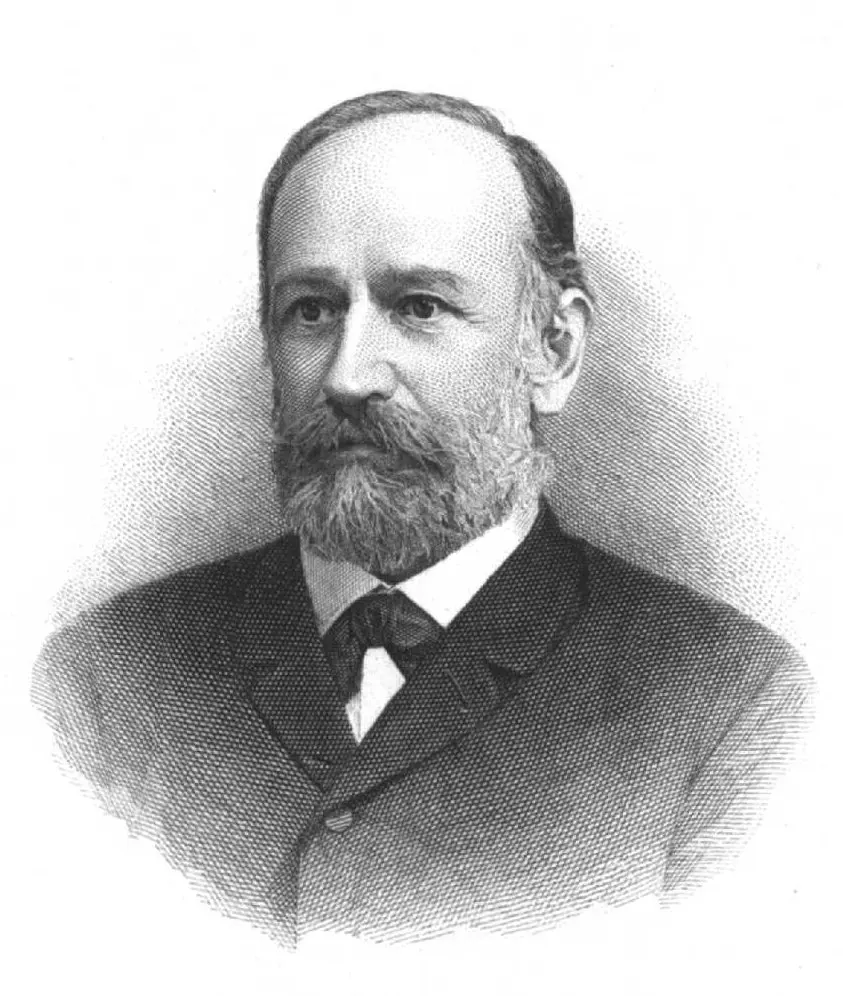
In 1879 Josef Stefan found from experiments that the energy radiated by a body depends strongly on its temperature, and in 1884 Ludwig Boltzmann derived the same law from the theory of heat and electromagnetism. It is called Stefan’s law, or the Stefan–Boltzmann law.
Stefan’s law: the emissive power of a perfectly black body is directly proportional to the fourth power of its absolute temperature.
where is the temperature of the body’s surface in kelvin and (sigma) is Stefan’s constant, the same for all black bodies:
Equation (12.8) is the energy the body gives out; it holds as written if the surroundings are at absolute zero, or if we count only what the body emits.
For a body that isn’t perfectly black, of emissivity , the emissive power is times as much:
Since , the total power radiated by a surface of area is
The fourth power makes radiation change dramatically with temperature: double the absolute temperature, and a body radiates times as much. A stove coil at 1300 K radiates about 350 times as much per square meter as a wall at room temperature, 300 K.
The absolute temperature of a black body is raised from 300 K to 900 K. Its emissive power becomes:
Pick an answer to see why.
12.11 Net loss of heat by radiation
A body never radiates into nothing: its surroundings radiate too, and the body absorbs part of their radiation. A body at temperature in surroundings at temperature (both in kelvin) gives out per unit area and, if it is black, absorbs per unit area from the surroundings. Its net emissive power, the rate at which it loses heat per unit area, is the difference:
and for a body of emissivity (which also absorbs a fraction of what falls on it):
So the net power lost by radiation from a surface of area is
If , the body loses heat; if , is negative: it gains heat from the warmer surroundings. If , it radiates exactly as much as it receives, and its temperature doesn’t change, though it is still radiating all the time.
12.12 Solar constant and the temperature of the Sun
The solar constant is the energy of the Sun’s radiation received per unit time, per unit area of a surface held at right angles to the rays, at the Earth’s mean distance from the Sun (1 astronomical unit, AU), outside the atmosphere. Measured by satellites, it is about
(Some books round it to 1400 W/m².) Less reaches the ground: the atmosphere reflects and absorbs part, and on a clear noon in Nepal about 1000 W/m² arrives on a surface facing the Sun.
Together with Stefan’s law, the solar constant gives the temperature of the Sun’s surface, as Stefan himself did in 1879. Take the Sun as a perfectly black sphere of radius and surface temperature , at a distance from the Earth (Figure 12.13).
- By Stefan’s law, each square meter of the Sun’s surface gives out . Its whole surface, of area , radiates the power
- This power spreads out equally in all directions. At the Earth’s distance, all of it crosses an imaginary sphere of radius , area , each square meter of which receives . So the power crossing that sphere is
- With nothing in between to absorb it (space is empty), the two are the same power:
With today’s values ( W/m², m, m), this gives about 5770 K, or about 5800 K. It is called the Sun’s effective (or apparent) temperature: the temperature of a black body of the Sun’s size that would give out the same power.
Exercise
Choose the correct option
- Which of these ways of transferring heat depends on gravity?
Pick an answer to see why.
- Which of the following has no effect on the heat radiated (given out) by a surface?
Pick an answer to see why.
- The total radiation given out by a perfectly black body is proportional to:
Pick an answer to see why.
- The thermal conductivity of a material depends on:
Pick an answer to see why.
- A good absorber of radiation is also:
Pick an answer to see why.
- If the absolute temperature of a black body is doubled, the rate at which it radiates heat increases by a factor of:
Pick an answer to see why.
- At which of these temperatures does a black body not radiate heat?
Pick an answer to see why.
- The rate of flow of heat in the steady state through a metal bar of cross-section 1 m², kept at a temperature gradient of 1 °C/m, is:
Pick an answer to see why.
- At the same distance from a fire, why is it hotter above it than beside it?
Pick an answer to see why.
- A solid sphere and a hollow sphere of the same material and the same size are heated to the same temperature and left to cool in the same surroundings. Which is correct?
Pick an answer to see why.
- Heat flows through two cylinders of the same material. The ratio of their diameters is 1 : 2 and of their lengths 2 : 1. If the temperature difference between their ends is the same, the ratio of the heat conducted through them per unit time is:
Pick an answer to see why.
- A rod AB is 150 cm long. End A is kept at 100 °C and end B at 25 °C. What is the temperature of a point P 50 cm from end B? (Assume the rod is lagged.)
Pick an answer to see why.
- A wall has two layers, A and B, of different materials and the same thickness. The thermal conductivity of A is one-third of B’s. If the temperature difference across layer B is 15 °C, what is the temperature difference across layer A?
Pick an answer to see why.
- Four objects of the same size and material, painted blue, red, black and white, are heated together and then left to cool. Which cools first?
Pick an answer to see why.
Answer these questions
- a.On a winter night you feel warmer when clouds cover the sky than when it is clear. Why?
- b.The bulbs of two identical thermometers are coated, one with lamp black and the other with silver. Compare their readings when they are exposed i. to a hot sunny day, ii. to a clear night sky.
- c.You can hold your fingers beside a candle flame without harm, but not above it. Why?
Answer
- a.At a wedding party on a cold winter evening you are asked to sit on a chair. Would you choose a metal chair or a wooden chair? Explain.
- b.It is well known that a potato bakes faster if a large nail is pushed through it. Why?
- c.Is an aluminium nail better than a steel nail for baking a potato? Give a reason.
- d.A newly made quilt is warmer than an old one. Why?
- e.A pot with a steel bottom 8.5 mm thick rests on a hot stove. The area of the bottom is 0.15 m². The water inside is at 100 °C, and 390 g of water evaporates every 3 minutes. Find the temperature of the bottom surface of the pot, in contact with the stove. (Thermal conductivity of steel 50.2 W/(m K); specific latent heat of vaporization of water J/kg.)
Hint
Answer
- a.How does tea in a thermos flask stay hot for a long time?
- b.Why are ice houses in the Arctic (igloos) often made with double walls?
- c.Estimate the rate of heat loss through a glass window of area 2.0 m² and thickness 3.0 mm, when the room is at 20 °C and the air outside at 5 °C. (Thermal conductivity of glass 1.2 W/(m K); take the faces of the glass to be at the temperatures of the air on each side.)
- d.A squirrel wraps its bushy tail round its body during its winter sleep. Why?
Answer
- a.The Earth constantly receives heat radiation from the Sun and is warmed by it. Why doesn’t the Earth become as hot as the Sun?
- b.Does a body at 25 °C radiate heat in a room at 35 °C? If it does, why doesn’t its temperature fall?
- c.Standing in the sun on a cold winter day is much more pleasant than standing in the shade. Is the air in the sun much warmer than the air in the shade?
- d.The element of a 1 kW electric fire has a surface area of 0.006 m². Estimate its working temperature, taking it as a black body and neglecting the radiation it receives. ( W/(m² K⁴).)
Answer
- a.We are lucky that the Earth is not in thermal equilibrium with the Sun, whose surface is at about 5800 K. Why are they not in thermal equilibrium?
- b.How do glasshouses help us keep plants warm?
- c.A sphere of radius 2.00 cm with a black surface is cooled and then hung in a large evacuated enclosure whose black walls are kept at 27 °C. When the sphere’s temperature is −73 °C, its thermal energy is increasing at 1.85 J/s. Calculate a value for Stefan’s constant.
- d.Why are petrol tanks usually painted with aluminium paint?
Hint
Answer
- a.Why are stainless-steel cooking pans often made with an extra copper bottom?
- b.What special properties should a cooking pot have?
- c.A metal rod 20 cm long, of cross-section 3.14 cm², is covered with a non-conducting material. One end is kept at 100 °C and the other end in ice at 0 °C. 25 g of ice melts in 5 minutes. Calculate the thermal conductivity of the metal. (Specific latent heat of fusion of ice J/kg.)
Answer
A black body of surface area m² is heated to a high temperature and placed in an enclosure kept at 300 K. It radiates heat to the enclosure at a net rate of 0.73 W. What is the temperature of the black body? ( W/(m² K⁴).)
Answer
Each square meter of the Earth’s surface facing the Sun receives energy from the Sun at the rate of 1400 J/s. The distance of the Earth from the center of the Sun is m, and the Sun’s radius is m. Taking the Sun as a perfect black body, find the temperature of its surface. ( W/(m² K⁴).)
Answer
Printable PDFs
- The unit as a book (A5) 19 pages Answers as an A4 booklet, 5 sheets
- Study notes 2 pages
- Worksheet 4 pages Answer key
- Harder practice questions 2 pages Answer key
Quiz yourself: Energy, Heat, Light and Sound, Grades 5–12 →
Practice every question in the book, and keep track of the ones you miss →
A companion to your textbook, not a replacement for it: study from the book your school uses, and where the two differ, follow your teacher. Found a mistake? Please tell us.