
Look round the room you are in. The cotton of your shirt, the plastic of your pen, the rice in your lunch, the petrol in the bus outside, the medicine in the cupboard and the DNA in every one of your cells: nearly all of it is built on chains and rings of carbon atoms. Chemists have recorded well over a hundred million different substances, and the great majority of them contain carbon. One element, in a few rules, makes more compounds than all the other elements together.
This unit is the start of organic chemistry, the chemistry of carbon compounds. It asks why carbon deserves a branch of chemistry of its own, how its compounds are sorted into families, how chemists draw them, and then follows carbon into something you meet every day: petrol, why some petrol makes an engine knock, and what refineries do to stop it.
12.1 Introduction to Organic Chemistry and Organic Compounds
What is sodium chloride made of? Sodium ions and chloride ions. And methane, CH₄? One carbon atom joined to four hydrogen atoms by shared electrons. Compounds like methane, built from carbon held by covalent bonds, are the subject of organic chemistry.
The vital force theory
Two hundred years ago chemists sorted substances by where they came from. Salt, rocks and metals came from the non-living world: they were inorganic. Sugar, oils, urea, alcohol and dyes came from plants and animals, from organisms, so they were called organic. The leading chemist of the time, the Swede Jöns Jacob Berzelius, who gave organic chemistry its name, held that organic compounds could be made only inside living things, by a special vital force (Latin vita, life) that a chemist in a laboratory could never supply. This idea is the vital force theory: organic compounds can be formed only in living organisms, under the influence of a mysterious vital force.
The theory fell in a series of experiments:
- In 1828 the German chemist Friedrich Wöhler made urea, a compound found in urine, by heating ammonium cyanate, an inorganic salt. No kidney was involved.
- In 1845 Hermann Kolbe made acetic acid (ethanoic acid, the acid of vinegar) starting from its elements, carbon, hydrogen and oxygen, through carbon disulphide.
- In 1856 Marcellin Berthelot made methane in the laboratory, and went on to make many other organic compounds from inorganic ones.
Since organic compounds could be made in a flask from inorganic ones, there was no need for a vital force, and the theory was abandoned.
Wöhler’s ammonium cyanate is usually written as made from ammonium chloride and potassium cyanate:
The second step is the surprising one: ammonium cyanate and urea have exactly the same atoms, CH₄N₂O, joined in different ways. Heating only rearranges them (Figure 12.3).
What counts as organic today
Today an organic compound is defined by what it is made of, not where it comes from: organic compounds are the hydrocarbons and their derivatives, and organic chemistry is the branch of chemistry that deals with hydrocarbons and their derivatives.
- Hydrocarbons are compounds of carbon and hydrogen only: methane, CH₄; ethene, C₂H₄; benzene, C₆H₆. They are the parent organic compounds.
- Derivatives of hydrocarbons are made, on paper or in the laboratory, by replacing one or more hydrogen atoms of a hydrocarbon by other atoms or groups: chloromethane, CH₃Cl; methanol, CH₃OH; ethanoic acid, CH₃COOH.
So carbon is essential to every organic compound, joined by covalent bonds to hydrogen, oxygen, nitrogen, sulphur, phosphorus, the halogens and other carbon atoms. Carbohydrates, proteins, fats, vitamins, hormones, petroleum products, drugs, dyes, plastics, gums and rubber are all organic.
A few simple carbon compounds are not counted as organic, and are studied with inorganic chemistry because they behave like inorganic compounds: carbon monoxide (CO), carbon dioxide (CO₂), carbon disulphide (CS₂), carbonic acid and the carbonates (such as CaCO₃) and hydrogencarbonates (such as NaHCO₃), cyanides (such as KCN) and cyanates (such as KCNO), and carbides (such as CaC₂).
Why was the vital force theory given up?
Pick an answer to see why.
Which of these is an organic compound?
Pick an answer to see why.
12.2 Reason for the separate study of organic compounds
Look at the three structures in Figure 12.5. Sulphuric acid is one small molecule, and that is all it can be. Polythene and polypropylene are chains of carbon atoms that go on and on, the bracketed unit repeated n times, thousands of times in a real molecule; and nothing fixes n, so a chain can be any length.
Do you see a difference in their bonding and in the elements they are made of? Every bond in the polymers is C–C or C–H. That simple difference is why organic chemistry is studied as a branch of its own. There are three main reasons.
The very large number of compounds. Organic compounds run into many millions, far more than the compounds of all the other elements without carbon, and thousands of new ones are made every year. From the atoms of sulphuric acid no family of related molecules follows, but carbon chains can be extended, branched and closed into rings in endless ways.
Their own physical and chemical properties. Most organic compounds are made of separate covalent molecules, held to one another only by weak forces, so they have low melting and boiling points; they dissolve poorly in water but well in organic solvents, burn easily, don’t conduct electricity (they have no ions), react slowly, and often have large molecules with high molecular masses. Many also show isomerism: two or more compounds with the same molecular formula but different structures (Figure 12.6).
The unique nature of carbon. Carbon atoms join to one another in long chains and rings of any length and shape, a property called catenation (12.3). The chains of polythene and polypropylene show it.
Organic and inorganic compounds compared
| Property | Organic compounds | Inorganic compounds |
|---|---|---|
| Composition | Carbon is essential, usually with hydrogen. | May contain any elements. |
| Occurrence | Most were first found in living things (and in coal and petroleum, which came from them). | Most come from non-living sources: rocks, minerals, sea water. |
| Bonding | Covalent. | Ionic, covalent and coordinate covalent bonds. |
| Isomerism | Common. | Rare (shown only by some metal complexes). |
| Reactions | Between molecules; generally slow. | Often between ions; very fast, almost instantaneous. |
| Electrical conductivity | Their solutions don’t conduct electricity. | Their solutions (and melts) usually conduct. |
| Catenation | Form long chains and rings. | Rarely form chains or rings. |
| Melting and boiling points | Low; many are volatile. | Comparatively high; generally non-volatile. |
| Combustion | Burn, giving CO₂, H₂O and energy. | Generally don’t burn; when they do, the products vary. |
Which property belongs to most organic compounds?
Pick an answer to see why.
12.3 Tetracovalency and catenation nature of carbon
a. Tetracovalency
Tetra means four, and covalency the number of covalent bonds an atom forms.
Carbon has four electrons in its outer shell. To reach a stable octet it would need to gain four or lose four, and both cost far too much energy. Instead it shares four electrons, one with each of four partners, and so completes its octet. The property of the carbon atom by which it forms four covalent bonds is called its tetracovalency. (Carbon is said to be tetravalent, valency 4.)
The four bonds can be made in different ways (Figure 12.8, Figure 12.9). Every single bond is a sigma (σ) bond. A double bond is one σ bond and one pi (π) bond; a triple bond is one σ and two π bonds. So a carbon atom can have:
| Bonds round the carbon | σ bonds | π bonds | Example |
|---|---|---|---|
| four single bonds | 4 | 0 | methane, CH₄ |
| one double and two single bonds | 3 | 1 | ethene, C₂H₄ |
| one triple and one single bond | 2 | 2 | ethyne, C₂H₂ |
| two double bonds | 2 | 2 | carbon dioxide, O=C=O |
Every carbon still has four bonds in all: count a double bond as two and a triple bond as three.
How σ and π bonds form from overlapping orbitals, and why carbon’s four bonds point to the corners of a tetrahedron (109.5° apart), are in Unit 5, Sigma bonds and pi bonds and 5.9 Hybridization.
Turn methane, ethane, ethene and ethyne. Each carbon always has four bonds, pointing to a tetrahedron’s corners when they are all single, flat at 120° round a double bond, and in a straight line along a triple bond.
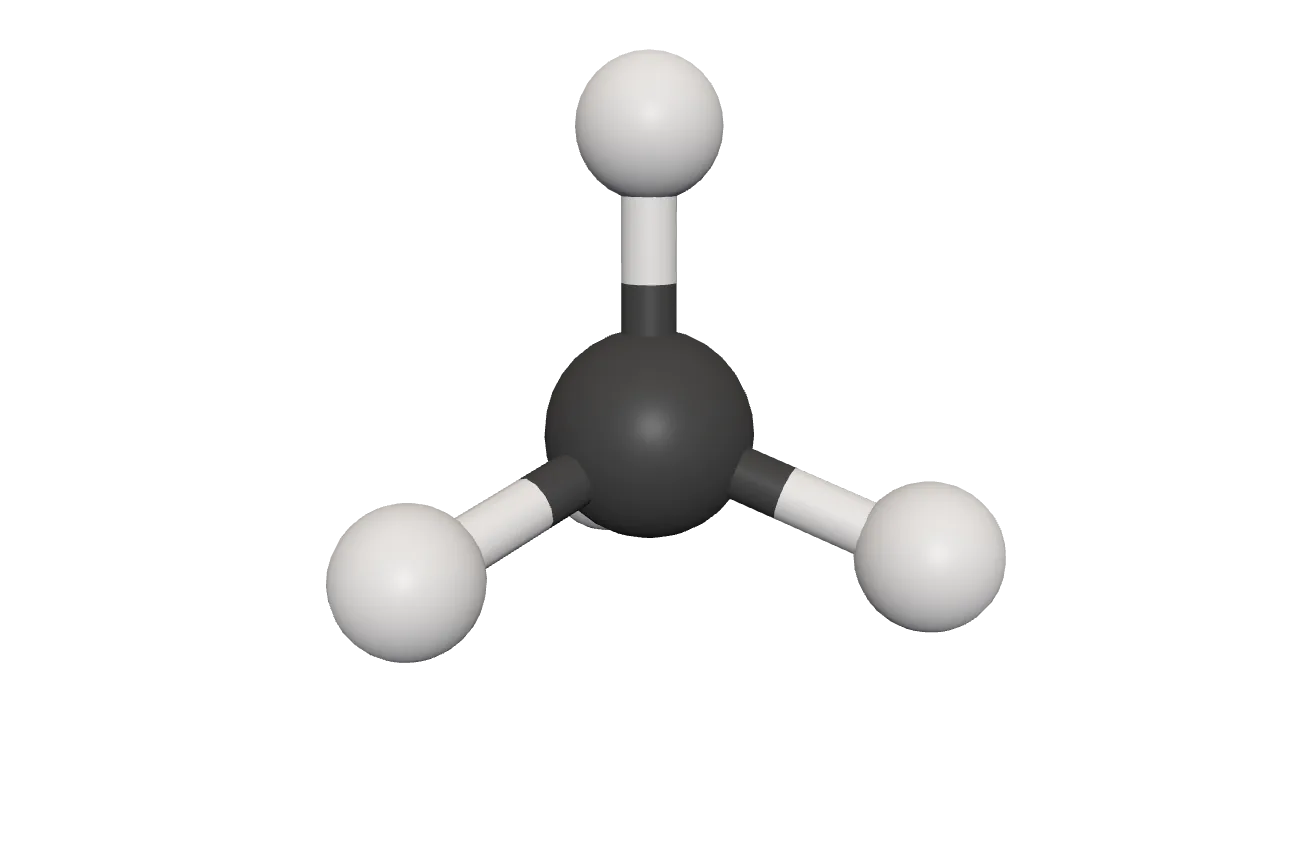
This browser can’t show the 3D model. The picture above is the same model.
A tetrahedron: the four hydrogens are as far apart as they can be, every two bonds 109.5° apart. Stood on three hydrogens, the fourth points straight up.
Carbon atom: four single bonds, one to each hydrogen.
Hydrogen atom: one single bond.
Single bonds only: each carbon’s four bonds point to the corners of a tetrahedron, about 109.5° apart (108.3° and 110.6° in this computed model).
Carbon atom: four single bonds, three to hydrogens and one to the other carbon.
Hydrogen atom: one single bond.
Flat: all six atoms lie in one plane (turn it edge-on), the bonds about 120° apart (118.5° and 120.7° here). The two carbons share a double bond.
Carbon atom: a double bond to the other carbon and a single bond to each of two hydrogens.
Hydrogen atom: one single bond.
Straight: all four atoms lie in a line (180°). The two carbons share a triple bond.
Carbon atom: a triple bond to the other carbon and a single bond to a hydrogen.
Hydrogen atom: one single bond.
Drag to turn it. Tap an atom to see what it is.
Molecules: computed 3D conformers from PubChem, National Library of Medicine (public domain): pubchem.ncbi.nlm.nih.gov, CID 297, 6324, 6325, 6326
How many σ and π bonds are there in a molecule of ethene, CH₂=CH₂?
Pick an answer to see why.
b. Catenation
Carbon has a unique ability to bond to other carbon atoms one after another, forming chains of any length and shape: straight, branched and closed into rings, with single, double or triple bonds between the carbons. This self-linking of atoms into chains and rings is called catenation (Latin catena, a chain). It is the main reason organic compounds are so many and so varied.
Why carbon? Because the C–C bond is strong, about 346 kJ/mol, nearly as strong as the C–H and C–O bonds around it, so a long chain is as stable as a short one. Other elements’ self-bonds are weaker: Si–Si about 226, N–N about 160 and O–O about 146 kJ/mol. So the silicon hydrides (silanes) form chains of only a few atoms, and catch fire in air, while nitrogen and oxygen chains stop at two or three atoms. Carbon is also small, so its bonds are short and tight, and with four bonds it has room for both a chain and branches.
Two methyl groups join to make a molecule of ethane, CH₃–CH₃. Which property of carbon does this show?
Pick an answer to see why.
12.4 Classification of Organic Compounds
What is different about the chains of P, Q and R in Figure 12.14? P (butane) is an open chain with two free ends. Q (cyclobutane) is the same four carbons with the ends joined into a ring. R (benzene) is a ring too, but of a special kind, with alternating double bonds.
Organic compounds are classified in many ways; first by the shape of their carbon skeleton. The parent compounds are hydrocarbons, and the others their derivatives, so the same scheme sorts them all. There are two broad classes:
A. Open chain or aliphatic compounds
B. Closed chain or cyclic compounds
A. Open chain or aliphatic compounds
Organic compounds whose carbon chain has two ends, with no bond joining the end carbon atoms, are open chain compounds, also called aliphatic compounds (Greek aleiphar, oil or fat, since the first ones studied came from fats). The chain may be straight (Figure 12.15) or branched (Figure 12.16, Figure 12.17).
“Straight” means unbranched: every carbon is joined to at most two others, one after another. The chain itself zigzags in space (the bonds are 109.5° apart), so a straight chain is never actually straight. A branched chain has at least one carbon joined to three or four other carbons, so groups stick out from the main chain.
An open chain may also contain double or triple bonds between carbons (Figure 12.18). Hydrocarbons with only single bonds are saturated (the alkanes); those with a C=C double bond (alkenes) or a C≡C triple bond (alkynes) are unsaturated.
B. Closed chain or cyclic compounds
Organic compounds in which the carbon atoms (with or without other atoms) form a ring are closed chain or cyclic compounds. In Figure 12.19, cyclopropane and cyclohexane are cyclic; propane, with three carbons too, is not. Cyclic compounds are divided by what the ring is made of.
Homocyclic (carbocyclic) compounds
Compounds whose ring is made of carbon atoms only are homocyclic (homo, same) or carbocyclic compounds. They are of two kinds.
i. Alicyclic compounds. Cyclic compounds that behave like the aliphatic (open chain) compounds are alicyclic compounds (aliphatic + cyclic). Their rings have three or more carbon atoms, and they may be saturated (Figure 12.20) or unsaturated (Figure 12.21). In their reactions cyclohexane is like hexane, and cyclohexene like hex-1-ene.
Rings are usually drawn as bond-line shapes (Figure 12.22): each corner is a carbon with enough hydrogens to make four bonds (12.6).
ii. Aromatic compounds. Have you ever smelled jasmine, lilac or vanilla? And have you seen a flame that gives off thick black smoke, like burning kerosene in a lamp, or a burning tire?
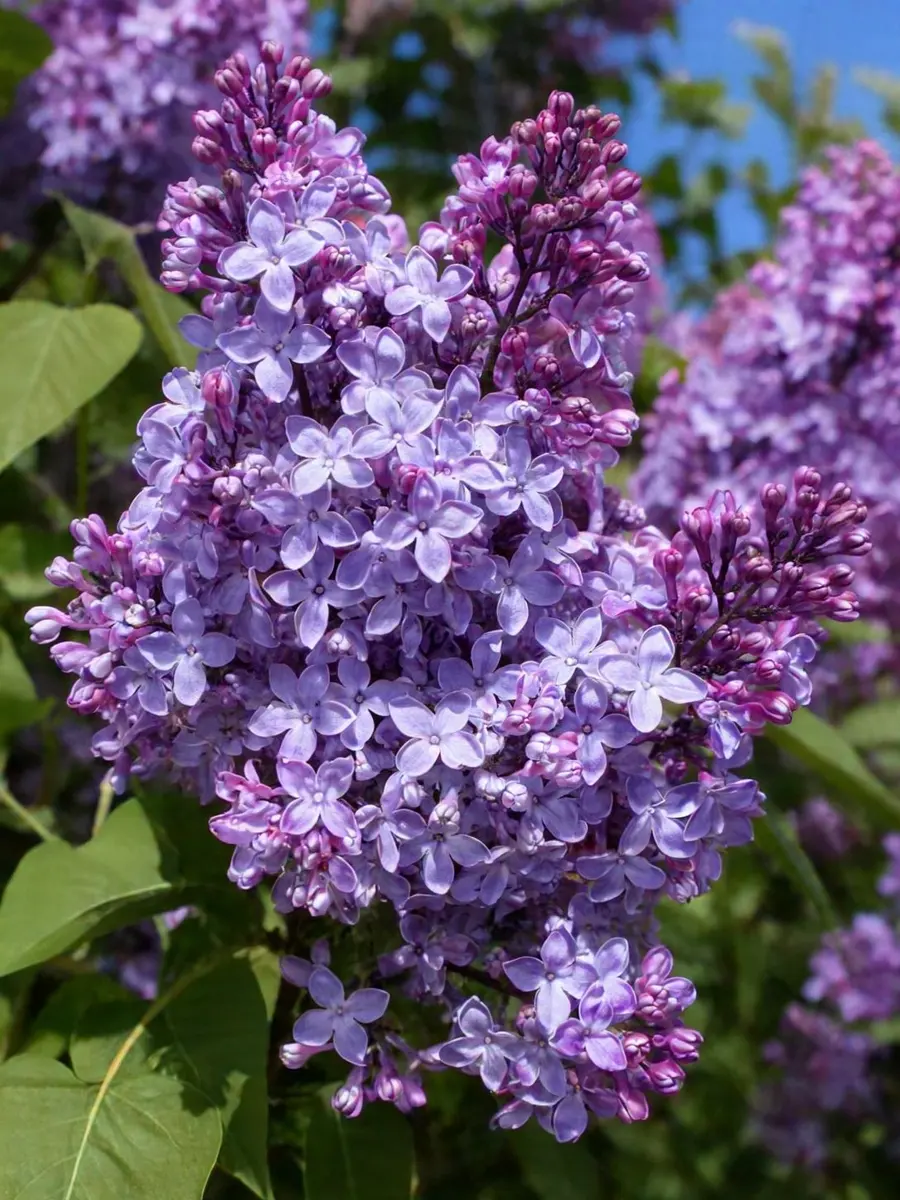
The first compounds of this family to be studied were sweet-smelling oils from plants (benzaldehyde in almonds, vanillin in vanilla, cinnamaldehyde in cinnamon), so they were called aromatic (Greek aroma, sweet smell). They have a high proportion of carbon and burn with a sooty, smoky flame. Homocyclic compounds with this aromatic character are aromatic compounds. Most contain at least one benzene ring, a flat ring of six carbon atoms with alternating single and double bonds, drawn in three ways (Figure 12.24). Benzene and compounds like it, such as phenol (Figure 12.25), naphthalene and anthracene (Figure 12.26), are aromatic.
Today “aromatic” has nothing to do with smell: many aromatic compounds smell unpleasant or of nothing at all, and many sweet smells come from non-aromatic compounds. It means a flat ring whose π electrons are shared all round it, which makes it unusually stable: it prefers to swap a hydrogen for another group (substitution) rather than add across its double bonds, as an alkene does. Hückel’s rule, which tells which rings are aromatic, is in Grade 10 Optional Science, 9.4 Hückel’s rule, and benzene itself in Unit 15.
Heterocyclic compounds
Look at the compounds in Figure 12.28 and Figure 12.29. What do they all have in common?
All are cyclic, some saturated (oxirane, THF) and some unsaturated (pyridine, furan, thiophene, pyrrole). The key point: one of the atoms in the ring is not carbon. An atom other than carbon in a ring is a heteroatom (hetero, different), usually nitrogen, oxygen or sulphur, and cyclic compounds with one or more heteroatoms in the ring are heterocyclic compounds. Like carbocyclic ones, they can be aliphatic in character (oxirane, THF) or aromatic (pyridine, furan, thiophene, pyrrole).
Which of these is a heterocyclic compound?
Pick an answer to see why.
Classification at a glance
12.5 Alkyl groups, functional groups and homologous series
Alkyl groups
The group of atoms left when one hydrogen atom is removed from an alkane is called an alkyl group (or alkyl radical), written R–. Its name is the alkane’s, with -ane replaced by -yl. Alkyl groups have the general formula CₙH₂ₙ₊₁–.
| Alkane | Alkyl group | Formula |
|---|---|---|
| methane, CH₄ | methyl | CH₃– |
| ethane, C₂H₆ | ethyl | CH₃CH₂– or C₂H₅– |
| propane, C₃H₈ | n-propyl (propyl) | CH₃CH₂CH₂– |
| propane, C₃H₈ | isopropyl (propan-2-yl, 1-methylethyl) | (CH₃)₂CH– |
| butane, C₄H₁₀ | n-butyl (butyl) | CH₃CH₂CH₂CH₂– |
Functional group
Study these compounds. All of them have two carbon atoms. What makes them so different, an alcohol you can drink, the acid in vinegar, a gas, a fishy-smelling amine?
They differ in the groups –OH, –COOH, –O–, –NH₂, –CONH₂, –NO₂ and –CHO. Each group gives its compound its own set of chemical reactions, whatever hydrocarbon part it is attached to.
An atom or group of atoms in an organic compound which largely decides its chemical properties is called a functional group. An organic compound can be thought of as two parts: the hydrocarbon part (an alkyl group, R, the “molecular body”) and the functional group (G), R–G. In methanol, CH₃–OH, CH₃– is the molecular body and –OH the functional group (Figure 12.35).
A compound’s physical properties, such as its boiling point, depend on both parts; its chemical reactions mostly on the functional group. Ethanol, CH₃CH₂OH, and butan-1-ol, CH₃CH₂CH₂CH₂OH, react with sodium in the same way because both have –OH.
Table of functional groups
(R and R′ stand for alkyl groups, the same or different; X for a halogen atom, F, Cl, Br or I.)
| Functional group | Name | Class of compound | General formula | Example |
|---|---|---|---|---|
| –X | halo | haloalkanes (alkyl halides) | R–X | chloroethane, CH₃CH₂Cl |
| –OH | hydroxyl | alcohols | R–OH | ethanol, CH₃CH₂OH |
| –O– | ether (alkoxy) | ethers | R–O–R′ | methoxymethane, CH₃OCH₃ |
| –CHO | formyl (aldehyde) | aldehydes | R–CHO | ethanal, CH₃CHO |
| –CO– | carbonyl (keto, oxo) | ketones | R–CO–R′ | propanone, CH₃COCH₃ |
| –COOH | carboxyl | carboxylic acids | R–COOH | ethanoic acid, CH₃COOH |
| –COX | acyl halide | acid halides | R–COX | ethanoyl chloride, CH₃COCl |
| –CONH₂ | amide | acid amides | R–CONH₂ | ethanamide, CH₃CONH₂ |
| –CO–O–CO– | acid anhydride | acid anhydrides | R–CO–O–CO–R′ | ethanoic anhydride, (CH₃CO)₂O |
| –COOR′ | ester | esters | R–COOR′ | methyl ethanoate, CH₃COOCH₃ |
| –N=N– | azo | azo compounds | R–N=N–R′ | azomethane, CH₃N=NCH₃ |
| –NO₂ | nitro | nitro compounds | R–NO₂ | nitroethane, CH₃CH₂NO₂ |
| –NH₂ | amino | amines | R–NH₂ | ethanamine, CH₃CH₂NH₂ |
| –N=O | nitroso | nitroso compounds | R–N=O | nitrosomethane, CH₃NO |
| –SO₃H | sulphonic acid | sulphonic acids | R–SO₃H | methanesulphonic acid, CH₃SO₃H |
| –C≡N | cyano (nitrile) | nitriles (alkyl cyanides) | R–C≡N | ethanenitrile, CH₃CN |
| –SCN | thiocyanato | thiocyanates | R–SCN | methyl thiocyanate, CH₃SCN |
Why functional groups matter
- They are the basis of the classification of organic compounds into families (alcohols, aldehydes, acids…).
- Organic compounds are named from their functional groups: the -ol of ethanol, the -al of ethanal, the -oic acid of ethanoic acid.
- They are the reactive site of a molecule and give a compound its characteristic properties: all alcohols react with sodium, all carboxylic acids turn blue litmus red and fizz with sodium hydrogencarbonate.
In CH₃CH₂–NH₂, which part is the functional group?
Pick an answer to see why.
Homologous series
Study these four alkanes. What changes from one to the next?
| Condensed formula | Molecular formula | Name | Molecular mass |
|---|---|---|---|
| CH₄ | CH₄ | methane | 16 |
| CH₃–CH₃ | C₂H₆ | ethane | 30 |
| CH₃–CH₂–CH₃ | C₃H₈ | propane | 44 |
| CH₃–CH₂–CH₂–CH₃ | C₄H₁₀ | butane | 58 |
Each member has one more –CH₂– group than the one before, and so a molecular mass 14 u greater (12 + 2 × 1). A series of organic compounds with the same functional group, in which each member differs from the next by a –CH₂– group (14 u), is called a homologous series. Each member is a homolog, and the relationship is called homology.
The same pattern runs through every family. Alkyl halides (haloalkanes), general formula CₙH₂ₙ₊₁X:
| Formula | Name |
|---|---|
| CH₃Cl | chloromethane |
| CH₃CH₂Cl | chloroethane |
| CH₃CH₂CH₂Cl | 1-chloropropane |
| CH₃CH₂CH₂CH₂Cl | 1-chlorobutane |
Alcohols, CₙH₂ₙ₊₁OH:
| Formula | Name |
|---|---|
| CH₃–OH | methanol |
| CH₃CH₂–OH | ethanol |
| CH₃CH₂CH₂–OH | propan-1-ol (1-propanol) |
| CH₃CH₂CH₂CH₂–OH | butan-1-ol (1-butanol) |
From propyl on, a group can sit at more than one place on the chain, so the name says where: in propan-1-ol the –OH is on carbon 1, in propan-2-ol on carbon 2. Naming in full is Unit 13.
Characteristics of a homologous series
- All the members have similar chemical properties, because they have the same functional group.
- Two consecutive members differ by a –CH₂– unit, 14 u in molecular mass.
- All the members can be represented by the same general formula: CₙH₂ₙ₊₂ for alkanes, CₙH₂ₙ₊₁OH for alcohols, CₙH₂ₙ₊₁X for alkyl halides.
- They can be prepared by the same general methods.
- Their physical properties (melting point, boiling point, density) change gradually from member to member, as the molecular mass increases (Figure 12.36).
- The first member often behaves differently from the rest, because it is so small and has no alkyl group of its own (methanoic acid, HCOOH, also reacts like an aldehyde; methanal, HCHO, has H on both sides of its C=O).
Methane, ethane and propane have molecular masses 16, 30 and 44 u. What do the steps of 14 u show?
Pick an answer to see why.
12.6 Idea of structural formula, contracted formula and bond line structural formula
A compound’s formula can be written with more or less detail. From least to most:
Empirical formula
The empirical formula gives the simplest whole-number ratio of the atoms of each element in a compound, and nothing more. Ethene, C₂H₄, has twice as many hydrogen atoms as carbon atoms, a ratio of 1 : 2, so its empirical formula is CH₂. Glucose, C₆H₁₂O₆, has C : H : O = 6 : 12 : 6 = 1 : 2 : 1, so its empirical formula is CH₂O. (More on empirical formulas in Unit 1.)
Molecular formula
The molecular formula gives the actual number of each kind of atom in one molecule. It is always a whole-number multiple, n, of the empirical formula:
How are these found? Elemental analysis (burning a weighed sample and weighing the carbon dioxide and water formed, for example) gives the percentage of each element in a compound, and from that the empirical formula. Knowing the molecular mass (measured separately) then gives the molecular formula. Neither tells how the atoms are joined: that takes the molecule’s chemistry and, today, spectroscopy.
Structural formula
Ethanol and methoxymethane are both C₂H₆O (Figure 12.6): the molecular formula can’t tell them apart. A structural formula shows every atom and every bond in the molecule, each bond as a line (–, = or ≡). It is also called a graphic formula or displayed formula.
Contracted (condensed) formula
Drawing every bond takes space, and in a chemical equation it is impractical. A contracted or condensed formula writes each carbon atom with the hydrogen atoms joined to it as one group (CH₃, CH₂, CH), one after another, leaving out the bonds between the groups (or showing only the C–C ones, CH₃–CH₃). Multiple bonds are always shown, and a branch is written in brackets after the carbon atom it is joined to.
| Compound | Molecular formula | Contracted formula |
|---|---|---|
| methane | CH₄ | CH₄ |
| ethane | C₂H₆ | CH₃CH₃ |
| ethene | C₂H₄ | CH₂=CH₂ |
| propene | C₃H₆ | CH₂=CHCH₃ |
| ethyne | C₂H₂ | HC≡CH |
| propyne | C₃H₄ | HC≡CCH₃ |
| ethanol | C₂H₆O | CH₃CH₂OH |
| 2-methylpropane | C₄H₁₀ | CH₃CH(CH₃)CH₃ |
Bond-line structural formula
Are CH₃–CH₂–CH₃ and the bent line in Figure 12.41 the same compound?
They are: both are propane. In a bond-line (skeletal) formula, bonds are drawn as lines in a zigzag, and each corner and each end of a line is a carbon atom. The hydrogen atoms on carbon are not shown: every carbon is understood to have enough hydrogens to make up its four bonds. Atoms other than carbon and hydrogen (O, N, Cl…), and the hydrogens joined to them, are written in. Double and triple bonds are drawn as two or three lines.
How many carbon atoms are in a bond-line zigzag of five lines, with no other atoms written?
Pick an answer to see why.
12.7 Preliminary idea of cracking and reforming, quality of gasoline, octane number, cetane number and gasoline additive
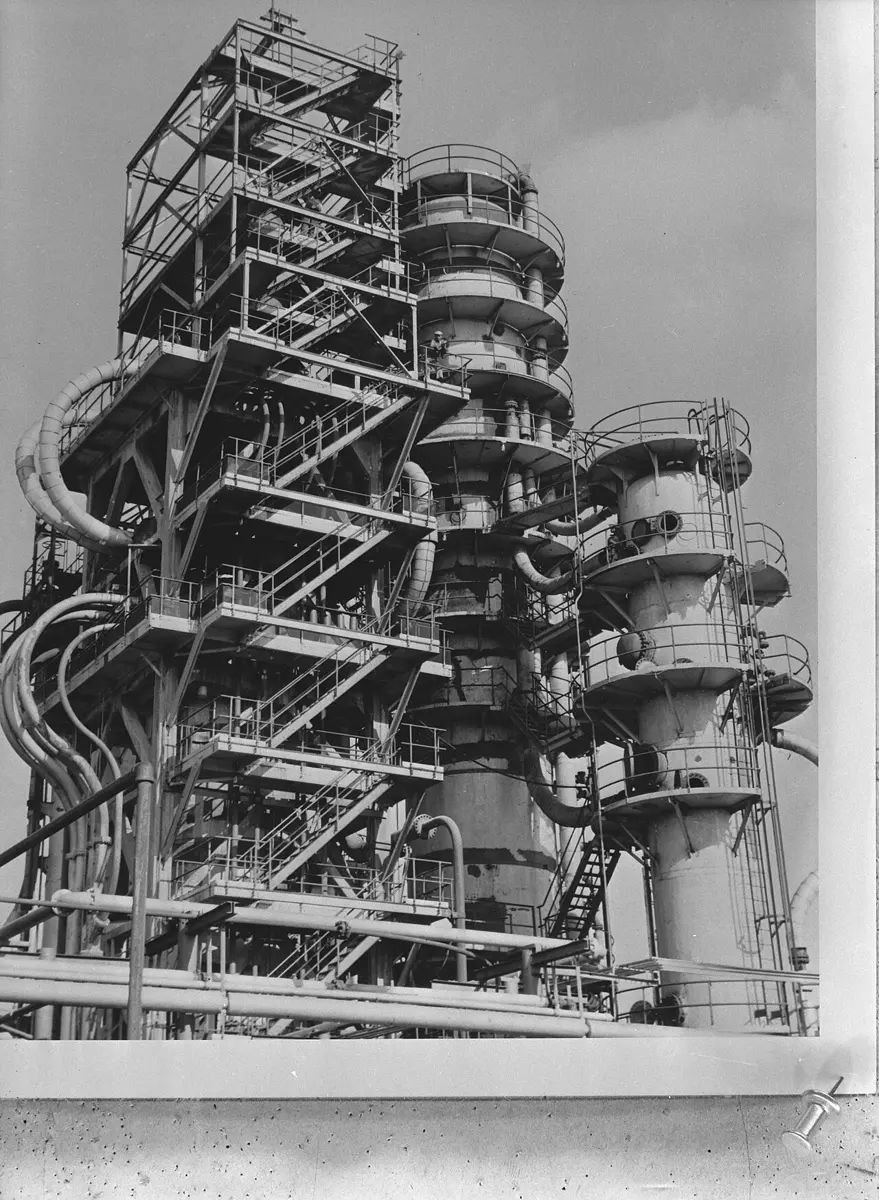
Crude petroleum is a mixture of thousands of hydrocarbons, separated in a refinery by fractional distillation into gases, petrol (gasoline), kerosene, diesel and heavier oils. The trouble is that crude oil gives more heavy oil than the world wants, and less petrol, and the petrol it gives directly is poor fuel. Two processes fix both problems: cracking and reforming.
Cracking
Study the reactions below. How are the products formed?
A larger molecule, octane, can break in several places, each giving its own pair of products:
In each, a long-chain hydrocarbon from petroleum breaks into smaller molecules: one alkane and one alkene. This happens when the higher hydrocarbons are strongly heated in the absence of air, which breaks C–C bonds (and some C–H bonds). The process of breaking larger hydrocarbon molecules into smaller ones by heat, with or without a catalyst, is called cracking.
Why is there always an alkene? Count the hydrogens. An alkane has 2n + 2 hydrogens, and two alkanes made from it would need 2 more than it has. So one piece is short of two hydrogens and makes up its four bonds with a C=C double bond.
Cracking is used to turn heavy, less useful fractions into petrol and into small alkenes (ethene, propene) for making plastics such as polythene and polypropylene. It is done in two ways.
Thermal cracking (pyrolysis). The heavy oil is heated alone, with no catalyst, to about 450–750 °C, often under pressure, and then cooled quickly. It gives a good yield of lower alkenes, such as ethene and propene.
Catalytic cracking. The oil vapor is cracked over a hot catalyst at about 500 °C and low pressure; the catalyst makes the chains break faster. The classic catalyst is a mixture of silica and alumina, SiO₂ and Al₂O₃, mostly silica (about 3 to 7 parts of silica to 1 of alumina); refineries today use zeolites, crystalline aluminosilicates. Kerosene and heavier oils are turned into petrol this way. Catalytic cracking also makes more branched chains, which, as you will see below, makes better petrol.
Reforming or aromatization
How can an open chain hydrocarbon become a closed chain, and then an aromatic one (Figure 12.47, Figure 12.48)?
The equations in full:
What has changed? In the first step a bond forms between two carbons near the ends of the chain, closing a ring of six, as one molecule of hydrogen is lost (cyclization): in hexane the two end carbons, in heptane carbons 1 and 6, which leaves carbon 7 as a –CH₃ on the ring. In the second, the ring loses three more molecules of hydrogen and becomes a benzene ring (aromatization). Straight-chain alkanes of petroleum with 6 to 8 carbons (C₆ to C₈) are turned this way into aromatic hydrocarbons such as benzene, toluene and the xylenes, which are the starting materials for many other organic compounds and also improve petrol.
Reforming (or aromatization) is the process in which straight-chain alkanes and cycloalkanes are converted into the corresponding aromatic hydrocarbons, by heating with a suitable catalyst. Platinum (on alumina) is the best catalyst, so the process is also called platforming. The hydrogen it gives off is itself useful in the refinery.
In reforming, hexane, C₆H₁₄, becomes benzene, C₆H₆. How many molecules of hydrogen does one hexane molecule lose in all?
Pick an answer to see why.
Quality of gasoline
Have you heard a rattling, metallic “pinking” from a motorbike, bus or scooter climbing a hill, a sound like small stones shaken in a tin? That is knocking.
In a petrol engine the mixture of petrol vapor and air is squeezed by the piston and then lit by a spark, and a flame spreads smoothly across the cylinder, pushing the piston down. The more the mixture is compressed before the spark, the more work the engine gets from each drop of fuel: the greater the compression, the greater the efficiency. But squeezing a gas heats it. If the mixture is compressed too much, the unburnt part ahead of the flame gets so hot that it explodes all at once by itself, before the flame reaches it. This sudden, irregular burning sends a shock through the cylinder that jerks the piston: the metallic sound called knocking. Knocking wastes fuel, lowers the engine’s power and, over time, damages the piston.
How much a fuel can be compressed without knocking depends on the fuel. A fuel that knocks easily is low-quality gasoline; one that resists knocking has good anti-knock quality. Compounds with anti-knock properties can be mixed in to improve a fuel.
Octane number
The anti-knock quality of petrol is measured against two pure hydrocarbons:
- Heptane (n-heptane), CH₃–CH₂–CH₂–CH₂–CH₂–CH₂–CH₃, a straight chain, knocks very easily. Its octane number is defined as 0.
- 2,2,4-Trimethylpentane (“iso-octane”, Figure 12.49), a branched chain, resists knocking very well. Its octane number is defined as 100.
Every other petrol is graded on this scale, which is arbitrary, set by these two compounds. The test is made in a standard single-cylinder engine whose compression can be changed: the fuel is run, then reference mixtures of the two compounds, until one is found that knocks just as hard as the fuel. The octane number of a fuel is the percentage by volume of iso-octane in a mixture of iso-octane and heptane that has the same anti-knock property as the fuel under test. A petrol with octane number 85 knocks just like a mixture of 85% iso-octane and 15% heptane.
The octane number depends on the structure of the hydrocarbons in the fuel:
- a.Straight-chain alkanes have low octane numbers, lower the longer the chain (heptane 0, octane below 0).
- b.Cycloalkanes have higher octane numbers than the straight-chain alkanes with the same number of carbons.
- c.Branching of the chain increases the octane number (iso-octane 100, against octane’s below 0).
- d.Aromatic compounds have very high octane numbers (toluene over 100).
- e.Compounds with double or triple bonds have higher octane numbers than the alkanes they come from.
That is why cracking (more branches, alkenes), reforming (aromatics) and the reverse of cracking, joining small branched molecules, all make better petrol. A fuel can score above 100 when it resists knocking better than iso-octane.
Cetane number
A diesel engine has no spark plug. It compresses air so much that it becomes very hot, then sprays diesel into it, and the diesel must catch fire by itself, at once. So a good diesel is the opposite of a good petrol: it should ignite easily on compression. Its ignition quality is measured on a second scale, against two reference compounds:
- Cetane, hexadecane, CH₃(CH₂)₁₄CH₃, a long straight chain that ignites very readily: cetane number 100.
- 1-Methylnaphthalene (α-methylnaphthalene, Figure 12.50), an aromatic compound that ignites poorly: cetane number 0.
The cetane number of a diesel is the percentage by volume of cetane in a mixture of cetane and 1-methylnaphthalene that has the same ignition quality as the diesel under test. A diesel with cetane number 70 ignites like a mixture of 70% cetane and 30% 1-methylnaphthalene. It is also called the cetane rating. (Since 1962 the low reference has been 2,2,4,4,6,8,8-heptamethylnonane, cetane number 15, which is easier to handle, but the scale is the same.)
Gasoline additives
Knocking can be reduced by adding small amounts of certain compounds to petrol. Compounds that improve petrol’s anti-knock quality are called anti-knock agents or gasoline additives.
The most famous is tetraethyl lead (TEL), (C₂H₅)₄Pb, added in very small amounts (less than a gram of lead in each liter of petrol). Petrol containing TEL is called leaded petrol. In the hot cylinder TEL breaks up into lead and ethyl radicals:
The lead becomes tiny particles of lead oxide, and these mop up the reactive free radicals that build up in the hot fuel–air mixture and set off its explosion before the flame arrives. With fewer radicals the mixture waits for the flame, and the knock is suppressed.
Lead left in the engine would build up as deposits, so a scavenger, 1,2-dibromoethane (ethylene dibromide), was added too. It turns the lead into lead(II) bromide, which is volatile at the engine’s temperature and leaves with the exhaust:
That is exactly the trouble: the lead went into the air. Lead is a poison that harms the brain and nerves, above all in children, and decades of leaded petrol raised the lead in people’s blood around the world. Leaded petrol for cars and other road vehicles has now been banned everywhere: Algeria, the last country to sell it, stopped in July 2021, and the United Nations Environment Programme announced the end of leaded petrol in August 2021. (Leaded fuel is still used by small piston-engined aircraft.) Today’s petrol gets its octane number from branched, cyclic and aromatic hydrocarbons made by cracking and reforming, and from additives without metals, such as ethanol and MTBE (methyl tert-butyl ether).
Why was leaded petrol banned?
Pick an answer to see why.
Exercise
A. Multiple choice questions
- How many valence electrons of carbon take part in making bonds?
Pick an answer to see why.
- Two methyl groups make a molecule of ethane. Which property does this explain?
Pick an answer to see why.
- How many secondary carbon atoms are there in the structure above?
Pick an answer to see why.
- Which functional group does the compound above contain?
Pick an answer to see why.
- What is the relation between these two compounds?
Pick an answer to see why.
- The molecular masses of three organic compounds are 16, 30 and 44 u (compounds 1, 2 and 3). What do the data show?
Pick an answer to see why.
- What do you understand by octane number 75?
Pick an answer to see why.
- Which of the following is used as an anti-knock agent?
Pick an answer to see why.
- Hexane heated to 773 K gives , or , or . What kind of reaction is this?
Pick an answer to see why.
- What is the octane number of heptane (n-heptane)?
Pick an answer to see why.
- Who proposed the vital force theory?
Pick an answer to see why.
- Which was the first organic compound made in the laboratory from inorganic substances?
Pick an answer to see why.
- What is the molecular formula of the organic compound with empirical formula CH₂O and molecular mass 90?
Pick an answer to see why.
- A motorbike makes a rattling, explosive sound while running on the road. What could be the reason?
Pick an answer to see why.
- Which of the following is used to improve petrol’s anti-knock quality?
Pick an answer to see why.
B. Short answer questions
Why is it necessary to study organic compounds separately? Explain with five suitable reasons.
Hint
Answer
Write the characteristics of a homologous series.
Answer
Differentiate between:
- a.ethene and ethane
- b.propyne and propane
Answer
How were organic compounds thought to originate? Explain with the help of the vital force theory.
Answer
How was urea obtained for the first time?
Answer
Write any five differences between organic and inorganic compounds.
Answer
The four compounds above share a characteristic of carbon. Which characteristic do they show? Explain the bonding of carbon in each.
Answer
How do we classify organic compounds? Explain the classification with the help of a chart.
Answer
The structures of two compounds are given above. Are these compounds different? If so, in what respects? Give four differences.
Hint
Answer
Write the first five members of the alcohol series. Find the difference in mass between two consecutive members.
Answer
Why does HCOOH behave differently from the other members of the carboxylic acid series? Write any three characteristics of a homologous series.
Answer
Write the structural formulas of C₆H₆, C₆H₁₂ and C₃H₇OH. How is a structural formula different from a contracted formula?
Answer
Which process is shown by the reaction above? How is it different from cracking?
Answer
Explain octane number and cetane number with examples. How is the knocking property different from the anti-knock property?
Answer
How is the octane number of a fuel increased? A mixture of heptane and iso-octane contains 40% heptane. What is its octane number? Write any two differences between cracking and reforming.
Answer
What is the vital force theory? How was it discarded? Explain.
Answer
C. Long answer questions
- a.Explain the tetracovalency of carbon with an example.
- b.How is the knocking property of a fuel different from its anti-knock property?
- c.In the organic compound above, which part is the active site?
Answer
Here are three members of a homologous series: HCOOH, X, CH₃CH₂COOH.
- a.Write the contracted formula of X.
- b.Which of them has the highest melting point and boiling point? Give a reason.
- c.What are the molecular mass and IUPAC name of X?
- d.What is the IUPAC name of the fourth member of the series?
Hint
Answer
A motorbike rider hears a louder, explosive sound from his engine these days. What could be the reason? What would you suggest to reduce it? Is something wrong with his engine? How does tetraethyl lead reduce the explosive sound?
Answer
Write the compounds according to the table.
| Number of carbon atoms | Compound with –OH | Compound with –NH₂ |
|---|---|---|
| 2 | … | … |
| 3 | … | … |
| 4 | … | … |
| 5 | … | … |
Answer
Are octane numbers and cetane numbers comparable? Write three similarities and three differences.
Answer
Here are three members of a homologous series: HCHO, X, CH₃CH₂CHO.
- a.Write the contracted formula of X.
- b.Which of them has the highest melting point and boiling point? Give a reason.
- c.Why does HCHO behave differently from the second and third members?
- d.What are the molecular mass and IUPAC name of X?
Answer
Make a chart of the classification of organic compounds and give an example of each class.
Answer
Write the functional groups in urea, chlorophyll (Figure 12.62) and hemoglobin (its heme, Figure 12.63).
Answer
Project work
Printable PDFs
- Study notes 3 pages
- Worksheet 4 pages Answer key
Quiz yourself: Materials and Chemicals We Use, Grades 5–12 →
Practice every question in the book, and keep track of the ones you miss →
A companion to your textbook, not a replacement for it: study from the book your school uses, and where the two differ, follow your teacher. Found a mistake? Please tell us.