
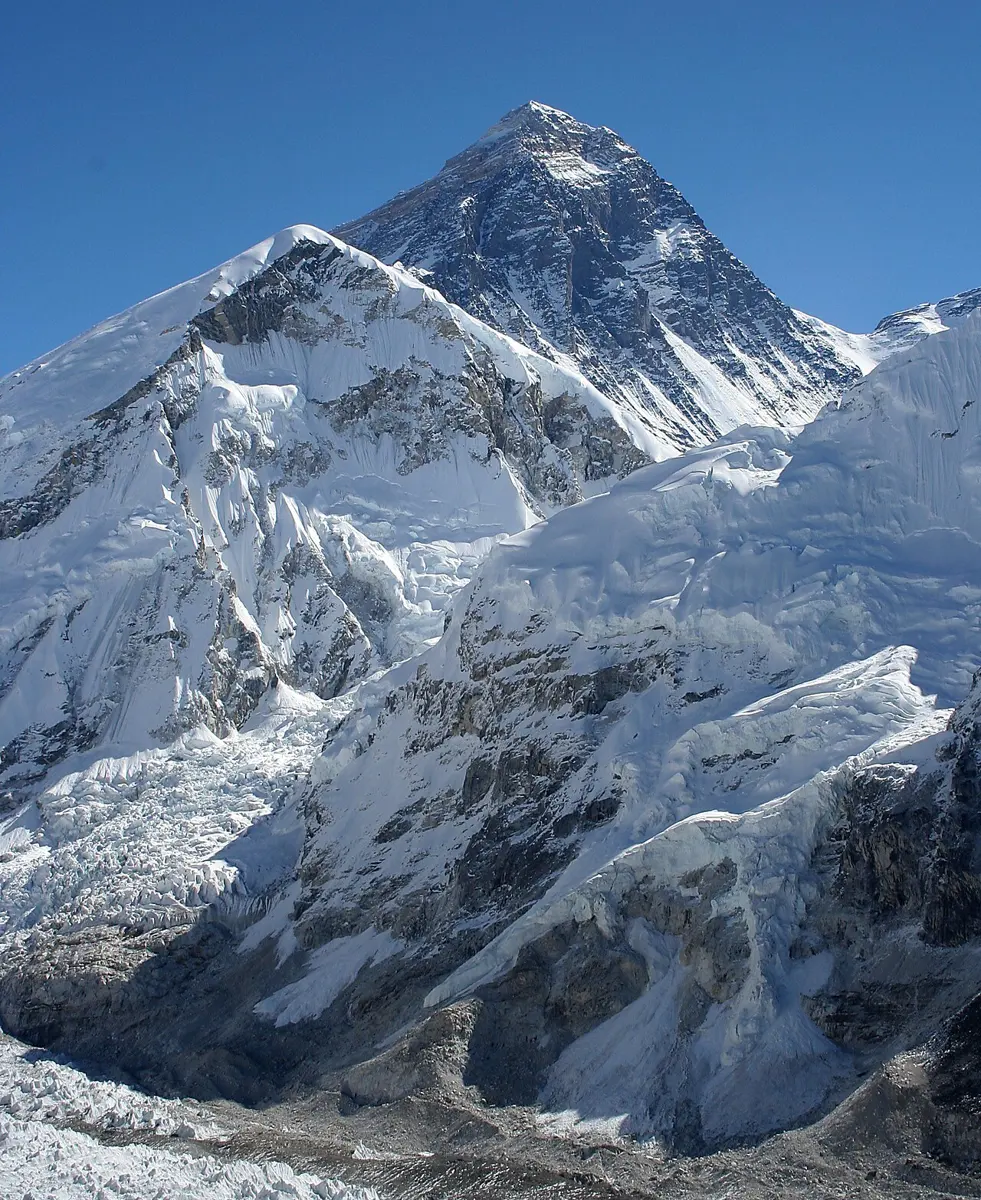
In 1849 a surveyor named James Nicolson carried a theodolite weighing about 500 kg (it took 12 men to carry it) across the plains of northern India and measured the angles up to a far-off summit the survey called Peak XV. He was never closer than 174 km to it, and the mountain was in Nepal, which no surveyor could enter. In 1852, working in the survey’s office, the mathematician Radhanath Sikdar worked through the angles and found that Peak XV was higher than any mountain measured before. We call it Sagarmatha, or Everest.
How can a few angles, measured from far away, give a height? And what happens to sine and cosine when angles are added, doubled, halved or combined? This unit answers both; the height comes back in 7.7.
7.1 Introduction
Trigonometry is the branch of mathematics that studies how the sides and angles of a triangle are related (from the Greek trigonon, “triangle”, and metron, “measure”). In Grade 9 you met its six ratios, sin θ, cos θ, tan θ and their reciprocals , , , and the identities between them, such as . In Grade 10 Mathematics you used tan to find heights: Heights and distances. This unit goes further: what the ratios of A + B, 2A or A/2 are, in terms of the ratios of A and B.
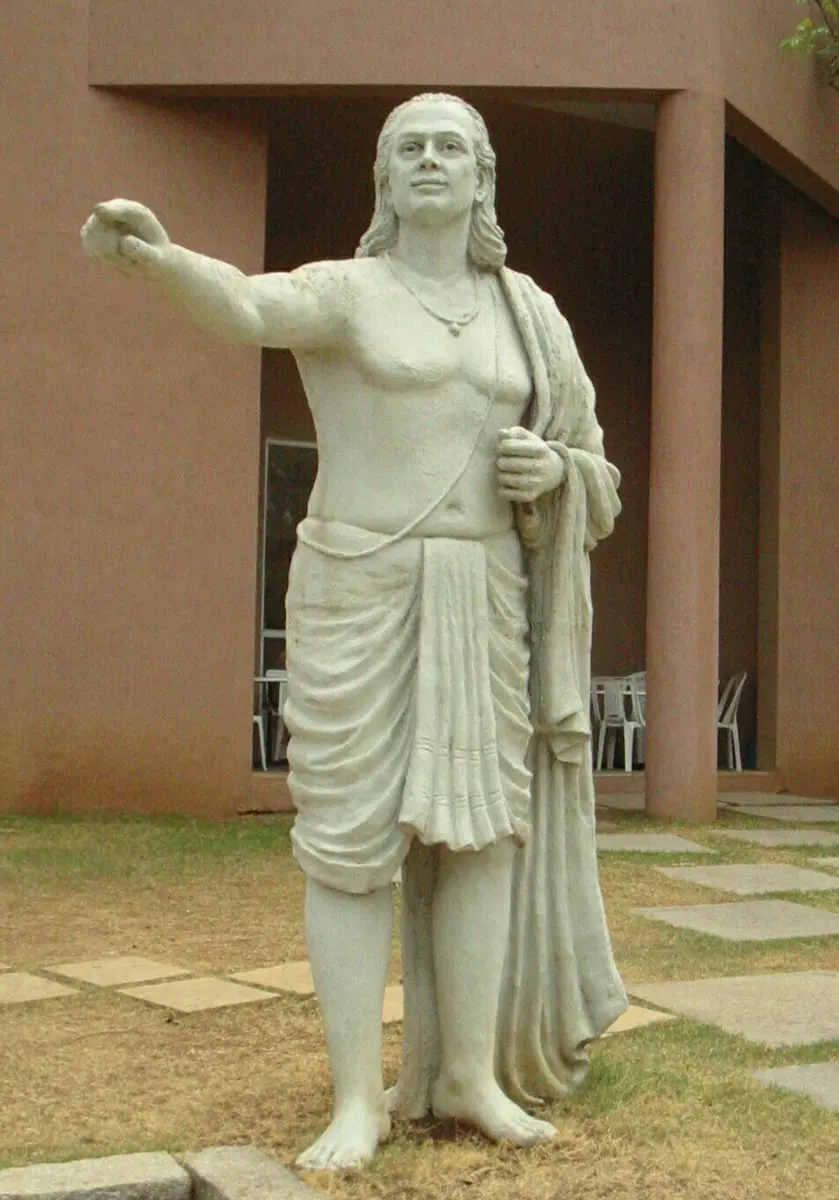
Trigonometry grew out of astronomy and building. The Egyptians and Babylonians used the relation between angles and sides to build pyramids and to follow the stars. The Greek astronomer Hipparchus (second century BC) is the first person known to have made a trigonometric table: a table of chords of a circle, the straight line across the circle that an angle at its center cuts off. For this he is called the father of trigonometry. In the second century AD Ptolemy extended his table, for every half degree, in his book the Almagest.
7.2 Compound angles
An angle made by adding or subtracting two or more angles is a compound angle. If A and B are angles, A + B and A − B are compound angles; so are 2A + B and A + B − C.
Why sin(A + B) is not sin A + sin B
Try . Then , but sin A + sin B = 1/2 + 1/2 = 1. Try : , but , more than any sine can ever be. A sine is a ratio of lengths in a turning picture, not a quantity you can add. So we need the true rule for sin (A + B) in terms of sin A, cos A, sin B and cos B. Finding it, once, gives every other formula in this unit.
7.2.1 Trigonometric ratios of compound angles A + B and A − B
cos(A + B) and cos(A − B)
Draw a circle of radius 1 (a unit circle) with its center at the origin O. A point on it whose radius is turned through an angle θ from the positive X-axis has coordinates ( cos θ, sin θ): that is what cosine and sine mean on a circle of radius 1.
Let ∠POQ = A and ∠QOR = B, so ∠POR = A + B. Turn OS through B the other way, below the X-axis, so ∠POS = B and ∠SOQ = A + B. The four points are:
(S is at angle −B, and cos (−B) = cos B, sin (−B) = − sin B.)
By the distance formula,
since . And
The chords PR and QS both cut off the angle A + B at the center, so they are equal: . So
Put −B for B, with cos (−B) = cos B and sin (−B) = − sin B:
The widget shows the proof’s one idea: however you turn A and B, the two chords stay equal. Watch the last readout: cos A + cos B is almost never cos (A + B), and it can even be more than 1 or less than −1, which no cosine can be.
sin(A + B) and sin(A − B)
Use and the cosine formula just proved:
Put −B for B:
tan(A + B) and tan(A − B)
Divide the sine by the cosine, then divide the top and the bottom by cos A cos B:
and, putting −B for B (tan (−B) = − tan B),
In the same way, dividing the top and bottom of cos (A ± B)/ sin (A ± B) by sin A sin B:
Which of these equals cos (A − B)?
Pick an answer to see why.
Worked examples
Exercise 7.1
Question 1
A. Which one is equal to sin (A + B)?
Pick an answer to see why.
B. Which is equal to cos (A − B)?
Pick an answer to see why.
C. If and , what is the value of sin (A + B)?
Pick an answer to see why.
D. If sin (A + B) = 1/2 and , what is the value of A?
Pick an answer to see why.
E. Which of the following relations is correct?
Pick an answer to see why.
Question 2
Prove, without a calculator or table:
Answer
Answer
Answer
Answer
Answer
Answer
Question 3
If sin A = 3/5 and cos B = 12/13 (A and B acute), find the value of each. First, from the 3, 4, 5 and 5, 12, 13 triangles, cos A = 4/5 and sin B = 5/13.
sin (A + B)
Answer
cos (A + B)
Answer
sin (A − B)
Answer
cos (A − B)
Answer
tan (A + B)
Answer
Answer
Question 4
Prove that:
sin (A + B) + sin (A − B) = 2 sin A cos B
Answer
sin (A + B) − sin (A − B) = 2 cos A sin B
Answer
cos (A + B) + cos (A − B) = 2 cos A cos B
Answer
cos (A + B) − cos (A − B) = −2 sin A sin B
Answer
Question 5
Prove, without a calculator or table:
Answer
Answer
Answer
Answer
Answer
Answer
Answer
Answer
Question 6
Prove that:
Answer
Answer
Answer
Answer
Question 7
If , prove that:
tan A + tan B + tan A tan B = 1
Answer
(1 + tan A)(1 + tan B) = 2
Answer
Question 8
If tan X = 2/3 and tan Y = 1/5, prove that .
Answer
If tan A = m and tan B = 1/m (m > 0), prove that .
Answer
Question 9
Prove that:
Answer
Answer
Answer
Answer
Question 10
Prove that:
Answer
Answer
Answer
Answer
Answer
Answer
Question 11
Prove that:
Answer
Answer
Answer
Answer
Question 12
Prove that:
Answer
tan 10A − tan 6A − tan 4A = tan 10A tan 6A tan 4A
Answer
Answer
Answer
Question 13
Prove that:
Answer
Answer
Question 14
Prove that:
Answer
Answer
Answer
Question 15
Prove that:
Answer
sin (A + B + C) = cos A cos B cos C( tan A + tan B + tan C − tan A tan B tan C)
Answer
cos (A + B + C) = cos A cos B cos C(1 − tan A tan B − tan B tan C − tan C tan A)
Answer
Answer
7.3 Multiple angles
If you know , can you find from it? It is , but it is not (that would be about 0.518, not 0.5). And is , not .
An angle made by multiplying an angle by 2, 3, 4, … is a multiple angle of it: 2A, 3A, 4A are multiple angles of A. A multiple angle is just a compound angle whose two parts are equal, 2A = A + A, so every formula below comes from 7.2 by putting B = A.
7.3.1 Trigonometric ratios of multiple angles
1. The ratios of 2A
Replace by , or by , for two more forms:
And with B = A in tan (A + B):
The two last forms of cos 2A are worth turning round, because they turn a square into a plain cosine:
2. sin 2A and cos 2A in terms of tan A
Write 2 sin A cos A over , then divide the top and the bottom by :
Another way, with :
In the same way,
So if you know only tan A, you know all three ratios of 2A. With tan A = t, draw a right-angled triangle with sides 2t and : its hypotenuse is , since .
3. The ratios of 3A
If tan A = 1/2, what is sin 2A?
Pick an answer to see why.
Worked examples
Exercise 7.2
Question 1
A. Which of the following is equal to cos 2A?
Pick an answer to see why.
B. Which of the following is equal to sin 3θ?
Pick an answer to see why.
C. If , what is the value of sin 2A?
Pick an answer to see why.
D. What should the value of A be when cos 3A = −1?
Pick an answer to see why.
E. Which of the following is equal to tan 2A?
Pick an answer to see why.
Question 2
If sin A = 4/5, find the values of sin 2A, cos 2A and tan 2A.
Answer
If cos A = 12/13, find the values of sin 2A, cos 2A and tan 2A.
Answer
If cos θ = 4/5, find the values of sin 3θ, cos 3θ and tan 3θ.
Answer
If tan y = 1/2, find the value of tan 3y.
Answer
Question 3
If cos 2A = 7/25, find the value of sin A.
Answer
If cos 2A = 13/36, find the value of cos A.
Answer
If tan 2A = 120/119, find the value of tan A.
Answer
Question 4
Prove that:
Answer
Answer
Answer
Answer
Answer
Answer
Answer
Answer
Answer
Question 5
Prove that:
Answer
Answer
Answer
Answer
Answer
Answer
Answer
Answer
Question 6
If , prove that .
Answer
If , prove that .
Answer
If , prove that .
Answer
If , prove that .
Answer
Question 7
Prove that:
Answer
Answer
Answer
Question 8
Prove that:
Answer
Answer
Question 9
Prove that:
(2 cos θ + 1)(2 cos θ − 1) = 2 cos 2θ + 1
Answer
(2 cos θ + 1)(2 cos θ − 1)(2 cos 2θ − 1) = 2 cos 4θ + 1
Answer
Question 10
Prove that:
Answer
Answer
Answer
Answer
Answer
Answer
Question 11
Prove that:
Answer
Answer
Answer
Question 12
Prove that:
Answer
Answer
Answer
Answer
Question 13
Prove that:
Answer
Answer
Question 14
Prove that:
Answer
Answer
Answer
Question 15
Prove that:
Answer
Answer
Answer
Question 16
Express cos 4θ in terms of sin θ.
Answer
Express cos 5θ in terms of cos θ.
Answer
Question 17
Prove that:
Answer
Answer
Answer
Answer
Question 18
If 2 tan α = 3 tan β, prove that:
Answer
Answer
Question 19
If tan A = b/a, prove that a cos 2A + b sin 2A = a.
Answer
Question 20
Prove that , where sin A + cos A > 0.
Answer
Question 21
Prove that .
Answer
Question 22
Prove that .
Answer
7.4 Submultiple angles
If you know , how do you find , half of 60°? Or , half of 30°, or , half of 45°? 7.3 doubled angles; now we halve them.
An angle made by dividing an angle into 2, 3, 4, … equal parts is a submultiple angle of it: A/2, A/3, A/4 are submultiple angles of A. 15° and 20° are submultiple angles of 60° (a quarter and a third of it).
7.4.1 sin A, cos A and tan A in terms of A/2
Every formula of 7.3 holds for any angle, so it holds with A/2 in place of A: then 2A becomes A. For example, . In the same way:
Turning c and d round gives the half-angle formulas, the way to halve an angle you know:
The sign is the sign of the ratio in the quadrant where A/2 lies: for an acute half angle, both are positive.
7.4.2 sin A, cos A and tan A in terms of A/3
With A/3 for A in the triple-angle formulas:
Which formula finds from ?
Pick an answer to see why.
Worked examples
Exercise 7.3
Question 1
A. Which of the following is equal to sin A?
Pick an answer to see why.
B. Which of the following is equal to cos θ?
Pick an answer to see why.
C. If , what is the value of sin (A/2)?
Pick an answer to see why.
D. Which is a submultiple angle of 60°?
Pick an answer to see why.
E. Which is equal to tan A?
Pick an answer to see why.
Question 2
Define a submultiple angle, with an example.
Answer
Express sin θ in terms of tan (θ/2).
Answer
Express cos θ in terms of cos (θ/2).
Answer
Express cos θ in terms of tan (θ/2).
Answer
Express sin θ in terms of sin (θ/3).
Answer
Question 3
Take the given angle (A/2, θ/3) as acute.
If sin (A/2) = 4/5, find sin A, cos A and tan A.
Answer
If tan (A/2) = 3/4, find sin A, cos A and tan A.
Answer
If cos (A/2) = 5/13, find sin A, cos A and tan A.
Answer
If sin (θ/3) = 1/2, find sin θ, cos θ and tan θ.
Answer
If cos (θ/3) = 4/5, find sin θ, cos θ and tan θ.
Answer
If tan (θ/3) = 1/2, find the value of tan θ.
Answer
Question 4
If cos A = 7/25, find the value of sin (A/2).
Answer
If cos A = 13/36, find the value of cos (A/2).
Answer
If tan A = 4/3, find the value of tan (A/2).
Answer
Question 5
If , prove that: i. ii. iii. iv.
Answer
If , prove that: i. ii. iii. iv.
Answer
Question 6
Prove that:
If , then .
Answer
If , then .
Answer
If , then .
Answer
If , then .
Answer
Question 7
Prove that (with s = sin (A/2), c = cos (A/2) where it helps):
Answer
Answer
Answer
Answer
Answer
Answer
Answer
Answer
Answer
Answer
Answer
Answer
Question 8
Prove that:
Answer
Answer
Answer
Answer
Answer
Answer
(for cos A > 0)
Answer
Answer
Question 9
Prove that
Answer
7.5 Transformation of trigonometric identities
Sometimes a product such as is easier to work with as a sum, and sometimes a sum such as is easier as a product. This section turns one into the other. Both come straight from the four compound-angle formulas, by adding and subtracting them.
7.5.1 Transformation of a product into a sum or difference
Write the two sine formulas one under the other:
Adding (i) and (ii), the cos A sin B terms cancel; subtracting (ii) from (i), the sin A cos B terms cancel:
Do the same with the two cosine formulas:
Mind the order in (viii): the difference angle comes first. (Written the other way, cos (A + B) − cos (A − B) = −2 sin A sin B.)
7.5.2 Transformation of a sum or difference into a product
Read the four formulas from right to left. Let
Adding and subtracting these, A = (C + D)/2 and B = (C − D)/2. Put them into (iii), (iv), (vii) and (viii):
What is as a product?
Pick an answer to see why.
Worked examples
Exercise 7.4
Question 1
A. Which expression is equal to 2 sin A cos B?
Pick an answer to see why.
B. Which expression is equal to sin A − sin B?
Pick an answer to see why.
C. Which expression is equal to cos C − cos D?
Pick an answer to see why.
D. What is cos 6A + cos 4A as a product?
Pick an answer to see why.
E. is equal to which of these?
Pick an answer to see why.
Question 2
Write each product as a sum or difference.
Answer
Answer
cos 10A sin 6A
Answer
Answer
Question 3
Write each sum or difference as a product.
Answer
Answer
cos 7A − cos 5A
Answer
Answer
Question 4
Prove that:
Answer
Answer
Answer
Answer
Answer
Question 5
Prove that:
Answer
Answer
Answer
Answer
Answer
Answer
Answer
Answer
Question 6
Prove that:
Answer
Answer
Answer
Answer
Question 7
Prove that:
Answer
Answer
Answer
Answer
Question 8
Prove that:
Answer
Answer
Answer
Answer
Answer
Answer
7.6 Conditional identities
A relation that is true for every angle, such as sin 2θ = 2 sin θ cos θ, is a trigonometric identity. A relation that is true only when the angles satisfy some condition, such as , true when , is a conditional identity.
The condition you will meet most is that A, B and C are the angles of a triangle, so . Then , and the ratios of an angle and its supplement give:
and, since ,
Proving one for every triangle
Checking with numbers shows that a relation holds for those numbers; a proof shows it holds for every triangle. For example, if , then , and
(as long as none of the angles is 90°, where tan is not defined). So in every triangle without a right angle, the sum of the three tangents equals their product: a surprising fact you can test with any triangle you draw.
Which of these is a conditional identity, not an identity?
Pick an answer to see why.
Worked examples
Exercise 7.5
Question 1
A. Which of the following statements is correct?
Pick an answer to see why.
B. If tan A = 1, what is the value of A (A acute)?
Pick an answer to see why.
C. Under what condition is sin A = cos B true?
Pick an answer to see why.
D. Which of the following is a conditional identity?
Pick an answer to see why.
E. If , which one is correct?
Pick an answer to see why.
Question 2
The angles of a triangle are , and . Verify that:
Answer
Answer
Answer
Answer
Answer
Answer
Question 3
If , and , verify that:
tan A + tan B + tan C = tan A tan B tan C
Answer
tan 2A + tan 2B + tan 2C = tan 2A tan 2B tan 2C
Answer
Answer
Answer
Answer
Question 4
If the angles of △ABC are , and , verify that:
sin 2A − sin 2B + sin 2C = 4 cos A sin B cos C
Answer
sin 2A − sin 2B − sin 2C = 4 sin A cos B cos C
Answer
cos 2A + cos 2B + cos 2C = −1 − 4 cos A cos B cos C
Answer
cos 2A − cos 2B + cos 2C = 1 − 4 sin A cos B sin C
Answer
Question 5
The angles of a triangle are , and . Verify that:
Answer
Answer
Answer
Answer
Question 6
For which of these conditions is sin 2A + sin 2B + sin 2C = 4 sin A sin B sin C valid? a. and b. c. d.
Answer
7.7 Height and distance
How tall is your school building? How far apart are two electric poles across a river? How high is a mountain you can’t climb? Measuring these directly is hard or impossible. But an angle is easy to measure from where you stand, and with the trigonometric ratios of a right-angled triangle an angle and one distance give the rest. In Grade 10 Mathematics you met the method: Heights and distances. Here it is used again, often with two angles at once.
7.7.1 Angle of elevation and angle of depression
When you look at something above your eye level, the angle between your line of sight and the horizontal is the angle of elevation. Looking at the top of a house, a pole or a tree from the ground, you measure an angle of elevation.
When you look at something below your eye level, the angle between the line of sight and the horizontal is the angle of depression: looking down at a bird in the yard from a roof, or at a car from a tower.
That equality is the key to most questions: an angle of depression measured from the top can be drawn at the bottom, inside the triangle, as an angle of elevation.
Worked examples
The same idea works for any two angles α (from the far point) and β (from the near point), d apart. The near point is h/ tan β from the foot and the far one h/ tan α, so
This is how surveyors measure a mountain whose foot they can’t reach: the point straight below the summit is inside the rock.
Back to Peak XV
Now the opening question. From a station on the plains, a surveyor measured the angle of elevation of Peak XV. If the Earth were flat and the light came straight, the height would be the distance times the tangent of that angle, as in this unit. Two things make it harder over 174 km:
- The Earth curves. Over a distance d the ground falls away below a level line by about , where km is the Earth’s radius. For 174 km that is km: from Nicolson’s nearest station, the bottom 2.4 km of the mountain lay below his level line. The angle he saw was only about 2°.
- The air bends light. Light coming down through denser and denser air curves, so the summit looks a little higher than it is. Nicolson’s first average, about 9,200 m, did not allow for this.
The survey’s mathematicians corrected for both, and for the stations’ own heights, and checked the figures for years. In 1852 Sikdar’s calculations showed Peak XV higher than Kangchenjunga; in March 1856 the survey announced 29,002 ft (8,840 m). The calculation had given exactly 29,000 ft; the story goes that Waugh added 2 ft so that it would not look like a rounded guess.
Later measurements, by better instruments and then by satellite, came very close: the Survey of India’s triangulation of 1952 to 1954 gave 8,847.73 m. After the 2015 earthquake, Nepal’s own survey department planned a new measurement, and in 2020 Nepal and China announced the result of a joint survey: 8,848.86 m. The method of a few angles and a measured base line, used on Peak XV in the 1840s, is the method of this unit.
Exercise 7.6
Question 1
A. What is the angle between the line of sight and the horizontal called, when you look at an object below eye level?
Pick an answer to see why.
B. What is the angle between the line of sight and the horizontal called, when you look at an object above eye level?
Pick an answer to see why.
C. If the angle of elevation of an object seen from a place is 0°, where is the object?
Pick an answer to see why.
D. The angle of elevation of the top of a pole from a place is 45°. How do the pole’s height and its distance from the place compare?
Pick an answer to see why.
E. As the angle of elevation of the top of a tower seen from a place increases, what happens to the distance from the tower?
Pick an answer to see why.
F. What is the angle of elevation of the top of a tree m high, seen from a point 10 m from its foot?
Pick an answer to see why.
Question 2
Find the values of x, y and θ in each figure.
Answer
Answer
Answer
Answer
Answer
Answer
Questions 3 to 13
From a point on the ground, the angle of elevation of a point on the roof of a house is 60°. From 50 m farther away it is 30°. Find the height of the house.
Answer
The angles of elevation of the top of a 30 ft pole from two points on the same side are 60° and 45°. Find the distance between the points.
Answer
From the top of a hill 500 m high, two points on the ground on the same side are seen at angles of depression of 60° and 30°. Find the distance between the points.
Answer
From the roof of a house, two people sitting on the ground 10 ft apart, on the same side, are seen at angles of depression of 60° and 45°. Find the height of the house.
Answer
The angles of elevation of the top of a pole from two points 40 m and 36 m from its foot, on the same side, are complementary. Find the height of the pole.
Answer
Two poles stand 50 m apart, one twice as tall as the other. From the point midway between them, the angles of elevation of their tops are complementary. Find the heights of the poles.
Answer
The shadow of an upright pole on level ground is 50 m longer when the sun’s altitude is 30° than when it is 60°. Find the height of the pole.
Answer
When the sun’s altitude is 30°, the shadow of a pole 35 ft high is x ft longer than when the altitude is 45°. Find x.
Answer
From the roof of a building 30 m high, the angles of depression of the top and the foot of a column are 45° and 60°. Find the height of the column.
Answer
The pinnacle of a temple is seen from the roof of a building 20 m high at an angle of depression of 60°, and from the foot of the building at an angle of elevation of 30°. Find the height of the temple.
Answer
A flag of Nepal flies on top of a tower. From a point 100 m from the foot of the tower, the angles of elevation of the top of the tower and the top of the flag are 45° and 60°. Find the height of the flag.
Answer
A man whose eye is 1.8 m above the ground sees the roof of a house at an angle of elevation of 45°, and the top of a window in the house, 20 m above the ground, at 30°. Find the height of the house.
Answer
From the foot and the roof of a house 15 m high, the angles of elevation of the top of a column are 60° and 45°. Find the height of the column.
Answer
An airplane flying level at a height of 6,000 m is seen from a point on the ground at an angle of elevation of 30°. Ten seconds later, from the same point, it is at 45°. Find its speed in km/h.
Answer
Two poles of equal height stand on opposite sides of a road 30 m wide. From a point on the road between them, the angles of elevation of their tops are 60° and 30°. Find the height of the poles and the point’s distances from them.
Answer
A man whose eye is 1.6 m above the ground stands midway between two poles and sees their tops at angles of elevation of 60° and 45°. The shorter pole is 41.6 m high. Find the height of the taller pole and the distance between the poles.
Answer
A point divides a pole in the ratio 4 : 5 from the ground. Both parts subtend equal angles at a point 20 m from the foot. Find the height of the pole.
Answer
A flag 5 m high is fixed on top of a tower. From a point on the ground, the tower and the flag subtend angles of 45° and 15°. Find the height of the tower.
Answer
Two poles are of equal height. A person standing between them sees each top at an angle of elevation of 45°. After moving 20 m closer to one pole, the angle of elevation of its top becomes 60°.
a. Represent the context in a diagram. b. Find the height of the poles. c. Find the distance between the poles. d. As the observer moves closer to a pole, the angle of elevation increases. Explain why.
Answer
A ladder 10 m long leans against the outside wall of a building with its top 4 m below the roof. From the foot of the ladder, the angle of elevation of the roof is 60°.
a. Draw a diagram. b. Find the height where the ladder’s top touches the wall. c. Find the distance from the foot of the ladder to the building. d. Find the angle of elevation of the ladder’s top from its foot.
Answer
How the SEE asks it
In the SEE’s Optional Mathematics paper (75 marks, 3 hours), Trigonometry is a content area on its own, with more marks than any other unit. CDC’s specification grid gives it 17 marks, in three kinds of question:
| Group | Kind of question | Trigonometry’s marks | Levels |
|---|---|---|---|
| A | multiple choice, 1 mark each | 3 | knowledge 1, application 1, higher ability 1 |
| B | within the content area: questions on trigonometry alone, each of several parts | 9 | knowledge 2, understanding 2, application 4, higher ability 1 |
| C | across content areas: one question joining trigonometry with another area | 5 | understanding 2, application 2, higher ability 1 |
In CDC’s model paper:
- Group A: the value of in another form (sum to product); sin (A + B) written out; and what happens to the angle of elevation of a tree’s top as you walk towards it.
- Group B: write sin 2A from sin (A + B) (1 mark), then show (1 mark); a cliff with two angles of depression: draw the diagram (1 mark) and find a distance (2 marks); a conditional identity in a triangle: write a product as a sum (1 mark), verify the identity for given angles (2 marks), and say with a reason why it fails for angles that are not a triangle’s (1 mark).
- Group C: a straight line’s slope written as tan of an angle, joined with the double-angle formula.
What each kind asks, and where its marks are:
- Proving an identity: start from one side (usually the harder one) and reach the other; each correct formula used is a step mark.
- Values without a calculator: split the angle into 30°, 45°, 60° and 90° pieces, or halve a known one.
- Verifying a conditional identity: both sides worked out separately with the given angles; the reason it fails elsewhere is the condition.
- Heights and distances: the figure (a mark of its own), the right ratio in the right triangle, the answer with its unit.
Here is a question of the longer kind, written for this book, with how it is marked.
Miscellaneous exercise
Given and :
- a.Write any two compound angles of A and B.
- b.Find the value of A − B.
- c.Is cos (A − B) = cos A cos B + sin A sin B true for all values of A and B? Give a reason.
Answer
Given :
- a.Express cos A in terms of sin (A/2).
- b.Write any two submultiple angles of 15°.
- c.Prove that .
Answer
The angles of △ABC are , and .
- a.Write cos 2A in terms of cos A.
- b.Verify with these angles that tan A + tan B + tan C = tan A tan B tan C.
- c.Is true for this triangle? Give a reason.
Answer
A ladder 9 m long leans against the outside wall of a house, with its top 9 m below the roof, making an angle of 60° with the ground.
- a.Show this in a diagram.
- b.How high up the wall does the ladder reach?
- c.How far is the foot of the ladder from the house?
- d.The foot is moved out until the ladder makes 30° with the ground. How far below the roof is its top now?
Answer
Two poles are of equal height. A person standing midway between them sees the top of each at an angle of elevation of 60°. After walking 60 m towards one pole, he sees the top of the other pole at 45°.
- a.Define angle of elevation.
- b.Show this in a diagram.
- c.Find the height of the poles.
- d.How are the distance from a pole and the angle of elevation of its top related?
Answer
Practice every question in the book, and keep track of the ones you miss →
Where these facts come from
- Peak XV: the Great Trigonometrical Survey begun in 1802, its theodolites of about 500 kg carried by 12 men; James Nicolson’s observations of 1849 from Jirol (190 km) and five stations, the nearest 174 km away; his raw average of about 9,200 m without the correction for refraction; Radhanath Sikdar identifying it as the highest peak in 1852; Waugh’s announcement of 29,002 ft (8,840 m) in 1856; the Survey of India’s 8,847.73 m (1952 to 1954); Nepal’s planned survey after the 2015 earthquake; the joint Nepal–China height of 8,848.86 m (2020) (the opening, Back to Peak XV): Wikipedia, “Mount Everest”, read October 2026.
- Radhanath Sikdar (1813 to 1870), his calculation of exactly 29,000 ft and the 2 ft Waugh added: Wikipedia, “Radhanath Sikdar”, read October 2026.
- Triangulation by measured baselines and angles; the large theodolites of the survey: Wikipedia, “Great Trigonometrical Survey”, read October 2026.
- Hipparchus’s table of chords, Ptolemy’s table for every half degree in the Almagest and his use of what we call the sum and difference formulas, his half-angle result; Habash al-Hasib’s first tables of the tangent and cotangent (about 830); Madhava’s series; Euler’s modern form (1748) (7.1, 7.2, 7.4): Wikipedia, “History of trigonometry”, read October 2026.
- Hipparchus as the first known maker of a trigonometric table: Wikipedia, “Hipparchus”, read October 2026.
- Aryabhata (476 to 550), the Aryabhatiya (499), his table of sines in a single verse at intervals of 3¾°, ardha-jya and jya, kojya: Wikipedia, “Aryabhata”, read October 2026.
- The word sine from jya through Arabic jiba, read as jaib, and Latin sinus; cosinus from complementi sinus: Wikipedia, “Sine and cosine” (Etymology), read October 2026.
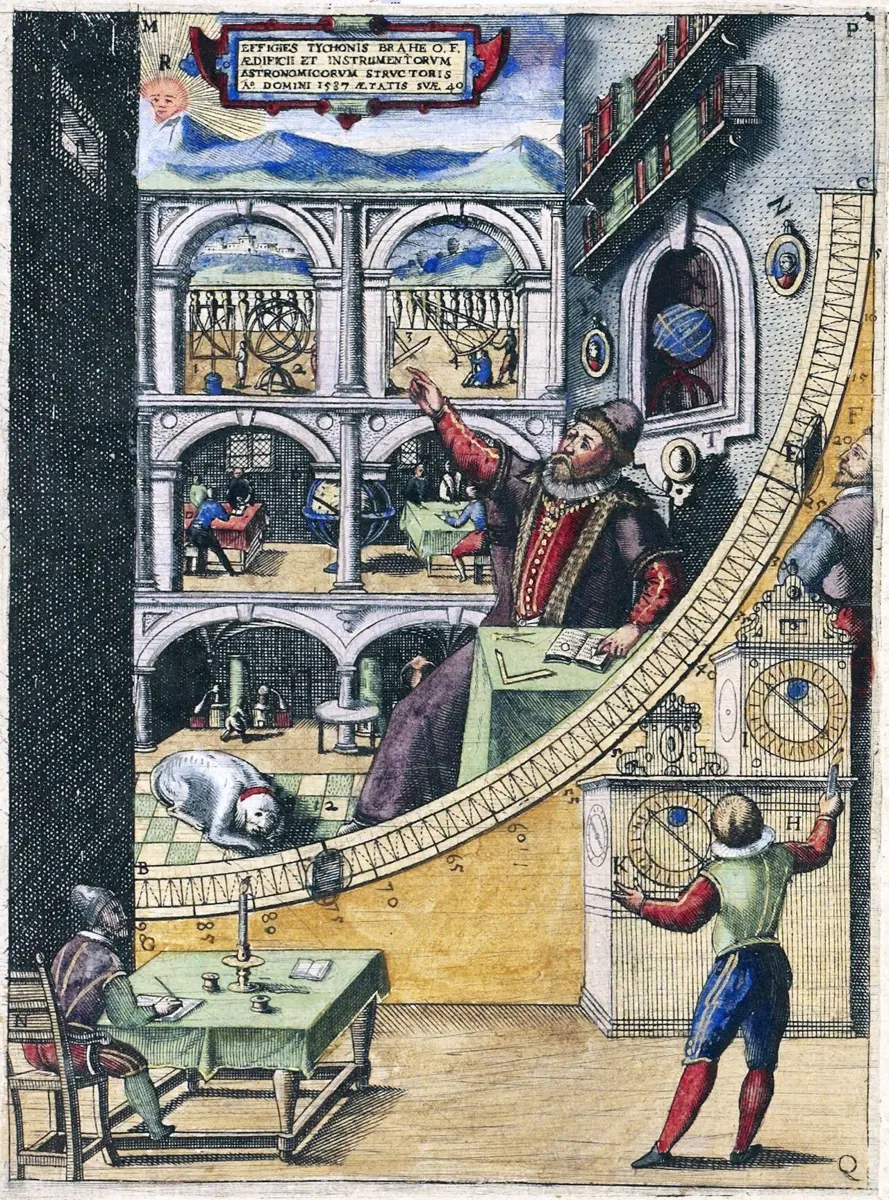
- Prosthaphaeresis: multiplication by the product-to-sum formulas from the 1580s, used by Tycho Brahe, the only general shortcut for about 25 years before logarithms (1614) (7.5): Wikipedia, “Prosthaphaeresis”, read October 2026.
- Beats: two close frequencies heard as one sound whose loudness varies at the difference of the frequencies; tuning by beats (7.5): Wikipedia, “Beat (acoustics)”, read October 2026.
- A projectile’s range on level ground without air resistance, greatest at 45° (7.3): Wikipedia, “Range of a projectile”, read October 2026.
- Rotation by an angle as x′ = x cos θ − y sin θ, y′ = x sin θ + y cos θ, and two rotations composing (7.2): Wikipedia, “Rotation matrix”, read October 2026.
- The curvature drop over 174 km and the angle of about 2° (Back to Peak XV): worked out for this book from the distances above and the Earth’s mean radius, 6,371 km.
- The statue of Aryabhata at IUCAA, Tycho Brahe’s mural quadrant and Everest from Kala Patthar: their Wikimedia Commons file pages.
- CDC’s specification grid and model paper for Optional Mathematics, 2082 (How the SEE asks it): the textbook folder,
Specification Grids/grid-Opt. Math-G10.
A companion to your textbook, not a replacement for it: study from the book your school uses, and where the two differ, follow your teacher. Found a mistake? Please tell us.