
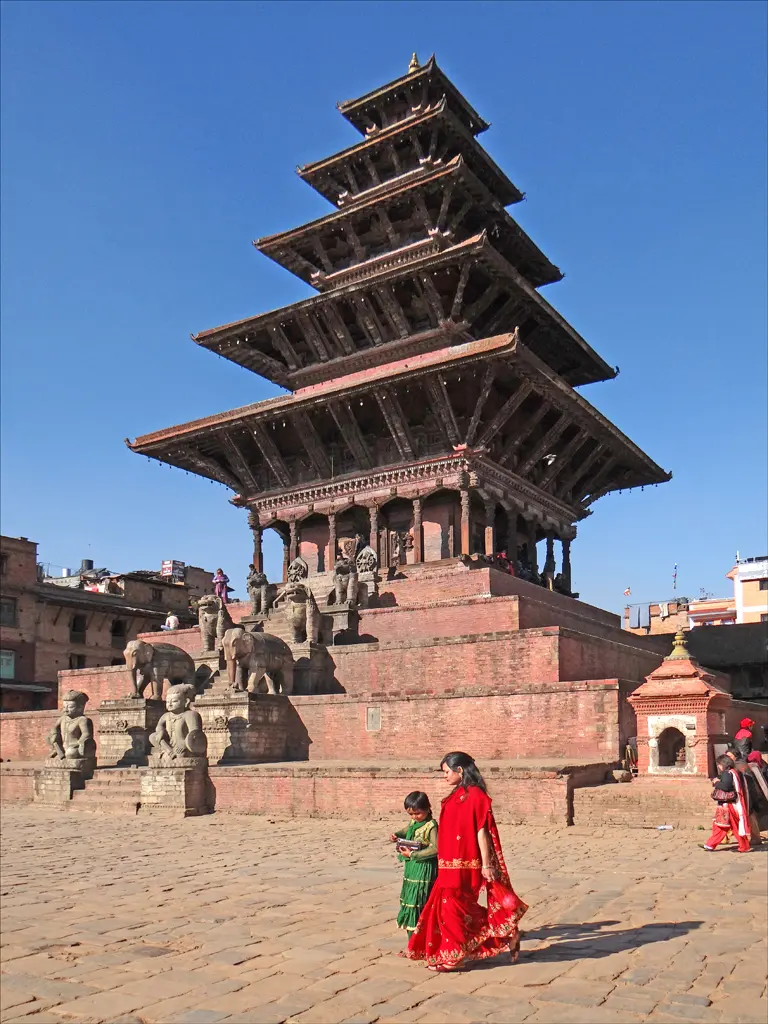
How tall is the Nyatapola? Nepali Times says 30 m; Wikipedia and the Bhaktapur.com guide say about 33 m. Three meters is a whole floor of a house, and nobody is going to climb the five roofs with a tape.
You don’t need to. Stand in Taumadhi Square, measure how far you are from the point under the top, and measure one angle: how far you tip your eyes up to see the finial. Trigonometry turns those two numbers into the height. This unit shows you how, with a protractor, a straw and a thread, and how to find any height or distance you can’t reach: a tree, a tower, a kite, the width of a pond.
Heights: Nepali Times, Wikipedia, bhaktapur.com (Sources).
15.0 Review
Grade 9 named the sides of a right-angled triangle from the angle you are looking at. For the angle θ at C in Figure 15.2:
- the hypotenuse h is the longest side, opposite the right angle: AC;
- the perpendicular p is the side opposite θ: AB;
- the base b is the third side, next to θ: BC.
The three trigonometric ratios of θ are
Why do these ratios belong to the angle? Every right-angled triangle with the angle θ at C is the same shape, only bigger or smaller (the triangles are similar), so its sides keep the same proportions. Double the triangle and AB and BC both double: tan θ doesn’t change. That is the whole trick of this unit: measure the angle, and you know the ratio of the sides, whatever their size.
| θ | 0° | 30° | 45° | 60° | 90° |
|---|---|---|---|---|---|
| sin θ | 0 | 1 | |||
| cos θ | 1 | 0 | |||
| tan θ | 0 | 1 | not defined |
You don’t have to learn the table by heart: it comes from two set squares.
Cut a square with sides 1 along its diagonal: the diagonal is , and both acute angles are 45°. So and . Cut an equilateral triangle with sides 2 down its middle: the half has angles 30° and 60°, a short side of 1 and an upright side of . So , , and the sines and cosines follow the same way.
In a right-angled triangle, which ratio uses only the perpendicular and the base?
Pick an answer to see why.
15.1 Angle of Elevation and Angle of Depression
When an observer looks at something higher than the eye, the angle between the line of sight and the horizontal line through the eye is the angle of elevation. When the observer looks at something lower than the eye, the angle between the line of sight and the horizontal is the angle of depression. Both are measured from the horizontal, never from the upright. An instrument that measures them is a clinometer.
In Figure 15.5, AF and DE are both horizontal, so they are parallel, and the line of sight AE cuts both. ∠FAE and ∠AED are alternate angles, so they are equal: the angle of depression from A to E equals the angle of elevation from E to A. One line of sight, one angle, seen from either end.
Top or middle? Ramnaresh asked one more thing: is the angle of elevation bigger when you look at the top of the tree or at its middle? Try it with your own eyes: you tip your head further back for the top. The higher the point you look at, the bigger the angle of elevation. And from the top of the tree looking down, the angle of depression is bigger for a point close to the tree than for one far away: the nearer the point, the more steeply you look down.
Sushma stands on the roof of her house and sees her friend on the road below. Which angle does she measure?
Pick an answer to see why.
From the top of a tower, a car on the road is seen at an angle of depression of 35°. From the car, what is the angle of elevation of the top of the tower?
Pick an answer to see why.
The clinometer
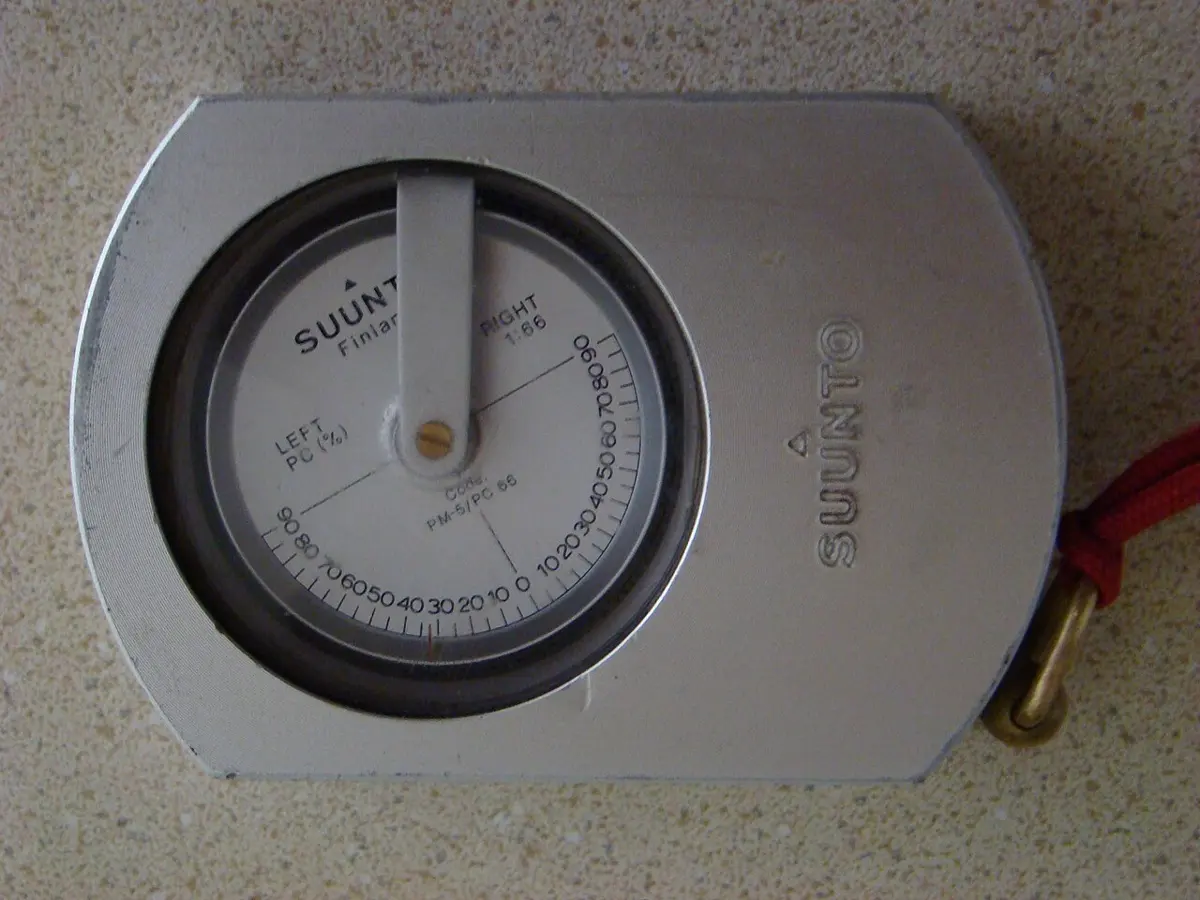
Foresters measure trees exactly the way this unit teaches: a clinometer for the angle to the top, a tape for the distance, and then “horizontal distance at eye level × tan θ = height above eye level”. That is called the tangent method. Its usual error is a top that isn’t straight above the base (a leaning tree, a branch reaching towards you): the method takes the top to be over the base, and the height almost always comes out too big.
You can make a clinometer that works on the same idea from a protractor.
15.2 Heights and distances
Every heights-and-distances problem goes the same way:
- Draw the picture: the ground, the object, the observer, the dashed horizontal through the eye, the line of sight, the angle.
- Find the right-angled triangle whose angle you know. Its right angle is where the horizontal through the eye meets the upright object.
- Pick the ratio that joins the side you know and the side you want: opposite and adjacent, tan; opposite and hypotenuse, sin; adjacent and hypotenuse, cos.
- Solve, then add or take away the eye height (or a building’s height) that isn’t inside the triangle.
- Ask whether it makes sense: at 45° the height above the eye equals the distance; above 45° it is more, below 45° less.
Back to the Nyatapola
Yes, you can settle 30 m or 33 m from the square, with a homemade clinometer, if you are careful. Here is how big the difference is.
Say you stand 40 m from the point straight under the finial, with your eye 1.5 m above the paving. The top is 28.5 m above your eye if the temple is 30 m, or 31.5 m if it is 33 m:
The two claims are about 2.7° apart. A clinometer read to the nearest degree tells them apart; one read carelessly, to within 2° or 3°, can’t. Three things matter:
- The distance is to the point under the top, the middle of the temple, not to the bottom step. The five plinths spread far out under the roofs, so measure to the middle of the lowest plinth’s front and add half its width (pace it along the side).
- Measure several times and take the mean: from two or three distances, each reading twice.
- Stand back. Close up the angle is steep and a half-degree slip moves the answer a lot; near 45° it moves it least. Try “Clinometer reads whole degrees” in the widget at the top of this unit, near and far.
How the SEE asks it
CDC’s Specification Grid for Compulsory Mathematics gives Trigonometry 4 marks: one question with four parts, one each in knowledge, understanding, application and higher ability. The figure is usually given; the angles are 30°, 45° or 60°. Here is a question of our own in that shape.
Exercise 15
Question 1
Define the angle of elevation and the angle of depression, with an example of each.
Answer
In a right-angled triangle, which trigonometric ratio relates the perpendicular and the base?
Answer
In a right-angled triangle, which trigonometric ratio relates the perpendicular and the hypotenuse?
Answer
Question 2
Find the value of x in each right-angled triangle.
Answer
Answer
Answer
Question 3
A tower is 60 m high, and a man is x m from it. He sees its top at an angle of elevation of 30°. Find x. (Ignore his height.)
Answer
A tower is 12 m high and a man is 12 m from it. He sees its top at an angle of elevation of . Find x.
Answer
A tower is x m high and a man is 12 m from it. He sees its top at an angle of elevation of 45°. Find x.
Answer
Question 4
A tree 14 m high breaks in the wind. Its top touches the ground, still joined to the trunk, and the broken part makes an angle of 60° with the ground. Find the length of the broken part.
Answer
A tree breaks partway up in the wind. Its top touches the ground, still joined to the trunk, making an angle of 60° with the ground. The broken part is 7.5 m long. How tall was the tree before it broke?
Answer
A tree breaks partway up in the wind. Its top touches the ground, still joined to the trunk, making an angle of 30° with the ground. The broken part is 30 m long.
- i.How tall was the tree before it broke?
- ii.How far from the foot of the tree does its top meet the ground?
Answer
Question 5
A man 1.7 m tall sees the top of a tower at an angle of elevation of 60°. He is 30 m from the tower. Find the height of the tower.
Answer
A man 1.4 m tall is flying a kite from the roof of a house 33.6 m high. The kite string is m long and makes an angle of 45° with the horizontal. Find the height of the kite above the ground.
Answer
A man 1.5 m tall sees the top of a tree 51.5 m high at an angle of elevation of 45°. Find the distance between the man and the tree.
Answer
Question 6
A man is 20 m from a tower 36.5 m high. The angle of elevation of its top from his eye is 60°. Find the height of his eye above the ground.
Answer
From the top of a house 30 ft high, the angle of depression of the top of a tree is 30°. The house and the tree are ft apart. Find the height of the tree.
Answer
A tower is 60 m high and a house is 35 m from it. From the top of the tower, the angle of depression of the top of the house is 45°. Find the height of the house.
Answer
Question 7
A circular pond is 90 m across. A pole at its center stands 45 m above the water. Find the angle of elevation of the top of the pole from the edge of the pond.
Answer
A circular pond is 130 m across. A pole stands at its center. From the edge, the angle of elevation of its top is 45°. Find the height of the pole above the water.
Answer
A pole stands at the center of a circular pond, 11.62 m above the water. From the edge of the pond, a man whose eye is 1.62 m above the water sees its top at an angle of elevation of 60°. Find the diameter of the pond.
Answer
Question 8
At a festival, Ramesh flies a kite. The string makes an angle of 30° with the horizontal and is 120 m long. Ramesh is 1.5 m tall. Find the height of the kite above the ground.
Answer
Ramsharan, 1.5 m tall, flies a kite from the roof of a house 9 m high. The string makes an angle of 30° with the horizontal, and the kite is 58 m above the ground. Find the length of the string.
Answer
A man 2 m tall flies a kite from the roof of a house 32 m high. The string is m long and makes an angle of 45° with the horizontal. Find the height of the kite above the ground.
Answer
Question 9
At 2 pm a pole 20 m high casts a shadow m long. Find the angle of elevation of the sun then, and the length of the shadow of a tower m high at the same time.
Answer
Question 10
A tree 25 m high stands at one corner of a school ground. A man whose eye is 1.2 m above the ground sits at another corner, 23.8 m from the tree.
What is the angle of elevation of the top of the tree from the man?
Answer
Would the angle of elevation increase if the tree were taller? Give a reason.
Answer
Does the angle of elevation increase or decrease if the man moves closer to the tree? Give a reason.
Answer
Question 11
A cat on the ground looks up at a parrot in a cage on a pole, m above the ground, at an angle of elevation of 30°.
What is the angle the parrot’s line of sight makes with the horizontal, when it looks down at the cat, called?
Answer
Find that angle in degrees.
Answer
How far is the cat from the pole?
Answer
As the cat moves towards the pole, does the angle the parrot makes looking at it get smaller? Give a reason.
Answer
Question 12
The circumference of a circular pond is 176 m. A pole stands at its center. From the edge of the pond, a man whose eye is 1.6 m above the water sees the top of the pole at an angle of elevation of 45°.
Find the distance between the man and the pole.
Answer
Find the height of the pole above the water.
Answer
How much shorter would the pole above the water have to be for the angle of elevation to be 30°?
Answer
Question 13
A man whose eye is 1.2 m above the roof flies a kite from the roof of a house 8.8 m high. The string is 180 m long and makes an angle of 30° with the horizontal.
Show the situation in a diagram.
Answer
How high is the kite above the ground?
Answer
What is the horizontal distance between the man and the kite?
Answer
Question 14
Two buildings, 20 m and 32 m high, stand 12 m apart.
Looking from the roof of the taller building to the roof of the shorter one, what kind of angle is formed?
Answer
How is the angle of elevation of the taller roof, seen from the shorter roof, related to the angle of depression of the shorter roof, seen from the taller one? Give a reason.
Answer
Find the angle of elevation of the taller roof from the shorter roof.
Answer
How long a ladder would reach from the top of the shorter building to the top of the taller one?
Answer
Question 15
A tower and a house stand 25 m apart on level ground. The house is 15 m high.
From a point A on the edge of the roof, the angle of elevation of the top B of the tower is 45°. Find the height of the tower.
Answer
How would the angle of elevation change if the tower were taller?
Answer
Question 16
From the top C of a view tower 50 m high, the angle of depression of a point A on the roof of a house 20 m to the east is 60°.
What is the angle of elevation of the top of the tower from A?
Answer
Find the height of the part BC of the tower.
Answer
Find the height of the house.
Answer
How far down from the top of the tower must an observer come to see the roof at A at an angle of depression of 45°?
Answer
Practice every question in the book, and keep track of the ones you miss →
Where these facts come from
- The Nyatapola’s height, 30 m: Nepali Times, “Nyatapola alight”, 12 May 2019, read October 2026. About 33 m (33.23 m), five plinths and five roofs, built 1701–1702: Wikipedia, “Nyatapola”, read October 2026; “the ultimate height of the temple is 33 meters”: bhaktapur.com, “Nyatapola Temple”, read October 2026.
- The tangent method (clinometer and tape; “horizontal distance at eye level × tangent Θ = height above eye level”; a top not over the base adds to the height): Wikipedia, “Tree height measurement”, read October 2026.
- Thales measuring the pyramids by their shadows when his shadow equaled his height, as told by Diogenes Laërtius, Pliny and Plutarch from Hieronymus of Rhodes (the story): Wikipedia, “Thales of Miletus”, read October 2026.
- Peak XV observed from stations up to 240 km away, given 8,840 m (29,002 ft) in 1856, refraction, the 2020 height 8,848.86 m (fact box): Wikipedia, “Mount Everest”, read October 2026.
- The glide slope about 3° above the horizontal (fact box): Wikipedia, “Instrument landing system”, read October 2026.
- The SEE’s Trigonometry marks, one 4-mark question with parts K1 U1 A1 HA1 (For the SEE, How the SEE asks it): CDC, Specification Grid, Compulsory Mathematics, Grades 9–10 (2078), the grid table.
- Photos: Wikimedia Commons, credited under each.
A companion to your textbook, not a replacement for it: study from the book your school uses, and where the two differ, follow your teacher. Found a mistake? Please tell us.