
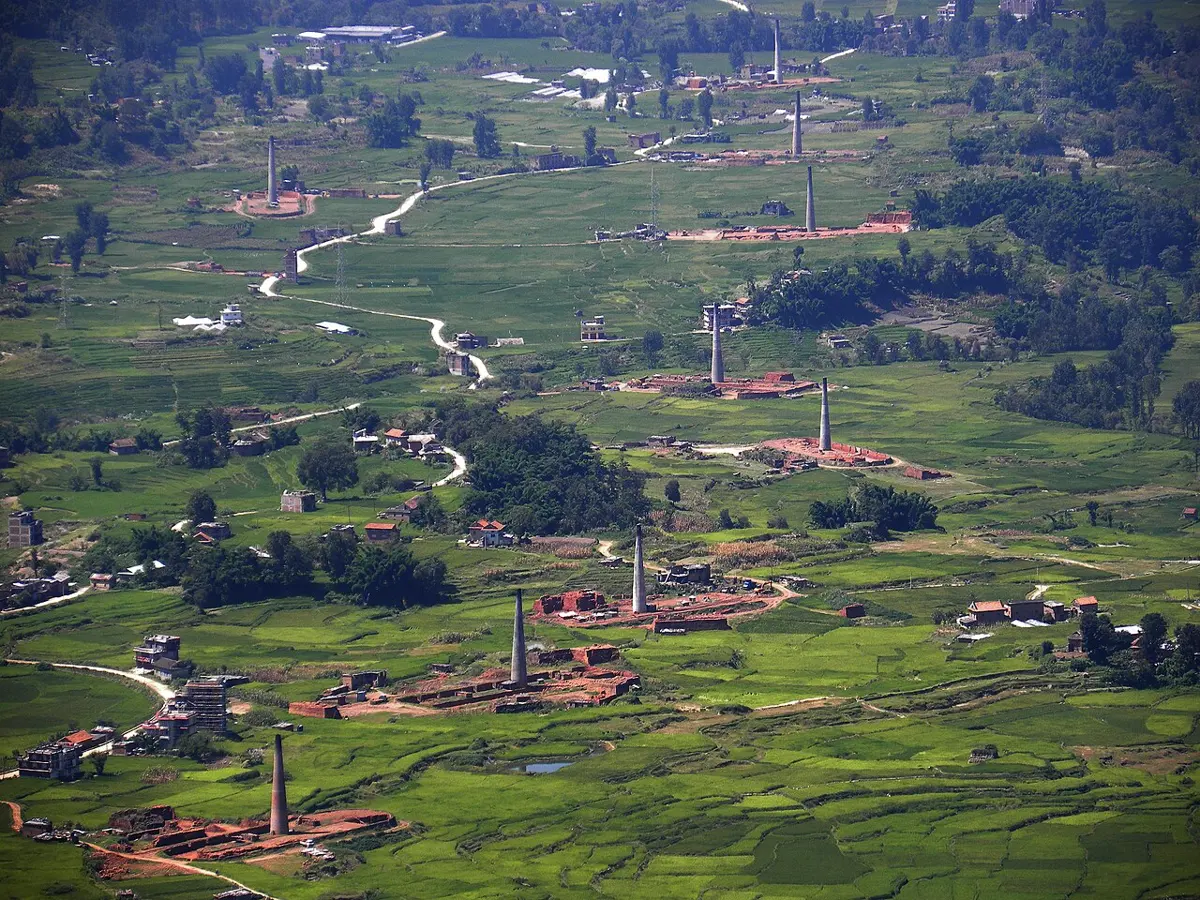
Look out over the fields of Bhaktapur and you see chimneys, tall thin ones of red brick, standing among the rice fields like the masts of ships. A study in 2016 counted about 110 brick kilns in the Kathmandu Valley, and 62 of them were in Bhaktapur district alone. The bricks they bake are dug out of the ground they stand on. Farmers lease their fields to the kilns, and the kilns dig away the soil and fire it.
A day’s journey west, in the hills, the houses are different. Their walls are stone, and their roofs are stone too: gray slabs of stone, split thin and laid in overlapping rows. In the valley the ground gives clay. In the hills it gives a rock that comes apart in sheets.
Here is the whole chapter in short. The ground under every place is rock of one of three kinds. Where it meets the air and rain it slowly breaks, and what it breaks into, with the help of living things and a great deal of time, becomes soil. The rock, and what weather and life have made of it, decide a surprising amount about a place: what it grows, what it builds with, even what its roofs look like.
Three ways to make a rock
Every rock on Earth was made in one of three ways, and geologists sort them into three families by how they were made.
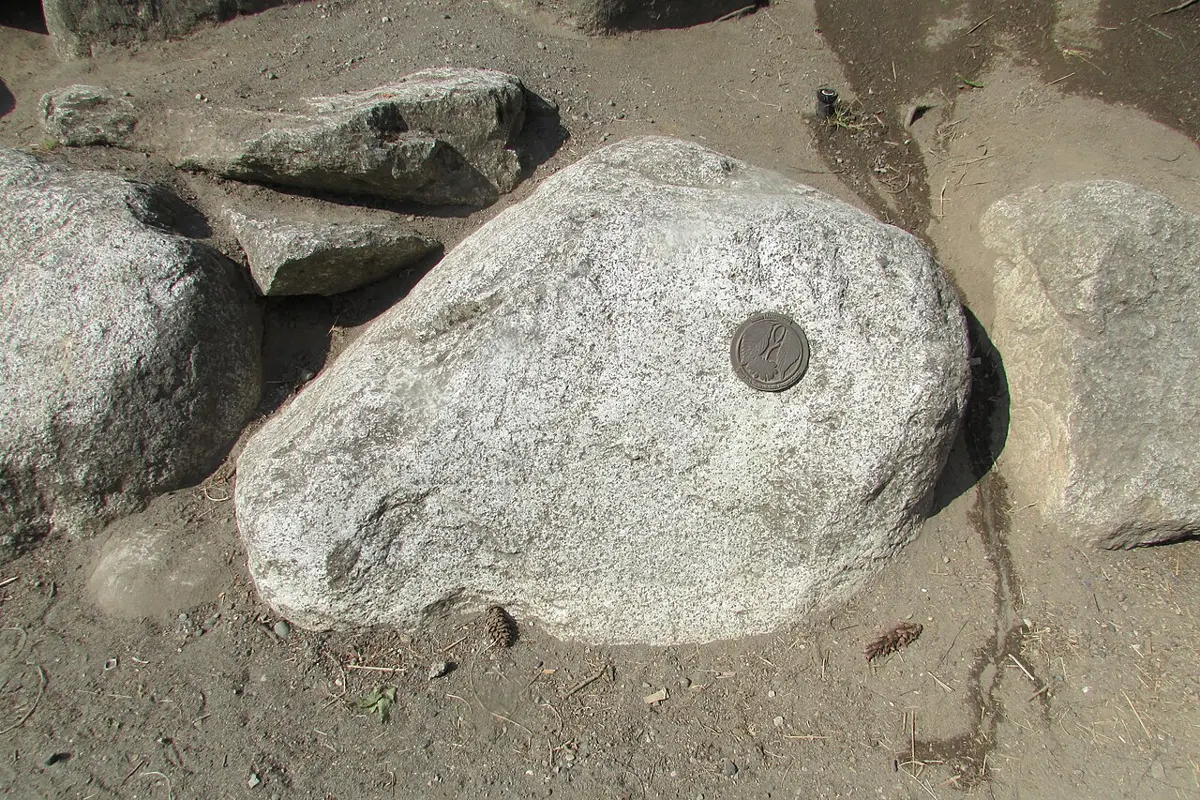
The first family is made from melted rock that cooled. Deep underground, where it cools slowly over thousands of years, the minerals have time to grow into crystals big enough to see. That is granite: a speckled rock of glassy gray quartz, white or pink feldspar, and flakes of black or silvery mica. When melted rock pours out of a volcano instead, it cools in days or hours, the crystals stay tiny, and you get a dark, fine rock like basalt, which floors the oceans. These are the igneous rocks, from the Latin for “fiery”.
The most famous basalt in the world is on the coast of Northern Ireland. At the Giant’s Causeway about 40,000 stone columns stand packed together, most of them with six sides, like a giant’s stepping stones. Legend says a giant built them. In fact, between 50 and 60 million years ago, a thick sheet of lava cooled, and as it cooled it shrank and cracked, the way mud cracks as it dries in the sun.
The second family is made of pieces. Rivers carry sand and mud down to lakes and seas, shells pile up on sea floors, and layer by layer, under the weight of what settles on top, the bits are pressed together and cemented into stone. Sand becomes sandstone, mud becomes shale, shells become limestone, and a mix of pebbles and sand becomes conglomerate, which looks like rough concrete. These are the sedimentary rocks, and they are the ones that keep fossils, like the sea animals in the limestone at the top of Everest. They are only a thin skin on the planet, about 8 percent of the crust by volume, but they cover about three-quarters of the land. The low Chure hills along the south of Nepal are made of them: sandstone, mudstone and conglomerate laid down by rivers.
The third family is rock that has been changed. Bury any rock deep enough, or squeeze it hard enough between colliding plates, and the heat and pressure make its minerals grow again into new ones, without the rock ever melting. Limestone becomes marble, which is why the Taj Mahal, built of marble from Makrana in Rajasthan, is in a sense made of ancient sea floor. Sandstone becomes quartzite, one of the hardest common rocks. And shale, squeezed, becomes slate. Squeeze it more and it becomes phyllite, then schist, then gneiss, each one more changed than the last. These are the metamorphic rocks, the changed ones.
Nepal is full of them, because the Himalaya were made by squeezing. The hills of the middle of the country are largely old sea and river sediments that have been cooked and pressed into slate, phyllite, schist and quartzite, beside limestone and dolomite, and the high range is mostly gneiss, threaded with pale granites.
No rock stays in its family forever. Granite worn to sand can become sandstone, sandstone buried deep can become quartzite, and rock pulled down far enough melts and starts again. This slow round is the rock cycle, and How Does One Rock Become Another? follows a rock around it. This chapter is about the step at the surface, where people live: the breaking.
How rock breaks
Rock seems like the one thing that lasts. It doesn’t. Leave it out in the weather and it breaks, and the breaking where it lies is called weathering. Carrying the pieces away is a different job, erosion, done by rivers, ice, wind and gravity, and those have chapters of their own. Weathering comes first, and it works in three ways.
The first is plain force. Water seeps into cracks, freezes, and the growing ice pries them wider, night after night, which is one reason the slopes below high cliffs in the Himalaya are heaped with loose broken stone. In deserts, rock heated by day and chilled at night swells and shrinks until its surface cracks. And when the rock above a granite is worn away, the granite, freed of the weight, expands and peels off in curved sheets, like the layers of an onion.
The second way is chemistry, and it’s the one that makes soil possible. Rain picks up a little carbon dioxide from the air and from the soil it soaks through, and becomes a very weak acid. That acid dissolves limestone outright, which is how water carved the caves of Pokhara; What Does Water Do to Rock? goes into the caves and the rest. Other minerals it doesn’t dissolve but changes. Iron in a rock rusts, just as an iron gate does, and turns the rock red-brown and crumbly.
The most important change happens to feldspar. Feldspar is the commonest mineral in the Earth’s crust, about 60 percent of it, and slowly, in wet ground, the weak acid turns it into clay. Quartz, on the other hand, hardly changes at all. It just comes loose. So a granite, given enough rain and time, falls apart into two things: grains of quartz, which are sand, and soft flakes of clay. Between them, those two make up most of the mineral part of most soils. The red clay of a hillside and the sand of a riverbank can come out of the same rock.
The third way is life. Roots push into cracks and widen them, and they give off acids of their own. Lichens, the flat crusts of gray, green and orange on old stones, loosen grains from the surface and eat into the minerals underneath.
Which way wins depends on the climate. In the cold and dry of the high mountains, rock is mostly cracked and shattered, so the ground is all sharp broken stone. In warm, wet places, chemistry works faster, and rock can rot deep into clay. That one difference, as the next part shows, makes the world’s soils.
From rock to soil
Broken rock isn’t soil yet. A heap of fresh sand and clay on bare ground is just rock in small pieces. It becomes soil when life moves in: plants grow on it and die, leaves fall and rot, and fungi, bacteria and burrowing animals mix the rotted matter, called humus, down among the grains.
Pick up a handful of good soil and only about half of it is solid. Most of that half is rock grains, and about a tenth of it is humus. The other half is empty space between the grains, and in a healthy soil roughly half of that space holds water and half holds air, which roots and soil animals need to breathe. The grains come in three sizes. Sand is anything from 2 mm down to 0.05 mm, gritty between your fingers. Silt is finer, smooth like flour. Clay is finer still, under 0.002 mm, and sticky when wet. A soil with a balanced mix of the three is called loam, and it is what most farmers would choose: the sand lets water drain and air in, the clay holds water and food for plants, and the silt sits in between.
The animal that does the most mixing is one most people never think about. Charles Darwin’s last book was about earthworms. He kept them in pots indoors and tested them, and found they couldn’t hear: a whistle, a bassoon, shouting and a piano played as loudly as possible had no effect, though when he set the pots on the piano and struck a note, the worms shot into their burrows. He also weighed what they did. In many parts of England, he reckoned, more than ten tons of earth passed through worms on every acre each year and was dropped on the surface, so that the whole top layer of soil went through their bodies every few years. The plow, he wrote, is one of the oldest human inventions, but long before people existed the land was “regularly ploughed, and still continues to be thus ploughed by earth-worms.” The book came out in October 1881 and sold thousands of copies in weeks. He died six months later.
Over time a soil sorts itself into layers, which show wherever a road or a riverbank cuts straight down. At the top there is often a thin layer of fallen leaves. Under it lies the topsoil, dark with humus and full of roots and life: this is the layer that grows crops. Rain soaking down carries clay, iron and other things out of the upper layers and leaves them lower down, in a paler or redder subsoil. Below that is broken pieces of the parent rock the soil came from, and below that the solid rock itself. A cut like this is called a soil profile, and Grade 6 Science, Explained has a drawing of one with its layers named.
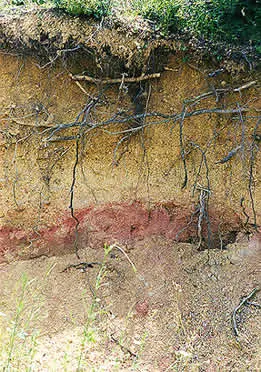
A soil’s color tells you a lot about it. Dark brown or black means plenty of humus. Red means iron that has rusted in soil with plenty of air; yellow, iron in soil with less. Gray or bluish-gray means the soil sits waterlogged, with no air, as under a paddy field. White means salt or lime, usually in a dry land.
The man who first saw soil as something with a story of its own, not just crumbled rock, was the Russian geologist Vasily Dokuchaev. Studying the soils of the Russian plains, the subject of his book Russian Chernozem (1883), he argued that a soil is made by five things working together: the climate, the plants and animals, the rock it starts from, the slope of the land, and time. The same granite becomes a different soil in a wet forest and on a dry grassland, on a steep slope and on a flat one, after a thousand years and after a hundred thousand. Soil scientists still use his five, and he is often called the father of their subject.
Climate matters most for the great soils of the world, and three show it well. On the grasslands of Ukraine, southern Russia, Kazakhstan and the North American prairie lies chernozem, Russian for “black earth”: humus makes up 4 to 16 percent of it, the dark layer can be a meter and a half deep, and it gives some of the biggest harvests on Earth. Under the cold, wet conifer forests of the north lies its opposite, podzol, Russian for “under ash”. Dokuchaev named it in 1875 after the gray, ash-like layer that farmers plowed up just below the surface: acid water from the fallen needles has washed the iron and humus out of it, leaving bleached sand. Podzols are poor for crops. And in the hot, wet tropics, where rain falls hard for months at a time, weathering goes so deep and so long that almost everything that can dissolve has been washed away, leaving soil rich in iron and aluminum, and rusty red.
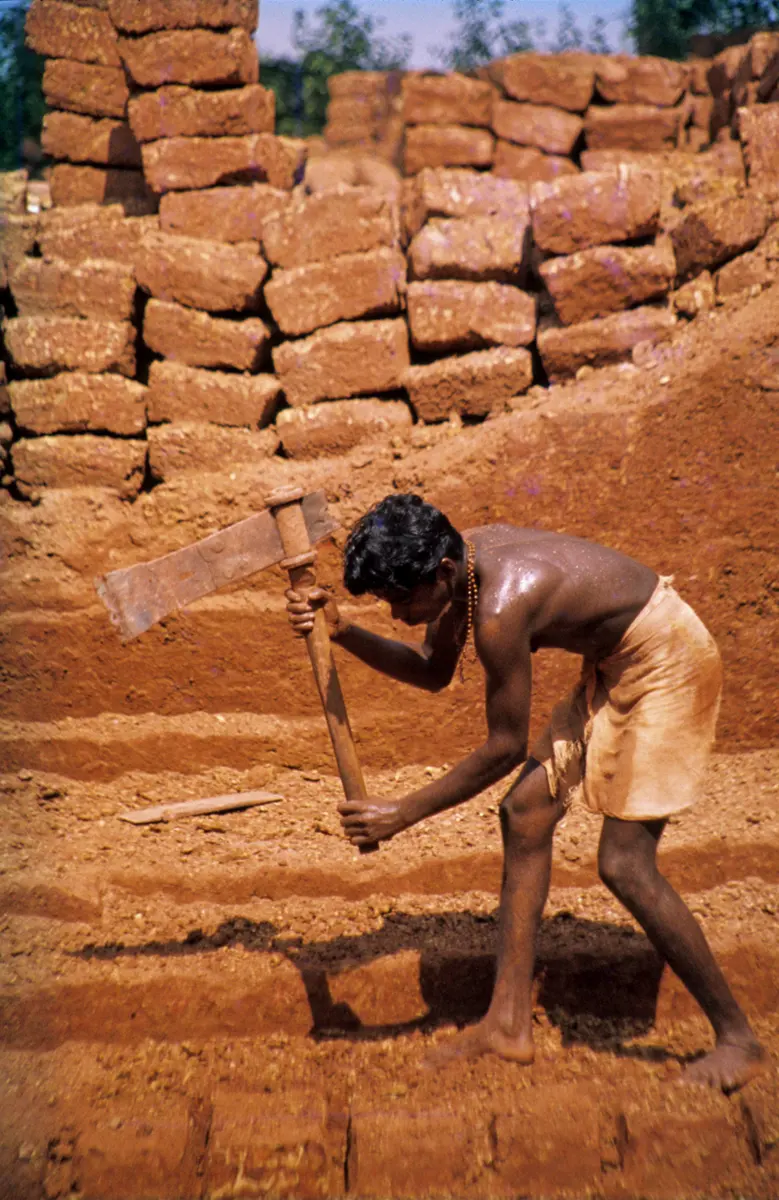
That red tropical soil was named in South India. In 1807 a Scottish surgeon and surveyor, Francis Buchanan, described a red earth at Angadipuram in Kerala that, while it is moist, can be cut with a spade into neat blocks, which harden in the air as they dry, hard enough to build with. He called it laterite, from the Latin later, “a brick”. A monument stands at the spot today. The same Francis Buchanan later wrote An Account of the Kingdom of Nepal (1819).
In dry lands the sun draws water up through the soil instead of rain washing it down, and it leaves its lime and salt near the surface, sometimes as a hard white crust. Where water can’t drain away, soils stay gray and waterlogged whatever the climate. And young soils, on fresh river sand or on rock just bared by a landslide, haven’t had time to become any of these yet.
All of this is slow. Making soil from rock takes centuries, and soil, once lost, doesn’t come back in a human lifetime, which is why the UN’s Food and Agriculture Organization calls it a resource that can’t be renewed. It forms fastest on fresh lava in a warm, wet climate.
What the ground gives
Back to the brick kilns. The Kathmandu Valley’s floor is the bed of an old lake. For hundreds of thousands of years, on and off, a lake filled the valley, and on its still floor the finest clay, washed down from the weathering rocks of the hills around it, settled in layer after layer. Geologists call these beds the Kalimati Formation, from कालीमाटी, “black soil”, because that is what the clay looks like. The lake drained roughly ten thousand years ago, though geologists argue about the date and whether it went in stages, and left a flat floor of fine, soft earth. Why Do People Live Where They Do? tells how the lake filled and emptied, and a later chapter of this book is the valley’s own.
The valley’s farmers knew the black clay well. For generations they dug it up and spread it on their fields, mixed with farm waste, as fertilizer, and the valley’s soil, with its mild climate, gave two or even three crops a year. A report from 1994 says the clay had to be dug from deep below the ground, and that its use was by then banned because of the danger of workers being buried alive. The bricks come from the same fine earth. Brick clay has to be plastic, so that it can be molded without crumbling, and the valley’s brick earth is exactly that, a loam or clay loam that holds its shape. So the old lake bed does two jobs that compete. Every field dug for bricks loses topsoil that took centuries to make, and workers told one reporter that harvests fall by a fifth when land is let to a kiln. With fields in the valley now scarce, some kilns bring their clay in from Kavre.
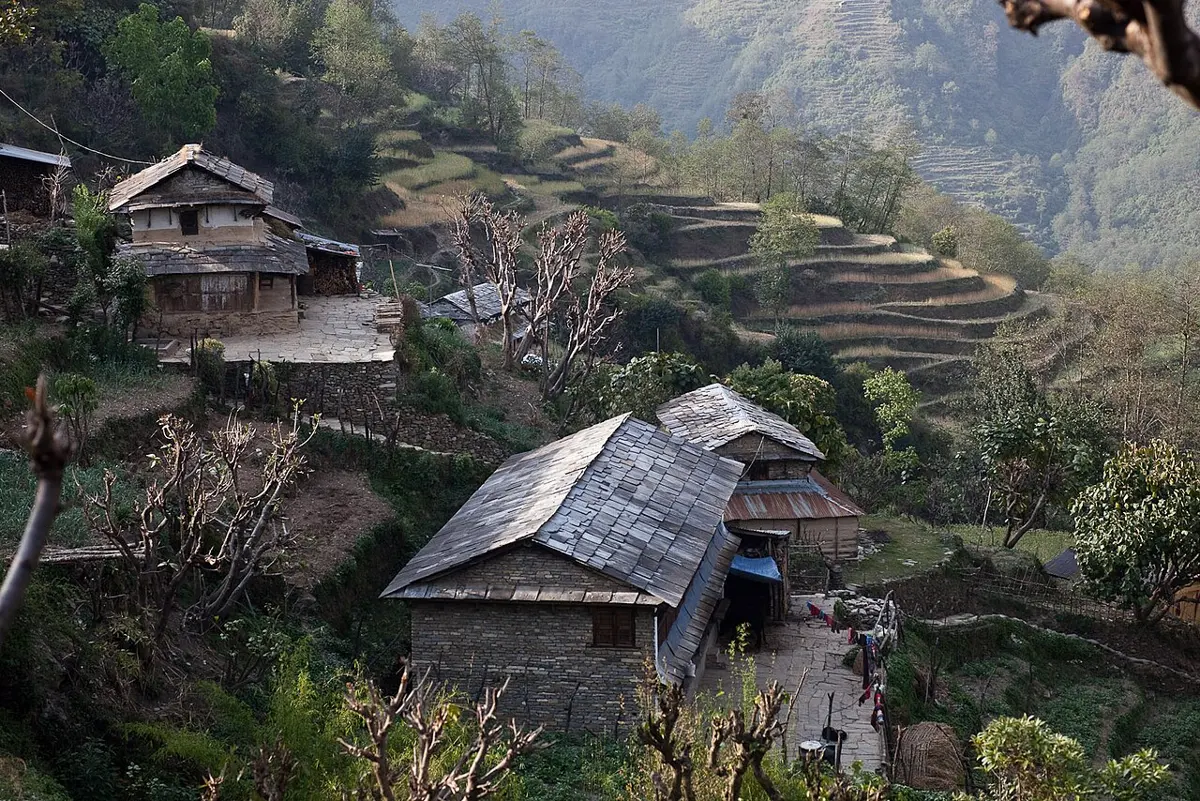
Up in the hills the rock gives roofs. Slate splits into thin, flat, even sheets because of how it was made. When shale is squeezed, its flat flakes of clay turn and line up at right angles to the squeeze, and the rock comes apart along them. Slate hardly soaks up water, under half a percent, so frost can’t break it, and it doesn’t burn. Geologists who studied Nepal’s slate in 2016 wrote that most houses here have been roofed with it since historic times, yet the country has hardly any slate industry; their samples from Tanahun and Baglung passed the usual tests for roofing slate. Bhujung, in Galkot in Baglung, has always been known for its slate and is now called the “stone village”: its tiles are cut for roofs, paving and walls, and are wanted all over Nepal. Bandipur’s main street, on its ridge-top saddle, was paved with slabs of it.
The same rock made northwest Wales one of the world’s great slate regions: in 1882, 92 percent of the United Kingdom’s slate came from there, and in 2021 its quarries and villages became a World Heritage Site. Wales and the hills of Gandaki chose the same roofs for the same reason: the rock under them splits.
So the ground decides more than people notice. Bhaktapur builds in brick because it sits on an old lake’s mud; the hill villages roof in stone because the rock under them splits into sheets. The soil a farmer plows was a mountain once, and is on its way to the sea. The rain, rivers, ice and the pull of gravity that carry it there, and the hillsides that come down with them, are the business of the chapters ahead.
Found a mistake? Please tell us.