
On 7 December 2015, a Chinese pharmacologist named Tu Youyou gave her Nobel lecture at the Karolinska Institute in Stockholm. In it she told of a line from a Chinese book of about 1,600 years before, Ge Hong’s Handbook of Prescriptions for Emergencies. “A handful of Qinghao immersed in two liters of water,” it says, “wring out the juice and drink it all.” Most herbs, she noted, were boiled before a patient drank them. This one was soaked cold. That small difference had given her the idea that saved her team’s search, and the medicine that came out of it is now at the heart of malaria treatment around the world.
It is the story everyone wants to hear about old medicine: the forgotten remedy that turns out to be real. Such stories do happen, and this chapter tells two of them. But the plain answer to how a plant becomes a medicine is that tradition can only offer the first clue. After that come long years of other work: an extract tested on animals, the one chemical that does the job found among hundreds, its structure worked out, its dose learned, fair trials in people, a way to make it at the same strength every time, and a watch for harm long after it is sold. Most clues fail somewhere along that road. The two that made it show what the road demands.
The cold-soaked herb
Tu’s search began as a military secret. By the late 1960s the malaria parasite had learned to survive the old drugs, and Southeast Asia, where the war in Vietnam was being fought, was one of the worst places for it. China’s army had begun a secret search for new drugs in 1964, and in 1967 the country set up a national project to coordinate it. For secrecy it was named after the date it began, 23 May: Project 523. By 1969 its laboratories had screened several thousand chemical compounds, and none had worked.
That year Tu, a researcher at Beijing’s Academy of Traditional Chinese Medicine, was put in charge of a group to search among the old medicines instead. In three months she gathered more than two thousand prescriptions, from plants, animals and minerals, by reading the old medical books and folk recipes and by interviewing experienced practitioners. She narrowed them down to 640 and sent the list round to other research groups. Then the testing began. Through 1969, 1970 and the first half of 1971, her team made extracts of more than a hundred herbs, in water and in alcohol, and tested them on rodents infected with malaria. The results were poor.
One of the herbs was qinghao, sweet wormwood. Its first extracts did little too, and it was when the work stalled that Tu went back to the books and found Ge Hong’s cold-soaked recipe. Perhaps heat was destroying whatever worked. In September 1971 her team tried soaking the plant at a low temperature in ether, a solvent that boils easily, then removed the acidic part of what came out. On 4 October 1971 their sample number 191 cleared the malaria parasites from every infected rodent it was tested on, and in the following winter it did the same for infected monkeys. Making enough of it was hard work: with little equipment, the team soaked the plant in ordinary household water vats, and some of them fell ill from breathing the solvent fumes.
Animals are not people. The animal tests said little about safety, so before any patient took the extract, Tu and members of her team took it themselves. Between August and October 1972, the extract was tried on thirty patients with malaria, twenty-one on the island of Hainan and nine in a Beijing hospital, and every one of them lost their fever and their parasites. Meanwhile the team was hunting for the single substance in the extract that did the work, and in November 1972 they isolated it. It was named qinghaosu, artemisinin. Its formula, C₁₅H₂₂O₅, was worked out the next year, and X-ray studies later showed a ring of atoms holding two oxygens joined together. More work turned it into related drugs that work better. China’s health ministry approved artemisinin as a new drug in 1986.
The same lecture holds a lesson about the plant itself. The old books used the name qinghao for several plants without saying which one, or which part to use. Tu’s team compared six species of the wormwood genus, Artemisia, and found that only one, Artemisia annua, holds a useful amount of artemisinin. A tradition can point to the right family of plants and still be no help in telling one species from another. Nepal’s own wormwood, तितेपाती (titepati), whose leaves many homes burn against mosquitoes, is a cousin in the same genus, not the plant the medicine is made from.

Today the most widely used treatments for malaria pair artemisinin or one of its relatives with a second drug, so that the parasite is hit two ways at once. Even so, in the Greater Mekong region of Southeast Asia, parasites have begun to resist artemisinin, which Tu called a matter of great concern. In 2015 she shared the Nobel Prize in Physiology or Medicine. Her lecture called artemisinin a gift from traditional Chinese medicine to the world. It was also a gift of chemistry, of patient animal tests and of fair trials, and the tradition’s line about cold water was the clue that got it moving again.
The snake root
South Asia has its own story, and it began earlier. सर्पगन्धा (sarpagandhā), Rauvolfia serpentina, is a small shrub of warm forests, Nepal’s Tarai among them, with white flowers and black berries. Its root had been used for hundreds of years, for a long list of unrelated troubles: snakebite, diarrhea, sleeplessness and madness among them. In Patna and Bhagalpur, in Bihar, it was sold as “Pagla-ka-dawa”, the madman’s medicine. Rustom Jal Vakil, a Bombay doctor who searched the old literature, reported that Charaka’s book names it, under the name सर्पगन्धा; that rests on his reading of the old texts.
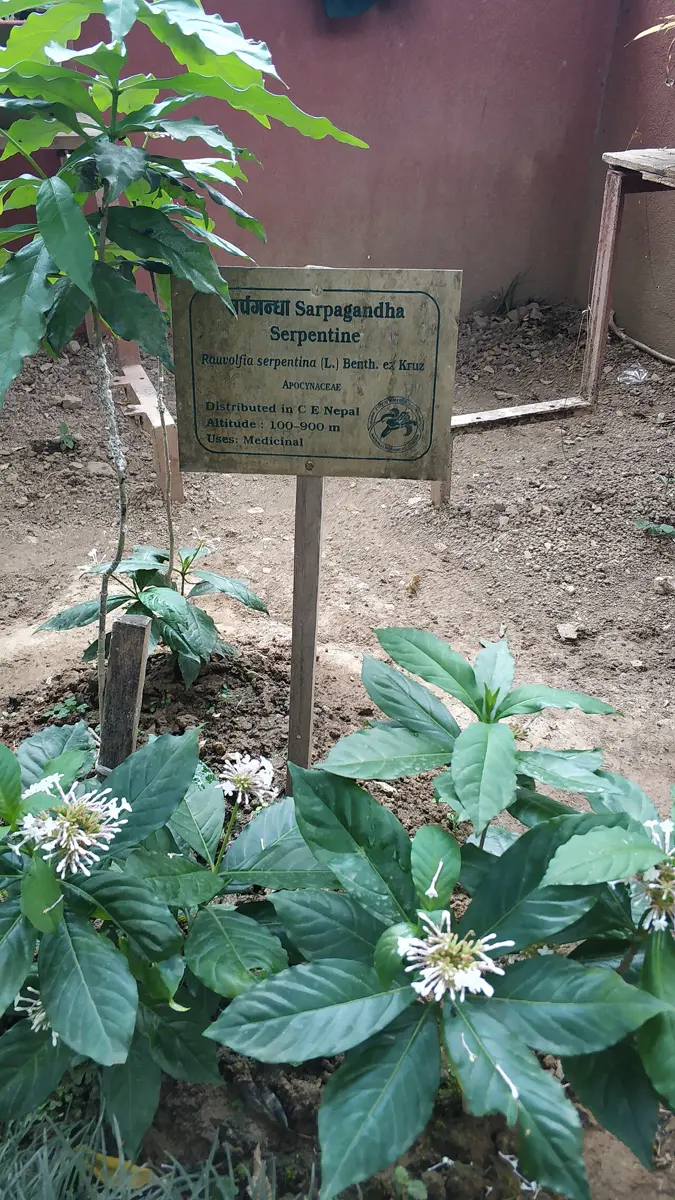
What makes this story unusual is that the plant was turned into a modern medicine first in India, by Indian scientists, a generation before the West noticed. In 1931, two physicians, Sen and Bose, published a paper on it as “a new Indian drug for insanity and hypertension”. The same year two chemists named Siddiqui, S. and R. H., reported chemicals isolated from its root, among them ajmaline. They found something any maker of herbal medicine should know: roots of the same species from Dehradun and from Bihar gave different chemicals. From 1933, R. N. Chopra and his colleagues at the School of Tropical Medicine in Calcutta, in a government project to study India’s own drugs, tested its alkaloids on animals one after another. They found that it calmed and that it lowered blood pressure, though the animal results didn’t always agree with each other.
The doctor who turned this into evidence for patients was Vakil. In 1949 he published a long paper in the British Heart Journal. In it he summed up ten years of his own careful work: after trying the other remedies for high blood pressure in several thousand cases, he wrote, he had found सर्पगन्धा “the most consistently successful”. He had also asked fifty physicians across India, and 46 of them called it the best remedy for high blood pressure they had used. The paper reached doctors in the West who had been ignoring what was published in India. R. W. Wilkins of Boston, who took it up, wrote that Vakil’s paper was the one that “really excited my interest”, and that before his own studies, all the reports on the drug were from India. When the Lasker Foundation gave Vakil one of America’s great medical prizes in 1957, it called the story “a block in medical communication”, in which a lead published in Indian journals since at least 1931 was overlooked while “innumerable fruitless leads were being followed”.
Then the chemists of Ciba, a drug company in Basel, in Switzerland, isolated the alkaloid that mattered most, and in 1952 published the first full report of reserpine, its isolation, chemistry and effects. Sold as a pure tablet of known strength, it became America’s drug for high blood pressure in the 1950s. The psychiatrist Nathan Kline in New York gave it to 411 patients in a mental hospital and found it an effective calming drug, at a time when the main treatments for severe mental illness were electric shocks and insulin. Reserpine, with the newer drug chlorpromazine, helped open the age of medicines for the mind.
Why it was put aside
Reserpine had a dark side. Doctors began reporting depression in people taking it, and in a few cases suicide. How often reserpine really causes depression is still argued: some historians call the link exaggerated, and some doctors even tried it for depression that nothing else helped. As other drugs for blood pressure came, its use fell. A Cochrane review of 2016 found only four trials, with 237 people in all, that properly compared reserpine with a dummy pill. It lowers the top number of blood pressure by about 8 points, roughly what other first drugs do, but those few trials are too small to say much about the right dose or its harms. Some trials kept it as a second drug, added when a first wasn’t enough, but it is no longer a first choice.
Its greatest gift turned out to be to science. In the late 1950s a Swedish pharmacologist, Arvid Carlsson, gave reserpine to rabbits and other animals. It drained the brain of several of its chemical messengers, and the animals stopped moving of their own accord. When he gave them L-dopa, a chemical the brain turns into the messenger dopamine, they moved again, and a chemical that the brain turns into serotonin didn’t help. So dopamine was not just a step on the way to another messenger, as was thought, but a messenger in its own right, and it mattered for movement. That finding led to the understanding that Parkinson’s disease comes from a lack of dopamine in certain parts of the brain, and to L-dopa as its treatment. In 2000 Carlsson shared the Nobel Prize in Physiology or Medicine. A root sold in a Bihar market as the madman’s medicine had opened up the chemistry of the brain.
Not every plant does so well. Turmeric, बेसार, is a spice in every Nepali kitchen and an old remedy in several traditions, and its yellow chemical, curcumin, has been studied many times, for fatty liver, arthritis, high cholesterol and much else. After all those studies, the US National Center for Complementary and Integrative Health says, we still don’t know enough to say whether turmeric or curcumin helps with any health purpose. A team of chemists who went through the research in 2017 counted more than 120 trials of curcumin and its relatives, and found that not one carefully controlled trial, with a dummy pill and neither patients nor doctors knowing who got what, had succeeded. Curcumin, they argued, breaks down quickly, is poorly absorbed, and fools laboratory tests into looking active. Some researchers disagree with them, but so far curcumin has not clearly passed a fair test. And the forms made to be better absorbed into the body may harm the liver. A promising chemical in the laboratory is not yet a medicine. The besar page tells its story.
Safe from the start to the shelf
The road from a forest to a pharmacy has one more stretch: making sure what is sold is what it says. Siddiqui’s two roots, with their different chemicals, show the first problem. The same species grown in a different place, picked at another season, or dried and stored differently can carry more or less of what works, and a remedy made from it may be stronger or weaker from one batch to the next. That is why reserpine’s success came as a pure tablet of known strength, not as a powdered root. A medicine can also hold what it shouldn’t. Chapter 12 tells how researchers in Boston found lead, mercury or arsenic in about one in five Ayurvedic medicines they bought, most often in those made with metals on purpose.
In Nepal, these checks fall to the Department of Drug Administration, which registers Ayurvedic medicines and licenses their makers, as Chapter 12 tells. Its work shows how hard the job is. In December 2022 it ordered two batches of powders made by Nepali companies called back from the market, because they didn’t meet the standards of the Ayurvedic Pharmacopoeia of India, the reference book that sets out what each medicine must contain. But as The Kathmandu Post reported in 2025, the national laboratory tests only about 500 medicines a year, while more than 25,000 brands are sold, and the department’s director general said results can take a year, by which time a bad batch may have been sold and taken. About twenty inspectors cover some 25,000 pharmacies. Those figures are for all medicines, not only Ayurvedic ones. Chapter 29 gathers the other questions of safety.
Nepal’s forests and the world’s medicines
Nepal sits where much of this begins. Its hills and mountains hold hundreds of medicinal plants, most of them gathered wild, often by poor families in the far west, for whom they can be a large part of a year’s income. Yet as a World Bank study of 2018 found, very little of the value stays in the country. In 2016 Nepal exported US$6.48 million worth of medicinal plants, the world’s 49th largest exporter, down from US$10 to 13 million a year between 2011 and 2014. The top exports were यार्सागुम्बा (yarsagumba), रिट्ठो (riṭṭho, soapnut), झ्याउ (jhyāu, lichens), कौलो (kaulo), जटामसी (jaṭāmasī) and कुटकी (kuṭakī). Most of the यार्सागुम्बा went to China, and the rest of the plants went mostly to India: just under two-thirds of the recorded exports by value. A United Nations study of 2012 estimated that only about a tenth of what was gathered was made into oils, medicines or other finished goods inside Nepal. And the Ayurvedic medicines Nepal did export, in 2015, went almost entirely, 99 percent, to India, most likely from Indian firms with factories in Nepal.
So the roots and lichens leave Nepal’s hills raw, and the money that comes from making them into medicines, and from the testing, the trials and the standards that make a medicine trustworthy, is mostly made elsewhere. Plants from the Hills tells how the trade works and the laws that try to keep the plants alive.
A plant becomes a medicine only by a long road. Tradition can offer the first clue, as Ge Hong’s cold-soaked wormwood did for Tu Youyou and the madman’s root did for India’s chemists and doctors. After that, the work is the same for every plant: find the one chemical that works, learn its structure and dose, test it fairly in people, make it to the same strength every time, and keep watching for harm. Artemisinin passed every step and now treats malaria around the world, though the parasite has begun to resist it. Reserpine passed, lowered blood pressure around the world, and then fell from use, but not before it showed scientists how the brain’s chemical messengers work. Curcumin, after many studies, has not yet passed. What turns a plant into a medicine is the testing, not the age of the tradition behind it.
Found a mistake? Please tell us.