
तितेपाती: the bitter weed of every roadside
तितेपाती · Artemisia indica · A scented, bitter weed of the daisy family
It is evening, and you are doing homework by the window. The mosquitoes have found you. In some homes, as in Ramkot on the valley’s western rim, someone then puts a few dried leaves on the embers, and a thick, bitter-smelling smoke drifts through the room. Those leaves are often तितेपाती (titepati), “the bitter leaf”.
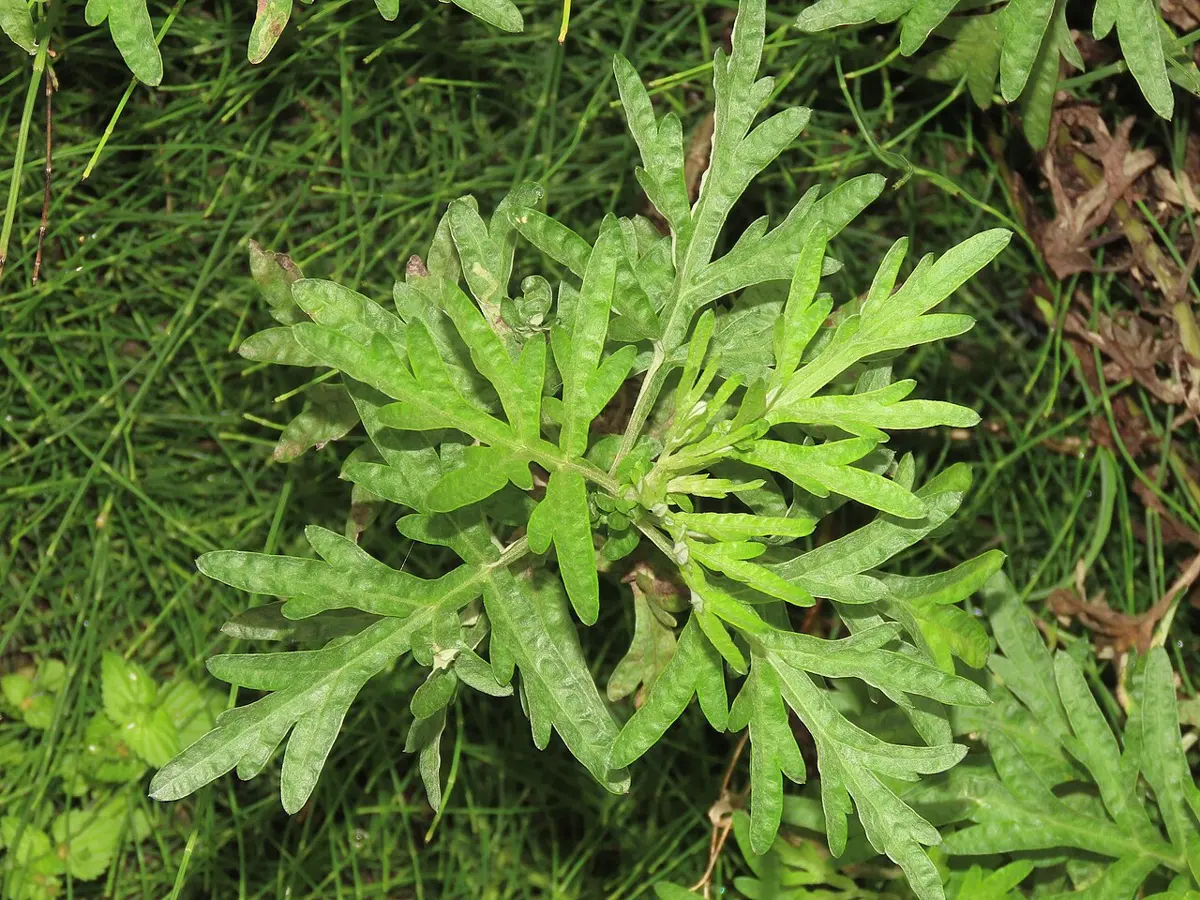
You have walked past this plant a thousand times. It grows beside the path to school, at the edge of the football ground and along every field wall. Crush one leaf between your fingers and you will know it again for life: a sharp, medicine-like smell, and a bitterness you can almost taste just from breathing it.
This page is about that weed: how to know it, which plant the name really means, why its smell is not the same everywhere, what tradition uses it for, and what science has and hasn’t found.
How to know it
तितेपाती is a perennial: it lives for years, sometimes turning a little woody at the base. Look for:
- the stems: upright, about 80 to 150 cm tall, often in a thick patch, because the plant spreads by underground stems (rhizomes);
- the leaves: deeply cut into narrow, pointed lobes, green on top and paler, greyish underneath (see the photo below);
- the flowers: tiny heads crowded on long spikes at the tops of the stems (the dictionary’s word for such a spike is मञ्जरी, manjari);
- the smell: strong and bitter when you crush a leaf.
The Nepali Brihat Shabdakosh describes तितेपाती as a weed with leaves like a chrysanthemum’s (गोदावरी, godavari), flowers in spikes, a strong smell and a bitter taste. It also gives other names: कुर्जो (kurjo), and सिलिपा (silipa) from a Kirat language; a thicket of तितेपाती is a तितेनी (titeni). Newar speakers in Kavrepalanchok call it dusun.
It belongs to the daisy family (Asteraceae), the family of marigolds and chrysanthemums. Its genus, Artemisia, has about 500 species of herbs and shrubs.
One name, several plants
The name तितेपाती is given to more than one Artemisia. This page is about Artemisia indica, the species that studies in Kavrepalanchok and Ramkot (Kathmandu) recorded as तितेपाती. But in Nepal:
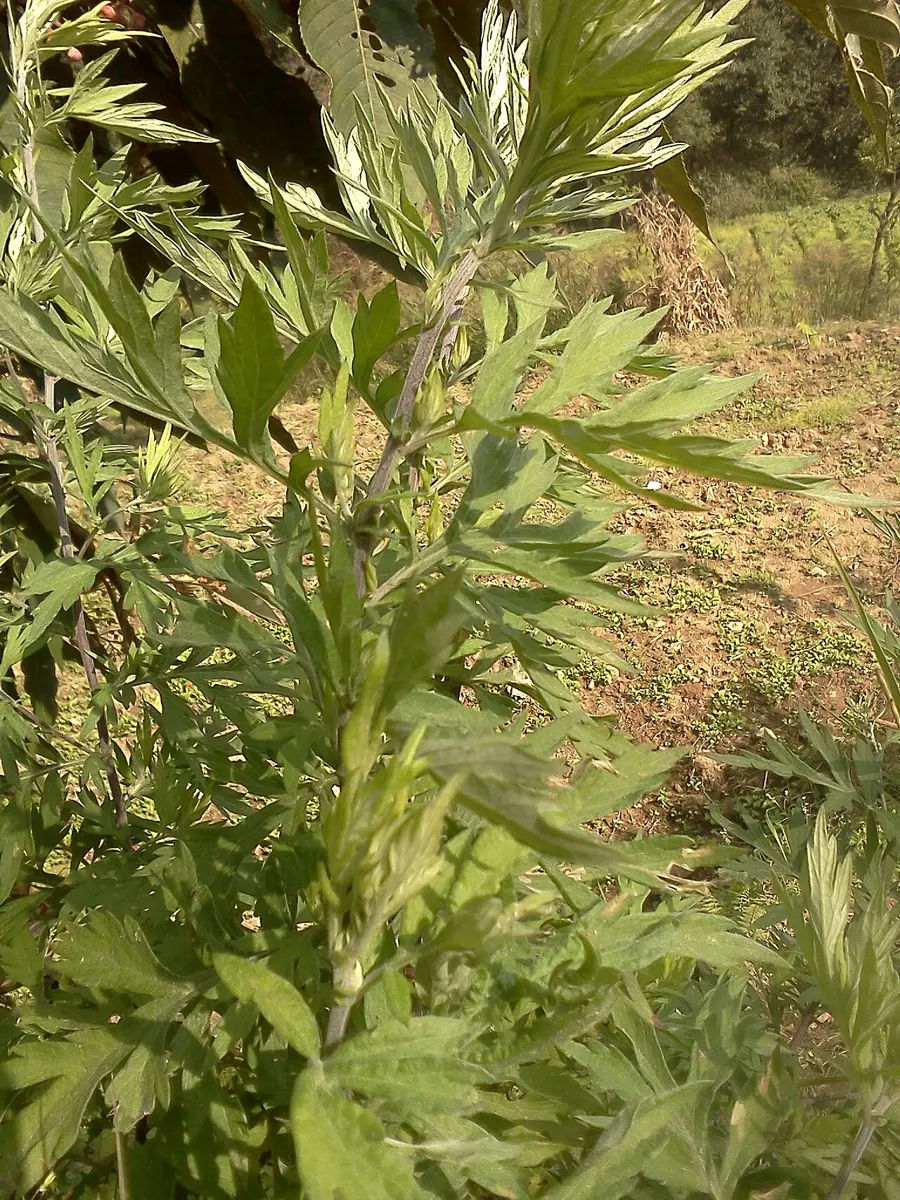
- many papers call titepati Artemisia vulgaris, the common mugwort, and you will see that name on websites, in old books and even under the photo of the Nagarkot plant above;
- Artemisia dubia, a very similar plant: Newar families in Pharping, Kathmandu, call both plants dhuswan and use the juice of either against leeches, and that of A. dubia on cuts and wounds.
Botanists discussing these plants on the eFlora of India forum explain the mix-up this way: in the old Flora of British India, plants from all over the Himalaya were put under A. vulgaris, and they have since been split into several species, A. indica and A. dubia among them. So when a study says “A. vulgaris (titepati)”, it may well mean the plant on this page.
A website says “Titepati (Artemisia vulgaris) grows in every field in Nepal.” What is the most careful way to read it?
Pick an answer to see why.
Where it grows
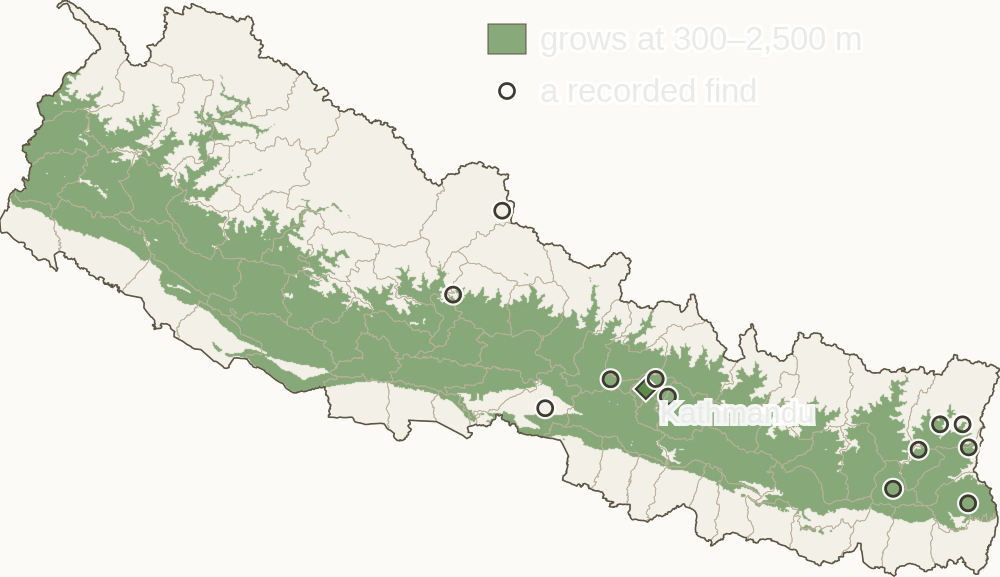
In Nepal, A. indica grows from about 300 to 2,500 meters, on the sides of paths and tracks and at the edges of cleared forest, on ground that people have cleared. Botanists and naturalists have recorded it from Ilam, Dhankuta and Taplejung in the east to the Chitwan plains, Phulchoki and Nagarkot, at the edge of our own Bhaktapur. Beyond Nepal it grows in India, Myanmar, Thailand, Malaysia, China and Japan. It has not been assessed for the IUCN Red List.
Why it smells different in every district
Here is something surprising. If you crushed a तितेपाती leaf in Kavre and another in the far west, they might not smell the same.
A leaf’s smell comes from its essential oil: a mix of dozens of light, scented chemicals that float into the air. When chemists steam the leaves, collect the oil and sort out what is in it, they find very different recipes for the same species:
| Where the A. indica grew | Main scented chemical in its oil |
|---|---|
| Dhulikhel, Kavrepalanchok | ascaridole (about 15%) |
| Dadeldhura | α-thujone |
| Kanchanpur | eucalyptol (also the smell of eucalyptus leaves) |
| Garhwal, India | davanone (about 31%) |
| Kashmir, India | artemisia ketone (about 42%) |
The Dadeldhura and Kanchanpur samples were studied together in one project in 2025: of the 39 and 37 chemicals found in them, only 21 were shared.
A review of Himalayan scented plants sums it up: the oil of A. indica shows wide variation from one place to another. The same happens in its relatives: oils of Chinese mugwort from seven provinces of China held anywhere from about 5% to 22% eucalyptol. That is why “titepati oil” is not one thing, and why a test on one sample says little about another.
Why insects keep away
People have long used the smoke and smell of these plants against biting insects:
- in Ramkot, Kathmandu, villagers told researchers that the leaves and twigs are used as an insecticide and that dried leaves are burned to repel mosquitoes;
- Newar families in Pharping, Kathmandu, use the plant or its juice against leeches;
- in southern China, smoke from burning dried leaves of a close relative, Chinese mugwort (Artemisia argyi), has long been used against mosquitoes.
Scientists tested that Chinese mugwort in 2022. Volunteers put a small amount of its oil on a patch of skin and held it in a cage of hungry Anopheles mosquitoes, the kind that carry malaria. The best oil, which was also the richest in eucalyptol, kept every mosquito off for the first minutes, as well as the standard repellent DEET; after an hour it still kept away about two-thirds of the landings, a little less than DEET.
Traditional uses
तितेपाती is part of daily life and worship in Nepal. Studies of the herbs people use record:
- in worship: the dried plant burned as incense (धूप, dhup), in Kavrepalanchok; and the dictionary’s पन्चुगब (panchugab) is a पञ्चगव्य (panchagavya, a holy mixture of the cow’s milk, curd, ghee, urine and dung) with barley, sesame, तितेपाती and कुश (kush) added;
- against insects: the leaves and twigs as an insecticide, and the smoke against mosquitoes, in Ramkot, Kathmandu; the plant against leeches, among the Newar of Pharping, Kathmandu;
- for wounds: a paste of the leaves put on cuts and wounds, in Rasuwa;
- as a home medicine: in Kavrepalanchok, juice of the plant for food poisoning and cough, and of the crushed young shoots for a sore throat; the plant as one part of a Newar mixture for fever, joint pain and headache.
A guide to useful plants, quoting the book Plants and People of Nepal, records more uses again, from stomach pain to an eyewash. These are the uses of a living tradition, passed down in families and by traditional healers. Whether a use works is a separate question.
What science has tested
- The scent chemicals: well studied. Chemists have measured what is in the oil of तितेपाती from several districts (above), and found it varies a lot.
- Effects on germs: tested only in the laboratory, with mixed results. A 2025 study of Dadeldhura and Kanchanpur samples found that leaf extracts slowed the growth of bacteria in dishes, less than a standard antibiotic did; the Dhulikhel oil showed no effect on microbes at all.
- Keeping mosquitoes off: some evidence, but from a relative: the Chinese mugwort test above, with three volunteers. Smoke from burning तितेपाती itself has not been tested against mosquitoes in a study we could find.
- As a medicine in people: not tested. We found no trial in people for any of its traditional uses.
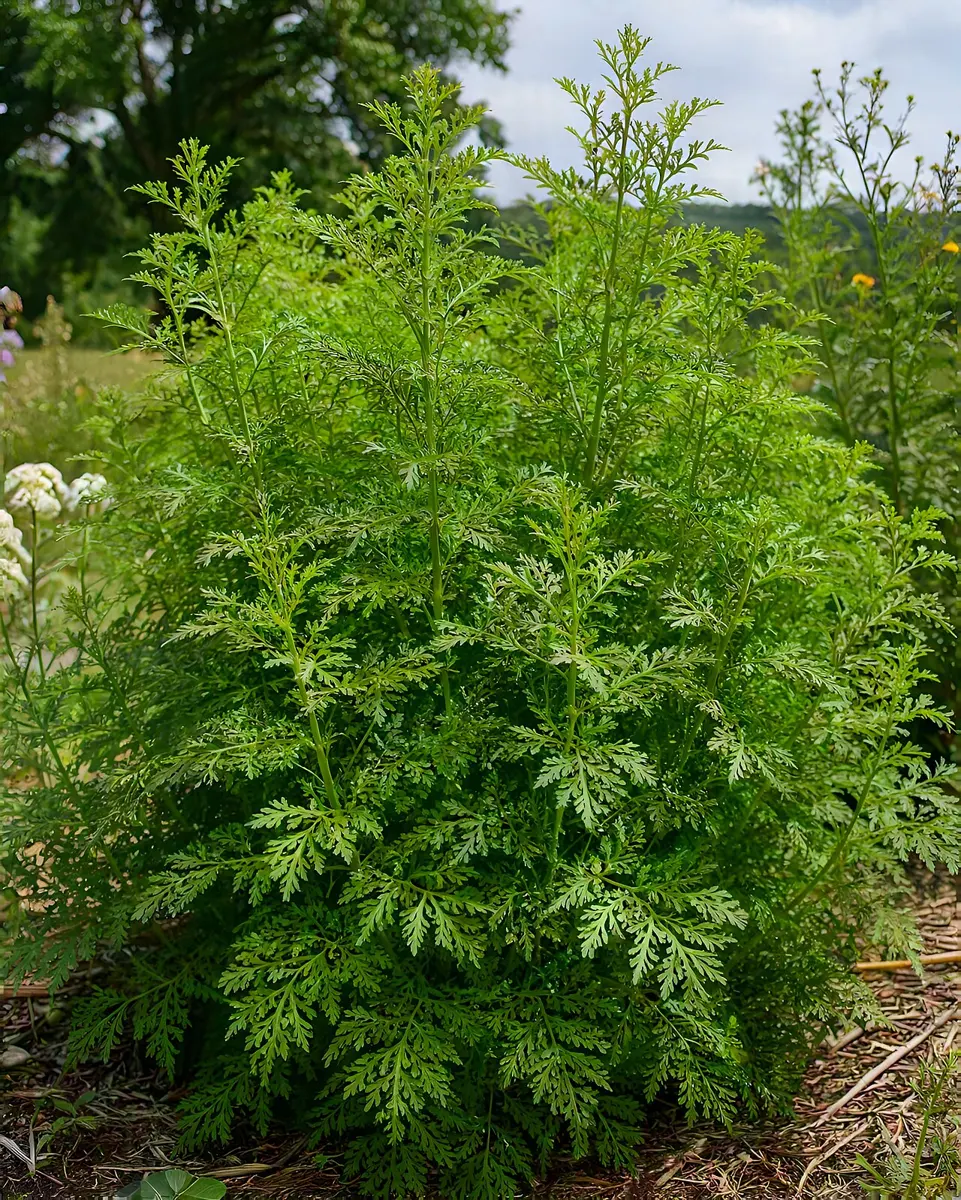
- Malaria: don’t use it. तितेपाती is not the plant artemisinin comes from. And even for sweet wormwood, the World Health Organization says it does not support using Artemisia plant material in any form, such as teas or leaves, to prevent or treat malaria: the amount of medicine in a plant varies, is often too little to kill all the parasites, and could help the parasites become resistant to artemisinin. Real malaria medicines are made from the pure compound, combined with a second drug.
See it at the Science Playground
Our exhibit Medicinal and Culinary Herbs of Nepal shows dried herbs and spices used in Nepal. On your way to the center, look along the field walls and path sides: तितेपाती may well be growing there. More plants in Herbs of Nepal.
Where these facts come from
- Ambu G. et al., Traditional uses of medicinal plants by ethnic people in the Kavrepalanchok District, Central Nepal, Plants, 2020.
- Uprety Y. et al., Indigenous use and bio-efficacy of medicinal plants in the Rasuwa District, Central Nepal, Journal of Ethnobiology and Ethnomedicine, 2010.
- Silwal G.R., Medicinal plants and their traditional uses in Ramkot village, Kathmandu, Nepal, Patan Pragya, 2020.
- Joshi R.K., Satyal P. and Setzer W.N., Himalayan aromatic medicinal plants: a review of their ethnopharmacology, volatile phytochemistry, and biological activities, Medicines, 2016.
- Jaishi D.R. et al., Extraction, chemical composition, antioxidant, and antibacterial activities of essential oil using aerial part of Artemisia indica, Journal of Nepal Chemical Society, 2025.
- Hussain A., The genus Artemisia (Asteraceae): a review on its ethnomedicinal prominence and taxonomy with emphasis on foliar anatomy, morphology, and molecular phylogeny, Proceedings of the Pakistan Academy of Sciences B, 2020.
- Artemisia indica, Useful Tropical Plants (Ken Fern), citing N.P. Manandhar, Plants and People of Nepal (2002), checked November 2026.
- Artemisia indica, eFlora of India (the forum’s notes on the splitting of the old A. vulgaris), checked November 2026.
- Balami N.P., Ethnomedicinal uses of plants among the Newar community of Pharping village of Kathmandu District, Nepal, Tribhuvan University Journal.
- Artemisia indica: occurrence records in Nepal and IUCN Red List category, GBIF, checked November 2026.
- Luo D.-Y. et al., Repellency and insecticidal activity of seven mugwort (Artemisia argyi) essential oils against the malaria vector Anopheles sinensis, Scientific Reports, 2022.
- World Health Organization, The use of non-pharmaceutical forms of Artemisia, 2019.
- European Medicines Agency, Committee on Herbal Medicinal Products, Public statement on the use of herbal medicinal products containing thujone, 2012.
- Tang R. et al., Artemisia allergy research in China, BioMed Research International, 2015.
- तितेपाती, कुर्जो, सिलिपा, तितेनी and पन्चुगब in the Nepali Brihat Shabdakosh (Nepal Academy).