
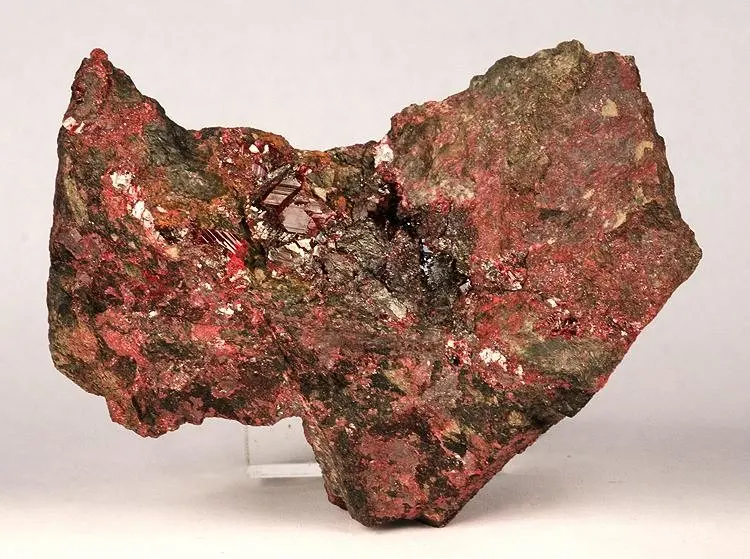
There is a red stone that holds a liquid metal. Cinnabar is heavy and deep crimson, and when it is heated it gives up mercury, which rises as a vapor and settles as bright, rolling drops. Mercury is the only metal that stays liquid at room temperature. It shines like silver and slips away from anything that tries to hold it. People in many lands thought it had powers no other substance had.
In China, cinnabar went into medicines for thousands of years, and some are still made. In Europe, mercury was a common medicine for centuries: the army officer whose nose Joseph Carpue rebuilt in London in 1814, in Chapter 6, had lost it to mercury treatment. And in India, between about the tenth century and the sixteenth, a whole art grew up around this one metal, with its own books, its own laboratories and two great hopes. One was to turn ordinary metals into gold. The other was to turn the human body into something that would not grow old.
This chapter is about that art, what its books claimed, and what laboratories have found in the medicines it left behind. It describes a craft and its history. It isn’t a guide to making or taking anything.
The king of रस
The art is called रसशास्त्र (rasaśāstra), the science of रस (rasa). In Chapter 8 रस meant taste, and so it does, but the big Nepali dictionary, the बृहत् शब्दकोश (Bṛhat Śabdakośa), gives it more than a dozen meanings: juice, the essence of a thing, the nectar that makes the gods immortal, and, among the rest, पारो (pāro), mercury. In this art mercury is the रस above all others. The dictionary has a word for it, रसराज (rasarāj), the king of रस, and gives रसशास्त्र itself as the study of mercury’s many uses.
The art’s traces are all over everyday Nepali. The word for chemistry that every Nepali science student learns, रसायनशास्त्र (rasāyanaśāstra), is built on रसायन (rasāyana), which the dictionary explains as medicine, as the science of melting metals or turning one substance into another, and also as an imagined preparation that could turn copper into gold. Nepal’s national color, the deep red सिम्रिक (simrik), came into Nepali from Persian, and the dictionary gives it as another name for हिङ्गुल (hiṅgula), a mineral with mercury in it: cinnabar.
CDC’s Grade 10 Ayurveda book defines रसशास्त्र as the study of the mercury-like substances, the metals, the gems and the poisons, and how each is used. Its list of medicines from the earth names gold, silver, copper, iron and mercury, and the Grades 11–12 course gives a chapter to mercury and how it is used.
The central idea is simple to say. A raw metal, by itself, was thought unfit to take into the body, and some were known to be poisons. The answer of रसशास्त्र was to change the metal until it was something else. The first stage is शोधन (śodhana), purifying, a word the dictionary also uses for making a metal shine. The second is मारण (māraṇa), killing. The dictionary’s first meaning for मारण is exactly this: turning a metal into भस्म (bhasma). And भस्म, in its first meaning, is a medicine made by burning metals and minerals in Ayurveda’s way. Its everyday meaning is ash.
The words tell you what the makers wanted. A “killed” metal should have lost everything that made it a metal: its shine, its weight, its lumps. The old tests of a finished भस्म are all tests of that. Rubbed between the fingers, the powder should be fine enough to sink into the lines of the fingertip. Sprinkled on water, it should float. It should have no glitter, and it shouldn’t feel gritty between the teeth. Makers still use these checks. What they can’t show is what the powder is made of, or what it does inside a body.
Mercury, which runs and flies off as vapor, was the hardest to tame, and much of रसशास्त्र is about fixing it, often by binding it with sulfur. Many of the finished powders are made with sulfides, compounds of a metal and sulfur: cinnabar, the red ore of mercury, and others of lead and arsenic.
A body that would not die
The oldest books of Ayurveda, Charaka’s and Sushruta’s, use plants for almost everything. Minerals appear, but only a little. Mercury shows up late. Its first use in a tonic in Ayurveda’s medical books is a single recipe in the books of वाग्भट (Vāgbhaṭa), from about the seventh century. Ways of purifying mercury are described by the ninth.
Then came the alchemists’ own books. The oldest one we can read is the रसहृदयतन्त्र (Rasahṛdayatantra), “the heart of mercury”, by a man named Govinda, from about the tenth or eleventh century. It is 506 verses in nineteen chapters, and its shape shows what the art was for. Seventeen chapters describe the substances and the long series of processes each one goes through. The eighteenth uses them to turn base metals into gold or silver. The nineteenth turns to the body.
That last chapter is the heart of the dream. First the body is cleansed, by purging, sweating and vomiting, much like the पञ्चकर्म of Chapter 11. Then comes a slow course of mercury, prepared over and over. At the end, the book says, a person made perfect by mercury leaves misery, aging and death behind, and roams all the worlds through the sky. It goes on to pills with names to match: one for “immortal beauty”, one for “raising the dead”, and a “diamond pill” said to give the strength of nine elephants.
The same chapter also gives a warning. If someone takes mercury without first preparing the body, it says, the mercury will not enter the body properly and will damage every part of it.
The medical books had promised to overcome aging and disease; the alchemists promised to overcome aging and death. Their gold and their elixirs were one idea: a metal could be perfected, and so could a body.
Tradition traces the art to a Buddhist sage named नागार्जुन (Nāgārjuna), famous for his skill with mercury. More than one man bore that name: a great Buddhist philosopher did, and so, an old commentator says, did a reviser of Sushruta’s book. Which of them, if any, was the alchemist isn’t clear. Other alchemical books followed, as late as the sixteenth century, all hard to date.
From the ninth or tenth century, the medical books took in the alchemists’ minerals and some of their methods, in simpler forms. Mercury never became the center of ordinary medicine as it was of alchemy. The handbook of शार्ङ्गधर (Śārṅgadhara), from about the thirteenth or fourteenth century, describes the purifying of metals at length. The first book of Ayurveda known to discuss the poisoning that unprocessed metals cause is the भावप्रकाश (Bhāvaprakāśa) of the sixteenth century. Ayurvedic scholars today say the masters of the art were watchful about harm, since their books describe what goes wrong when a medicine is badly made.
What the laboratories found
That belief was put to the test not by argument but by chemistry.
In 2003 a team of researchers in Boston, in the United States, went round every shop within twenty miles that sold Ayurvedic medicines made in South Asia, bought one of each of the seventy products they found, and measured the metals in them. Fourteen of the seventy, one in five, held lead, mercury or arsenic. If taken as the labels advised, every one of those fourteen would have given a person more of these metals in a day than official safety limits allow.
In 2005 the same team went further, and published the results in 2008. This time they picked Ayurvedic medicines at random from websites, made in India and in the United States, ordered them and tested the 193 that arrived. Again about one in five held lead, mercury or arsenic, and the medicines made in the United States were no cleaner than those made in India. The difference that mattered was the kind of medicine. Of the medicines made in the रसशास्त्र way, with metals added on purpose, four in ten contained detectable metals, against fewer than two in ten of the rest. Where mercury was found in them, its typical amount was about 2 percent of the medicine’s weight. Every product that held any of the three metals went over at least one standard for a safe daily amount, and three-quarters of them came from makers who said they followed good manufacturing practice or tested for metals. The metals in the other medicines could have come from contamination, of the herbs by the soil or during making.
India’s own laboratories have found the same pattern. In 2017 doctors in Chandigarh bought forty-three common Ayurvedic medicines from licensed shops and tested forty-two of them. Mercury was above the limit set for herbal medicines by the United Nations’ food and health agencies in twenty-nine.
The metals turn up in people’s blood too. America’s disease agency reported twelve adults with lead poisoning linked to Ayurvedic medicines in five states between 2000 and 2003. In New York in 2011 and 2012, doctors found lead poisoning in six pregnant women who had taken medicines from India, the worst of them 2.4 percent lead. In 2011 a community of Ayurveda followers in one American state was offered blood tests after a single case came to light, and forty-six of the 115 people tested had raised lead. Nepal has its own cases. In 2019 the police had medicines on sale in Nepal tested and found too much arsenic, and in 2024 doctors in Kathmandu told reporters they were seeing more patients poisoned by metals from supplements and some Ayurvedic medicines, and that the country lacked antidotes for many of them.
Lead and mercury are not small worries. The World Health Organization says there is no known safe level of lead in the blood, and that lead can permanently harm a child’s developing brain. It counts mercury among the ten chemicals of greatest concern to public health.
Is “purified” safe?
The art’s defenders have an answer, and it deserves a fair hearing. They say that a भस्म made by a skilled maker, by the old methods, is not the raw metal at all, and that the poisonings come from careless factory work, from contamination, or from medicines taken without a trained practitioner. Some of that is plainly true: contamination is real, and medicines bought online are not a skilled practitioner’s own.
The chemistry shows what a भस्म really is. The metal doesn’t vanish; it changes form. When researchers analyzed a gold भस्म, it was more than 98 percent gold. A lead भस्म, analyzed in a laboratory in India, turned out to be lead sulfide. Whether that change makes a metal safe is a real scientific question, not a silly one. Mercury bound with sulfur, as in cinnabar, dissolves very poorly, and little of it is absorbed from the gut. It takes about a thousand times as much of it to harm the nerves as of the mercury compound found in fish. But what is absorbed collects in the kidneys, long use can damage them, and heating it releases mercury vapor.
Studies in rats by researchers within the tradition have reported little sign of harm from mercury भस्म at the doses used in practice, though one of them also found changes in the rats’ genes linked to possible toxic effects. What is missing is the test that counts most: careful studies in people. The Boston team wrote that they knew of no rigorous evidence that preparations made with lead, mercury or arsenic are harmless, and that the poisoning cases point the other way. An editor of one of Ayurveda’s own research journals called in 2013 for well-planned studies of these medicines, in large numbers of people, to establish their safety. So “purified” is a claim to be tested, not a guarantee. On the evidence so far, nobody can say that a metal medicine is safe because it was made in the old way.
Who checks
India’s Ayurvedic medicines fall under its Drugs and Cosmetics Act of 1940, under which their makers are licensed, and a medicine containing a substance on the law’s list of poisons must carry a warning on the label to take it only under medical supervision. Since 2006, India has required its purely herbal Ayurvedic medicines sold abroad to carry a label or a laboratory certificate saying their heavy metals are within permitted limits. The rule names only the purely herbal ones, not those made with metals on purpose, and in 2008 the Boston researchers noted that India set no limits on metals in medicines sold at home. In the United States, the Food and Drug Administration warns that the metals in some Ayurvedic products make them potentially harmful. In Nepal, the Department of Drug Administration registers Ayurvedic medicines and licenses their makers, and since 2018 it has required factories, and the makers of imported medicines, to meet the World Health Organization’s standards for making herbal medicines well.
The world’s mercury treaty, the Minamata Convention, signed in 2013, has phased out mercury in batteries, lamps, thermometers and much else. It leaves out, by name, products used in traditional or religious practices.
Chapter 29 gathers the other questions of safety: herbs that change how medicines work, liver injury, products sold with promises. One rule runs through all of them. Nobody should stop a doctor’s treatment for any of this.
So the plain picture is this. रसशास्त्र, the art of mercury, grew up in India in the centuries after the old medical books, with two great hopes: to make gold, and to free the body from age and death. Its makers developed long processes to purify metals and “kill” them into ash, and believed that a metal made this way became a medicine. Laboratories have since found lead, mercury and arsenic in many Ayurvedic medicines, most often in those made with metals on purpose, at amounts above safety limits, and doctors have seen people poisoned by them. Whether the old processing makes a metal safe has never been shown in careful studies of people. Until it is, “purified” is a claim to test, not a promise.
Found a mistake? Please tell us.