
बेसार: the yellow that turns red
बेसार · Curcuma longa · A leafy herb of the ginger family, Zingiberaceae
Spill a little dal on a white school shirt and you know what बेसार (besar, turmeric) does: a bright yellow stain that hardly washes out. Now try something strange. Rub a bar of soap on that yellow stain. The yellow may turn reddish brown.
This page is about the plant behind the yellow: how to know it, how it is grown, why its color changes, what science has and hasn’t found, and one real danger in some turmeric powder.
How to know it
बेसार is a leafy herb that comes up each year from underground stems. It grows to about 1 to 1.5 meters (three to five feet). Look for:
- the leaves: large and pointed, rising from the ground;
- the flowers: a spike of funnel-shaped yellow flowers among pale green or white leaf-like scales, from June to August;
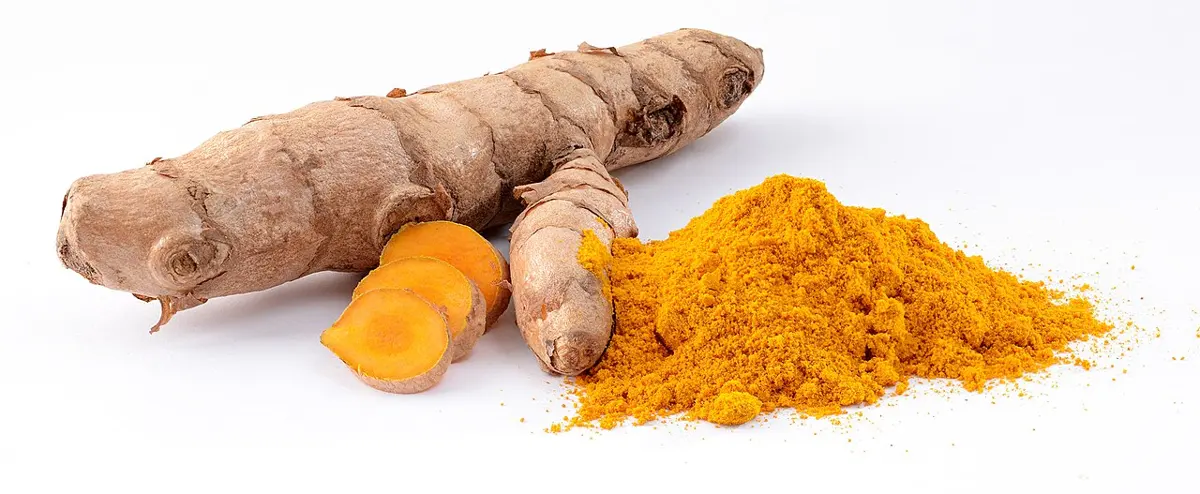
- the part we use: the rhizome, an underground stem, knobbly and brown outside and bright orange-yellow inside.
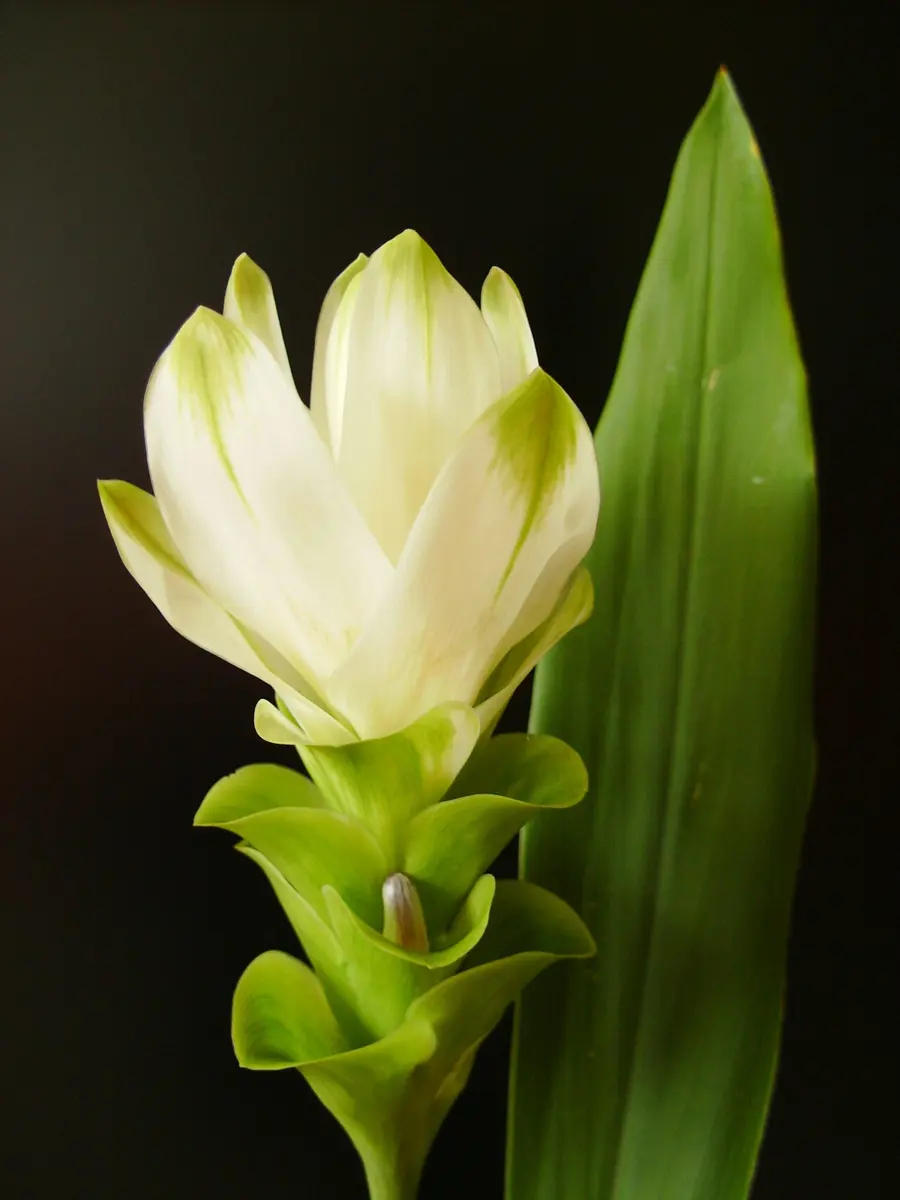
Which plant is “besar”?
This page is about Curcuma longa, the kitchen turmeric, in the ginger family (Zingiberaceae), the same family as अदुवा (ginger). The living plant and its fresh rhizome are also called हलेदो (haledo); dried and ground, they become बेसार. In the Terai, Tharu speakers call it hardi.
Other Curcuma plants grow in Nepal too. One, कचुर (kachur, Curcuma aromatica), is traded from the far west as a medicine of its own; don’t mix the two up.
Where it grows
Turmeric is a farm crop, grown from pieces of rhizome. Ethnobotanists describe it as a plant of tropical to subtropical places, cultivated on dry, open land. The Ministry of Agriculture’s figures for 2078/79 (2021/22) give 10,847 hectares of turmeric in Nepal, producing 111,074 tonnes.
Why the yellow turns red
The yellow in turmeric comes from a group of chemicals called curcuminoids, mostly curcumin. They make up only 3 to 5% of turmeric, but that is enough to color a whole pot of dal.
Curcumin behaves in two ways that explain the shirt.
- It hardly dissolves in water. In acid or neutral water, curcumin is “practically insoluble”, but it dissolves in oils and fats. That is one reason a turmeric stain doesn’t simply wash out with water.
- It changes color with pH. In acid and neutral solutions (pH 1 to 7) curcumin is yellow. Above about pH 7.5, in an alkaline solution, it turns red. Soap water is alkaline (a base), so turmeric turns red-brown in it. Curcumin is a natural pH indicator, like the litmus in a science lab.
There is a catch: in alkaline solutions curcumin also breaks down, into other chemicals, some of them brownish yellow. So a stain left in soap water doesn’t stay bright red.
Traditional uses
In Nepal turmeric is first a spice, in dal, tarkari and pickles. Studies of plant use record it, in tradition:
- in Bhardew, Lalitpur: rhizome powder with cumin, ginger and तुलसी (tulasi, holy basil) for colds, sore throat, tonsillitis and stomach trouble, and a paste put on wounds, burns and sprains;
- in the Terai of Rupandehi: rhizome powder in lukewarm water for jaundice and liver trouble;
- across Bagmati Province: for appetite and body ache.
What science has tested
The United States’ National Center for Complementary and Integrative Health (NCCIH) sums them up (2025):
- Overall: “We don’t know enough” to say whether turmeric or curcumin helps for any health purpose.
- Osteoarthritis (worn joints, such as stiff, painful knees): some evidence: the first reviews of turmeric or curcumin taken by mouth are positive, but better studies are needed.
- Fatty liver: early research suggests it might improve some measures; not enough to say.
- Most other uses: not enough evidence to say.
Makers now also sell curcumin pills made so that the body absorbs more of it (mixing it with piperine, from black pepper, is one way). These bring a new problem.
Lead in turmeric powder
In 2020 and 2021, researchers from Stanford University bought 356 samples of turmeric, roots and powder, in markets in 23 cities in India, Pakistan, Sri Lanka and Nepal, including 17 samples from Kathmandu, and measured the lead in them.
- In 14% of all the samples, the lead was high enough to measure (over 2 micrograms in a gram of turmeric); 7% had more than India’s legal limit of 10 micrograms per gram.
- In Kathmandu, 2 of the 17 samples were over that limit, the higher one at 82 micrograms per gram.
- In the samples with the most lead, the lead came with chromium, about one atom for one, as in lead chromate, an industrial yellow pigment. That points to the pigment being added to the turmeric, not to lead from soil or dust. One Kathmandu sample was of this kind, and its turmeric had been grown in Nepal.
- The worst samples were polished roots and loose powder. Nepal had no legal limit for lead in turmeric when the study was published (2024).
There is no safe amount of lead to eat. In young children it holds back the growing brain, and the harm can’t be undone.
Turmeric in trade
Nepal grows a lot of turmeric but sells little of it abroad. In 2078/79 (2021/22), the Ministry of Agriculture’s trade tables show:
| Exported | Imported | |
|---|---|---|
| Turmeric powder | 4.8 tonnes | 222 tonnes |
| Fresh turmeric | none listed | 286 tonnes |
| Other turmeric | 5.8 tonnes | 2,340 tonnes |
See it at the Science Playground
Our exhibit Medicinal and Culinary Herbs of Nepal shows dried herbs and spices used in Nepal. Try the turmeric test with an adult at home. More plants in Herbs of Nepal.
Where these facts come from
- Ministry of Agriculture and Livestock Development, Statistical Information on Nepalese Agriculture 2078/79 (2021/22), Government of Nepal, 2023 (Tables 1.4, 2.13, 11.1 and 11.2).
- Gautam R.S., Shrestha S.J. and Shrestha I., Some ethnomedicinal plants of Bhardew village, Lalitpur district, Nepal, Patan Prospective Journal, 2022.
- Singh A.G., Kumar A. and Tewari D.D., An ethnobotanical survey of medicinal plants used in Terai forest of western Nepal, Journal of Ethnobiology and Ethnomedicine, 2012.
- Subedi D. et al., Current outlook of ethnobotany in Bagmati Province, central Nepal, Journal of Plant Resources (Department of Plant Resources), 2025.
- Kunwar R.M. et al., Medicinal plants, traditional medicine, markets and management in far-west Nepal, Journal of Ethnobiology and Ethnomedicine, 2013.
- Joint FAO/WHO Expert Committee on Food Additives, Curcumin: chemical and technical assessment, FAO, 2004.
- National Center for Complementary and Integrative Health, Turmeric, updated April 2025.
- Forsyth J.E. et al., Evidence of turmeric adulteration with lead chromate across South Asia, Science of the Total Environment, 2024.
- Science Playground, Grade 8 Science, Explained: Scientific learning (indicators) and Grade 10 Optional Science, Explained: Chemical reaction (turmeric paper).
- बेसार and हलेदो in the Nepali Brihat Shabdakosh (Nepal Academy).