
Nearly two thousand years ago, the Roman writer Pliny the Elder described the chief ingredient of Rome’s perfumes. It came from India, he wrote, from a plant with a short, heavy, black root that smelled musty and tasted sharp. A pound of the best cost a hundred silver denarii, and dealers cheated by mixing in a look-alike plant, gum, and even antimony, a heavy gray mineral, to make it weigh more. The Romans called it nard. Seventeen centuries later, in Bengal, the English scholar William Jones set out to learn what this Indian nard really was. He asked physicians, his pandit and a Brahmin, compared the dried drug with old Persian and Arabic descriptions, and argued that it was the root Indians call जटामसी (jaṭāmasī), brought down by merchants from the mountains to the north. Pliny’s English translators of 1855 added a note that it grows in the far mountains of “Bootan and Nepaul”. Nobody can prove a plant from a description, but if Jones was right, Nepal’s hills have been selling it for a very long time.
They certainly sell it now. On one estimate, more than four-fifths of all the जटामसी harvested anywhere comes from Nepal. And it is one plant among many. About three hundred kinds of medicinal and scented plants, fungi and lichens are gathered and sold in and from Nepal, tens of thousands of tonnes a year, worth tens of millions of dollars. More than three hundred thousand households earn money from them. Most of these are wild: dug, cut or picked on slopes that belong to no one family.
This chapter is about that trade, told from the side of the plants: who gathers them, where they go, what they fetch, what happens to a plant when too many people want it, and what the law does about it. It follows three of the best known, चिराइतो, जटामसी and यार्सागुम्बा. Each has a page of its own in Herbs of Nepal, with how to know it and what it is used for; here they are goods on the move.
From a slope to a truck
The trade works much the same way for almost every plant. A family from a high village goes up in the plant’s season and gathers it, dries it, and sells it to a trader. Village traders sell to bigger ones in the towns, Nepalgunj in the west, Birtamod in the east, and from there it goes by truck, mostly to India. Some goes north to China and Tibet. A decade ago, about seven thousand tonnes of herbs a year went out to India through Nepalgunj alone.
The law runs alongside. A district’s forest office is meant to draw up a five-year plan for which herbs may be gathered there and how much, and to have it approved. Then it gives gatherers a permit and charges a royalty, a fee to the government for each kilogram taken from its forests. When the plans in Karnali ran out in 2023 and weren’t renewed in time, gathering in the national forests stopped from that July, and the families who gather lost that income. Much of the trade is never written down, though, so nobody knows for certain how much of most plants is taken, and careful studies of how fast a plant grows back exist for only about one in a hundred of the species in trade.
चिराइतो and जटामसी
Start low, with the plant most Nepali kitchens know. चिराइतो (cirāito) is the bitter herb whose dried stems are boiled for a fever. It grows wild on hillsides from about 1,700 to 3,500 meters and has long been one of the main herbs on the market, traded from 61 of the 75 districts Nepal had in 2008.
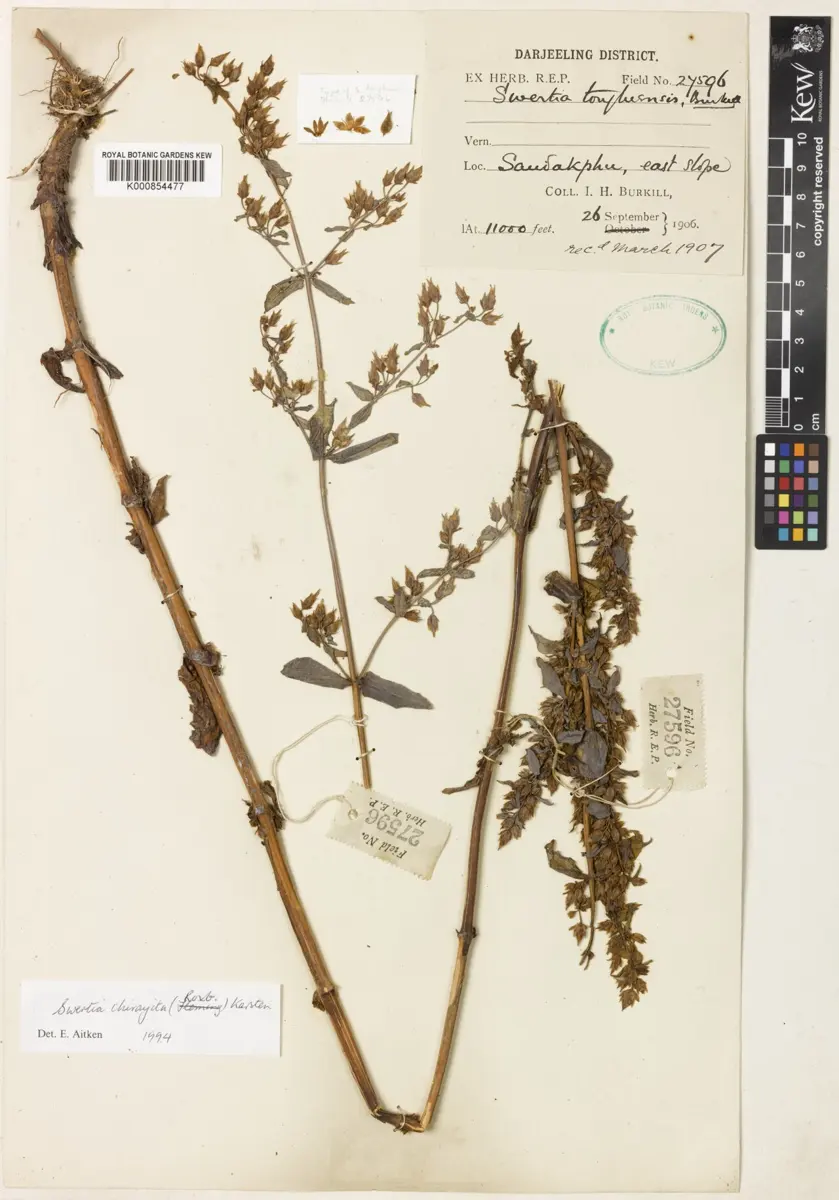
Its road shows how a trade follows the market. For a long time its biggest buyer was Tibet, and yak caravans carried it over the pass at Olangchung Gola in Taplejung. In 2020 China closed the border against Covid, and the yaks stopped. The traders turned south to India, and by January 2023 the price in Taplejung had reached a record 1,000 rupees a kilogram. So much had been taken from the wild that farmers there had begun to plant it, and a planted crop is ready about 28 months later. Growing it on farms, and gathering the wild plants with care, are what its researchers suggest to keep it common.
Higher up, above about 3,000 meters, grows जटामसी, the scented root with matted hair, जटा (jaṭā), in its name. Over 70 percent of what Nepal sells goes to India. Some 15,000 households dig it, and it brings them a fifth to a quarter of their year’s income. So much has been dug that the IUCN, the International Union for Conservation of Nature, which keeps the world’s Red List of threatened species, rates it critically endangered.
That has brought it more law than any other plant in this chapter. It is listed under CITES, the world treaty on trade in endangered species, in its Appendix II, so it may cross a border only with permits. Nepal adds its own rule: the raw root may not be exported, only what is made from it, such as its oil. Then, in 2017, came a law that went further than anyone meant. An act to enforce CITES more strictly banned, by accident, the export of every Appendix II species altogether, and legal trade in जटामसी stopped for three years, until the law was amended and Nepal set a yearly limit.
Is the harvest too big? Researchers from Copenhagen and Nepal tried to answer properly, measuring how much of the root grows back on a slope each year and setting it beside how much traders said they had bought. Their answer wasn’t a plain yes or no. By 2014 the harvest had grown a great deal and moved west, and on the most cautious reckoning Nepal was digging more than its slopes could replace. But it depends on how the root is dug. If a harvester puts the top of each plant back in the ground with about two centimeters of root still attached, the root grows back fastest of all, and on that reckoning the slopes could give more than they do now. The forest department’s advice to harvesters runs the same way: dig only plants three or four years old, leave a fifth to a quarter of them, and come back to a slope only once in four years.
यार्सागुम्बा, the gold rush
Higher still, at 3,500 meters and more, in the high meadows of Dolpa and the other mountain districts of the west, is the strangest thing in the trade. यार्सागुम्बा (yārsāgumbā) isn’t a plant at all. It is a fungus that grows inside the caterpillar of a moth underground, kills it, and sends up a thin dark stalk from its head. Grade 10 Science explains how it forms; what matters here is that a piece weighs well under a gram, and that people will pay more than its weight in gold for it.
It wasn’t always so. Gathering यार्सागुम्बा was against the law in Nepal until 2001. Demand had begun to soar in China in the 1990s. One story, which Nepal’s central bank repeats, says it began in 1993, when Chinese athletes set world records and people believed they had been taking it as a tonic. Whatever the cause, the price of a kilogram went from about 5 dollars in 1992 to 1,400 in 2002, and by 2012 a kilogram was worth around 100,000 dollars in China and Hong Kong. In Beijing in 2017 the best pieces sold for more than three times the price of gold. Once it had become a living for mountain families, Nepal made gathering legal and charged a royalty, first 20,000 rupees a kilogram, later 30,000.
Every May and June, tens of thousands of people now climb to the high pastures and camp there for weeks, combing the slopes for a tiny tip of fungus poking through the soil. For a collecting family, a central bank study found, these few weeks bring in more than half the year’s income. At the pasture they are paid by the piece, up to about 1,000 rupees each. Traders buy the pieces up, wholesalers come later and buy by weight, and a kilogram, between 2,500 and 4,000 pieces, sold in Dolpa for something like 22 to 32 lakh rupees in recent years. The money has built houses in Surkhet and Nepalgunj.
The work is dangerous. Collectors cross cliffs and risk lightning and altitude sickness, and in three years 39 of them died in Karnali Province alone. With so much money in so small a thing, there are quarrels over who may dig where. In one, in June 2009 in Manang, seven farmers who had come to dig were beaten to death by villagers of Nar; a court convicted nineteen people for it two years later. A national park and the local governments now charge entry fees, from a few hundred rupees for local people to a few thousand for outsiders.
And there is less to find each year. The IUCN listed यार्सागुम्बा as vulnerable in 2019, estimating that it had declined by at least 30 percent in fifteen years because of overharvesting. A team at Stanford University, unable to trust the official figures because so much of the trade is hidden, asked the collectors themselves, through dozens of earlier studies and their own interviews. Collectors in China, Bhutan, Nepal and India all said the harvest was falling, from damaged pastures, from a warmer climate, and above all from too much digging. The team’s models showed that the fungus does best in the cold, close to ground that stays frozen all year, and in parts of its range the winters have warmed by as much as 4°C since 1979. Collectors in Nepal say the same in their own words: it is now hardly ever found below 4,000 meters. Karnali Province sent out 1,214 kilograms in 2018–19, and only 214 in a recent year.
What does it do for the people who eat it? It is sold as a tonic, and traditional medicine has used it for many illnesses, from kidney disease to aging. The claims most often made for it, that it works as an aphrodisiac and a cure for impotence, have no scientific evidence behind them. For kidney disease, a review of 22 trials in China, with about 1,700 patients, found some signs that it might help beside ordinary treatment, but the trials were too poor for anyone to draw a firm conclusion.
What keeps a plant alive
Put the three side by side and the pattern is plain. A wild plant grows on land no one family owns, so a root one family leaves in the ground can be dug by the next. When the price rises, more people go up, and they dig sooner. The plant pays for it, and in the end so do the families whose income goes with it.
The tools for keeping a plant alive are all somewhere in this chapter. Permits, royalties and five-year plans decide how much may be taken from a forest. Export rules, like the ban on sending जटामसी out as a raw root, control what crosses the border. A few plants the law protects outright. Since a government notice at the end of 2001, पाँचऔँले (pā̃caũle), a medicinal orchid of the high mountains, may not be gathered, carried, sold or exported at all. And the list of forest goods Nepal bans from export, as it reported to the World Trade Organization in 2022, is short: पाँचऔँले, जटामसी, the bark of walnut trees from national forests, unprocessed शिलाजित (śilājit), a tarry ooze from mountain rocks, and logs of sal and two other timber trees. The IUCN’s Red List isn’t a law at all, only scientists’ judgment of how threatened a species is; CITES is the treaty that sets rules at the border. Farming, as with चिराइतो, takes the pressure off the wild plants, and careful digging lets a slope recover.
None of it works without knowing how much grows and how much is taken, and that is where the trade is weakest. Even the collectors can be wrong. In one study in western Nepal, gatherers said the plants were becoming scarce; the researchers found that each family was bringing home less because more families were gathering, while the village’s total harvest stayed the same. A plant in trouble and a crowded market can look alike from the slope.
So Nepal’s hills send some three hundred kinds of wild plants, fungi and lichens out into the world, mostly to India, and hundreds of thousands of households live partly on them. चिराइतो has moved from Tibet’s market to India’s and is beginning to be farmed. जटामसी is critically endangered, protected by a world treaty and Nepal’s own export rule, and could recover if it is dug with care. यार्सागुम्बा, legal since 2001, is the richest and most dangerous harvest of all, and it is getting scarce, both because it is overdug and because the mountains are warming. The laws are there; what is still missing, for most plants, is knowing how much each slope can give.
Found a mistake? Please tell us.