
On a hill at Sanchi, in the middle of India, stands a great stupa, and around it stand four stone gateways, one on each side. Each gateway is two square posts with three long crossbeams laid across the top, their ends rolled up into spirals, and every surface is crowded with carving: elephants, lions, horsemen, trees, women leaning out from the posts as if they were holding onto a branch, and whole cities with their walls and gates and people looking out of the windows. On one of the posts of the southern gateway a short line of writing records who carved one of its panels: the ivory carvers of Vidisha, the town at the foot of the hill.
That line explains a great deal. These gateways were made about two thousand years ago by people who were used to working in other materials. The archaeologist who cleared and repaired the site in the 1910s said the gateways were the work of carpenters rather than stonemasons: they are put together as a wooden gate would be, in a stone that was never meant to be joined that way. Ivory carvers did the fine work. A carver in Bhaktapur, used to wood, would understand the job at once.
This chapter follows the art of South Asia over about fifteen hundred years, from the third century BCE to the twelfth century CE. Three things happen in it. Sculptors learned to make a figure of the Buddha, and then of the Hindu gods, that people could stand in front of and worship. Builders learned to make a temple, first by cutting it out of a hillside and then by building it of stone. And these ideas left India. They went north into the Kathmandu Valley, and east across the sea, to Java and Cambodia, where they grew into Borobudur and Angkor Wat.
Polished stone
The oldest great stone carving of India was made for one man, Ashoka, the Maurya emperor who ruled most of the subcontinent in the third century BCE and turned to Buddhism. His story belongs to World History. What concerns us here are his pillars. He had tall stone columns set up across his empire, many of them carved with his messages to his people, and topped with animals.
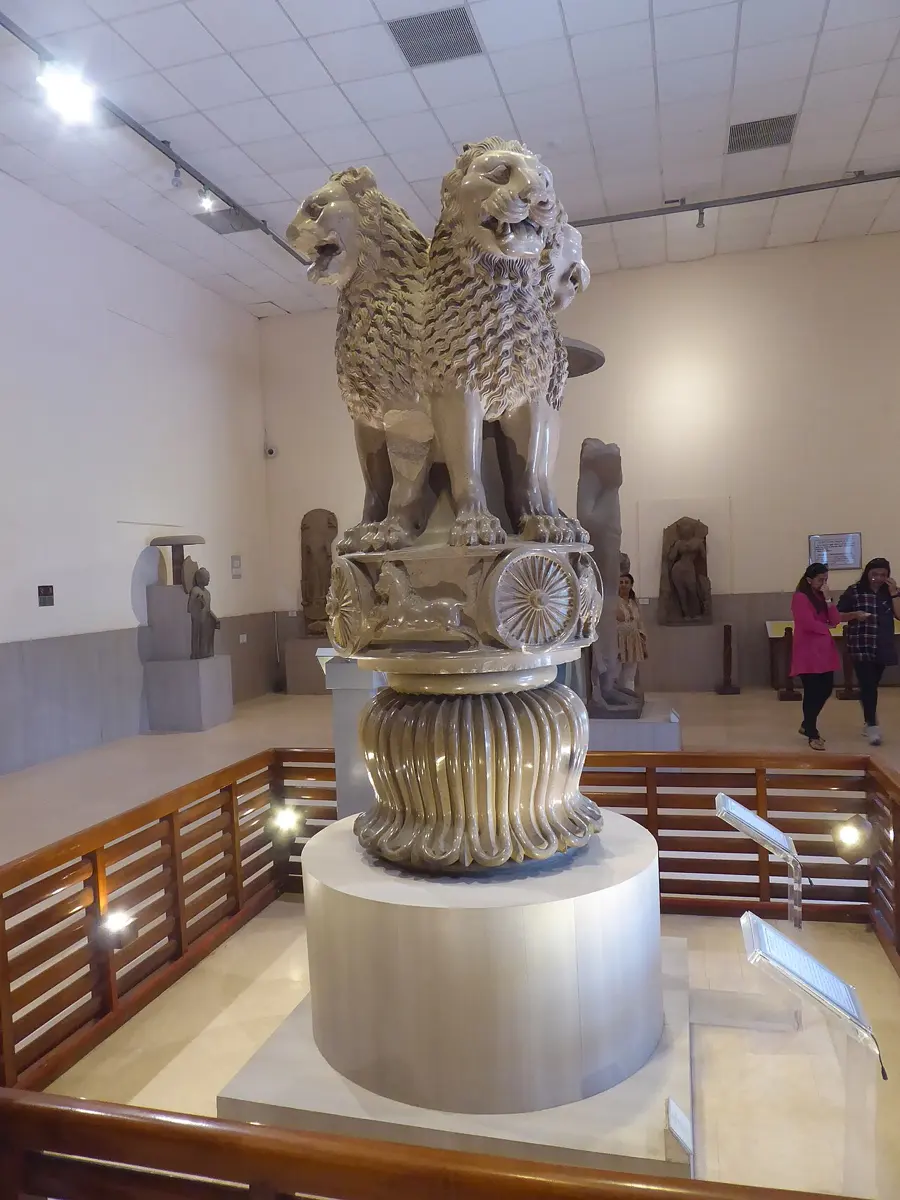
The finest of the tops, or capitals, is the one from Sarnath, near Varanasi, where the Buddha gave his first sermon. It was dug up in the winter of 1904–05 by an engineer of the Public Works Department named F. O. Oertel, who had been building a road. Four lions sit back to back on a round drum, which stands on a bell shaped like an upturned lotus. Around the drum run four wheels and, between them, an elephant, a bull, a running horse and a lion. The lions once had precious stones for eyes, held in place by tiny iron pins, and one of the pins is still in an eyelid. On their heads stood a stone wheel with, it seems, thirty-two spokes. It was all carved from one block of fine sandstone from the quarries at Chunar, near Varanasi.
And it shines. The pillars were polished all over, top to bottom, until the stone gleams almost like metal, a finish that is the mark of Ashoka’s time. The pillar at Sanchi was cut from a block of the same Chunar stone more than twelve meters long and weighing about forty tons. It was carried hundreds of kilometers, probably on rafts up the rivers in the rainy season, and then hauled up the hill. Nepal has one of these pillars too, at Lumbini, where Ashoka wrote that he had come to worship because the Buddha was born there, as Nepal’s History tells.
Where the style came from is an old argument. The archaeologists of a hundred years ago saw Persia in everything: the bell-shaped capital, the smooth shaft and the polish all have older examples in the palaces of the Persian kings, and they thought a sculptor trained in the Greek and Persian West must have made the lions. Others have looked for the roots in India itself. Nobody doubts that Ashoka’s India knew Persia and the Greeks well; how much its sculptors took from them is the question.
A Buddha who isn’t there
Sanchi’s gateways went up about two hundred years after Ashoka, in the first century BCE. Their inscriptions are a list of givers: monks, nuns, townspeople, guilds, and on the southern gateway a man named Ananda, foreman of the craftsmen of a king called Satakarni. They give the names of the people who paid. Not one of them says what the carvings show.

They show the life of the Buddha, and the stories of his earlier lives, the जातक (jātaka), in which he is born as a monkey, an elephant or a prince and does some great kindness. But look for the Buddha himself, and you won’t find him. Where he should be there is an empty throne, a pair of footprints, a tree, a wheel, or a stupa. A horse leaves the palace with an umbrella held over an empty saddle: that is the young prince leaving home. A wheel is his first sermon. For a long time scholars took this to mean that early Buddhists thought the Buddha shouldn’t be shown in human form, and the idea is still in most books. Not everyone agrees. One historian has argued that many of these scenes show ordinary people worshipping at the holy places of Buddhism, and not moments from the Buddha’s life at all. Either way, at Sanchi the stories are full of people, and he isn’t among them.
The same kind of art grew in the south, at Amaravati, on the Krishna river, where a great stupa was faced with slabs of grayish white limestone carved with the Buddha’s stories, and ringed by a railing about four meters high. It had a sadder history. In 1797 a British surveyor, Colin Mackenzie, found that a local landowner was digging the mound for its bricks to build his new town. Many of the carved slabs went into lime kilns, burned to make mortar, and many of those that survived were shipped to Madras and to London.
A face for the Buddha
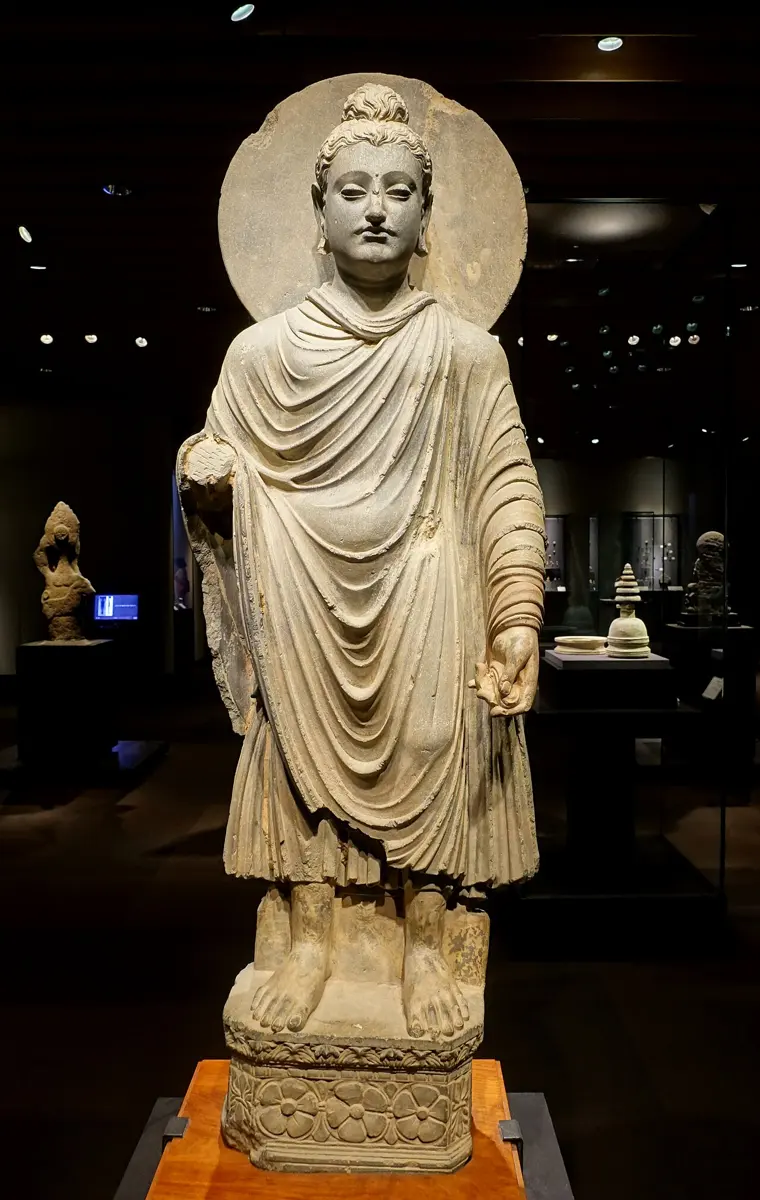
About the first century CE, at much the same time and in two different places, the Buddha appears. Both were in the empire of the Kushans, who ruled from what is now Afghanistan across the north of India.
In Gandhara, around Peshawar, sculptors worked in a gray stone called schist, and their Buddha looks as if he has walked out of the Roman world: wavy hair, a calm face, and a heavy monk’s robe falling in deep folds like a Roman toga. Gandhara had been ruled by Greek kings, and it sat on the roads that carried trade between India and the Mediterranean. Its sculptors put the two worlds together.

At Mathura, south of Delhi, the sculptors carved in a speckled red sandstone, and their Buddha is different: a fuller face, a robe so thin that the body shows through it, one shoulder bare, hair in a coiled knot on top, and long earlobes stretched by the heavy earrings he wore when he was a prince. He sits under his tree with a disk behind his head like the sun. Sculptors at Mathura had long made big, solid figures of local spirits of nature and fertility, and their Buddha seems to grow out of that habit.
Which came first, the Gandhara Buddha or the Mathura one, is one of the oldest arguments in the study of Indian art. A French scholar early in the twentieth century said the Greeks of Gandhara had shown India how; a scholar from Sri Lanka answered in 1927 that everything the Buddha image needed was already in Indian art, and that Mathura could have made it on its own. Nobody has found a dated piece that settles it. The Kathmandu Valley’s oldest dated statue, the life-size figure from Maligaon in Stone, was carved in these same centuries, by Kushan sculptors or by people they trained, in the pale sandstone they favored.
Then, under the Gupta kings in the 400s and 500s, the two styles melted into one. The first sculpture Oertel found when he began digging at Sarnath was a Gupta Buddha. The Buddha sits cross-legged with his hands together at his chest in the gesture of teaching, and on his pedestal are a wheel and two deer, for the first sermon he gave in the deer park there. His robe is so fine that it is hardly there at all: it clings to the body like wet cloth, and only its hem shows. The face looks down, still and calm. This is the style the Licchavi sculptors of the Valley learned from.
The same sculptors carved the Hindu gods. At Deogarh, on the Betwa river, stands a small stone temple from the Gupta years, about fifteen hundred years old: one square room for an image of Vishnu, set on a terrace laid out as a grid of nine squares, with the temple in the middle one. It is called the दशावतार (Daśāvatāra) temple, after Vishnu’s ten forms, and it is one of the oldest stone temples of India still standing. Its doorway is guarded by the river goddesses Ganga, standing on her crocodile, and Yamuna, on her tortoise. On each of the other three walls is one big carved panel: Vishnu asleep on the coils of the serpent Ananta, Vishnu arriving on Garuda to save an elephant caught by a serpent king, and two sages sitting in meditation. In the Valley in those same years Licchavi kings were setting up their own Vishnus, like the striding Vishnu of 467 in Signs and Stories.
Into the rock
There is another way to make a building in India, older than building with stone: you cut it out of a cliff. A hall cut into a hillside needs no roof beams and never falls down, and Buddhist monks had been cutting halls and monasteries into the cliffs of western India for centuries.
At Ajanta, in a horseshoe bend of a river valley, there are about thirty of them. A few are about two thousand years old. Most of the rest were cut in a single burst in the second half of the 400s, while an emperor named Harishena ruled the region, and the work stopped soon after he died. One scholar who spent his life there dates nearly all of it to a few years between 462 and 480. Then the site was left, and the jungle and the bats moved in.
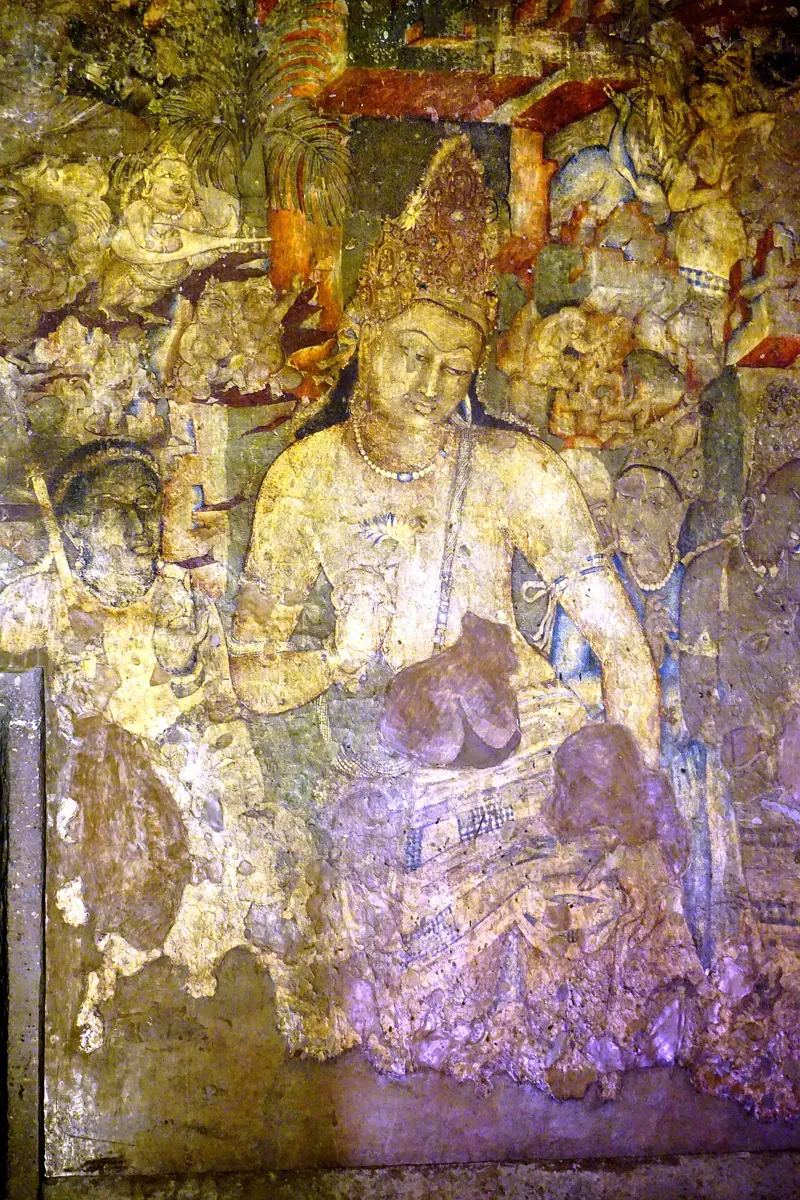
What makes Ajanta famous is its paint. The walls, ceilings, pillars and even the statues were plastered and painted, every inch, with the Buddha’s stories, palaces, crowds, animals and flowers. The painters first pressed a layer of clay mixed with cow dung and crushed rock into the rough walls, with rice husk added on the ceilings, then spread a skin of fine white plaster over it, about as thick as an eggshell, and painted on that. When a government chemist examined some flakes for a book published in 1896, he found the reds were all iron reds, the green a powdered mineral containing iron, and the blue an ultramarine. In Cave 1 a bodhisattva, a being who could become a Buddha but stays to help others, holds a lotus and bends his head.
The paintings have had a hard time since they were found again. On 28 April 1819 a British cavalry officer named John Smith came to the caves; he and his friends are said to have been hunting tigers nearby when a local boy led them there. In Cave 10 he scratched his name and the date across the chest of a painted Buddha on a pillar, standing on about a meter and a half of rubble that had built up on the floor, which is why it is so high up today. From the 1840s an army officer named Gill spent years copying the paintings, many of them at large size. Most of his copies were sent to London and hung in the Crystal Palace, a great exhibition hall, where in 1866 they burned.

Three centuries later, at Ellora, in the same part of India, the cutters did something on a scale no one had tried. Instead of going into the cliff from the front, they cut down into it from the top. They dug three great trenches into the hillside, two running back into it and one joining their ends, more than thirty meters deep, and left the block in the middle standing. Then they carved that block, from the top down, into a complete temple for Shiva, with its halls, its towers, a shrine for his bull Nandi, two stone flagpoles nearly fifteen meters tall, elephants, and bridges of rock between the parts. The temple is called कैलास, after Shiva’s mountain home. Its courtyard is about 84 meters long and 47 wide, and the temple rises about 30 meters, as high as a ten-story building. It was all once plastered and painted, which is why people nearby called it the Painted Palace.
Nothing could be added afterward. Every pillar, every elephant’s trunk, every finger of every god is what was left when the rest of the hill was taken away, so the plan had to be complete in someone’s head before the first block came out. Who gave the order is argued. The work began under the राष्ट्रकूट (Rāṣṭrakūṭa) kings around the middle of the 700s, and an old inscription says that the king Krishna I set himself up at a hill called Elapura, where there was a famous temple of Shiva. Many scholars think that was this one. Others give it to the king before him, his nephew Dantidurga.
Across the sea
By the time Ellora was cut, Indian ideas had crossed the sea. In the islands and kingdoms of Southeast Asia, kings took up Buddhism and Hinduism, Sanskrit and the Indian way of making a holy building, and made something of their own with them.
In central Java, early in the 800s, Buddhists built Borobudur. It is a stepped hill of stone, nine terraces, each smaller than the one below. You climb it, walking round each terrace in turn, and the climb is the point. On the five lower terraces, galleries with walls on both sides carry about fifteen hundred carved panels, most of them the Buddha’s life and the journeys of seekers after truth, so that walking round them is reading a book in stone. At the very bottom, on a base now buried under stone, a row of panels shows the world of cause and effect, people doing good and harm and being reborn in heaven or hell, with scenes of graveyards and punishment. At the top the walls stop. Three round terraces open to the sky carry rings of small bell-shaped stupas of stone latticework, each with a seated Buddha inside, half-seen through the holes, around one great stupa at the summit.

In Cambodia, the kings of the Khmer built their capital at Angkor, and in the first half of the 1100s a king named Suryavarman II built his great temple, Angkor Wat. You reach it along a causeway across a wide moat, which runs from east to west to the great gate in its western side, and inside, the temple rises in three stepped levels to its towers. The galleries around it are carved with stories. The best known, on the eastern side and nearly fifty meters long, is the churning of the ocean of milk: the gods on one side and the demons on the other, pulling a great serpent wound round a mountain that stands on the back of a turtle, churning the sea to bring up the drink of immortality. Vishnu is everywhere in its carving.
In Europe few people had heard of it until a French naturalist named Henri Mouhot visited it on his travels of 1858 to 1860, and his notes were published after his death. He was overwhelmed. It was, he wrote, grander than anything left to us by Greece or Rome. In the same breath he called the Cambodians of his own day barbarians.
Put this chapter together and it is one story. The polished pillar and the carved gate, the Buddha in the Roman robe and the Buddha in the Mathura sandstone, the Gupta face, the small square temple at Deogarh, the painted caves and the temple carved out of a hill, the stone book of Borobudur and the towers of Angkor: they are one family, spread over fifteen centuries and thousands of kilometers. Nepal belongs to it. Ashoka’s pillar stands at Lumbini, the Valley’s first sculptors learned from the Kushans and then the Guptas, and its Vishnus and Buddhas would be at home in an Indian museum. But the Valley made its own things too: the tiered temple of brick and timber, the cast and gilded gods of Lost Wax, the paubha. The same ideas traveled north as well as east, over the mountains to China, which is where the next chapter goes.
Found a mistake? Please tell us.