
In the first days of December 1896, a team of diggers was at work in the Tarai jungle of Rupandehi, beside a small shrine near the village of Rummindei. The diggers were the men of Khadga Shamsher, the governor of Palpa. Only the top of a stone column showed above the ground, a stump about three meters high, its surface scratched with the names and prayers of pilgrims from long ago. The diggers went down around it. A little below the ground, on the side of the pillar, they found five lines of letters, in a script that had been read again only sixty years before. A German scholar working for the British in India, Alois Anton Führer, had come to see the pillar, but by the accounts written at the time he was away from the pit when the letters came to light, and arrived a little later.
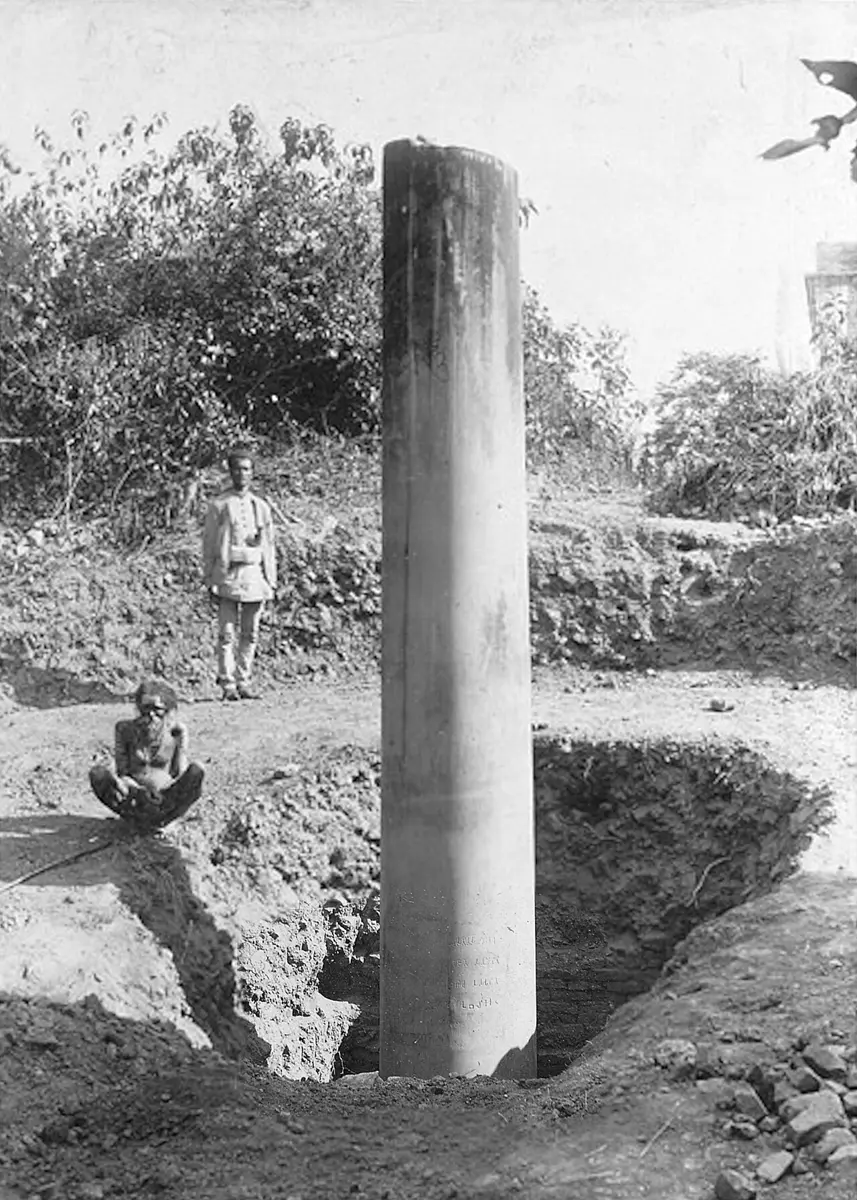
Within weeks the news was in the newspapers in India and Britain. The letters were the words of Ashoka, the emperor who ruled most of the Indian subcontinent from Pataliputra, today’s Patna, more than 2,200 years ago. They said that he had come to this spot himself, because the Buddha was born here. The place the Buddhist books called the Lumbini garden, lost for centuries under the jungle, had been found.
Who found it is still argued. The stump itself had never been lost: an estate manager across the border had sent copies of its pilgrims’ lines to a British official a dozen years before. Führer wrote the reports, and in them he barely mentioned Khadga Shamsher. Khadga Shamsher, in letters of his own, said that he had guessed the pillar mattered, sent for Führer to look at it, and had his soldiers dig while Führer was away. The digging was Khadga Shamsher’s; telling the world was Führer’s.
What the stone says
The script on the pillar is Brahmi, the script that Devanagari and the other scripts of South and Southeast Asia descend from. Its old letters had been forgotten for some fifteen hundred years, until a British scholar in Calcutta, James Prinsep, worked them out, about sixty years before the find, largely from Ashoka’s other inscriptions. So once the Lumbini lines were cleared, they could be read almost at once. They are short, about ninety signs in all, and they are in Ashoka’s own language, a Prakrit, an everyday language of the time and close kin to Sanskrit. That is why the Buddha’s people, शाक्य (Śākya) in Sanskrit, appear on the stone as sakya, and why the king is not rāja on it but lāja, as the eastern Prakrit said it.
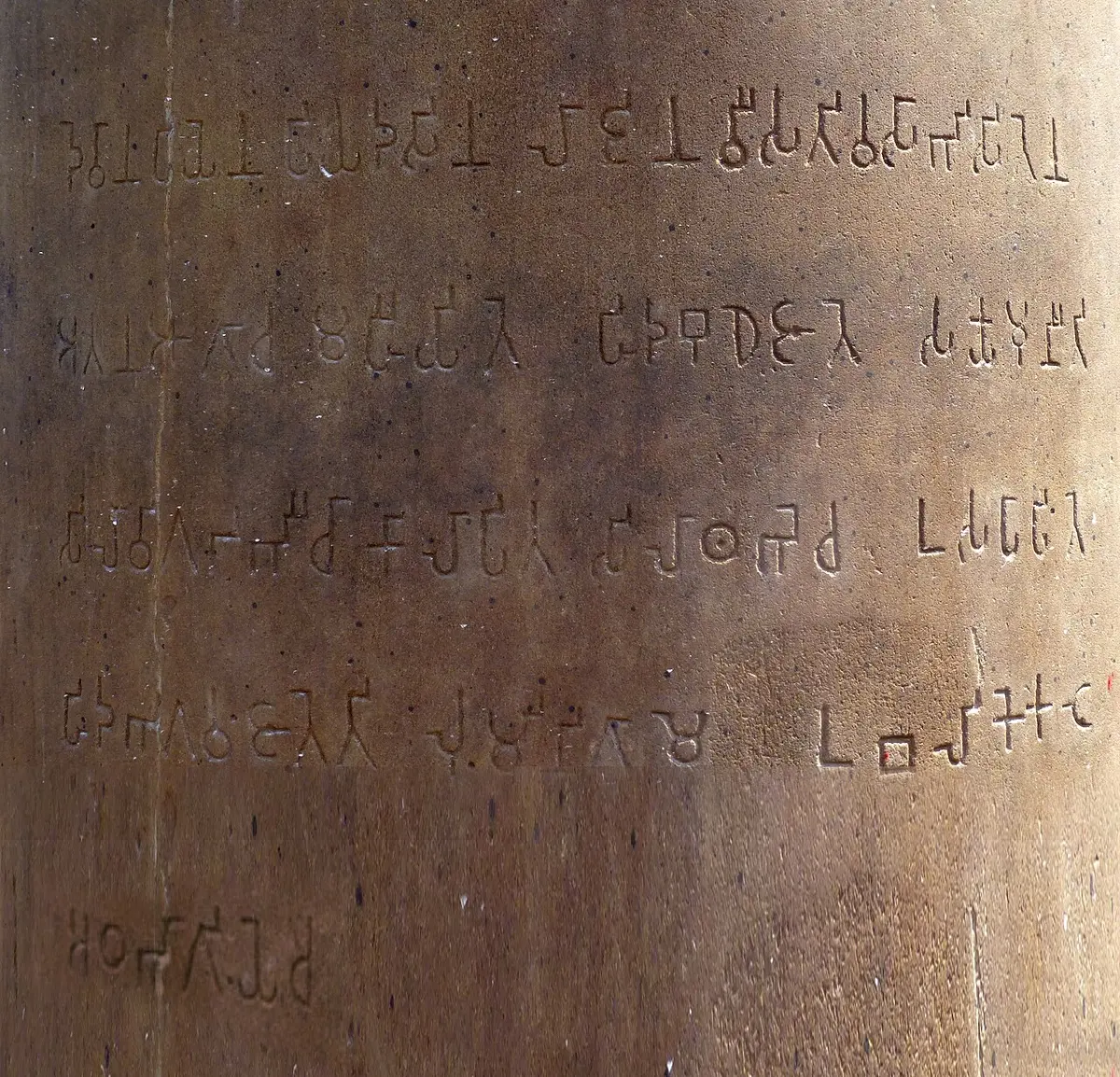
Ashoka’s name isn’t on the stone. It calls him devānapiya piyadasi, the Beloved of the Gods, Piyadasi, the titles his inscriptions use. Then it says three things. Twenty years after he became king, he came here himself and worshipped, because the Buddha, the sage of the Shakyas, was born here. He had a stone made, and he had a stone pillar set up, because the Blessed One was born here. And he made the village of Lumbini free of tax, paying only an eighth share of its harvest.
Two words in it are not settled. One is the stone he had made, vigaḍabhī, a word found nowhere else. Some scholars have taken it to mean a stone bearing a horse, since a Chinese pilgrim who came here about 1,400 years ago wrote of a horse on top of the pillar, and others as a wall. The other is the share of the harvest, which some of the first readers took as “sharing in riches”: a gift to the village, not a tax. Most now read it as a tax cut down to an eighth. One scholar remarked that even at Lumbini, the officials won out over charity.
Each Brahmi sign is a whole syllable: a consonant with its vowel, as in Devanagari, where क is ka and का is kā. The vowel is a small mark added to the consonant, and in both scripts the long ā is a stroke on the right.
For the history of Lumbini, the stone does something more than name a place. It doesn’t prove that a baby was born at this spot. It proves that, by Ashoka’s time, people were sure he had been, sure enough for an emperor to come and worship, and to put up a pillar to say so.
A man who made things up
There is one reason to look at the stone twice. Führer, its first editor, turned out to be a forger. Within two years of the find he was caught. Parts of a book of his had been copied from other scholars’ work; he had reported inscriptions that did not exist; he had sent a Burmese monk “relics of the Buddha” that were fakes; and near Tilaurakot he had faked a set of inscribed bricks. Vincent Smith, a British official and historian of the region, said of his description of a nearby stupa that every word of it was false. He resigned in 1898 and went back to Europe.
So were the Lumbini lines his work too? The scholars who know Ashoka’s inscriptions best say no. Führer didn’t know the old script or its language well enough to cut lines like these, with letter shapes that went out of use within a century or so of Ashoka. The lines were under the ground until another man’s workers dug them out, before Führer reached the pit. And the man who exposed his forgeries never questioned this one. A scholar who copied the letters in 1900 did remark that they looked almost freshly cut, as letters kept under the soil for centuries might. One historian has argued that the stone speaks of Ashoka rather than in his voice, so it could have been cut later than his visit. But nearly every expert takes the words to be Ashoka’s.
The story told at Lumbini
What Ashoka came to honor was a story already old in his time. It is told in the Buddhist books, and pilgrims heard it at Lumbini itself. A Chinese monk, Faxian, who walked to India about 1,600 years ago, wrote it down as it was told to him there. In the garden, the queen bathed in its pond, walked twenty steps, reached up and took hold of the branch of a tree, and, facing east, gave birth. The child was Siddhartha, who would become the Buddha. As soon as he touched the ground, the story says, he walked seven steps, and two dragon-kings came and washed him. Faxian saw the pond, and the monks still drank from it. The queen was Maya Devi, the wife of Suddhodana of the Shakyas; by tradition, she had stopped at Lumbini on her way to her parents’ home.
This is a sacred story, told with reverence by millions, and it should be read as one: a story of what the birth meant to those who loved the Buddha’s teaching, not a report written on the day. The tradition goes on that Maya Devi died seven days after the birth, and that her sister, Prajapati Gautami, raised the boy.
The ground at Lumbini has its own story to tell. Beneath the Maya Devi temple, archaeologists have found layer upon layer of older buildings: brick shrines, and under the oldest bricks, the holes left by the posts of a wooden shrine built around an open space in the middle, where the roots of a tree once grew. The team that found it dated it to three centuries or more before Ashoka, near the Buddha’s own time, and suggested it was a shrine around the tree of the story. Other archaeologists find this convincing but not certain: a shrine around a tree could have been for a tree spirit, not for a birth. The marker stone now shown in the temple, said to mark the exact spot, was found by an earlier dig in 1996, on a platform of bricks from about Ashoka’s time; the later team thought it was put there when Ashoka rebuilt the shrine, but nothing on the stone says so.
When was the Buddha born? Nobody knows to within a century. The dates most often given, and the ones in Nepal’s school books, are 563 BCE for his birth and 483 BCE for his death, at eighty. Scholars work back from Ashoka, because the Buddhist chronicles count the years from the Buddha’s death to Ashoka’s crowning. But the chronicles don’t agree on the count: the ones from Sri Lanka give about 218 years, and others about a hundred. The usual dates come from the longer count. At a meeting of experts on the question, most put the Buddha’s death nearer 400 BCE, some eighty years later, and his birth with it. Nepal’s government has used an older year still, 623 BCE. Each is an honest reading of the evidence, and nobody can yet choose between them.
Where was Kapilavastu?
The Shakyas were a small people at the edge of the plains. Their country was not a kingdom as we think of one. It was ruled by an assembly of its leading families, meeting in a hall, with one of them chosen as its head; Suddhodana was one of those leaders. The Shakyas were under the bigger kingdom of Kosala, to the south-west. Their main town was Kapilavastu, where Siddhartha grew up until he left home. Not long before the Buddha’s death, the books say, a king of Kosala attacked the Shakyas and destroyed their town. Later Buddhist writers made the attack into a great slaughter. How much of that is true, nobody can tell.
When Faxian came, Kapilavastu was in ruins: “neither king nor people,” he wrote, “all was mound and desolation,” with a few monks and a score or two of families, and travelers had to watch out for white elephants and lions. Then the town was lost under the jungle, like Lumbini. So where was it?
There are two answers, on either side of the border, about sixteen kilometers apart.
In Nepal, the answer is Tilaurakot, north of Taulihawa in Kapilvastu district. It is a walled town, about half a kilometer long, with a moat and gates. Near it stands another of Ashoka’s pillars, at Nigali Sagar, which says he enlarged the stupa of an earlier Buddha there and came to worship. In recent years, a team from Nepal’s Department of Archaeology and Durham University in Britain mapped the whole buried town from the surface with instruments, without digging it all up. They found streets laid out on a plan, rows of houses and shops, a walled center and a large tank. Beneath the brick town they found an older wall of earth, and the post holes of timber buildings, which they dated to the Buddha’s time. Many scholars think Tilaurakot is Kapilavastu, and Nepal has put it forward to be a World Heritage Site.
In India, the answer is Piprahwa, just across the border in Uttar Pradesh, with the ruins at Ganwaria beside it. A year after the Lumbini find, a British landowner, William Peppé, dug into a large brick stupa on his estate and found a stone chest. In it were five vases, bits of bone, and some 1,800 small jewels. One vase had a line in Brahmi on it, read as saying that these were the relics of the Buddha, of the Shakyas, given by his kinsmen. Some seventy-five years later, India’s archaeologists dug the stupa again and found older caskets beneath, and, in the monastery beside it, clay seals made some centuries after the Buddha that they read as naming “the community of monks of great Kapilavastu”. India’s archaeologists say that settles it.
Each side has a reply to the other. Against Piprahwa, scholars point out that its stupa and buildings were raised after the Buddha’s death, as monuments to him, and that relics and a written name show a Shakya place of worship, perhaps one of several Shakya settlements, not necessarily their capital. Against Tilaurakot, Indian archaeologists say that its oldest finds are younger than Piprahwa’s, as the first Indian dig there, in 1962, had concluded; Nepali writers answer that the dig was stopped early, and the newer digs by Nepal’s and Durham’s team found an older town beneath. A Nepali scholar has written that the argument has always been about where a pilgrimage site lies, in which country, and the money and pride that come with it, as much as about the ground. Neither side’s answer has been accepted by the other.
This book takes no side. The difference matters: Nepal’s school books treat Tilaurakot as the capital without a doubt, and it may well be, but the question is open, and the people who hold the other answer are archaeologists too. What is not in doubt is Lumbini. When an Indian minister once spoke of the Buddha as one of the greatest Indians, Nepal’s foreign ministry protested, and India’s foreign ministry answered plainly that there was no doubt the Buddha was born in Lumbini, “which is in Nepal”. Ashoka’s stone settles that, and both governments agree.
Lumbini now
After Ashoka, the pillar stood for centuries. Pilgrims came, and scratched their own lines on it. The Chinese pilgrim who wrote of the horse found the pillar broken in the middle by lightning. Then the jungle came back. What remained was a small village shrine, with a carving of Maya Devi giving birth, made about 1,600 years ago. After the find, the temple was rebuilt, and then rebuilt again; the one you can visit today was finished at the start of this century. Around it, a large garden with monasteries built by many countries was laid out after a visit by the head of the United Nations, U Thant, and Lumbini became a World Heritage Site. Before the pandemic, about one and a half million visitors came in a year. Farther east stand the stupa of the Buddha’s relics at Ramagrama, said to be the only one of the first eight never opened, and Devadaha, which tradition gives as Maya Devi’s parents’ home.
So the chapter ends where it began, with the stone. The Shakyas, the birth, the boy who left home: these come to us in sacred books written down long after. The place where the Shakyas’ town stood is still argued, across a border that did not exist when it was built. But at Lumbini a king’s own words, still where his workers put them, say that the Buddha was born here. Even if they don’t tell us the day it happened, they tell us that more than two thousand years ago people were sure of it and honored it, and that is history written on stone.
Meanwhile, in the world: in the Buddha’s centuries Confucius taught in China and Socrates asked his questions in Athens. Ashoka’s stones name the Greek kings of Syria, Egypt and Macedonia, and about ten years after his death China’s first emperor joined its warring states into one.
Found a mistake? Please tell us.