
In 1974 some farmers near the city of Xi’an in northern China were digging a well. Instead of water, they found faces: heads of gray baked clay, the size of a real man’s head, looking up at them out of the earth. They had found the edge of one of the largest works of art ever made. Under their fields stood an army of clay soldiers in battle order, life-sized, each with his own face, buried more than two thousand years earlier beside the tomb of the man who first made China one empire.
The clay army is a good place to start, because it shows two things that run through the art of China, Korea and Japan. The first is organization. The soldiers were made by thousands of workers, in a system so well planned that archaeologists now study it the way engineers study a factory. The second is the hand. Each soldier, made from the same few molds as the others, was finished by a craftsman who gave him a mustache, a hairstyle, a look of his own. The same pair turns up again and again in this chapter: a great system, and the touch of one person’s hand.
The emperor’s workers
The man in the tomb was the king of Qin, who conquered the last of his rivals in 221 BCE and took a new title, First Emperor. (His empire, its laws and its book-burning are in World History’s Rome and Han.) Work on his tomb began when he became king, as a boy, and went on for over thirty years. The historian Sima Qian, writing about a century later, says 700,000 men were put to work on it. The clay army stands in three pits to the east of it. Over two thousand soldiers have been dug out so far, and several thousand more are thought to be still buried. From how close together they stand, archaeologists estimate about seven thousand in the largest pit alone and about eight thousand in all, though nobody will know the true number until the digging is done.

How do you make eight thousand life-sized men out of clay? Not one at a time. Each soldier was built from parts, legs, a body, arms, hands and a head, and the parts came out of molds, a fairly small number of them. For the faces, it seems, only about eight head molds were used. The head was made separately and set into the body. Then came the finishing, by hand: eyebrows, beards, the knot of hair, the lines of the face, added and shaped in wet clay, so that each soldier looks like a different man. The whole figure was fired in a kiln at about 950 to 1,000°C, which turns clay into a hard gray earthenware, and then covered with lacquer and painted.
Somebody had to answer for every soldier. Stamped or written on many of their backs are the names of the foremen in charge of making them, at least 87 of them. Words carved on broken pieces of pottery from the site name the workers and the places they came from: men called up from all over the empire, convicts among them. The soldiers also carried real weapons of bronze: swords, spears, crossbows, and arrowheads, about forty thousand of them. A team of Chinese and British archaeologists measured the metal of the arrowheads one bundle at a time, and found that each bundle of a hundred, the contents of one soldier’s quiver, had been made together in one batch. That suggests not a single long assembly line but many small workshops, each turning out whole arrows from start to finish, a way of organizing work that car factories call “cellular”.
The same team settled an old puzzle. For forty years people had said that the bronze weapons came out of the ground shining because Qin smiths had coated them with chromium to stop rust. The team found that the chromium had come from the lacquer on the soldiers and had got onto the metal after burial. The bronze probably stayed bright because the soil around it is very fine and slightly alkaline. It is a good story, and it wasn’t true.

The same emperor is also remembered for a wall. Sima Qian tells it this way. Once Qin had conquered all under heaven, it sent its general Meng Tian north with three hundred thousand men to drive back the peoples of the north, and he built a long wall, following the shape of the land and using the ridges and gorges as its defenses, from Lintao in the west to Liaodong in the east, more than ten thousand li. Later dynasties built and rebuilt walls along the northern frontier, the Ming above all, some fifteen centuries later, and today’s Great Wall is the sum of many of them. When China’s cultural heritage office announced the results of a long survey in 2012, the wall it had measured came to about 21,000 kilometers. A traveler who followed it in the early 1900s found slabs set into it naming the head bricklayers, blacksmiths and stonemasons who had directed its repairs, like the foremen’s names on the backs of the clay soldiers.
Think of it, then, as a work of labor more than a work of art. Sima Qian himself had traveled along the old wall. He wrote that on his way home from the northern frontier he saw the walls and forts Meng Tian had built for Qin, “cutting through mountains and filling in valleys”, and his verdict was hard. Ordered to kill himself after the emperor’s death, Meng Tian decided, Sima Qian says, that in building ten thousand li of wall he must somewhere have cut the veins of the earth. Sima Qian didn’t accept that. The general had made light of the people’s strength: his crime was not against the earth but against the people.
One modern belief about the wall is not true. It is often said to be the only human work you can see from space. NASA, publishing a photograph of it that the astronaut Leroy Chiao took from the International Space Station, says it is hard or impossible to make out from orbit without a powerful lens, and it can’t be seen from the Moon at all. It is very long, but it is narrow.
The brush
Ask what the highest art in old China was, and the answer is not sculpture or building. It is what a person could do with a brush and ink: writing, and then painting. The two were never far apart. The same brush made both, and China’s historians said the two arts had been born together. A fine piece of writing was valued as highly as a fine painting, and what people prized in both was that the brushwork should be as personal as handwriting, each stroke alive, showing the mood of the person who made it. In the sixth century a painter named Xie He set down six rules for judging painting, and he put first not likeness, not color, but what one English scholar translated as “rhythmic vitality”, a sense of life moving through the picture. For a thousand years and more, Chinese critics agreed with him.

The most famous piece of writing in China is a short preface. In 353 CE an official named Wang Xizhi held a spring festival by a stream at the Orchid Pavilion, in what is now Zhejiang province, with some forty friends. Cups of wine were floated down a winding stream, and a guest in front of whom a cup stopped had to make a poem or drink. At the end of the day Wang wrote a preface for the poems: 324 characters in 28 columns, about how pleasant the day was, how quickly pleasure passes, and how people in the future would read his words and feel the same. The character 之 comes twenty times, and an account written down under the Tang says that no two of them are the same. Wang, the account adds, wrote the preface out dozens of times afterwards and never got it as good.
Wang’s original is lost. The same account, written in 714, says the Tang emperor Taizong collected everything of Wang’s he could find, sent an official in disguise to trick the preface out of an old monk who kept it hidden in his roof, had his court copyists trace it, and, as he lay dying in 649, asked his son to let him take it with him, and it went into his tomb. Whether it lies there still nobody knows. What survives are the traced copies, one of them credited to Feng Chengsu, one of the copyists the account names, and generations of writers learned from copies of copies.
What makes writing an art, when everyone has to write? Pick up a brush and part of the answer is in your hand. Ink soaks into the paper as soon as the brush touches it, so a stroke, once made, stays as it is, and going over it shows. The writer has to hold the whole shape of a character in mind and make it in one confident movement. The rest is in how sensitive the brush is. Pressed down, it makes a thick line; lifted, a thin one; dry, it leaves streaks of white paper showing through the stroke. One stroke can be heavy at the start and thin at the end, wet in one place and dry in another, and a reader who knows how to look can follow the writer’s hand moving across the page, its speed and its pauses. Painters in China used the same strokes for a branch of bamboo or the edge of a rock, and many painters were also writers, poets and officials. A painting in ink often carried a poem written on it, by the painter or by friends.
Bones and flesh
There is one Chinese art that the whole world wanted. In English it is still called china. Porcelain is a ceramic that is white all the way through, hard and glassy, and in the best pieces so thin that light shows through it. Every ancient people made pots of clay. For centuries, Europe couldn’t make porcelain at all, and bought it from China.
The secret was chemistry, and the best description of it comes from a visitor. Père d’Entrecolles was a Jesuit priest who lived in the great porcelain town of Jingdezhen in southern China in the early 1700s, and in 1712 he wrote a long letter home describing everything he saw. The town, he said, had a million people and three thousand kilns, and at night it looked like a city on fire. Porcelain, he explained, was made of two things dug out of the hills. One was kaolin, a soft white clay. The other was petuntse, “little white bricks”, a stone crushed to powder, washed and pressed into blocks. A rich merchant told him that the English or the Dutch had once bought some petuntse and taken it home to make porcelain, but taken no kaolin, and failed. The merchant laughed: “They wanted to have a body without bones to support its flesh.”
That is the chemistry in one sentence. In a kiln at about 1,350 to 1,400°C, much hotter than the fire that baked the clay army, the powdered stone melts into a kind of glass, which flows through the mix and fills every gap: that is the flesh. The kaolin doesn’t melt at that heat; it holds the pot’s shape while the rest turns glassy: that is the bones. The glaze, made of the same stone ground very fine, melts onto the surface in the same firing, so body and glaze become one. Get the mix wrong and the pot sags in the fire. Get it right, and you have a white stone you can make thin enough for light to pass through.
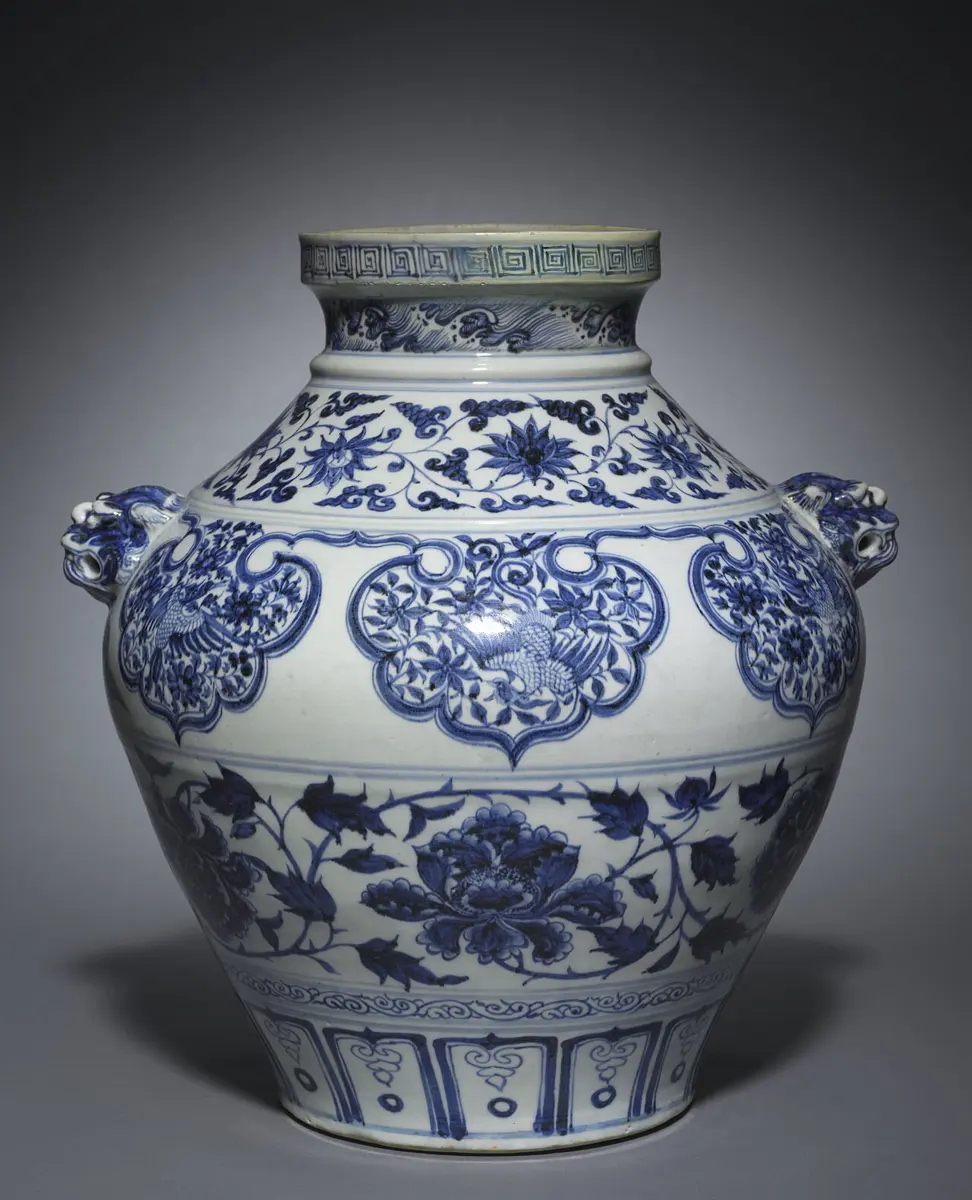
D’Entrecolles was struck by the organization as much as the chemistry. A cup, he wrote, was shaped on the wheel by one man, set straight on its base by a second, pressed on a mold by a third, trimmed thin by a fourth, and so on through other hands, and he was told that a piece of finished porcelain had passed through the hands of seventy workers. The emperor’s army of clay had been made in the same spirit, nearly two thousand years before. Meanwhile Europe’s chemists tried for generations to work out the recipe. The first in Europe to make true porcelain was a young alchemist named Johann Friedrich Böttger, who had fled to Saxony and been put to work in the ruler’s chemistry laboratory; in 1709 he showed a few rough pieces of it.
The porcelain most people picture is blue and white, and it is an international object. The white is Chinese, the blue is cobalt painted on under the glaze, and in the 1300s, when Mongol rulers held both China and Iran, the cobalt came from Iran, and some of the patterns painted with it came from Iran too. (The Mongols’ empire is in World History’s The Mongols.) Much of it was made to be sold overseas.

Korea, squeezed between China and Japan, is often left out of stories like this one, which is a mistake, because in one kind of ceramic it made something its teacher admired. Korean potters of the Goryeo kingdom, which ruled from 918 to 1392, learned from China to make celadon, pottery under a glaze that fires to a soft green. In 1123 a Chinese envoy named Xu Jing visited Goryeo and wrote a careful report on what he saw. Of the pottery he wrote that the Koreans called its green color “kingfisher-colored”, and that in recent years it had become very skillfully made and especially fine in color, and of an incense burner shaped like a lion that of all their vessels it was the finest. Most of their shapes, he noted, copied Chinese ones. The Goryeo potters then made the ware their own. They inlaid designs into the clay in white and black, under the glaze, so that cranes, willows, reeds and chrysanthemums seem to float under the green glass. Their pots went into the tombs of the Korean nobility, and centuries later Japanese collectors treasured them so much that a cracked one was mended with gold.
A pillar from 594
From China and Korea, the Buddhist tower of stacked roofs called a pagoda reached Japan. China was building such towers in brick and timber centuries before Araniko’s journey, as Brick and Timber tells. Japan learned to build them from Korea. Japan’s own old chronicle, the Nihongi, records that in the year 588 the Korean kingdom of Paekche sent Buddhist monks, relics, two temple carpenters, a metal founder, four men skilled in pottery and a painter, and that same year the building of the temple of Hōkōji was begun.
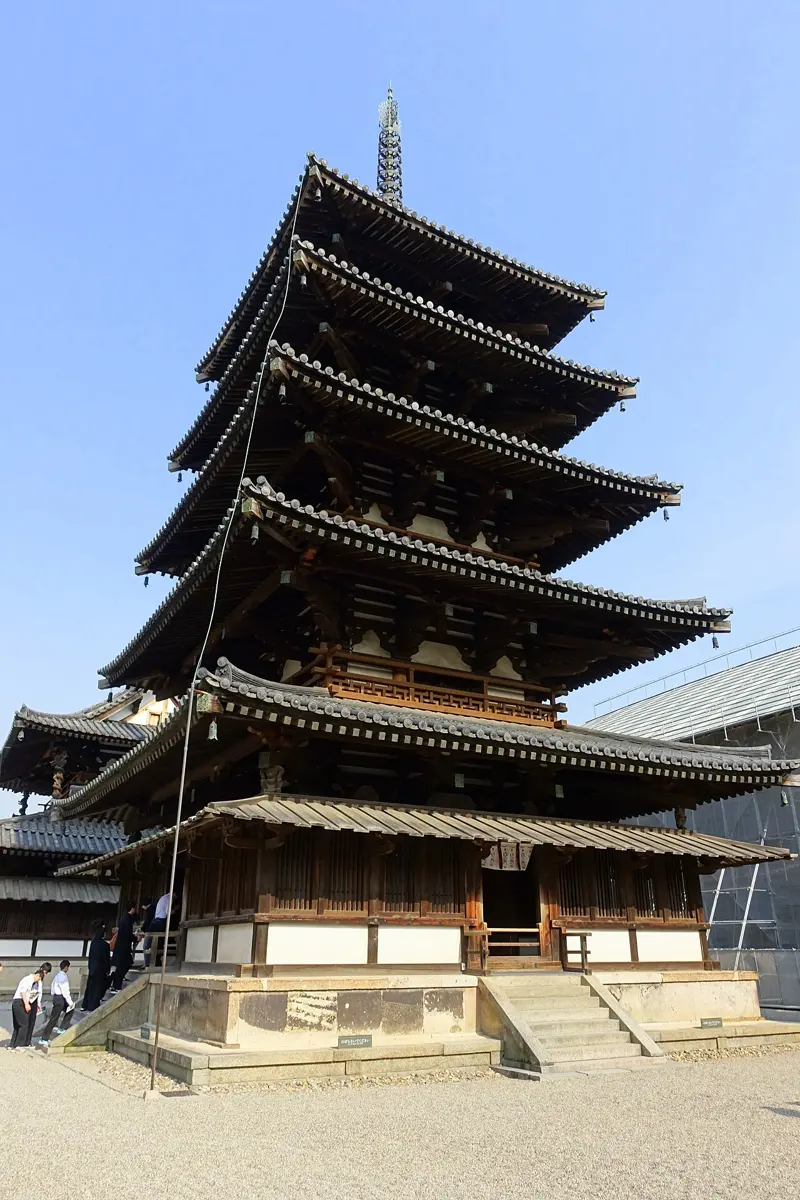
Another early temple is Hōryū-ji, near Nara, and its five-storied wooden pagoda, more than 32 meters tall and thought to be the oldest in Japan, still stands. Up its middle runs a central pillar of cypress wood. The pillar holds up only the spire on top. Each of the five stories is a box of timber resting on the one below, not fastened to it, and the pillar stands free in the middle with a little gap all round. No record tells of a pagoda like it falling in an earthquake, and engineers who have tried to explain why point to several things at once, among them wooden joints that slip and rub, and stories that can each sway a little on their own. The Nihongi says that in 670 a fire broke out at Hōryū-ji after midnight, and “not a single building was left”. So historians long argued about whether the buildings standing today are the originals or a rebuilding, and most came to agree that they were rebuilt after the fire.
Then the pillar spoke for itself. Its foot had been set into the ground, and when the pagoda was repaired after the Second World War, the bottom of the pillar was found rotted hollow, so the repairers cut it off and joined new wood on. In 1950 a disc about ten centimeters thick was cut from the old piece and given to a wood scientist to study, and it was stored at Kyoto University. Half a century later, in 2001, scientists at the national research institute in Nara measured the growth rings on that disc against a long record of tree rings from Japanese timber, which lets a ring be matched to the year it grew, and announced that the tree had been felled in 594, seventy-six years before the fire. That set off the argument again. Was the pillar reused from an older building, or is the date too early? The outermost rings, just under the bark, are missing, so the felling year was worked out by adding the number of rings such timber usually loses; the scientist who first studied the disc pointed out that this tree had grown unevenly and may not be usual. The rings themselves are certain; what they mean for the building is still argued.
The rotted foot is a reminder of how wooden buildings last. A wooden building stands for many centuries only because people keep mending it, as the carvers of Patan did after 2015, which Wood tells.
A wave in thousands
The last picture in this chapter is perhaps the most famous image Japan ever made, and it was made for the mass market. Katsushika Hokusai’s Under the Wave off Kanagawa, the Great Wave, is a woodblock print from a series of views of Mount Fuji that Hokusai began in 1830, when he was seventy years old and short of money. What the Eye Actually Gets looks at how it is put together, and Color and Paint at its new chemical blue. Here the point is how it was made, because it is the clay army and the porcelain town again: a system, and a hand.
A Japanese print was the work of three people. The artist drew the design in ink, with a brush, on thin paper. A carver pasted the drawing face down on a block of cherry wood and cut away everything that wasn’t a line, which left the key block. From prints of that, more blocks were cut, one for each color. Then a printer brushed color onto each block in turn, laid damp paper on it and rubbed the back with a round pad, lining up each color with marks cut on the blocks. The carver and the printer worked for the publisher, who paid for it all and sold the prints in shops. Only the artist’s name is remembered, but he couldn’t have made the picture alone.
From those blocks the Great Wave was printed over and over, for years, even after Hokusai died, until the blocks wore out and new ones were cut. Thousands of copies were sold, in shops, to buyers in Edo, as Tokyo was then called. Only about a hundred of the early ones survive, and the Art Institute of Chicago, which owns three, shows them for only a few months every five years, because light fades the colors: in the earliest prints the sky behind Fuji was pink, a color that has faded from most copies, so that hardly anyone today thinks of the Great Wave as having a pink sky. A picture made in thousands for people who couldn’t afford a painting became, in time, a treasure kept in the dark. When such prints reached Europe they caught the eye of painters and musicians there, a story that comes back in Chapter 30.
Put the chapter together and the same pair keeps returning: a clay army from eight head molds, each soldier finished by hand; a wall built by hundreds of thousands; a preface written in one afternoon by one man; a cup that passed through seventy pairs of hands; a print made in thousands from blocks cut by craftsmen whose names are forgotten. In all of it the art is not only in the great design, nor only in the single hand, but in how the two were made to work together. The next chapter turns west, to the lands where the blue of the porcelain came from, and to the art of the Islamic world.
Found a mistake? Please tell us.