
On the hilltop at Changu Narayan, a few kilometers north of Bhaktapur, a stone slab beside the temple shows a giant in mid-stride. He has many arms, spread out like the spokes of a wheel. One leg is planted on the ground and the other is flung up and out to the side, as high as his shoulders. Around his feet, small figures crowd together.

He needs no label. In two of his hands are a discus, a flat ring with a sharp edge, and a long club, a mace. Those two things belong to one god, Vishnu. And a Vishnu in a giant stride, one leg flung up into the air, can only be telling one story. A demon king named Bali had driven the gods out of heaven. Vishnu came to him as a dwarf, वामन (Vāmana), a boy dressed as a student, and asked for as much land as he could cover in three steps. Bali agreed. Then the dwarf grew until he filled the universe, covered the earth with one step and the sky with the next, and, with nowhere left for the third, set his foot on Bali’s own head and pressed him down into the world below. The raised leg is a step across the sky. The Valley has older carvings of this god, त्रिविक्रम (Trivikrama), “of the three steps”. Two of them in Kathmandu carry inscriptions saying that King Manadeva set them up in 467, for the merit of his mother, Rajyavati. The Changu slab is younger, though nobody knows exactly how much; one leading historian of Nepal’s art puts it in the 800s.
That is the trick this chapter is about. Many figures in temples, paintings and statues come labeled, not with writing, but with what they hold, what they ride, how they sit and what their hands are doing. Once you know a few of these signs, a wall of carvings that looked like a crowd of strangers turns into a crowd of people you can name, each in the middle of a story.
What a god holds
Signs like these have a name in English: attributes. They exist because a carver or painter had a problem. Gods and saints were usually shown as human beings of much the same shape, young, calm and well dressed, and a viewer had to be able to tell them apart without reading. So each was given a few things that only they carry, a kind of visual shorthand, and the shorthand stayed the same for centuries so that everyone could learn it.
Vishnu’s is the easiest to learn. Most of his images have four arms, and in the four hands are four things: the discus, called सुदर्शन (Sudarśana); a conch shell, शङ्ख (śaṅkha), which is blown like a trumpet in temples to this day; the mace, गदा (gadā); and a lotus flower, पद्म (padma). On his head is a tall crown, किरीट (kirīṭa). Find a figure with those four things and you have found Vishnu, wherever it is and however old.
The shorthand can do more than name him. Old Sanskrit books on making images list twenty-four forms of Vishnu, each with its own name, and the only thing that tells one from another is the order of the four objects in the four hands: which hand has the discus, which the conch, and so on. Four things in four hands can be arranged in exactly twenty-four ways, and every one of them was given a name. The books don’t all agree on which order goes with which name, but the idea is plain. A sculptor could say which Vishnu he meant just by moving the conch from one hand to another.
Gods also ride. Each has an animal or bird called its वाहन (vāhana), its vehicle, and it often appears beside or below the god. Vishnu’s is Garuda, a great bird, or a man with wings and a bird’s features. Shiva’s is Nandi, the bull. Brahma rides a swan.
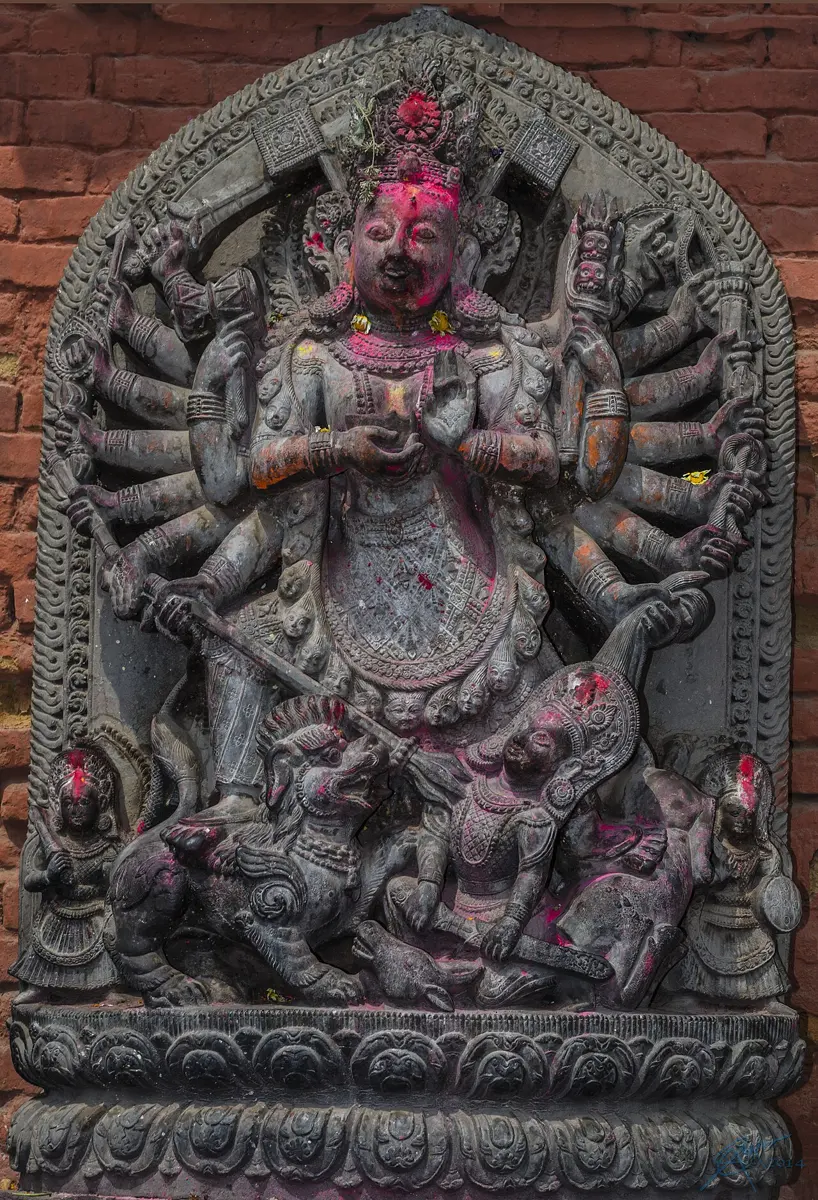
Durga, the warrior goddess at the heart of Dashain, carries the most. She has many arms, eight or more, and each holds a weapon given to her, in the story, by the gods. She rides a lion. And in her best-known form she is in the middle of a fight. Her enemy is Mahishasura, the buffalo demon, and in many carvings she drives her trident into him as he comes out of the buffalo’s body. Carvers show the fight: the lion biting, the demon at her feet, the goddess above it all.
What the hands say
The Buddha is harder. He holds almost nothing. He wears a plain monk’s robe, and there is a bump on the top of his head, the उष्णीष (uṣṇīṣa). But one Buddha image looks much like another, so the work of telling them apart falls to the hands.
A position of the hands with a meaning is called a मुद्रा (mudrā). A few are seen everywhere. With both hands resting in the lap, the right on the left, palms up, the Buddha is meditating. With the right hand raised, palm out, he is saying “Don’t be afraid”. With the hands held at the chest, fingers touching as if turning a wheel, he is teaching, and the wheel is the teaching he set going in his first sermon, at Sarnath. Each gesture points back to a moment in his life.

The best known is the earth-touching gesture. The Buddha sits cross-legged, the left hand in his lap and the right reaching down over his knee to touch the ground. The story behind it is the night he reached enlightenment, sitting under a tree at Bodh Gaya. Mara, a demon of death and uncontrolled desire, came with an army to drive him away, and demanded who could vouch for the good the Buddha had done in his past lives. No person was there to answer, so the Buddha reached down and touched the earth, and the earth itself thundered that it was his witness. In some tellings the earth is a goddess, who answers for him. So a Buddha touching the ground is the Buddha at the moment of his enlightenment, and the gesture is one of the commonest in Buddhist art.
In Nepal and Tibet the hands combine with color. Many paintings and shrines show five Buddhas side by side, and each has his own gesture and his own color. White Vairocana makes the teaching gesture; blue Akshobhya touches the earth; yellow Ratnasambhava holds a hand down and open in giving; red Amitabha meditates; green Amoghasiddhi raises his hand to say “Don’t be afraid”. With the colors and the hands together, a painted row of five near-identical figures can be read at a glance.

Reading a picture from somewhere else
None of this is only Asian. Walk into an old church in Italy and you meet the same problem, solved the same way. Christian saints were mostly ordinary people in long robes, so each was given the thing that marked their story, very often the way they died. Saint Peter, who the Bible says was given the keys of heaven, holds keys. Saint Lawrence, who was burned to death, holds the iron grill he was burned on. Mary, the mother of Jesus, is usually in a robe of costly blue. And Saint Catherine of Alexandria has a wheel.
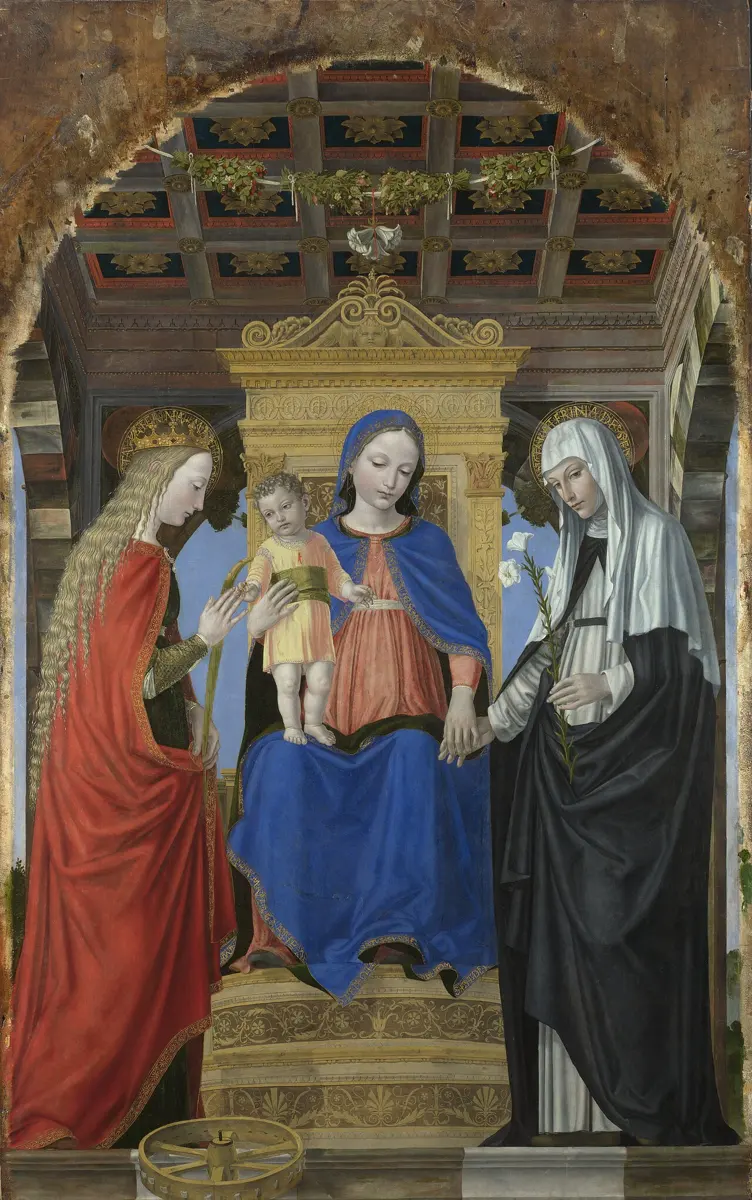
Catherine’s story was told in the Golden Legend, a book of saints’ lives that Christian painters drew on for their attributes. An emperor ordered her torn apart between wheels set with blades, and, the story goes, she prayed and an angel broke them. Painters put a wheel beside any young woman they meant as her, and viewers knew her at once. In the painting here she stands beside another saint of the same name, Catherine of Siena, who holds a lily, a sign of purity. The painter wrote their names on their haloes too, but a viewer who knew the signs had no need to read them.
A painter in Italy and a carver in Bhaktapur, who never heard of each other, arrived at the same solution because they had the same problem. That makes the method portable. Faced with a picture from a tradition you don’t know, you can do what a stranger does at Changu Narayan. Look at what the figure holds, what it rides or stands on, its crown or headdress, how it sits and what its hands do, and what is happening around its feet. Then ask what story could need those things. You may not get the name, but you will usually find that the picture has been built to be read, and you will know what to look up.
What the image is for
Knowing who a figure is still leaves a bigger question: what was the thing made for? The answer changes from one image to the next, and one image can be several things at once.
Some are stories, like the Changu slab, a moment from a tale that the viewer already knows, chosen so that it brings back the whole. Some are portraits, of a king or a donor who paid for the temple, made so that they would be remembered. Some are aids to meditation: a Buddhist painting of a Buddha or a mandala, a diagram of a perfect world, is meant to be looked at slowly and held in the mind, and the colors and gestures are part of what the meditator holds.
And some are much more than a picture of a god. In Hindu temples a new image of stone or metal goes through a ceremony called प्राणप्रतिष्ठा (prāṇapratiṣṭhā), the setting of breath, which invites the god to live in it. Part of it is the opening of the image’s eyes, and from then on the image is, to the people who worship it, the god present. It may be bathed, dressed, given a seat and offered food, like an honored guest. A museum label calls such a thing an object. To the people who made it and worship it, it is someone. The record of the Nyatapola from Chapter 1 is, in its own title, a record of a temple’s प्रतिष्ठा. What the believers of each tradition think is happening is a story for Philosophy and World Religions, for the Curious; this book only asks you to look carefully, and with the same respect a guest would show.
That is why so many of the Valley’s images are smeared with red powder and rice, like the Changu slab and the Bhaktapur Durga in their photos. They aren’t art that happens to be religious. They are things people use, made to be easy to read.
So a figure carries its name in what it holds, what it rides and what its hands do. Vishnu has his discus, conch, mace and lotus; Durga her weapons, her lion and her buffalo demon; the Buddha his gestures, and in Nepal his colors; Catherine her wheel. These signs need no writing, and they work for anyone who learns a few of them. The next time you pass a small shrine at a crossroads, there is a story in it, and you can begin to read it. The Your Town’s Past series has a way to start: photograph the gods of your own neighborhood, and find out who each one is.
Found a mistake? Please tell us.