
Picture a Greek statue, and you probably see white marble: a god or an athlete, pale and smooth, standing in a quiet museum room. Picture a Greek temple, and it is white too, its columns gleaming against a blue sky. That is how the Greeks have looked to the rest of the world for about two hundred and fifty years. It is not how they looked to the Greeks. Their marble statues were painted, with skin, lips and eyes, and clothes with colored borders and patterns, and so was the carving on their temples. Ancient writers mention it again and again, and careful study of the marbles has found traces of the paint on a great many of them, faded or almost washed away by two thousand years of weather and burial.
So where did the white come from? Partly from time, which took the paint off. And partly from people who preferred it that way. In the 1760s a German scholar named Johann Joachim Winckelmann wrote a history of ancient art that taught Europe how to look at the Greeks, and in it he said that the essence of beauty lies not in color but in shape, and that a beautiful body is all the more beautiful the whiter it is. Europe has kept forgetting the paint: the fact was pushed aside in the Renaissance, remembered in the nineteenth century, and pushed aside again in the twentieth. Since 2003 a team led by the archaeologist Vinzenz Brinkmann has made full-size copies of Greek and Roman statues painted as the traces show, and taken them round the world’s museums.
The paint is worth knowing about for another reason. It reminds you that these were not museum pieces. They were working buildings and statues for gods and cities, like the temples and images in Patan and Bhaktapur, and like those, they were colorful. What the Greeks and then the Romans added to the long story of art was not whiteness, but two big ideas. The Greeks turned building into a system of rules, and made the human body the measure of beauty. The Romans took the Greek system and joined it to a new material, concrete, and a shape the Greeks had hardly used, the arch, and built on a scale nobody had seen before. How Greece and Rome were run, and why they mattered, is in World History’s chapters on Greece and Rome. This chapter looks at what they built and carved.
A system of columns
A Greek temple is a box for a god’s statue with a roof on top, surrounded by columns. The beams across the columns are stone, and a long stone beam snaps under its own weight, so the columns stand close together. Within that simple plan, the Greeks worked out a few fixed ways of doing it, each a complete set of shapes from the step at the bottom to the edge of the roof. These sets are called the orders.
The best guide to them is a Roman architect named Vitruvius, who wrote a book on architecture about two thousand years ago. He tells a story about each order, and the stories all say the same thing: a column is a body. The Doric, the plainest and sturdiest, was made, he says, from the proportions of a man: the length of a man’s foot was found to be a sixth of his height, so the column was made six times as tall as it was thick at the bottom. The Ionic was made from a woman’s figure: slimmer, eight times as tall as it was thick, with a base like a shoe, two curled scrolls at the top like curls of hair on each side of a face, and grooves down the shaft like the folds of a dress. And the Corinthian, the most decorated, was invented, he says, by a sculptor named Callimachus, who passed the grave of a young girl in Corinth and saw a basket that her nurse had left there with a tile on top, set by chance on an acanthus root, so that the plant’s leaves had grown up round it and curled under the tile. He copied it for the top of a column.
The stories may not be true, but the idea in them is: an order was a set of proportions, everything measured from the thickness of the column, so that a builder who knew the rules could build a temple of any size and it would come out right. Once you know the three, you see them everywhere, from banks in London to the front of the Gaddi Baithak in Kathmandu’s Durbar Square, the white Greek temple front that Chandra Shumsher added to the old Malla palace around 1908, as Stucco and Oil Paint tells.

The most famous Doric temple is the Parthenon, built on the Acropolis, the rocky hill above Athens, between 447 and 438 BCE, by the architects Iktinos and Kallikrates, with the sculptor Phidias in charge of the whole. It was the temple of Athena, the city’s goddess, and inside it stood her statue, about 13 meters high, of gold and ivory. It is built of white marble from Mount Pentelikon, near Athens, and its top step measures about 31 meters across the front and 70 along the side.
And it has hardly a straight line in it. The great platform the columns stand on is not flat: it rises very slightly toward the middle of each side, like a very low hill, about 7 centimeters along the front and 11 along the side. The columns are not straight: each one swells a little, by less than two centimeters, a swelling the Greeks called ἔντασις (entasis), and they all lean inward, each about 7 centimeters over its 10 meters of height, so that if the columns on opposite sides went on rising they would meet far up in the sky. Nobody noticed any of this until the nineteenth century, when architects measuring the temple found the curves. Vitruvius had actually explained it. A long platform built truly level, he wrote, looks hollow to the eye, and the eye must be helped where it is deceived; a column is given its swelling so that it looks pleasing. So the builders bent the stone to make it look right. It is the same trick that Woolley found in the ziggurat of Ur, in the previous chapter, done fifteen hundred years later, in marble and to a fraction of a centimeter.
The Parthenon you see is a ruin, and not because the Greeks built it badly. It was burned by invaders in 267 CE, made into a church in the sixth century and later into a mosque. In 1687, during a Venetian siege of the Acropolis, the gunpowder stored inside it exploded, and it was badly wrecked. In the early 1800s Lord Elgin had many of its surviving sculptures taken off to Britain. Restoration began in 1842 and still goes on.
The body as a measure
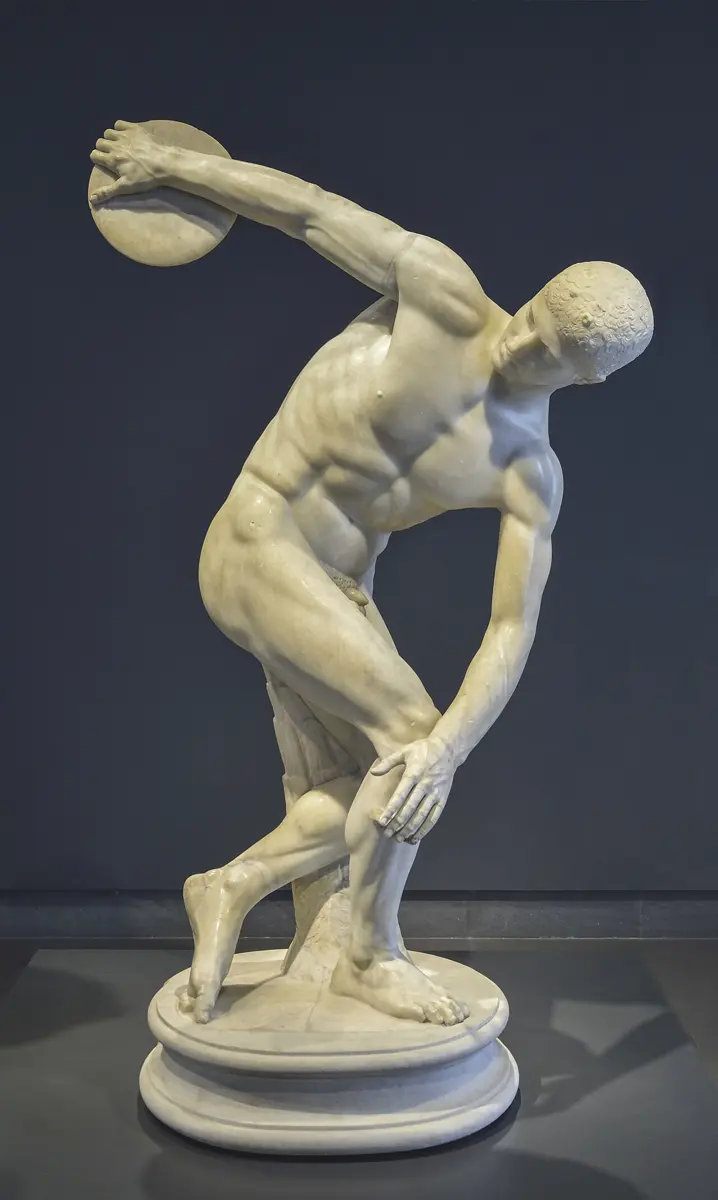
Greek sculptors made the same idea, the body as a system, into statues. You can see it in the Discus Thrower, which a sculptor named Myron made in bronze. The athlete is caught at the top of his swing, his body twisted like a spring, the moment just before everything lets go. It is not a moment anyone could hold. Its balance is the sculptor’s, not the athlete’s.
At about the same time a sculptor named Polykleitos went further. He made a statue called the Doryphoros, the Spear Bearer: a young man standing at rest with his weight on one leg. The Roman writer Pliny the Elder says that putting a statue’s weight on one leg was Polykleitos’s own discovery. Polykleitos also made a statue that artists called the Canon, the rule, and Pliny says they studied its proportions as a standard. Beauty, for him, was a matter of numbers, the same way a column was.
There is a catch in all this. Myron’s Discus Thrower and Polykleitos’s Spear Bearer are both lost. They were bronze, and bronze can always be melted down and used again. What survive are copies in marble, made in Roman times. So the statue in the photo is a Roman copy of a Greek bronze, and much of what is called Greek sculpture in museums is really Roman work, copying Greek originals long gone.
Arches and concrete
The Romans copied Greek columns for their temples, but their real building was done with two things the Greeks hardly used. The first was the arch. A beam of stone breaks if it is too long, because the bottom of it is stretched. An arch is a curve of wedge-shaped stones in which every stone is squeezed against its neighbors and nothing is stretched at all: it is a hanging chain turned upside down, as Standing Up shows. Arches could cross much wider gaps than beams.
The second was concrete. Vitruvius describes a kind of sand found around the Bay of Naples, near Mount Vesuvius, that when mixed with lime and rubble makes a mass so strong that it sets hard even under the sea. The Romans used this volcanic ash, from around Pozzuoli on the Bay of Naples, to make a concrete that could be poured into any shape, arches and vaults included. Their concrete is famously long-lasting, and in 2023 a team at MIT found one reason why: small lumps of lime left in the mix, which dissolve when water seeps into a crack and then set again, sealing it up.

Put arches and concrete together and you get the Colosseum. The emperor Vespasian began it in the middle of Rome, and his son Titus opened it in the year 80 with a hundred days of games, in which, the historian Cassius Dio writes, nine thousand animals were killed. It is an oval about 188 meters long and 156 wide, and its outer wall stands 48.5 meters high, built of big blocks of travertine stone. Inside, a web of walls and vaults of stone and concrete held up the seats, room for about 45,000 people sitting and perhaps 5,000 more standing. Look at the outside and you can see the two traditions being joined. The wall is a stack of arches, eighty in each ring on the ground floor, but between each arch stands a half-column that holds nothing up. The half-columns are decoration, and they follow the orders, one above another: Doric on the ground floor, Ionic above it, Corinthian above that, and flat Corinthian pilasters on the top storey. The Greek system had become a kind of dress for a Roman structure.
The same arches carried Rome’s water. About nineteen hundred years ago an official named Frontinus, put in charge of the city’s water supply by the emperor Nerva, wrote a book about it, listing nine aqueducts that brought water into the city from springs and rivers in the hills. Most of their channels ran underground, sloping gently all the way: the conduit of one of the oldest, the Anio Vetus, was 43,000 paces long, and only 221 of them were above ground. Where a channel had to cross a valley, it was carried high on arches. Frontinus was proud of them. Compare these, he wrote, with the idle pyramids, or the useless, though famous, works of the Greeks.

Rome also told stories in stone. About the year 113 the emperor Trajan finished a huge new forum in the city, designed by his architect Apollodorus, and in it stood a column a hundred Roman feet high, about 30 meters. Round its shaft, from the bottom to the top, winds a single band of carving, crowded with soldiers: it tells the story of Trajan’s two wars against the Dacians, in what is now Romania, between 101 and 106, with the Roman army shown at work in every detail, and it was once brightly painted. To read it you would have to walk round and round the column, craning your neck higher and higher. It was made as a monument to Trajan himself, and after he died his bones were laid in it.
The dome that stays up

The greatest thing the Romans built with concrete is the Pantheon in Rome, a temple to all the gods. From the outside you see a Greek temple front of granite columns; walk through it and you are inside a single round room covered by a dome. The room is exactly as high as it is wide, 43 meters, so that a whole ball of that size would just fit inside it. The only light comes from a round hole at the very top, 9 meters across, open to the sky. When it rains, the rain falls in.
Over its door in big letters it says that it was built by Marcus Agrippa, Augustus’s general. It was not. Agrippa’s temple stood here, but the building you see was put up by the emperor Hadrian and dedicated about 128 CE, who, the Roman histories say, liked to put the names of the original builders back on the buildings he restored. The bricks in its walls carry the stamps of brickworks of Hadrian’s time, which settles it. MIT’s team calls its dome the largest dome of unreinforced concrete in the world, nearly nineteen hundred years later.
How does it stay up? A dome is an arch turned round in a circle, as Standing Up shows, so it is squeezed, and concrete is good at being squeezed. But a dome also pushes outward all the way round its foot, and the heavier it is, the more it pushes. So the Romans did three things. They built the round wall underneath it more than six meters thick, with hidden arches inside it to carry the weight round the openings. They made the dome lighter as it rose: it grows thinner as it rises, to a little over a meter round the opening, and higher up they mixed lighter stone, such as the volcanic pumice, into the concrete. And they left the very top open, so the crown of the dome, its last and highest weight, is simply not there. It is a building made by people who understood where the load goes.
Faces of the Romans

There is one kind of art the Romans did very differently from the Greeks. Greek statues show perfect bodies; their faces are calm and could belong to anyone. Some Roman portraits, like this one, show exactly who someone was: the baldness, the bags under the eyes, the creases of a lifetime of worry. One Roman custom, described by the Greek historian Polybius, helps explain why. When a leading Roman died, his family made a mask of his face, of wax, faithful to his features and even his complexion, and kept it in a wooden shrine in the most conspicuous place in the house. At a family funeral the masks were brought out and worn by men who were as near the dead in size and bearing as could be found, so that all the family’s famous ancestors walked again in the procession. A face was a family record. Making it younger or better looking would have been beside the point.
So the two halves of this chapter pull in different directions. Greece looked for the rule behind the body, the perfect proportion, and made its buildings and statues out of it, then painted them. Rome took those rules and made them a dress for its own engineering, arches, vaults and domes of concrete, and kept, in its portraits, the plain faces of real people. Both left a vocabulary that the rest of the world borrowed: columns on a Kathmandu palace, domes on government buildings, a man’s weight resting on one leg in a statue made two thousand years later. The next chapter goes east, to the art of South Asia and the lands it reached.
Found a mistake? Please tell us.