
In early May 1992, workers digging the foundation of a house at Maligaon, in the east of Kathmandu, came on a man lying face down about a meter under the ground. He was made of stone, and he was in four pieces: his body from neck to ankles, his head, his right arm, and his feet still standing on their base. Put back together, he is life size, 171 centimeters tall, a barefoot man in heavy earrings and a cap, carved in a pale sandstone. Along the base runs a line of writing, 42 centimeters long, in an old Indian script called Kushan Brahmi. It names a great king, Jaya Varma, and gives a year that works out to about AD 185.
Before that day, the oldest writing anyone had found in the Valley was nearly three hundred years younger. The man from Maligaon pushed the story of Nepali sculpture back by three centuries in one find. He now stands in the National Museum at Chhauni, in the room of the earliest stone images.
He was made the way nearly every stone figure in this chapter was made, and the way stone figures are still made in Patan: by taking stone away until only the figure is left.
Taking away
A clay figure is built up, a lump added here and pressed on there. A stone figure can only be cut down. Everything that isn’t the god has to come off, chip by chip, and nothing that comes off can go back on. That one fact shapes the whole craft.
It starts at the quarry. Stone splits along a line if you drive a row of wedges into it, each one a metal plug hammered down between two thin tapered strips, so the force of the blow pushes outward into the rock. Quarrymen have split stone this way since ancient Egypt. The block that comes out is then cut to roughly the size of the figure inside it.
The rest is done with a handful of tools that have barely changed in all that time. The workhorse is the point, an iron rod sharpened to a point and struck with a hammer. One carver who studied the old tools reckoned that at least 85 percent of all the stone removed in making a statue comes off with it. The point roughs out the shape, a body here, a head there, a gap between an arm and a side. After it come chisels with teeth like a comb, which take stone off quickly but under control, and flat chisels, which leave a smooth face and cut a clean line. Drills dig out deep places and make patterns. Last come files and rubbing stones, from coarse grit to fine sand and pumice, with water, until the surface is as smooth as the carver wants.
How the tools are used depends on the stone. A soft stone, such as sandstone or limestone, gives way easily: a carver can use a broad punch on it, and often goes straight from the point to the flat chisel. A hard stone fights back. On granite, the point has to be held straight at the surface and struck so that it shatters the stone under it; held at a slant, it just bounces off. Toothed chisels are never used on granite, because the stone would snap the teeth. Marble, in between, is brittle: European carvers left little bridges of stone between a statue’s arms and its body, to be cut away once it was in place, and sometimes never cut away at all.
And only some stones can be rubbed to a high polish. The Valley’s carvers worked mostly in a darker, denser stone that Newars call kotakha lvaham, and some of their images are polished smooth. The man from Maligaon is not made of it. He is carved in a lighter sandstone, which Newars call Sankhu stone, and which Nepali sculptors hardly used later. That pale stone is one of the clues that he was carved by, or under, sculptors from the Kushan empire of northern India, who favored sandstone.
The craft is still alive. In a courtyard in Patan, in Bhinchebahal, a carver makes Buddhist images in the family house. He cuts the stone to size first, then sketches on it, carves and finishes, minding all the time how the grain runs, so that the stone doesn’t break. He keeps the stone wet as he works, which keeps down the dust and makes the stone a little easier to cut. The rough work is done downstairs, because of that dust, and the fine work upstairs. A statue takes him about fifteen days.
The old skill was needed after the earthquake of 2015, when Patan’s Harishankar temple fell and its stone image of the god broke across the waist. Custom says a broken image can’t be worshipped. So a master stone carver, Amar Shakya, carved a copy with the help of a photograph, and a priest gave it life with a fire ritual. The old god and the new one now stand side by side in the temple.
The oldest faces
The man from Maligaon has a neighbor. Decades before he was found, two men came on a headless stone torso lying in a ditch about fifty yards from where he would be dug up. Children in the area had been throwing stones at it, taking it for a headless ghost, and people there still remember it as the “headless image”. It is the same pale sandstone, in the same style, with a full round belly and a sash over one shoulder. It also stands in the museum at Chhauni now.
What it shows is still argued. Most scholars have called it a यक्ष (yakṣa), one of the earth spirits of old Indian belief. Others think it is a bodhisattva, a being on the way to becoming a Buddha, because it wears a sash and no jewelry. Since the man from Maligaon turned up beside it, a third idea has joined these two: that both are portraits of kings, perhaps shown as यक्ष. The same question hangs over Jaya Varma himself. His inscription names the king, but a careful reader can argue that the figure is a यक्ष he gave, not the king. Each side has good arguments, and nobody can yet settle it. Most scholars agree that Maligaon and Hadigaon, where both were found, were the site of the Licchavi kings’ old capital, and the place is rich in old stone: of some forty sculptures from the Kushan period known in Nepal, eight come from there.
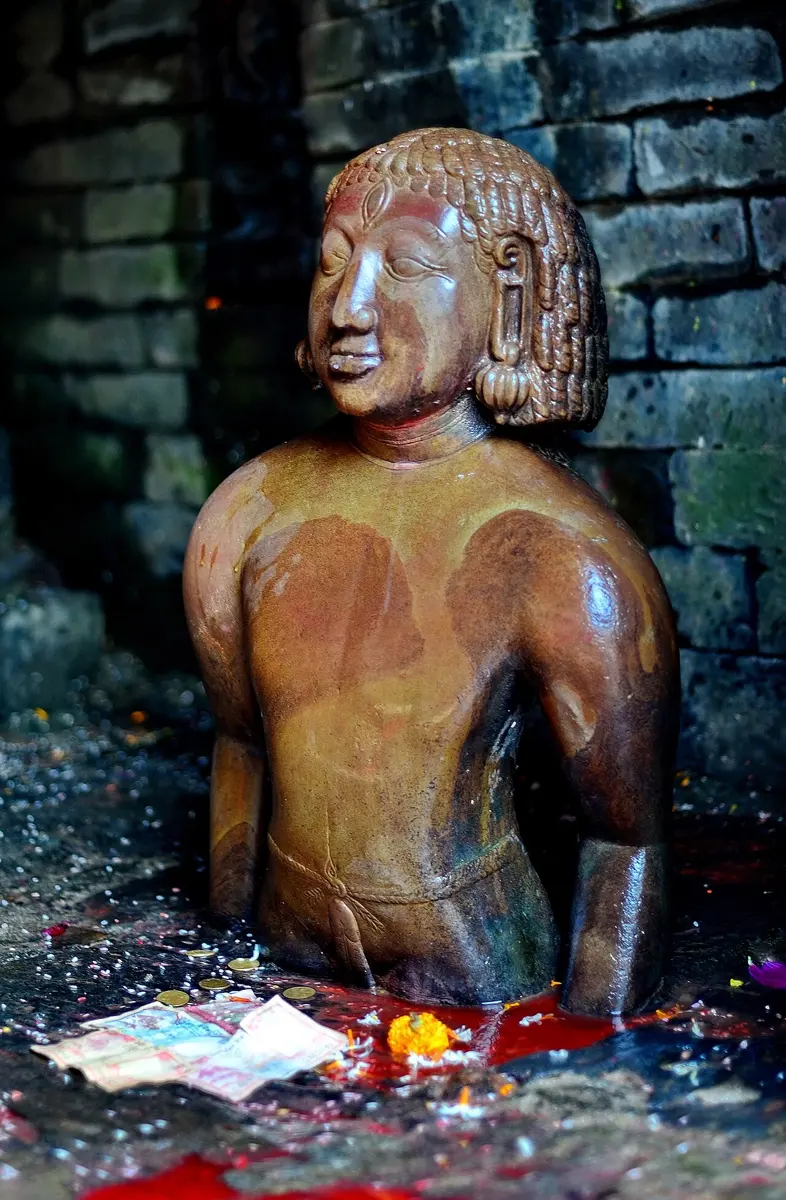
Down at Aryaghat, by the river at Pashupati, a smooth stone figure stands half buried in the ground, with offerings at its foot. It is called विरूपाक्ष (Virūpākṣa), and it is Shiva, with a third eye in his forehead. Some say it is the oldest sculpture in the Valley, from the time of the Kirat kings, before the Licchavis. Another very early image is a गजलक्ष्मी (Gajalakṣmī), the goddess Lakshmi standing between two elephants that pour water over her, at a water spout in Chyasal, Patan. Neither carries an inscription, so neither has a date of its own. One art historian, comparing their earrings, hair and clothes with carvings that can be dated, put the गजलक्ष्मी in the second century and the विरूपाक्ष in the late fourth; another put the विरूपाक्ष in the sixth. Both are guesses from style, and both images are older than almost anything else in the Valley.
The Licchavi carvers
The Licchavi kings’ inscriptions in the Valley begin in the fifth century, and from their time come many of the stone images in its temple yards. Their sculptors carved in the dark stone, and they learned much from India, where the Gupta kings ruled.

The best known are the striding Vishnus that King Manadeva set up in 467, which Signs and Stories tells. Another subject they carved again and again is Shiva and his wife Parvati together, which the Valley calls उमामहेश्वर (Umāmaheśvara). The couple sit on their mountain, Kailash. On the oldest slabs only two others are with them, their bull Nandi and their son Kumara. Over the centuries more of Shiva’s family and followers crowd in, and on many later slabs a row of little attendants dances along the bottom.
The loveliest might be a small slab, 84 centimeters tall, from a water spout at Deopatan, now in the National Museum. It shows the Buddha’s mother, Maya, standing and holding the branch of a tree, as she is shown at his birth. Her dress is carved so thin that her body shows through it. Nothing else in the Valley is quite like it.
Its date is a puzzle, and the puzzle is a good way to see how hard dating stone is. Experts have put the Maya relief in the fourth or fifth century, the fifth or sixth, and the tenth to the thirteenth: a spread of nearly a thousand years for one carving. A standing Buddha just west of the great stupa at Svayambhu, at 3.2 meters the tallest stone Buddha known in Nepal, has been dated anywhere from the fifth century to the fifteenth.
How can experts disagree by a thousand years? Because stone keeps no clock. Wood can be dated from the carbon inside it, as Wood tells, but a stone is as old as the mountain it came from. Tool marks don’t help much either: since the tools hardly changed, the same marks were being made in every century. And a carver may work in an older style on purpose. One expert thinks the Svayambhu Buddha is just such a case: carved in the old Licchavi style, but in the fifteenth century, since its surface shows none of the wear that a thousand years of weather and worship would have left. So a date has to come from somewhere else: from a dated inscription on the stone, or from comparing its style with images that have one.
That is why an inscription matters so much. One, on a carving of Shiva and Parvati found at Sikvabahi in Patan, gives its year in two different counting systems at once: the era the Licchavi kings counted from, and the Saka era used in India. It has been called the Rosetta Stone of the period, after the Egyptian stone that let scholars read one script through another: here, anyone can line up the two counts of years and check one against the other. A stone with a date is a fixed point. Every undated stone is then placed by how much it looks like the dated ones, and that is a judgment people can disagree about.
Stone that carries water
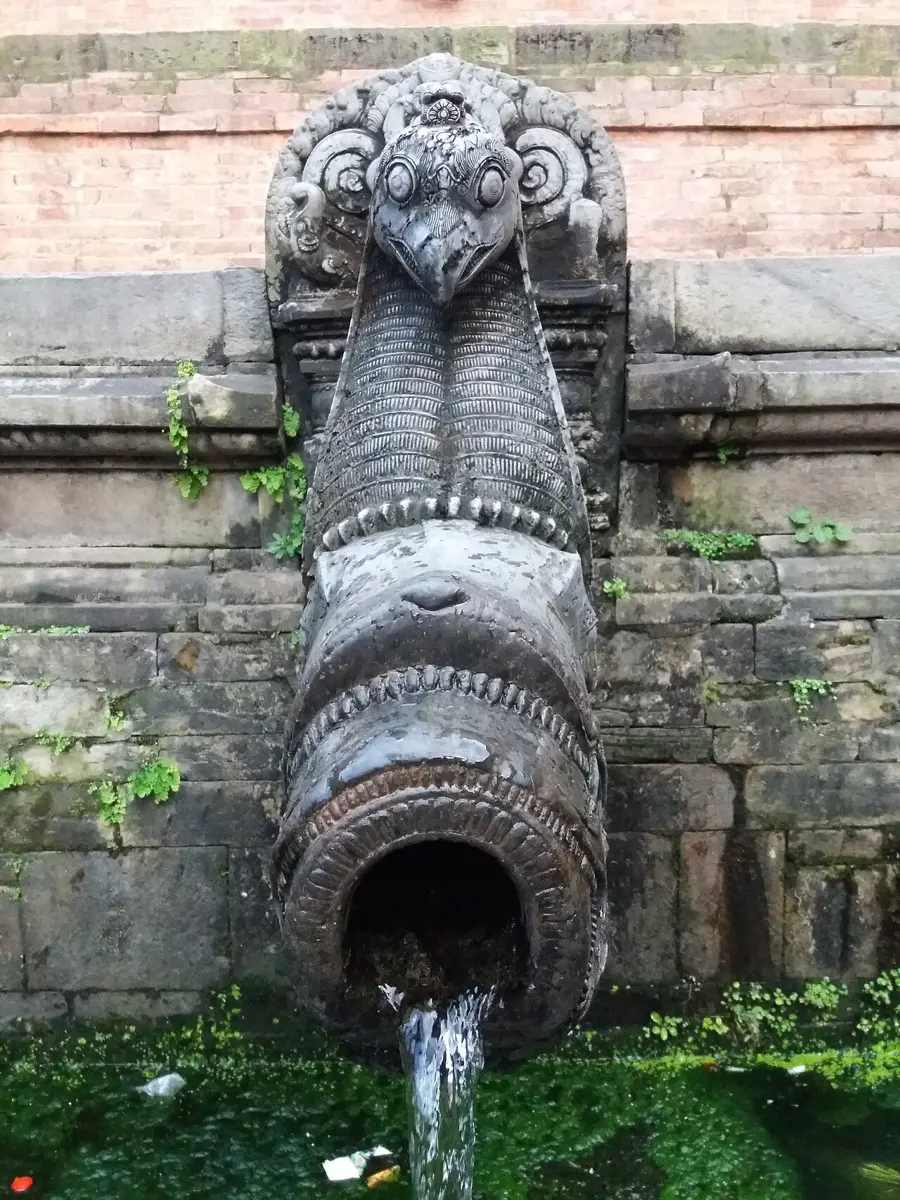
Some of the finest stone carving in the Valley is not in a temple at all. It is at the stone water spouts, the हिटी (hiṭī), sunk into the ground so that water led through underground channels from ponds and hills could pour out of a carved spout. Building one was a gift for the good of your family, and people still fetch water from several of them. Who built them and how they were shared is told in Life in Licchavi Times, which starts with one.
The carvers made a spout into a picture of water. The spout itself is usually shaped as a मकर (makara), a beast of the waters, which stands for water in the clouds and in the rivers both. In the oldest spouts, a carved यक्ष, the same kind of earthy spirit as the Hadigaon torso, often stands in the wall just under the spout. In later centuries his place goes to भगीरथ (Bhagīratha), the king who, in the old story, brought the river Ganga down from heaven to earth, so that the water pouring past him seems to fall from the sky. The Your Town’s Past guide to a spout says what to look for on the one nearest you, and its guide to photographing an inscription how to record the writing beside it.
So stone in the Valley is the craft of taking away, from a block that can only get smaller. It begins at the quarry and ends with pumice and water, and the stone decides how it is cut: soft stones give way, hard ones have to be shattered. The oldest figures, like the man from Maligaon, show the Valley’s sculptors starting from India’s, first the Kushan carvers and then the Gupta, and making the style their own in the dark Licchavi stone. But a stone keeps no record of its own age, so its date comes only from an inscription, or from a careful and arguable guess. Wood is another matter, and so is a carver’s way with it.
Found a mistake? Please tell us.