
In 1832 a committee of Britain’s Parliament called a young woman from Leeds named Elizabeth Bentley. She was twenty-three. Asked when she had started work in a factory, she answered, “When I was six years old.” She had been “a little doffer” in a flax mill, taking full bobbins of thread off the spinning frames and putting empty ones on. Her hours, when the mill was busy, were “From 5 in the morning till 9 at night”, with forty minutes for a meal at noon. If the children were slow, the overlooker strapped them, girls as well as boys. When the work left her no time to eat, she said, “the overlooker took it, and gave it to his pigs.”
Bentley lived through the biggest change in how people make things since farming began. In about a lifetime, from the 1760s to the 1830s, Britain moved much of its work from hands and homes to machines and factories, and from muscle, wind and water to coal and steam. A country that had bought its best cotton cloth from India came to sell cloth to India. Cities grew faster than anyone could build for them. Children like Bentley paid a large part of the price, and so, for a while, did most working people.
So here is this chapter in brief. First, how the machines and the engine worked, since everything else follows from them. Then what they did to the people who worked them and the towns they lived in. Then the question historians still argue over: why did this happen first in Britain, and not in China or India, which had been richer and more skilled for most of history? And last, the answers people gave to the factory, from a mill owner who ran his mill differently, to Parliament, to Karl Marx.
Machines that spin and an engine that pumps
To make cloth, you first spin: you pull loose cotton fibers out and twist them into a thread. Then you weave: you cross threads over and under each other on a loom. For thousands of years both were done by hand, and spinning was the slow part. One spinning wheel turns one spindle, so one spinner makes one thread at a time.
The machines of the 1760s and 1770s attacked exactly that. James Hargreaves, from near Blackburn, built a frame he called a jenny, which turned eight spindles at once from a single wheel; later jennies turned more than a hundred. Richard Arkwright built a spinning machine that was soon turned by a water wheel, so it had to stand by a river in a building full of such machines: a factory. Samuel Crompton, of Bolton, combined the two into the “mule”, which could spin thread fine and strong enough for the best cloth. Weaving was harder to hand to a machine, and power looms worked well enough to pay only in the 1820s.
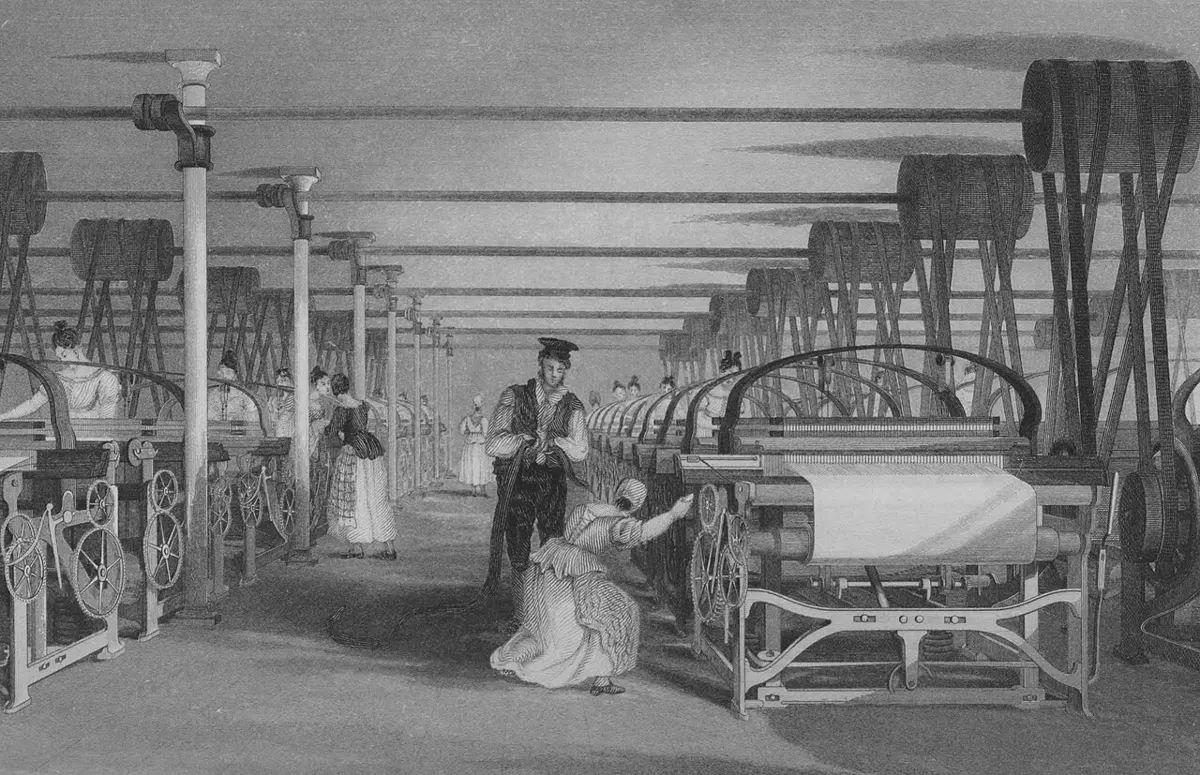
How much difference did it make? One rough estimate for the 1780s is that a pound of very fine yarn took an Indian spinner about 500 hours of work, and a Lancashire mule about 20. By 1825 the best mules, bigger, faster and driven by power, needed less than an hour and a half. Prices fell with the hours. The cost of ordinary yarn, allowing for the change in other prices, fell to about a quarter between the early 1780s and the early 1820s.
The other half of the story is power. Britain had long dug coal, and its mines flooded. In 1712 an engine was built in the Midlands to pump them out. Steam filled a large cylinder under a piston; then cold water was sprayed in, the steam turned back into water and left almost nothing behind, and the air outside pushed the piston down. A great wooden beam on top rocked like a seesaw and worked the pump. It ran, but it wasted fuel, because each stroke cooled the cylinder that the next stroke had to heat up again. By one modern reckoning it turned less than one percent of its coal’s energy into work, which was fine only at a coal mine, where coal cost almost nothing.
In 1763 James Watt, who made instruments for the University of Glasgow, was asked to repair a small model of such an engine. Two years later he saw the answer: let the steam out into a separate vessel, a condenser, kept cold, while the cylinder stayed hot all the time. His engines burned about two-thirds less coal for the same work. With a businessman from Birmingham, he began making them in 1775.
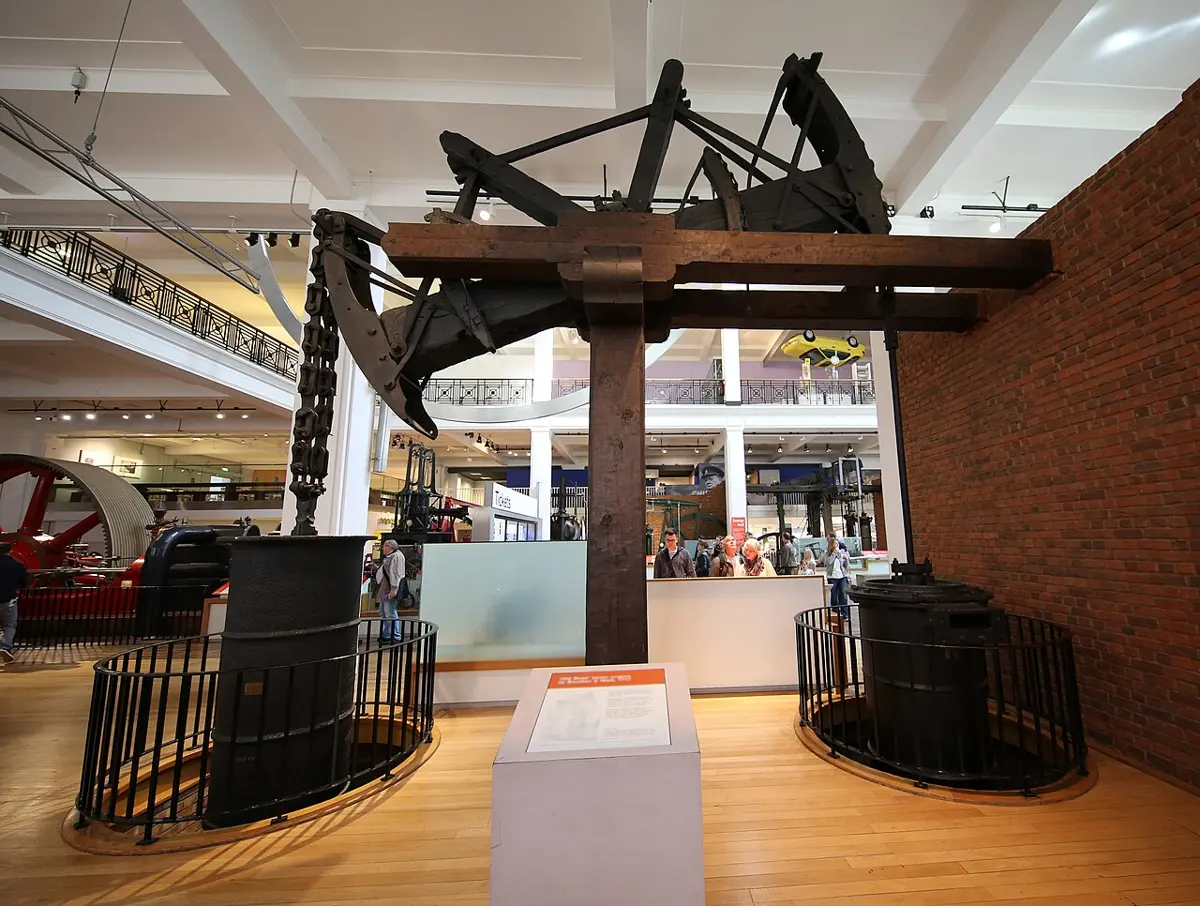
The businessman’s own works ran on a water wheel, and his stream wasn’t big enough for the factory he wanted. So in 1777 Watt put in an engine to pump the water back up to the wheel, and it kept the works going for seventy years. From the 1780s Watt’s engines could also turn a wheel, not just pump, and once that was possible, a mill no longer had to stand by a river. It could stand where the coal was, and where the workers were: in towns. Lancashire, in northwest England, with its coalfields and the port of Liverpool, became the center of it all. Britain brought in less than five million pounds of raw cotton a year in the early 1770s, and 528 million in 1841. The railway followed the cotton. The first great line, opened in 1830, ran between Liverpool and Manchester, and within fifteen years all of England’s great cities were joined by rail.
That changed where a cotton shirt came from.
In 1700 Britain was a customer of India. The East India Company brought home about 600,000 pieces of Indian cloth a year, and sold most of them on, to Europe, West Africa and the American colonies. Britain’s wool and linen makers were afraid of it, and from 1701 Parliament banned printed calico from India for use in Britain. By 1850 the journey ran the other way. Most of the cotton was grown and picked by enslaved people in the American South, on land taken from Native Americans, and British cloth was sold in India too. Indian weavers kept most of their own market until the 1860s, but the fine cloth Bengal had sold abroad lost its buyers to the mules of Lancashire. In 1818 the East India Company closed its cloth-buying station at Dhaka. It was not the shipping costs or the duties, a historian of Bengal wrote, but “the sharp reduction in prices of English cotton goods of a similar description”.
Mills, children and cities
The factory changed what a working day was. In a mill the machines set the pace and the owner set the hours, and fines and the strap kept time. A child who came a quarter of an hour late, Elizabeth Bentley said, lost half an hour’s pay: “we only got a penny an hour.” Some children were bound to a mill for years. A young man told the same committee that as a boy he had been bound to one for six years, for fifteen shillings paid to his mother, and that when he ran away he was brought back and whipped. Another was beaten whenever he came late: “I used to run, and cry all the way as I went to the mill.”
Their words have to be read knowing who gathered them. The committee’s chairman wanted a law limiting children’s hours. He chose the witnesses, they did not speak on oath, and many questions were put so that a witness had only to say yes. Other members of Parliament objected, so in 1833 the government sent its own commissioners to the mills, and they took evidence on oath. They found beating less common than the committee had heard, but they did find that children worked hours that harmed their health and kept them from school.
How many children worked, and how young? One historian read more than 600 life stories written by working people. Child labor, she found, rose with industry: between about 1800 and the 1830s more children worked than before or after, and they started youngest, orphans and the poorest youngest of all. In the textile mills of 1833, children under thirteen were a tenth to a fifth of the workers, and teenagers from thirteen to eighteen from about a quarter to over half.
Not every hand worker lost at once. While spinning raced ahead and weaving was still done by hand, Britain ran short of handloom weavers, and in the 1790s they earned very well. Then the power loom came, and machines took their work too.
Then there were the towns. In 1801, about 80,000 people lived in what the census of 1851 called the Manchester district. By 1851 there were about 230,000, with many more in the mill towns round it. In 1842 a young German named Friedrich Engels came to Manchester to work in his father’s cotton firm. He went through the workers’ districts and wrote down what he saw. In the factory towns, he found, houses were built back to back, so that no air could pass through them, with a single privy for several houses. Of the river Irk, he wrote: “At the bottom flows, or rather stagnates, the Irk, a narrow, coal-black, foul-smelling stream, full of debris and refuse.” In one district, “Little Ireland”, he wrote, there were “about two hundred cottages, built chiefly back to back, in which live about four thousand human beings, most of them Irish.” Once he went into Manchester with a well-off man of the town and spoke to him of the bad building and the workers’ wretched quarters. The man heard him out and said, “And yet there is a great deal of money made here; good morning, sir.”
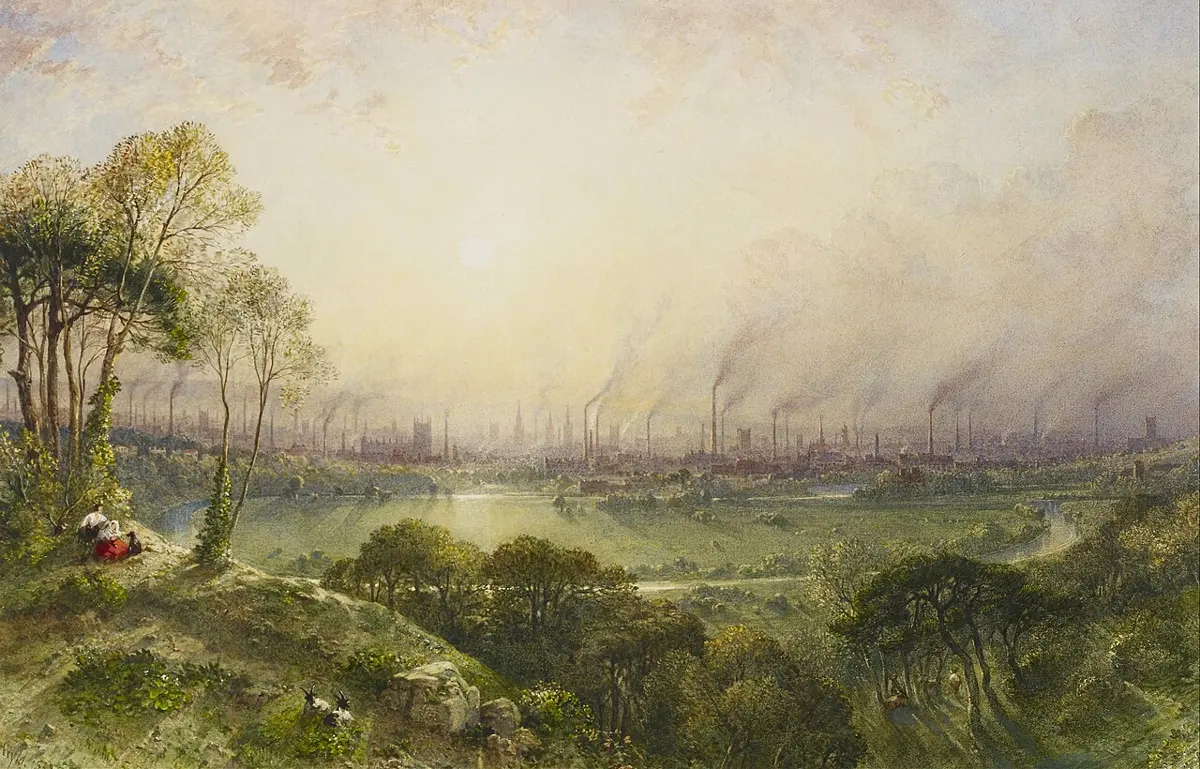
Deaths from hunger, bad housing and overwork, which no one person caused, workers called “social murder”, and Engels took up their phrase. His book, The Condition of the Working Class in England, came out in German in 1845, when he was twenty-four.
Did the factories make working people poorer or richer? Historians have argued about it for two centuries, and the best modern reckonings run like this. Between the 1780s and the 1850s the average working family’s living, counting what its wages could buy, rose by less than 15 percent. In the same years Britain’s output per worker grew much faster, by nearly half between 1780 and 1840 alone. So for two generations, much of what the machines added went to the owners, as profits that paid for more mills and machines. After about 1840 wages began to rise faster than output, and the gains reached working people. Some historians count the gains earlier and larger. For children like Elizabeth Bentley, born into the early years, the later gains came too late.
Why Britain?
Why Europe pulled ahead of Asia is an old question, and the machines put it in its sharpest form. In 1700 the finest cotton cloth in the world came from Bengal, and India’s merchants traded from East Africa to Southeast Asia. Why was it Britain that built the mule and the steam engine? The idea of a spinning machine was not new. A machine for spinning hemp had been invented in China in the 1200s, and it “was never generally adopted and fell out of use.” What needs explaining is why such machines paid in Britain. Historians give four main answers.
The first is about wages and coal. British workers, by the measures of their day, were paid more than workers almost anywhere else, and in northern Britain coal was the cheapest fuel in the world. A machine that saves workers’ hours and burns coal is worth building only where hours are dear and coal is cheap. The economic historian Robert Allen worked out that buying a jenny paid back well in England and would not have paid in France, and a steam engine made little sense anywhere coal wasn’t cheap. Counted in money, an unskilled laborer in India earned perhaps a fifth of an English one, so Indian cloth makers had little reason to save labor.
The second, Kenneth Pomeranz’s, is about coal and colonies, two lucky breaks for Britain. Its coal lay close to its towns and its ports. China had coal too, but most of its mines were inland, far from its busiest regions. And Britain had the Americas. Its cotton grew on land taken from Native Americans and was worked by enslaved Africans, so it fed Britain’s mills without using a single British field. Pomeranz calls such land “ghost acres”.
The third, Prasannan Parthasarathi’s, starts from India. Britain had two problems that India didn’t have. Its forests were running out, which pushed it to coal and so to engines. And it couldn’t match India’s cloth, so first it banned it and then it learned to imitate it by machine. India had no shortage of wood and needed no answer to anyone’s cloth, so it had no reason to look for either solution.
The fourth, Joel Mokyr’s, is about knowledge. Since the 1600s European thinkers had argued that knowledge of nature should be put to use, and by the 1700s Britain was full of people acting on it: lecturers traveling from town to town to show science, and clubs where scientists and engineers met. In Birmingham, the Lunar Society brought Watt and his partner together with chemists, a doctor and a famous potter. Inventions were written down, argued over and improved, and that, in this view, is why the changes kept coming instead of stopping after one or two.
The four answers overlap, and they also argue. Allen thinks Pomeranz basically right about coal, but doubts that ideas mattered as much as Mokyr says. Others answer Allen that the spinners the machines replaced were mostly women, whose pay was far lower than a man’s, so British labor was not as dear as he counts it. And a study of the cotton trade itself found that the bans on Indian cloth were broken so often that they made little difference either way. The question is open, and probably more than one answer is true.
Answers to the factory
One answer came from inside the mills. Robert Owen took over the big cotton mills at New Lanark, in Scotland, in 1800. He let no child under ten work in them, cut the working day to ten and a half hours, ran a village shop for the benefit of the people, and in 1816 finished a building he called the Institute for the Formation of Character, with a school for the children a year later. He was sure that people became what their surroundings made them.
Another answer came from Parliament, slowly. An act of 1819 banned children under nine from cotton mills, but no one was sent to check. The Factory Act of 1833 was the first that sent inspectors: four of them, for about four thousand factories. Children from nine to thirteen could work at most eight hours a day, and had to have two hours of school. A law of 1844 gave women the same twelve-hour limit as teenagers and made owners fence off dangerous machines, and one of 1847 cut the limit for both to ten hours a day.
The most radical answer came from Engels and his friend, the German writer Karl Marx. In 1848 they published a pamphlet, The Communist Manifesto. Factories, they wrote, had split society into two classes: the owners, who held the machines, and the workers, who had nothing to sell but their labor. By gathering workers together in the mills and the cities, the owners’ class was making, in their words, “its own grave-diggers.” One day the workers would take the factories for everyone. Near its end it says: “The proletarians have nothing to lose but their chains. They have a world to win.” Its ideas would shape much of the next century.
The plain lesson of the Industrial Revolution is that it was two things at once. It was the start of a long rise in what ordinary people could afford, as machines, coal and factories made cloth, and later almost everything, cheap. And for the people who lived through its first decades, children in the mills, families in crowded back-to-back houses, weavers in Bengal, it was hard, and its gains came late. It happened first in Britain for reasons still argued over: dear labor and cheap coal, colonies and enslaved people’s cotton, the competition of Indian cloth, a culture of useful knowledge, or all of them together.
Meanwhile, in Nepal: Jung Bahadur saw Britain’s factories on his visit of 1850, in The Kot and Jung Bahadur; at home the state’s work was done by people who owed it their labor, and its powder mills took machines only around 1888, in Life under the Ranas; and a jute mill at Biratnagar, whose workers’ strike of 1947 was the first test of the movement against the Ranas, opened only in the late 1930s, in The campaign against the Ranas and their fall, all in Nepal’s History, for the Curious.
Found a mistake? Please tell us.