
On 5 November 1688 a fleet sailed into Torbay, a wide bay on the south coast of England, and began putting an army ashore. There were dozens of warships and hundreds of smaller boats, and somewhere around fifteen thousand soldiers. Their commander was William of Orange, the leading officer of the Dutch Republic, whose title was stadtholder. His wife Mary was the eldest daughter of the man he had come to push aside, James II, king of England, Scotland and Ireland.
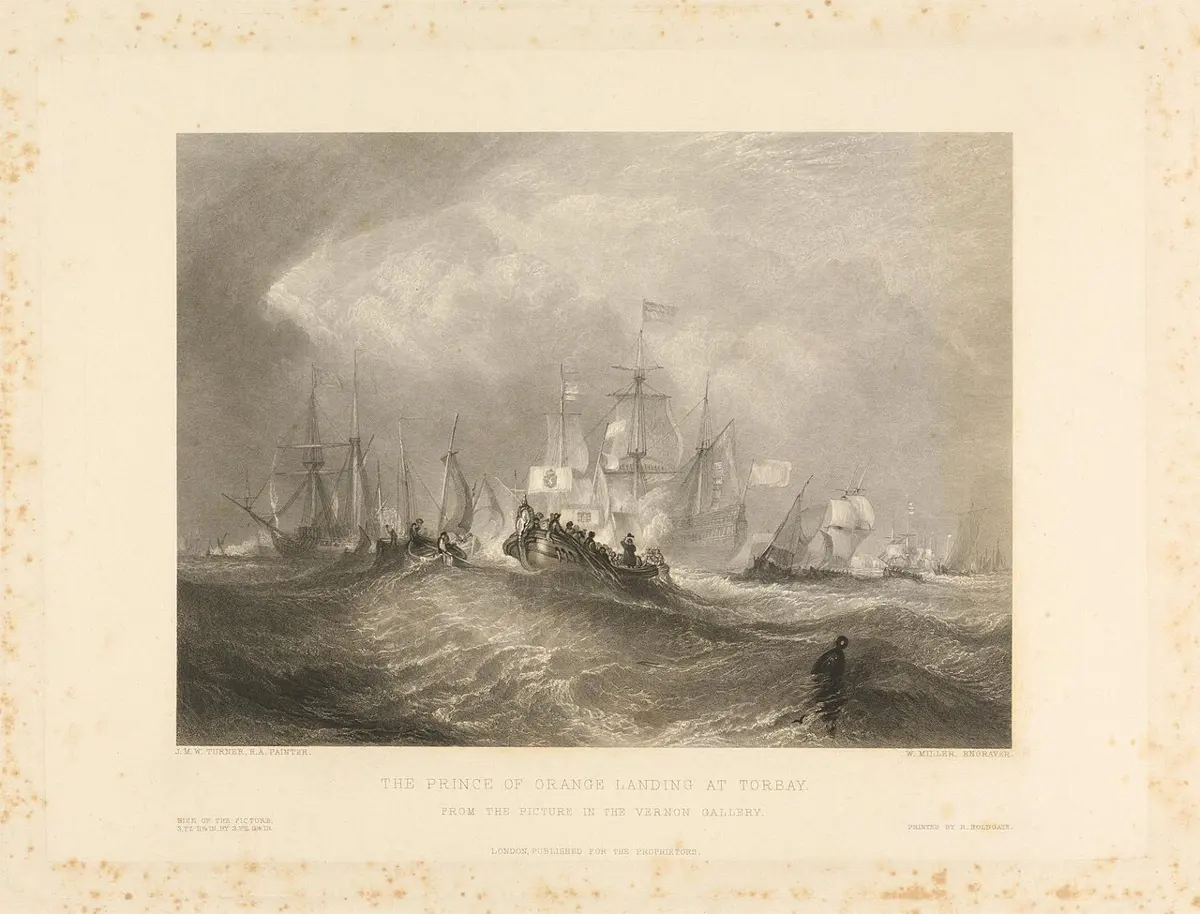
James had the bigger army, about thirty thousand men. He never used it. Some of his own officers rode over to William, among them John Churchill, one of his best generals. There were a couple of skirmishes, at Wincanton and at Reading, and little else. In December James sent his family away and tried to slip out of the country himself. On the way he dropped the Great Seal, the seal that made a king’s orders lawful, into the River Thames. Fishermen caught him at Faversham, on the coast, and he was brought back to London. A few days later he was allowed to slip away again, and on 23 December he sailed for France.
In 1688 and 1689 England swapped a king who claimed he could set aside the law for a king and queen who accepted a list of rules written by Parliament. That list, the Bill of Rights, is why the event is remembered as the start of a ruler who answers to law. A book by John Locke gave the change its reasons. Then, over the next century and a half, England’s farmers learned to grow far more food with fewer hands, and the old open fields and commons were fenced off. Whether that freed people for what came next is still argued.
Far away, the Kathmandu Valley was three small kingdoms, Kathmandu, Patan and Bhaktapur, making alliances and breaking them, and Gorkha was one hill kingdom among dozens. In the eighty years after 1688 England’s fields began to change, and in 1768 and 1769 Gorkha’s king, Prithvi Narayan Shah, took the Valley. Gorkha was making a state while Britain was making the changes that would lead to its machines.
A king above the law?
The quarrel was old. For most of the 1600s England’s kings and its Parliament argued about who had the last word. The first Stuart king, James I, told Parliament in 1610 that kings were God’s lieutenants on earth, an idea called the divine right of kings. Parliament was two houses, the Lords, for nobles and bishops, and the Commons, elected members, and kings needed it because new taxes had to have its agreement. In the 1640s the quarrel turned into a civil war. In 1649 the winning side put the king, Charles I, on trial for trying to hold “an unlimited and tyrannical power”, and cut off his head. For eleven years England had no king. In 1660 his son came back as Charles II, and when Charles II died in 1685 his brother became James II.
James was a Catholic, king of a mostly Protestant country with its own Church of England. Laws kept anyone who was not of that church out of government jobs and away from worship of their own. James did not try to get Parliament to change them. He simply set them aside by his own order. He put Catholics into the army and into offices, and in 1687 he declared freedom of worship. In 1688 he issued it again and ordered it read in every church. Few of the clergy read it. Seven bishops, the Archbishop of Canterbury among them, petitioned him, saying it was illegal. He had them tried for sedition, and on 30 June 1688 a jury let them go.
Freedom to worship sounds good to us, and some Protestants outside the Church of England welcomed it. But the question underneath was not about religion alone. If a king could set aside one law by his own order, he could set aside any law. And three weeks before the trial, James’s queen had given birth to a son. Mary, a Protestant, had been next in line. Now a Catholic boy was, and it looked as if Catholic kings would rule for generations.
On the day the bishops went free, a letter signed by seven powerful men left for the Netherlands, inviting William to come. William had his own reason to say yes. He was at war with Louis XIV of France, the strongest king in Europe, who was James’s friend, and an England on his side would change that war.
What Parliament wrote down
With James gone, a Parliament met in January 1689. It decided that James had given up the government by running away, and that the throne was empty. In February it offered the crown to William and Mary together, and read to them a list of the old rights it said James had broken. William and Mary accepted, and late in 1689 the list became law as the Bill of Rights.
Its English is old, but what it says is plain. A king may not set aside laws, or stop them working, without Parliament’s consent. He may not raise taxes without Parliament’s grant. He may not keep an army in peacetime without Parliament’s consent. Subjects may petition the king without being punished for it. Elections to Parliament should be free. What is said in Parliament may not be tried in any court outside it. There should be no excessive bail, no excessive fines, and no “cruel and unusual punishments”. And Parliaments should meet often.
So the king still ruled, but inside the law, and the law was what Parliament made. The money and the army, the two things a king most needed, now depended on Parliament too. That is the ruler who answers to law.
The same Bill was just as plain about who could rule. Because it was, in its own words, inconsistent with the safety of “this Protestant kingdom” to be governed by a Catholic prince, no Catholic, and nobody married to one, could ever wear the crown.
It is worth being clear about what the Bill did not do. Parliament was not the people. England and Wales had about 4.9 million people in 1690, and only about 200,000 could vote, by rules that changed from one town or county to the next. A very few women who owned property voted here and there. Women had no vote in national elections until 1918, and not on the same terms as men until 1928.
Religious freedom came only in part. A Toleration Act of 1689 let Protestants outside the Church of England worship in their own chapels, once these were registered. It did not cover Catholics, Jews, atheists, or Protestants who denied the Trinity. Even those it did cover were still kept out of Parliament and government jobs. Catholics could not sit in Parliament until 1829.
And it was not bloodless. In London, once James had fled, crowds wrecked Catholic houses and chapels. In Scotland, James’s supporters won a battle at Killiecrankie in 1689 and held out in the Highlands until 1692. In Ireland, where James himself landed in 1689, the war went on for more than two years, with his side losing at the Boyne in 1690 and at Aughrim in 1691. For Ireland’s Catholics, 1688 was a defeat, not a deliverance.
Locke’s reasons
John Locke had good reason to be glad. An English philosopher, he had fled to the Netherlands in 1683, when men close to him were suspected of plotting against Charles II and James, and he came home in February 1689, in the same weeks the crown was offered. That year a book appeared with no author’s name on it, Two Treatises of Government. It was Locke’s. Most of it had been written years earlier, around 1681, when his friends were trying to stop James from ever becoming king. Now he wrote a preface hoping it would help “establish the throne of our great restorer, our present King William; to make good his title, in the consent of the people”.
Imagine people with no government at all. Locke calls this the state of nature, and says it is “a state of perfect freedom”, and of equality too. Even there, he says, reason teaches a law: “no one ought to harm another in his life, health, liberty, or possessions.” The trouble is that nobody is there to judge when someone does. So people agree to join together and set up a government, to protect what he calls their “lives, liberties and estates, which I call by the general name, property.”
From there the rest follows. A government is made by people’s consent, for that purpose, and it holds its power as a trust. If rulers turn on the people they were set up to protect, and try to rule by “absolute arbitrary power”, they break the trust, and the people may set up a new government. Who decides when that has happened? Locke answers in five words: “The people shall be judge.”
In 1689 that read as a defense of what had just happened. It became much more. Later readers took from it the idea that government needs the consent of the governed, and that people have rights no ruler gave them and no ruler may take.
Locke, like the Bill, had limits of his own. He wrote about liberty while, in the 1670s, he had held shares in the Royal African Company, which shipped enslaved Africans to the Americas, and he had helped draft the laws of the English colony of Carolina, which allowed slavery. Some historians see a hypocrite. Others answer that he was a secretary drafting for his employers, and that his later book was written against the kind of absolute power that slavery came from. That argument is still going.
So is the argument about 1688 itself. In the 1800s the historian Thomas Macaulay called it “of all revolutions the least violent” and “of all revolutions the most beneficent”, the calm English way of winning freedom, and for a long time that was the story schoolbooks told. Others since have called it a Dutch invasion, pointing out that Parliament was hardly free with William’s soldiers in London. More recently one historian has argued the opposite of Macaulay: that 1688 was popular, violent and bitterly divisive, the first modern revolution, while his critics think he pushes that too far.
England’s fields
In much of middle England a village’s farmland lay in a few huge fields with no hedges. Each family held its land not as one plot but as long narrow strips scattered across all the fields, some good soil and some poor. The village decided together what each field would grow, and everyone followed. A common pattern was three fields: one in wheat or rye, sown in autumn, one in a spring crop such as barley, oats, peas or beans, and one resting, unsown, for a year. The next year each field moved one step along. After harvest, and on the resting field, the whole village’s animals grazed together. Beyond the fields lay the commons and rough waste land, where even families with no strips might keep a cow, cut fuel, or gather what they could.
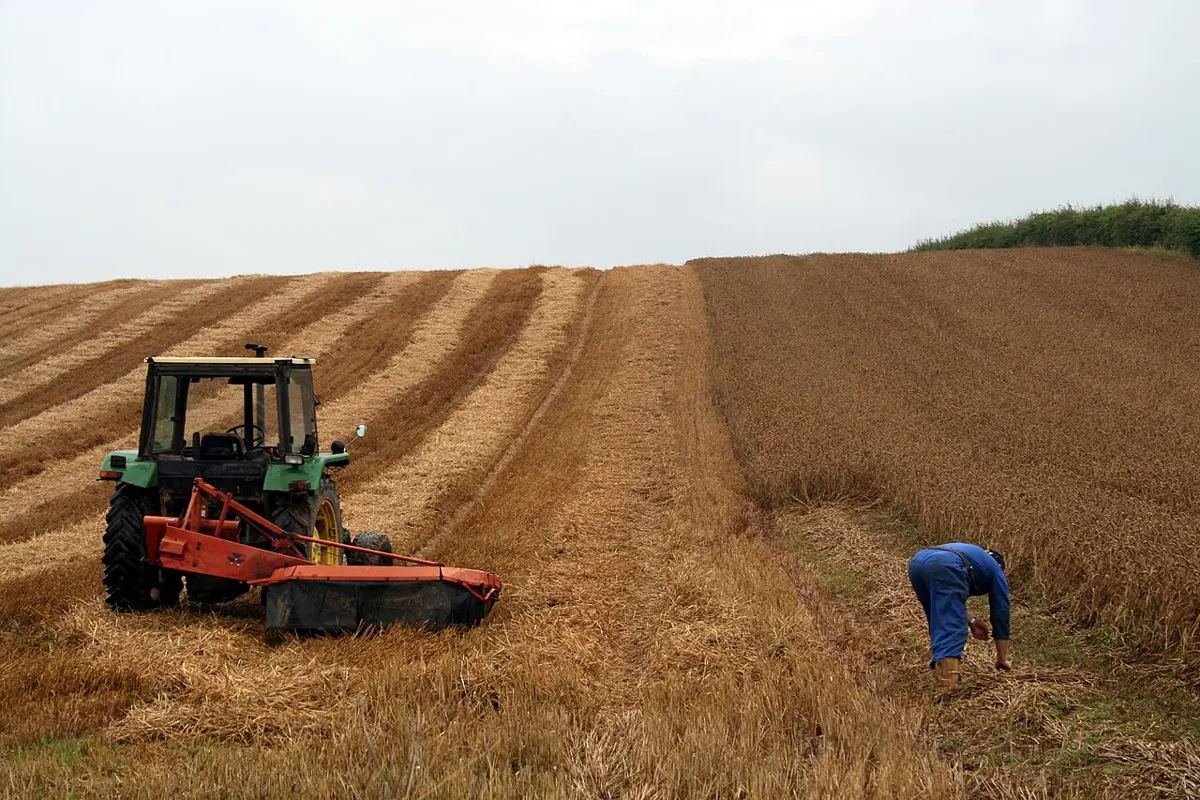
The resting year was not laziness. Plowing the empty field cleared its weeds, and the animals grazing on it left their manure. But a third of the land grew nothing each year, and the grain fields were always short of what we now know was the real limit on a harvest: nitrogen, the plant food that manure carries. More grain needed more manure, which needed more animals, which needed more fodder, which needed land the grain was using.
Two crops broke that circle. One was clover. Clover, like peas and beans, has bacteria in its roots that take nitrogen from the air and leave it in the soil. Farmers began sowing it from the mid-1600s, and the wheat that came after it grew better. The other was the turnip. Sown in rows, turnips could be hoed while they grew, which cleared the weeds as well as a resting year did, and they fed cattle and sheep through the winter. More animals meant more manure.
Put together, they made a round of four: wheat, then turnips, then barley, then clover, and back to wheat. It is called the Norfolk four-course rotation, after the county in eastern England where it became famous. No field ever rested, and half the land each year fed animals, whose manure fed the grain.
None of this happened quickly. Turnips are first recorded as cattle food in Suffolk in 1638, but they were not common until the middle of the 1700s, and the full four-course round was not widespread until the 1800s. In Norfolk, clover and turnips grew on about a tenth of the sown land between 1660 and 1739, and on about half by 1836. Across England, resting land fell from about a fifth of the plowland in 1700 to 4 percent in 1871. Wheat harvests per acre rose by about a quarter between 1700 and 1800, and by about a half again between 1800 and 1850.
That last number is the one that mattered. England had about 5.7 million people in 1750. It had reached about that many before, in Roman times, around 1300 and again around 1650, and each time it had stopped growing, because the farms could not feed more. This time it did not stop. By 1850 England had 16.6 million people, and they were fed mostly from its own farms. And they were fed by fewer farmers. By 1850 only about one British worker in five worked on the land, a smaller share than in any other country on Earth. The rest could work at something else.
The heroes, and the hedges
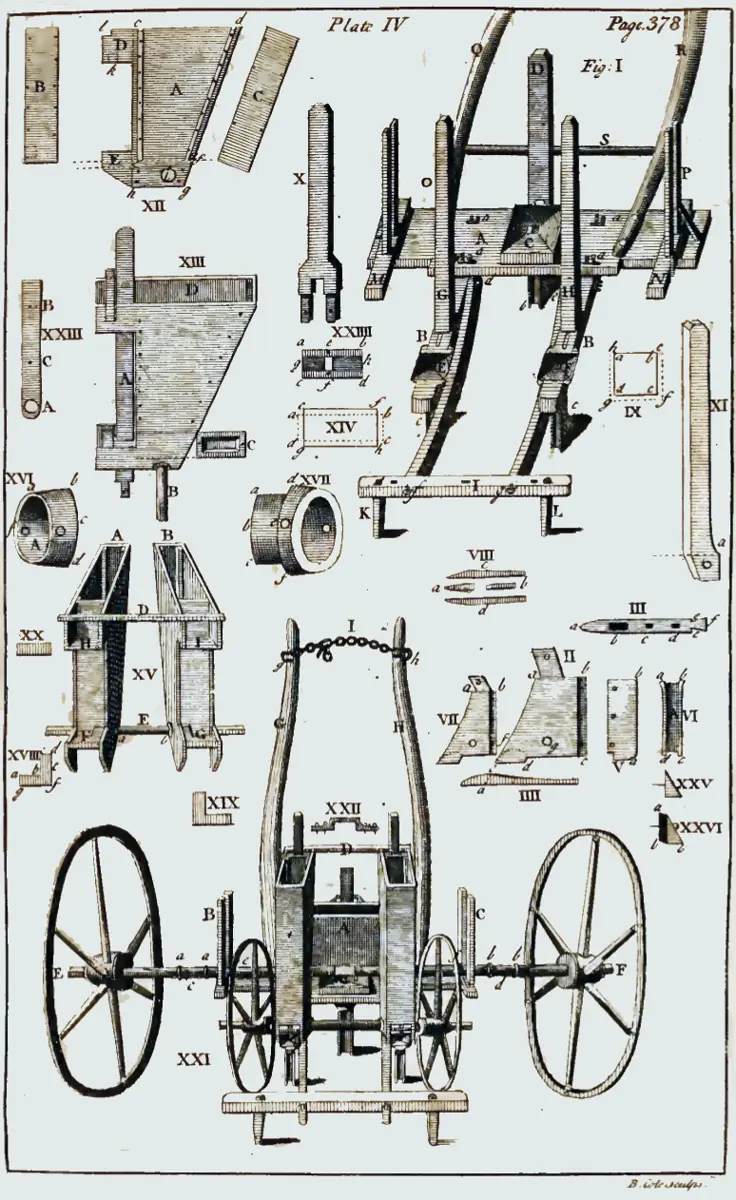
The older textbook story gives this change to a few great men. Jethro Tull made a seed drill in 1701, a horse-drawn machine that sowed seed in neat rows. “Turnip” Townshend, a lord who left politics in 1730, brought in turnips. Robert Bakewell bred better sheep and cattle. Arthur Young wrote books about the new farming. Historians today are much less sure. Townshend was a boy when turnips were first grown on his estate. Tull was not the first to make a seed drill: farmers in China had iron drills with several tubes by the 2nd century BCE, and in India the drill was in wide use among peasants by Mughal times. And his own drill was hardly used on English farms until a century after his book about it, published in 1731. He also thought manure was unnecessary, which was wrong. Bakewell’s sheep were a success; his cattle were not. Young has been called a charlatan by one writer and an early social scientist by others. The change was made by thousands of ordinary farmers, slowly.
The other great change in the fields was enclosure. To enclose a village was to end the open fields and the commons: the strips and the common rights were swapped for separate fields, each with one owner, fenced off with hedges and ditches. Enclosure was centuries old, but after 1750 it was mostly done by Act of Parliament, a village at a time, when the biggest landowners asked for one. In two bursts, in the 1760s and 1770s and again during the wars with France from 1793 to 1815, Acts of Parliament enclosed about a fifth of England’s land. In Oxfordshire, Northamptonshire and Cambridgeshire it was more than half.
Here 1688 and the fields meet. The Parliament that the Bill of Rights made strong was a Parliament of landowners, chosen, around 1689, by about one person in twenty-five. The landowners asked for each Act, and landowners passed it.
Who gained? The landowners did: rents went up when a village was enclosed. Who lost? The landless, who were most of a village, lost the commons where they had kept a cow and cut fuel. Families who had held common rights were given small plots in exchange, but fencing them cost money, and many sold up within a few years and lived on wages alone. In one county, between a third and a half of the landowners sold their land within two or three years of an enclosure.
How much all this did, and whether it freed hands for the factories, is the part historians argue over. The historian Mark Overton, who wrote the standard modern account, puts the great leap in the century after 1750: each farm worker grew more food, so a smaller share of workers was needed on the land, and in his view better farming made the industrial changes possible. The economic historian Robert Allen, from a careful study of the English Midlands, tells it differently. He finds the small farmers of the open fields already doubling their grain harvests in the 1600s, enclosure adding only about 6 to 14 percent, and the higher rents mostly money moved from farmers to landlords; his critics answer that he compares different villages at one moment, not the same village before and after. In the Midlands, he found, the people no longer needed on the farms stayed, and grew poorer, because industry came to that region a century later. Those who have counted who worked at what, century by century, go further back still: Stephen Broadberry and his colleagues find that most of England’s move off the land had happened before 1700, and that the factories, when they came, grew more through machines than through extra workers.
Enclosure’s part is argued too. One historian of it concludes that the countryside’s own growing population mattered more, and that enclosure helped the move to the towns but was not its main cause. What is not argued is that by 1850 a small share of Britain’s workers grew most of the food for everyone else.
So two things changed in England in these years, one quickly and one slowly. In 1688 and 1689 a king fled, and Parliament wrote down rules that its kings would have to keep, with Locke’s book to say why: government is a trust from the people, and must rule by law. The rules were real, but the people they served were few, and Protestant. Over the next century and a half England’s farmers, with clover, turnips and a new round of crops, grew far more food, and fewer of them were needed to grow it, while enclosure, asked for and passed by landowners, took the commons from the poor. By 1850 Britain had more people than ever before, fed mostly from its own fields by a smaller share of its workers than any other country, and the rest were free to work at something else.
Found a mistake? Please tell us.