
Children all over Nepal learn to sing that they are सयौँ थुँगा फूलका हामी, एउटै माला नेपाली (sayau̐ thũgā phūlkā hāmī, euṭai mālā nepālī): we are hundreds of flowers, one garland, Nepali. A girl singing it in Humla will never meet the boy singing it in Saptari. She doesn’t know his name, his language or his face. Yet the song asks her to feel that he is one of hers, and that if something happened to him, it would happen to her country.
That feeling is stranger than it looks. Nobody can know nearly thirty million people. Why should a stranger at the other end of the country feel nearer than a neighbor across a border a few kilometers away? This chapter is about that feeling, the nation, and about the harder question that comes with it: who gets to be in it, and on what terms.
People who imagine one another
A state and a nation are not the same thing. A state is the government and its laws, police, courts and borders, which Government and Law, for the Curious describes. A nation is the people who feel they belong together. The two don’t always match: the Nepali speakers of Darjeeling in Nepalis Elsewhere share a language with Nepal and belong to India’s state, and many of them insist, against those who doubt it, that they belong to India’s nation too.
In 1983 the historian Benedict Anderson gave the idea of a nation a short description that has been used ever since. A nation, he said, is an imagined community. Nobody in a nation knows more than a few of its people. What holds it together is a picture each of them carries of all the others, out there somewhere, belonging to the same thing. Imagined doesn’t mean false. Any group bigger than a village where everyone knows everyone is held together in people’s minds, by stories, symbols and habits. Anderson’s point was that a nation is made, by people, at a time, and could have been made differently.
He also noticed how odd its loyalty is. A nation is full of the rich and poor, the powerful and the ignored, and yet it is felt as a kind of comradeship, among equals, so strong that millions have been willing to die for it. Many countries have a tomb of an unknown soldier: nobody knows who lies there, and that is the point. He could be anyone, so he stands for everyone.
What made people imagine nations, Anderson thought, was print. When books and newspapers came to be printed in the languages people spoke, readers of the same language began to picture one another. A man reading the morning paper knows that thousands of others, whom he will never meet, are reading the same news at the same moment, about the same country. Later the state’s own tools did the same work: the census, which counts everyone into categories (Counting Peoples is about Nepal’s), the map, which draws one shape that schoolchildren learn by heart, and the museum, which tells one past.
So if a nation is imagined, someone does the imagining, and the picture they choose decides who fits in it comfortably and who is fitted in.
One nation
In the Panchayat years, from the early 1960s to 1990, Nepal’s state chose a picture and taught it. Nepal’s History, for the Curious tells the politics in The Rise of the Panchayat. The picture had three parts: a Hindu king, the Hindu religion and the Nepali language. Its slogan, एक भाषा, एक भेष, एक देश, one language, one dress, one country, and the dress that came with it are told in Dress and Houses; the one language in Languages.
The picture reached everywhere. Nepal was declared a Hindu kingdom in its constitution. Radio Nepal played Hindu devotional music and sermons; the state paid for Sanskrit schools; the national holidays were Hindu festivals; the national symbols, the color red, the cow and the flag, were drawn from Hindu tradition. An education commission in the 1950s had already advised that only Nepali be used in schools, and the plan for education of 1971 set out to harmonize Nepal’s many languages “into a single nationhood”. Schoolbooks told a history whose heroes were mostly kings and high-caste men. The census reported people’s religion and their mother tongue, and the share counted as Hindu and the share counted as speaking Nepali both rose, but it did not publish caste or ethnicity until 1991, as if the nation had none. People who organized as a people of their own were called साम्प्रदायिक (sāmpradāyik), communal, and seen as a threat to the country’s harmony.
Who felt at home in that nation? Many people did, and not only the powerful. For millions of Nepalis the king, the flag and the language were a real pride, and the idea of one nation made sense in a small country between two giants, which needed something to hold it together. But the picture fit some better than others. The sociologist Saubhagya Shah wrote that the national culture of those years was one “palatable to the dominant communities of Bahun and Chhetris, as well as to the elites among the Newars and other communities.” To belong fully, a Tamang, a Tharu, a Muslim or a Madhesi had to become a little more like a hill Hindu: speak Nepali at school and in the office, wear the dress for the photograph, keep the holidays. Many did. Others felt that the price of being counted Nepali was ceasing to be what they were.
At the very end of those years, in 1989, Bhutan tried the same thing with its own picture, one nation, one people, built on its northern customs. There, the Nepali speakers were the ones who didn’t fit, and many of them ended up in camps in Jhapa and Morang.
A garden or a melting pot?
In October 1908 a play opened in Washington called The Melting-Pot. Its writer was Israel Zangwill, a Jewish writer from London, and its hero, a young Jewish immigrant composer in New York, has a speech that gave the play its name: “America is God’s Crucible, the great Melting-Pot where all the races of Europe are melting and re-forming!” Into the pot, he says, go “Germans and Frenchmen, Irishmen and Englishmen, Jews and Russians”, and out of it God is making the American. The name stuck. A nation, in that picture, is a pot in which differences melt.
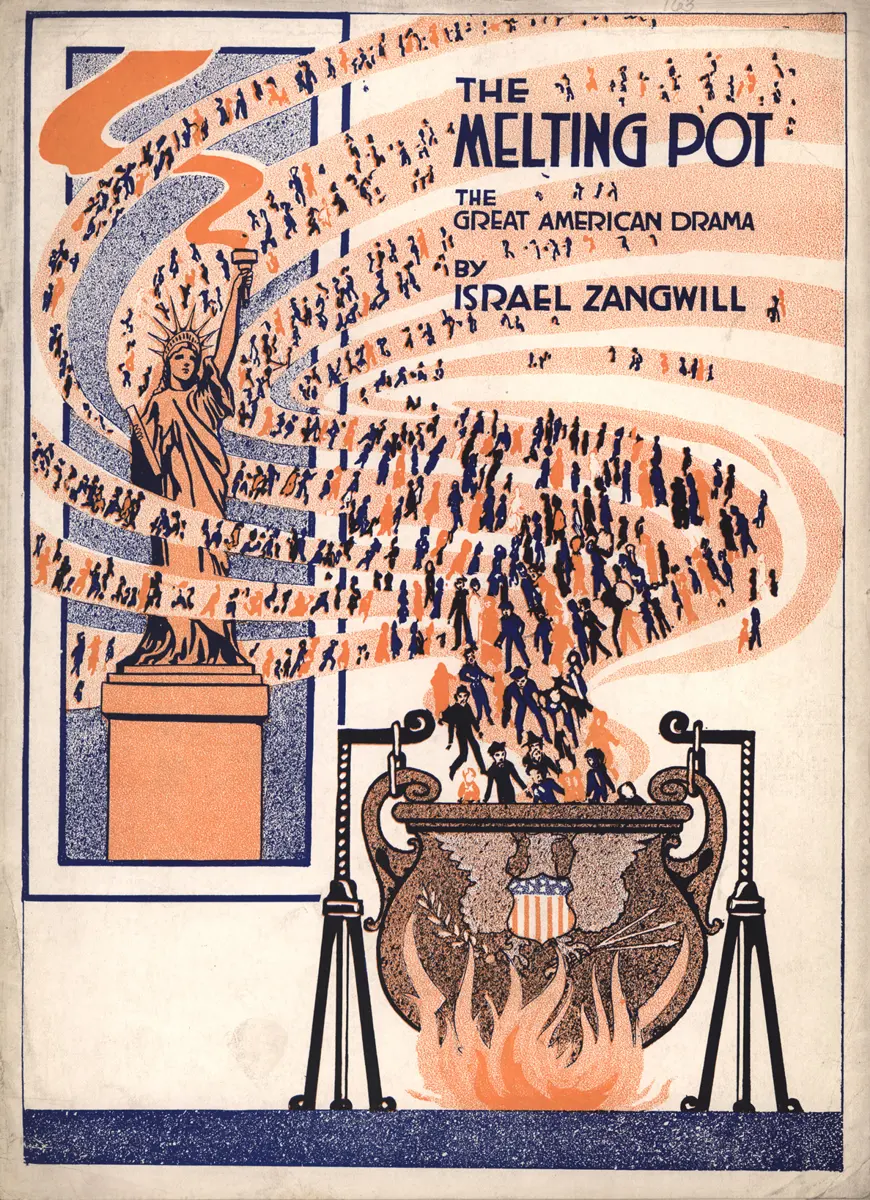
Not everyone liked being melted. A few years later, in 1915, the American writer Horace Kallen answered with another picture: a nation as an orchestra. Each people plays its own instrument, with its own sound, and together they make a symphony, “a multiplicity in a unity, an orchestration of mankind.” The melting pot asks people to stop being what they were; the orchestra asks them to play together.
Nepal has its own picture. In the दिव्य उपदेश (Divya Upadesh), the advice Prithvi Narayan Shah is said to have given near the end of his life, the country is called a garden of all its peoples, सबै जातको फूलबारी (sabai jātko phūlbārī). The words differ from copy to copy, and the text reached print only around 1950; Nepal’s History tells how it has been read. But the garden became the phrase every Nepali learns at school for the country’s many peoples.
In 1996, a few years after the Panchayat fell, two sociologists, Krishna Bhattachan and Kailash Pyakuryal, asked the question that gives this section its name. Can Nepal’s idea of national integration “be really equated with the idea of a ‘melting pot’ as is often done? Is Nepal a ‘garden of all castes and ethnic groups’ in the real sense?” Until 1990, they wrote, Nepal’s rulers had taken national integration to mean Hinduization, Sanskritization and Nepalization: the many peoples were asked to become more like the hill Hindus. And the rulers had found that idea in the garden itself, in Prithvi Narayan Shah’s saying that Nepal is a garden of four castes and thirty-six वर्ण (varṇa). The garden, in their reading, had worked like a melting pot. They called for the opposite, an integration whose aim was “not elimination of differences” but “to recognize and respect such differences.” Others disagree, and say that a shared language and shared institutions are what has let so many peoples live together in peace, and that a country needs some melting to hold together.
The country’s symbols moved towards the garden. After the movement of 2006, Nepal chose a new national anthem, by a competition, whose lyrics were by the poet Byakul Maila and its tune by the composer Amber Gurung: the hundreds of flowers and one garland of this chapter’s opening, with its “many peoples, languages, religions and cultures”. Children’s Social Studies books now ask which kinds of diversity the anthem names, under the heading unity in diversity. The Constitution of 2015 says, in its article called Nation, that all Nepali people, of many peoples, languages, religions and cultures, together make the nation (Names looks at what it calls them). On paper, at least, Nepal is now a garland and not a pot.
Movements and पहिचान
Changes like that don’t happen by themselves. They are won by social movements, which sociologists describe as purposeful, organized groups working towards a shared goal for society. A movement needs at least four things. A grievance: something wrong that people feel, not only see. People: enough of them, with leaders, money and ways to meet. An idea of “us”: a story of who they are and why the wrong is done to them, as Dalits, as women, as Madhesis, as Indigenous peoples. And a moment: a time when the state can be pushed, or has to listen.
Many of the movements in this book have been about पहिचान (pahicān), identity: the claim that a people has a name, a language, a history and a dignity of its own, and that the state should recognize them. They grew fast after 1990, and Bhattachan and Pyakuryal gave reasons. Since 1950 many more children of the peoples left out had been to school and could organize and write. Roads, radios and newspapers had brought peoples into contact with one another and with the capital, and they could see how unequal the country was: in who held land, who held office and who decided. The circle that ran the country was small and hard to enter. And 1990 was the moment: with multiparty democracy, people could form organizations and speak in public as they hadn’t been able to before. When a committee asked the public for ideas for the new constitution that year, most of what it received was about language, religion and identity. The constitution of 1990 kept Nepal a Hindu kingdom with Nepali the language of the state, and the disappointment pulled many separate groups into larger movements.
The second moment was the movement of 2006 and the years after it, when a new constitution was to be written and everything seemed open; Nepal’s History tells it in The Movement of 2062/63 and From 2063 to 2074, where the fiercest argument was whether new provinces should be drawn by identity or by other things.
People still disagree about what identity does. To some it is pride and justice: a people’s name and language recognized at last, and a way to claim the rights, the schools and the seats it was denied. One journalist wrote that it was time Nepal saw its nationalism “as multi-ethnic diversity and not a monolithic national identity”, and that the fact that Nepalis had lived together peacefully “should not be mistaken for harmony.” To others it divides. Another columnist wrote that “divisiveness in the name of identity is our enemy”, that provinces drawn for peoples would “spoil the social fabric”, and that they were no shortcut to what really lifts people, schooling and organizing. Between them, an unsigned opinion piece in a newspaper argued that inequality must be faced and the left-out given their share and their voice now, but that in the long run a plural politics needs group identity to matter less in it, not more.
The anthropologist Susan Hangen, who studied the identity movements closely, found their activists committed to the idea of a Nepali nation. What they asked for was a bigger place in it, not a way out of it; what they wanted changed was the picture.
So who belongs to the nation? In law, now, everyone: the Constitution says so. In feeling, it depends on whose picture of the nation is taught, whose language is heard in the office, whose festival is a holiday, and whose face is on the money. A nation is imagined, and so it can be imagined again, and Nepal has been doing that, loudly, for a generation. The next three chapters, Adivasi Janajati, Madhes and Tharu and Other Claims, tell the biggest of those movements in their own words.
Found a mistake? Please tell us.