
When the writer Claire Burkert first came to Janakpur in 1988, the town hall had put up a brightly painted signboard on public ground near the police offices. It showed Nepal’s national symbols: the national bird, the national flower, the national dress. Passing it one day in a rickshaw, a friend from Janakpur remarked that he had never seen the national bird or the national flower, and that the national dress was too hot for him. Some years later the paint had faded so far that the board could hardly be read. The people of Janakpur who spoke up for Maithil culture agreed that this was no time to repaint it: what all Nepal should know, they said, was how the gold mohur trees bloom in Janakpur and how sweet Maithili sounds.
That small joke holds the whole subject of this chapter. What people wear, and the houses they build, are first of all practical: a coat for the cold, a roof for the rain. But they are also signs. A cap or a sari or a wrap of cloth tells others who you are, or who you are taken to be. And sometimes it tells them who someone else has decided you ought to be. The national dress on the Janakpur board was a hill dress, and the man looking at it lived in the hot plains.
How a house is built and decorated, as art, belongs to Art and Architecture, for the Curious. This chapter is about what clothes and houses say about the people who wear and live in them.
One dress for the country
Every people in Nepal has its own clothes, and Nepal’s own Social Studies books list some of them. Many Sherpa men and women wear the बक्खु (bakkhu), a long robe. In the Kathmandu Valley many Newar women wear the black हाकुपटासी (hākupaṭāsī). In the hills there is the दौरा सुरुवाल (daurā suruwāl) for men, a long shirt tied across the chest worn over tight trousers, and the गुन्यु चोलो (gunyu cholo) for women. In the Tarai many men wear the धोती (dhotī), a length of white cloth wrapped round the waist and legs, with a कुर्ता (kurtā) or a shirt, or a लुङ्गी (luṅgī), and many women wear a sari. Many Tharu, Limbu, Gurung, Tamang, Magar and other families keep their own dress for festivals and weddings. In daily life most young Nepalis everywhere wear trousers, shirts, T-shirts and jeans.
The state chose one of these. Under the Panchayat, from 1960 to 1990, the दौरा सुरुवाल with a jacket and a topi, and the गुन्यु चोलो, were made the national dress. The idea went back further. The writer Balkrishna Sama had written of “our king, our country; our language, our dress”, and the Panchayat turned it into a slogan: एक भाषा, एक भेष, एक देश (ek bhāṣā, ek bheṣ, ek deś), one language, one dress, one country. From 1962 the Panchayat state promoted one language, Nepali, one religion, Hindu, and the culture of the hill Hindus, and the dress came with them.
The rule reached ordinary life. High officials had to come to work in the national dress, and other office staff had at least to wear a topi. A retired official remembered that junior staff who didn’t want to buy one could rent a topi for one rupee from the cigarette stalls near the offices, wear it for the day and give it back in the evening. For decades a man had to wear a topi in the photograph for his citizenship certificate or his passport.

The topi itself has a history of its own. The first was the black भादगाउँले टोपी (bhādgāũle ṭopī), made only in Bhaktapur, the old Bhadgaun. Then came the colored ढाका (ḍhākā) cap. Dhaka cloth was first brought from abroad and was so dear that only Ranas, royals and the rich wore it, until a weaver, Ganesh Man Maharjan, came home to Palpa in 1957 with one spool and one hand loom and began to weave it there. By 1973 his workshop had about 350 workers, and the ढाका टोपी had become the cap most Nepalis think of as their own.
Many Nepalis wear the national dress with real pride. A tailor in Kathmandu said men still order it for weddings and for a son’s ब्रतबन्ध (bratabandha), the sacred-thread ceremony, and men leaving to work abroad pack one. A student from Janakpur studying in India wrote that his Nepali friends called him Madhesi, but when he wore the national dress at college his Indian friends asked, surprised, if he was Nepali: at least they knew him as Nepali when he wore it.
Others felt the dress was being worn over them. As the History book tells, after 1990 the peoples who were not hill Hindus asked that the country’s symbols, its dress, holidays, anthem and calendar, stop being drawn from one culture only. The rule on the citizenship photo went first, after 1990. The dress itself took longer. In 2010 a government named the दौरा सुरुवाल the national dress again, and when the Supreme Court let that stand in 2011, Madhesi lawmakers held up Parliament and their supporters burned copies of the court’s order in Kathmandu. The Speaker then declared that the dress of every community in the country, “from Himal to Madhes”, was national dress. Soon afterward the government of Baburam Bhattarai dropped the दौरा सुरुवाल and गुन्यु चोलो as the one national dress, out of respect for the country’s many peoples. But the argument comes back. In 2018 the Home Ministry asked guests at the President’s award ceremony to wear “Nepali dress” or their own people’s dress, and an Indigenous activist answered that the government could ask, but could not force.
The धोती
For many Madhesi people, the clothes argument has been sharpest over one garment. The धोती is cool cloth for a hot land, worn across the Tarai, and Hindu priests in the hills wear it too. But to many hill people it was the sign of someone from India, and so of someone who wasn’t quite Nepali, and “dhoti” became a name for Madhesi people as a whole, used to insult. The Madhesi writer Mukesh Jha remembers how far it reached: “dhoti” and “bhaiya” were said to Madhesis whatever their standing, and a respected university professor could still be called “dhoti” on a public bus in Kathmandu. Maithil men told Burkert that when they went to Kathmandu they were abused for their धोती and called names. In 1974, when India took Sikkim into its union, demonstrators in Kathmandu shouted “Death to the dhoti-wearers”; a Maithil friend from India, staying with a historian who heard them, remarked that very many Nepali citizens wear one. The word stung because it carried a doubt about whether a person belonged to the country at all. What that doubt has cost Madhesi people, in citizenship papers and jobs, is the subject of Chapter 33.
Then something changed. During the Madhes movements, from 2007 on, many Madhesis took the word back. In 2018 a party worker in Birganj told the researcher Nirodh Pandey: “Earlier Madhesi people used to feel intense humiliation and insult while calling them Dhoti depreciatively. But now, as the Dhoti’s actions/movements became the precursor for federalism, inclusion and social justice in Nepal, they have begun to feel pride and say ‘Yes! We are Dhoti’.” Jha put it the same way in 2016: calling Madhesis “dhoti” might still be a racial slur, he wrote, but it no longer offends them. An insult had become a badge, though it hadn’t stopped being an insult. Pandey notes the irony: by then most young Madhesis no longer wore a धोती day to day. A garment can become the sign of a whole people just when fewer of them wear it, because what it stands for matters more than the cloth. On 1 January 2025 a Madhesi party, the Janamat Party, marked a Dhoti Day in Kathmandu, asking that nobody be treated worse for wearing one; across town, on the same day, others marked a National Dress and Topi Day.
So clothes can mean three things at once: who you are, who the state says you should be, and who others think you are. A man in a topi in Kathmandu, a woman in a हाकुपटासी in Bhaktapur, a man in a धोती in Janakpur may each be dressing for comfort, for a festival, or for pride. Reading more into it than that, or making fun of it, is where the harm begins. Getting Along, in Practice is about not laughing along.
What a house tells
A house says a lot about the land it stands on. The 2021 census asked every household what its roof was made of, and the answers draw a map of Nepal’s climates.
Across Nepal, the two commonest roofs were tin sheet and concrete, about four households in five between them. But in Kathmandu nearly nine houses in ten had concrete roofs; in Bhojpur, in the eastern hills, one house in four was still thatched; in Mahottari, in the Tarai, more than half had tile roofs; in Baitadi, in the far-western hills, four houses in five were roofed with stone slabs; and in Humla and Mustang, beyond the high mountains, most roofs were flat and made of mud.
Each roof fits its place. Up behind the Himalaya, in the rain shadow, little rain falls, and a flat roof of packed mud over timber has served for centuries. In Thini, a village near Jomsom in Mustang, some mud houses are nearly two hundred years old, and they hold the family’s grain stores and its animals under one roof. In the wet hills a flat roof would leak, so roofs slope, of slate or thatch or now tin. In the hot, wet Tarai, many Tharu houses have walls of woven bamboo or reeds plastered with mud, under roofs of tile or grass.

Things are changing here too. In Thini, people say, the rain has grown heavier in recent years, and mud roofs that were built for light rain and snow now leak. Some families have plastered their walls with cement, and some have built new houses in concrete. One man who did so in 2019 found his new house too cold in winter: “The mud house was warm in the winter and cool in the summer,” he said. In one part of the western Tarai, after land reform, Tharu villagers could no longer cut the grasses, reeds and wood their houses were made from, and a family in Bardiya said in 2026 that they could not afford concrete, while the elephants from the forest nearby kept breaking down their homes of bamboo and mud.
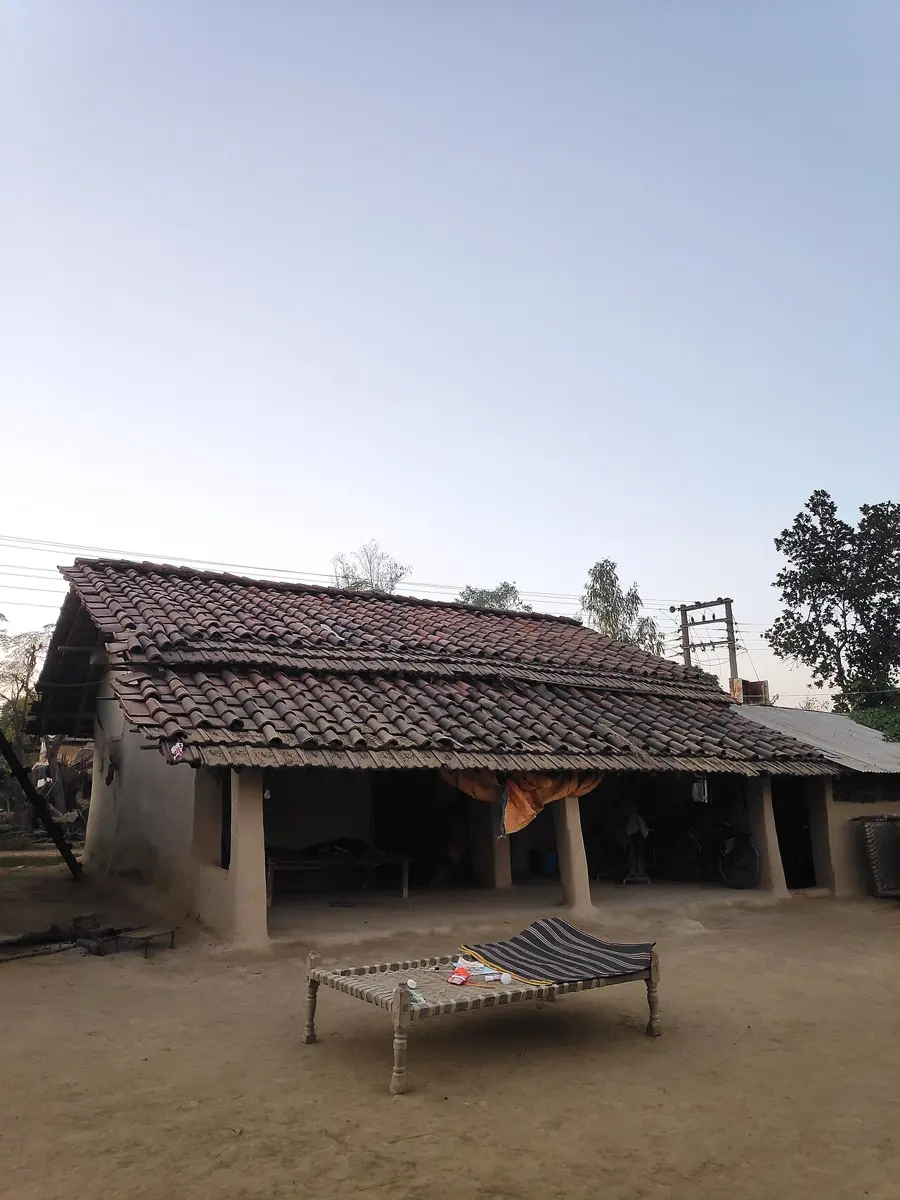
A house tells about the family, too. A Tharu family of 59 in Bardiya, three generations and more, shared one roof and one kitchen until it split into nine houses in 2026. In many Newar houses in Bhaktapur, the kitchen is on the top floor beside the room for the household gods. And in many homes, of many peoples, the kitchen is the one room that is guarded. A high-caste woman in her eighties told the sociologist Mira Mishra that in her day even Tamangs, though counted among the castes whose water could be taken, could not easily enter her kitchen, and Dalits not at all. Where the kitchen is, and who may come in, is one of the ways caste has lived on inside houses after it was outlawed outside them. The caste chapter tells how common that still is.
Houses built on wages from abroad
The biggest change to Nepal’s houses in a generation has been paid for from the Gulf, Malaysia and India. In 2021 more than a fifth of all Nepal’s households already lived in houses on reinforced concrete pillars, and many of them were built with money sent home.
Amar Basti, in Jhapa, shows how fast it happened. Forty years ago it was forest, and its first houses were mud, thatch and wood. In the 1990s men began leaving for work in the Gulf. Now the village has concrete houses, electric lines and motorcycles, and a bright pink gate across the road, paid for by a group of its men working abroad. One of the first things money from abroad often buys, a reporter there noted, is a house of the couple’s own, away from the husband’s parents, and that gives the wife some freedom.
A concrete house is a sign too. It says that someone in the family has gone and is earning, that the family is doing well, and that it means to stay. In Panchayan, a village in Sunsari studied by the researcher Ramesh Sunam, the smooth concrete houses rise, as one reviewer of his book put it, “among their weary-looking brick, mud and bamboo neighbours”. Sunam also found who was left out. The poorest families, often landless and of castes ranked low, could not raise the money for a visa and a ticket. A man whose company abroad stopped work six months after he arrived, and who came home in debt, told him, “I cannot imagine building a new house.” So a street of new houses shows who has gone abroad, and the old ones beside them often show who couldn’t.
Clothes and houses fit the climate and the work first: a mud roof where it doesn’t rain, a cotton धोती where it is hot. Then they become signs. The Panchayat made one hill dress the country’s dress, and the peoples it left out have asked ever since for their own to count as Nepali too. The धोती, once an insult, became a badge. Roofs map Nepal’s climates, kitchens still keep caste rules inside some homes, and concrete houses show where wages from abroad have gone. A person’s clothes or house tell you something true about them, but never everything.
Found a mistake? Please tell us.