
On 16 January 2007, the day after the interim constitution came into force, a few men in Kathmandu set fire to copies of it. They were leaders of the Madhesi Janaadhikar Forum, among them its leader, Upendra Yadav, and the police arrested them on the spot. Their complaint was that the new constitution promised a Constituent Assembly but said nothing of federalism, dividing Nepal into states that would govern themselves, and that the Assembly’s seats were not shared out fairly by population. For the people of the Tarai, they said, that left the old Nepal ruled from Kathmandu.
The question they raised took eleven years to answer. It was really several questions at once. Should Nepal be divided into states at all? How many, and where should their borders run, especially through the Tarai, the flat land along the southern border where half of Nepalis now lived? Should the states be named and drawn for the peoples who lived in them, or for rivers, roads and what each could pay for itself? How many seats should the plains get in parliament, and how should a child of a Nepali mother and a foreign father become a citizen? People were killed over these questions, two Assemblies sat, an earthquake shook the country, and a constitution was finally signed on 20 September 2015 that some Nepalis celebrated with lamps and others met with black flags. In 2017 Nepalis voted for the new governments it created. This chapter tells how that happened.
The Tarai is the land: the strip of plain from the Mechi to the Mahakali, and the inner valleys such as Chitwan and Dang. Madhes is what many of its people call it, from an old Sanskrit word for the middle land, and Madhesi is what they call themselves: people of the plains whose languages are mostly Maithili, Bhojpuri, Awadhi or Hindi, and whose families often have relatives across the border in India. Not everyone in the Tarai accepts the name. Many Tharus, among the Tarai’s oldest peoples, say they are not Madhesi but a people of their own, especially in the west, and so do the Rajbanshis of the far east. And since the malaria was cleared in the 1950s, so many families from the hills have settled there that they make up about a third of its people.
The demand for a Tarai that ran its own affairs was old. In 1951 (वि.सं. २००८), the year Rana rule ended, the Nepal Tarai Congress under Vedanand Jha asked for an autonomous Tarai, for Hindi to be recognized as a national language, and for Tarai people to get jobs in the civil service. It won no seat in the election of 1959. The grievances stayed. Madhesis were few in the army, the police and the offices of government. Millions had no citizenship certificate, the paper needed to own land, get a government job, a passport or a bank loan, because officials asked them to prove they were Nepali rather than Indian. A law passed in November 2006, just before the interim constitution, made it easier to get one.
The Janajati movements, the hill and mountain peoples such as the Limbu, Rai, Tamang, Magar and Gurung, had a demand of their own: states that would bear their names and give them a first claim in their own homelands. During the war the Maoists had divided the country, for their own organization, into regions named for peoples, Tharuwan among them, and many people now expected that a federal Nepal would look like that. Others, many hill Brahmins and Chhetris among them, but not only they, feared that states drawn for one people would leave everyone else a guest in their own home, and would one day pull the country apart. Most of what happened in the next eleven years came from these two views meeting.
Two movements in the Tarai
The burning of the interim constitution set off what came to be called the Madhes movement. Three days later, in the town of Lahan in Siraha, Maoist cadres shot dead a young Forum activist, Ramesh Kumar Mahato, at a protest against the arrests, and the next day they seized his body and cremated it. The Tarai rose. For three weeks crowds blocked the roads that supply Kathmandu and attacked government offices, police posts and the big parties’ offices, and the police fired on them. Human rights groups counted around thirty dead, most of them shot by the police; Madhesi leaders said forty or more, and about a dozen of the deaths may have come in clashes among the protesters themselves. The prime minister, Girija Prasad Koirala, spoke to the nation twice on television. The first time he promised federalism and more seats for the Tarai, and the protesters rejected it. The second time he expressed regret for the deaths and promised seats shared out by population and a proportional place in the state for groups left out of it, and the Forum called a pause. In March 2007 the interim constitution was amended to promise that Nepal would become a federal state.
The violence did not all run one way. That March, at Gaur in Rautahat, Forum supporters killed 27 Maoists.
A year later the plains rose again. In February 2008, with the Constituent Assembly election two months away, three Madhesi parties joined as the United Democratic Madhesi Front and called a general strike. For sixteen days traffic stopped across the Tarai. Six people died in clashes with the police, five of them from bullets, and a police officer was killed. The strike ended with an agreement of eight points, signed at the end of the month by Koirala and the Front’s leaders. It promised a federal democratic republic that would include, in its own words, “the Madheshi people’s aspiration for an autonomous Madhesh state”, left the details to the Assembly, and promised Madhesis entry into the army as a group. The Front went into the election.
The Tharus had their own moment in 2009, when the government decided that the Tarai’s indigenous peoples would be counted as Madhesi for the jobs and places reserved for Madhesis. Tharu organizations called a strike across the Tarai that lasted thirteen days, saying that Tharus are not Madhesi and that they would lose out if they had to compete with them. Four people lost their lives in the movement. The government agreed to reverse the decision, and when it was slow to do so, a second strike followed.
How many provinces, and whose
The first Assembly, which had ended the monarchy at its first meeting, had two years to write a constitution. The shape of the federation was where it stuck. In January 2010 one of its committees proposed fourteen provinces, nine of them drawn and named for the peoples who lived in them. A commission of experts set up to settle the matter split in January 2012: six of its nine members proposed ten provinces with borders and an eleventh, without borders, for Dalits wherever they lived; the other three proposed six, most of them running north to south from the mountains to the plains. Neither report settled anything. Copies were burned in Doti in the far west, and in the east the Limbuwan movement rejected the report too.
The argument came down to two words that every Nepali newspaper reader of those years knew: identity and capability. Those who stood for identity said Nepal had been ruled for two and a half centuries by one group of hill people speaking one language, and that a province named Limbuwan or Tharuhat would at last say that the others belonged too. Those who stood for capability said a province must be able to pay its own way and serve everyone in it equally, and that the peoples of Nepal were so mixed that a province drawn for one would hold many others. Most Madhesi parties wanted one or two provinces covering the whole plain from east to west. Tharus wanted their own in the west, and in May 2012 Tharu crowds demanding a Tharuhat province and hill people demanding an undivided far west faced each other in Kailali and Kanchanpur.
The Assembly’s term was extended four times. The Supreme Court said the last extension had to be the last, and at midnight on 27 May 2012 the first Constituent Assembly came to an end without a constitution. The parties blamed each other. The Congress and the UML said the Maoists and Madhesi parties had made a constitution impossible by insisting on provinces named for peoples; the Maoists said the old parties had refused to accept the people’s identity. Some politicians changed parties over it: that October Ashok Rai, a vice-chairman of the UML, and other Janajati and Madhesi leaders walked out of it because it wouldn’t support provinces named for identity.
For a year and a half Nepal had no elected body at all. Then, under an interim government led by the chief justice, Khil Raj Regmi, Nepalis elected a second Constituent Assembly on 19 November 2013. A party that had split from the Maoists, led by Mohan Baidya, boycotted it with an alliance of thirty-three parties, but nearly eight in ten voters came out. The result reversed 2008. Of the 575 elected seats the Congress won 196 and the UML 175, while the Maoists fell to 80. Kamal Thapa’s royalist party, which wanted Nepal to be a Hindu state again, came fourth with 24. The Madhesi parties, now split into many, won fewer than before, the largest of them 14 and 11. The two parties that had argued for capability now had the numbers to write the constitution, though not quite the two-thirds needed to pass it alone.
An earthquake and a fast track
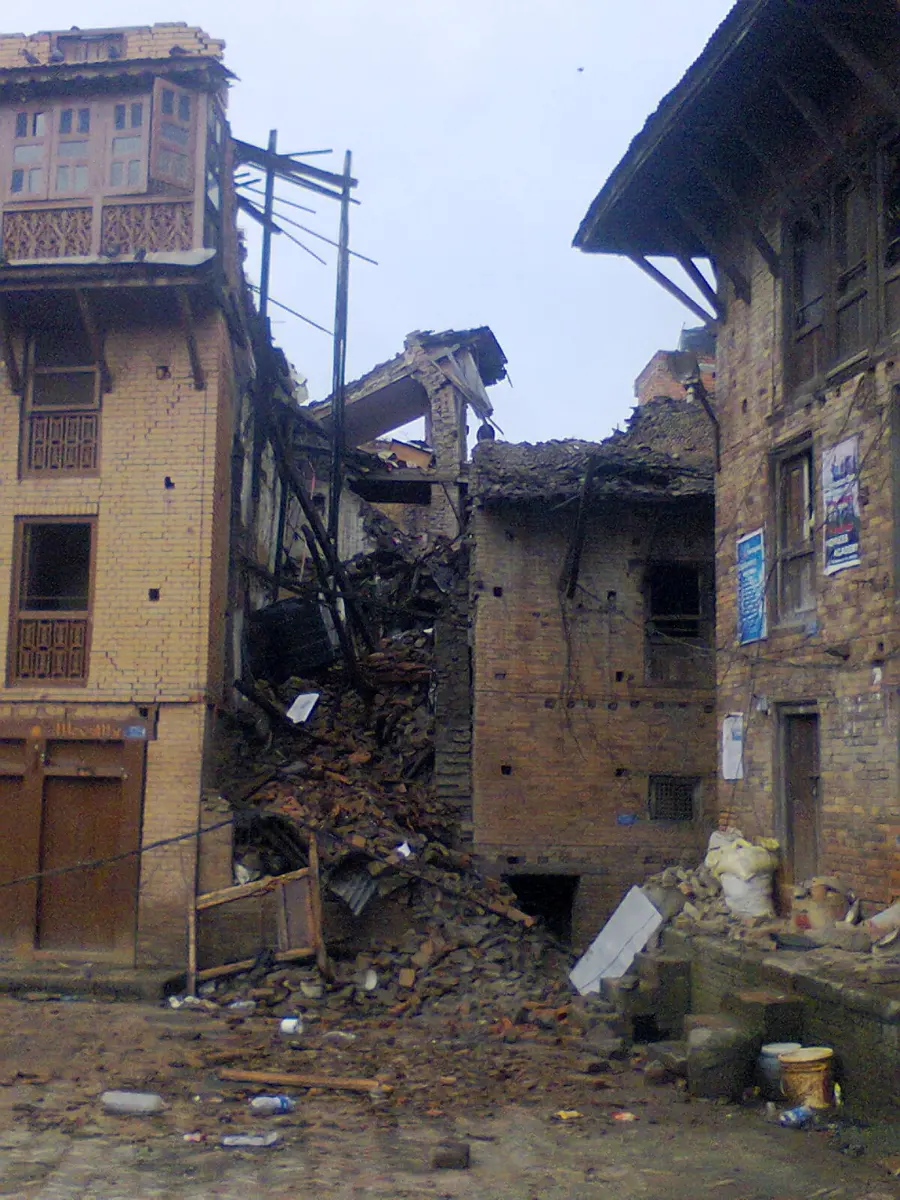
On Saturday 25 April 2015, at four minutes to noon, an earthquake struck below Barpak in Gorkha, about seventy-five kilometers northwest of Kathmandu. A second large shock came on 12 May, near Everest. Nearly nine thousand people died and over half a million houses were destroyed. The disaster pushed the largest parties to settle their quarrels and finish the constitution.
In June 2015 the Congress, the UML, the Maoists and one Madhesi party, the Madhesi Janaadhikar Forum (Democratic), agreed on sixteen points: the constitution would be finished quickly, Nepal would have eight provinces, and a commission would draw their borders and the provinces’ assemblies would choose their names later. Others went to court, and the Supreme Court ruled that the provinces’ borders had to be in the constitution itself. So in August the big parties drew a map, first of six provinces and then, after protests in Surkhet in which police shot two people dead, of seven.
The map was where the Tarai’s anger exploded. It joined the plains districts of the east to the hills above them, and those of the far west too, and left only the eight central districts from Saptari to Parsa as a province of the plains alone. Madhesi parties said it had been drawn to keep them a minority everywhere except in one strip. Tharu groups said Kailali and Kanchanpur, where they had hoped for Tharuhat, had been given to the hills, and when the parties made the seventh province for the hills of the mid-west less than two weeks after the shootings in Surkhet, they asked why their own older demand had been ignored.
On 24 August, at Tikapur in Kailali, a Tharuhat protest turned on the police. Eight police officers were killed, among them a senior superintendent, Laxman Neupane, and Tek Bahadur Saud, the eighteen-month-old son of one of the policemen, was shot dead by a gunman, probably one of the attackers. What set it off isn’t clear. A parliamentary committee concluded that the killings had been planned; Tharu villagers who had joined the protest said they had come to a peaceful one, for their community’s rights. The army was sent in for the first time since the war, and in the days after, Tharu homes were attacked in revenge and thousands of Tharus were thought to have fled across the border to India. In the central Tarai, meanwhile, the police fired on crowds again and again. By the day the constitution was signed, about forty-five people had been killed in the protests of those weeks, most of them protesters and bystanders shot by the police. The count went on rising after that, to between fifty-seven and sixty-six by the time the protests ended, depending on who counted.
Lamps and black flags
On 16 September 2015 the Assembly voted on the constitution. Of 598 members, 507 voted for it. The 25 against were from Kamal Thapa’s royalist party, which wanted a Hindu state, and the Madhesi and Tharu parties stayed away. Four days later, on 20 September (3 Asoj 2072), the president, Ram Baran Yadav, signed it.
That evening, as the Congress and the UML had asked, people in Kathmandu and other towns lit lamps and candles as at Tihar and set off firecrackers, glad that after seven years and two Assemblies Nepalis had a constitution written by an Assembly they had elected. In much of the Tarai, the Madhesi parties called the day a black day. Black flags went up, their leaders called for copies of the constitution to be burned, Biratnagar’s lights were switched off, and in Birgunj, as fireworks went up over the Assembly in Kathmandu, the police shot a man dead. Tharu groups put up black flags in Kailali and Kanchanpur, and some Janajati groups protested in Pokhara and Palpa.
What the two sides were looking at was the same document. It made Nepal, in its first articles, a federal democratic republic and a secular state, adding that “secular” included protecting the religions and cultures handed down from ancient times. It divided the state into three levels: the federation, seven provinces and local governments. The provinces had numbers, not names: each province’s assembly was to choose its own name by a two-thirds vote. It promised women at least a third of the seats in parliament, and places in the state for Dalits, Madhesis, Janajatis, Tharus, Muslims and others. To its supporters this was the constitution that at last included everyone. To its Madhesi critics it fell short on four points: the provinces’ borders, the number of seats for the plains, which were counted partly by land area rather than people, how inclusion would work in practice, and citizenship. A child of a Nepali mother and a foreign father could become a citizen only by naturalization, unlike a child of a Nepali father, and naturalized citizens, among them many women from across the border who had married into Madhesi families, could never hold the highest offices.
Within days the Madhesi parties turned to the border. From late September protesters sat on the bridge between Birgunj and Raxaul, the crossing through which most of Nepal’s fuel and much of its goods arrive, and at other crossing points, and for four and a half months only a trickle of goods got through. Petrol that cost a hundred rupees a liter sold for five hundred on the black market; a cylinder of cooking gas that cost about fourteen hundred went for ten thousand. The government sold firewood in Kathmandu for cooking, hospitals ran short of medicines, and thousands of families the earthquake had left homeless spent the winter under tarpaulins.
Who was blockading whom is told three ways. Nepal’s government called it India’s blockade: to hold back supplies from a country without a sea, its foreign minister said, broke international law. India said there was no blockade from its side: the trucks couldn’t move because of the obstruction on Nepal’s side, and Nepal should settle its differences with its own people by talking. The Madhesi leaders said the blockade was theirs, the only weapon left to people whose protests had been met with bullets. Some analysts believed India had at least backed it, with slow customs and officials who went missing on its side of the border, while agreeing that the protests themselves had begun in the Tarai. While it lasted, Nepal signed an agreement to buy fuel from China.
In January 2016 parliament amended the constitution to count seats more by population and to make inclusion in the state’s bodies proportional. The Madhesi parties said it wasn’t enough, but their protest was losing strength, and traders broke up some of their camps. In February 2016 the Front called the blockade off. The borders of the provinces stayed as they were.
Seven provinces and three elections
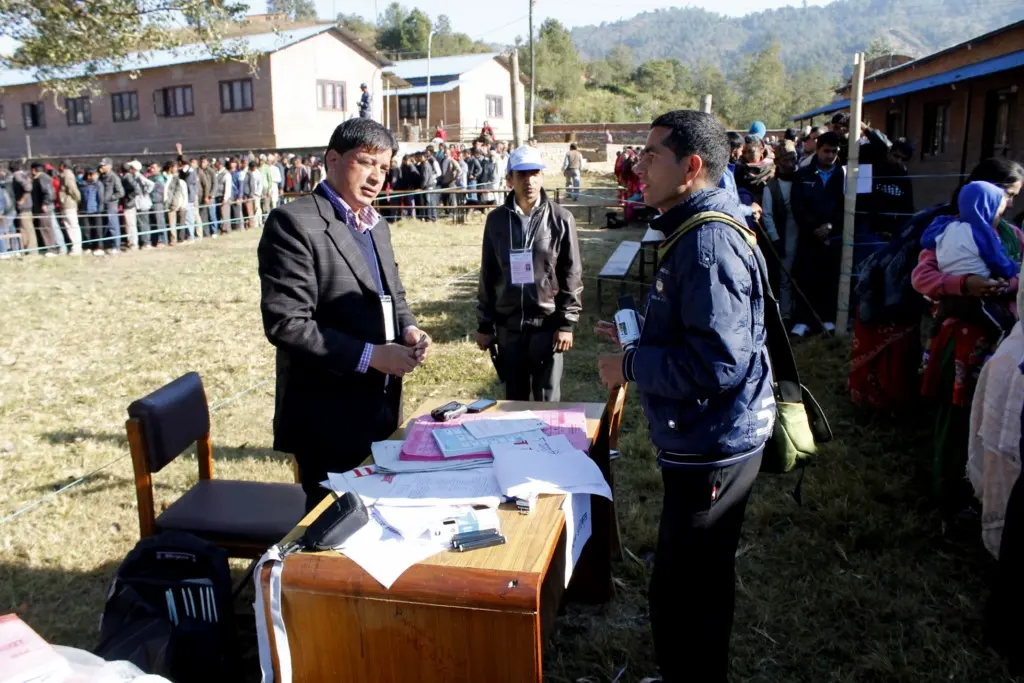
The constitution gave the new federation a deadline: the Assembly, now serving as parliament, would last only until January 2018, by when a new parliament had to be elected. First, the old village and town councils were redrawn into 753 local governments: six metropolitan cities, eleven sub-metropolitan cities, 276 municipalities and 460 rural municipalities, each with its own elected mayor or chair. Local elections were held in three rounds, between May and September 2017, the last in Province 2 after the Madhesi parties agreed to take part. They were Nepal’s first local elections in twenty years.
The federal and provincial elections followed in two rounds, on 26 November and 7 December 2017 (10 and 21 Mangsir 2074). The UML and the Maoists campaigned together as a left alliance and won a large majority: of the 275 seats in the new House of Representatives, the UML won 121, the Congress 63 and the Maoists 53. The UML was the largest party in six of the seven provincial assemblies. The seventh, Province 2, was won by the two Madhesi parties that had led the protests. The parties that had raised black flags two years earlier had now won a province under the constitution they had opposed. What came of all this, from the provinces choosing their names onward, is the next chapter.
The road from the burnt copies of 2007 to the elections of 2017 ran through every argument a country can have about who it is. Nepal became a federal republic because the people of the Tarai and the Janajati movements demanded it, and it got seven provinces drawn as the largest parties wanted, not as many of those who first demanded it hoped. The constitution was celebrated in Kathmandu as one written by an Assembly Nepalis had elected, and mourned in much of the Tarai as a promise broken. Both are part of what happened. Scores of people died in the protests of 2007, 2008 and 2015, police among them, and the blockade that followed left the whole country short of fuel. Nepal’s federation began amid that bitterness, and its first elections were held all the same.
Found a mistake? Please tell us.