
In the middle of Pokhara there is a crossroads called Prithvi Chowk, and for years a statue of Prithvi Narayan Shah stood on it. During the people’s movement of 2006 it was damaged. The Magar association of Nepal then put up a statue of its own on the spot: Lakhan Thapa, a Magar captain who was hanged in 1876 for leading a rising against Jang Bahadur Rana, and whom the government had named the country’s first martyr in 2000. In September 2017 the city took the Lakhan Thapa statue down, saying the road was too narrow. The next day, after protests from Magar groups, the city and the district’s officials agreed to put it back. Two weeks later four other groups, a Hindu federation, a Thakuri association, a Bishwokarma association and a Brahmin association, wrote to the mayor that if any statue stood there, it should be Prithvi Narayan’s.
It is one roundabout, and the argument over it runs straight back two and a half centuries. Between 1744 and 1816 the small hill kingdom of Gorkha took over the Kathmandu Valley, the hills east to the Teesta and west past the Mahakali, and much of the Tarai. Nobody argues about that. What people argue about is what to call it. In Nepali it is usually एकीकरण (ekīkaraṇ), unification: many small states made into one country. Others call it conquest, or the expansion of Gorkha: land taken by force from the people who held it. And some remember it above all as a defense, a hill kingdom making itself strong enough to stay free while the East India Company swallowed India. The same seventy years are told in all three ways, and which one a person hears first often depends on where their great-great-grandparents were standing. In these pages it is the Gorkha campaign, a name that says who did it and leaves the rest to the reader.
A founder’s story, and how it was written
It may come as a surprise that the founder’s story is younger than the motor car. For a century after his death, Prithvi Narayan Shah was remembered mostly in chronicles and in the papers of the court. The state he made didn’t even call itself Nepal at first. Its rulers spoke of the possessions of the king of Gorkha, and Nepal still meant the Valley. Government papers only switched to “Nepal” for the whole country around 1930.
The story as most Nepalis now know it was first written down outside Nepal, in Darjeeling, then in British India. Surya Bikram Gyawali came to Darjeeling from Banaras in 1923, aged twenty-five, where Nepali speakers from many peoples worked on the tea estates, in the army and in the town. He and his friends wanted to give those people a shared language and a shared past, and he wrote both. In 1935 he published a life of Prithvi Narayan Shah, and a later historian of Nepal said that before it, Nepalis had known very little about the man. Gyawali wrote that the Nepali people, his जाति (jāti), had been created when Prithvi Narayan put the larger state together, out of Newar, Kirat, Magar, Gurung and Tamang people who spoke different languages. Then he wrote more lives, of commanders such as Balbhadra and Amar Singh Thapa and a book of Nepali heroes, all of them बीर (bīr), brave, which is why historians call this the बीर way of telling Nepal’s past.
After the Ranas fell in 1951, historians in Kathmandu took the story up, one of them a minister in the new government, and the words “unification of Nepal” stuck. To those who hold it, the founder’s story is simple and strong. Dozens of small states, quarreling and weak, became one country in a single lifetime, just as the British were taking India state by state, and the country they made is still free. “Undoubtedly, he has established the identity of our country,” a leader of the Rastriya Prajatantra Party said in 2023. Another writer put it plainly in 2010: honoring Prithvi Narayan Shah, he wrote, doesn’t make anyone a royalist.
The founder’s story leans on one old text above all, the दिव्य उपदेश (Divya Upadesh), the advice the king is said to have given near the end of his life. In the printed edition, one passage calls the country सबै जात को फुलवारि, a garden of every जात (jāt), the old word for a caste or a people, and asks all of them, small and big, “all four जात and thirty-six वर्ण (varṇa)”, to know that this is the असिल हिन्दुस्थान (asil Hindusthān), the true Hindustan, and not to leave their family’s faith. The two halves of that sentence have been read two ways ever since. School books have long read the garden as a picture of a country where every people has its place. Others read the true Hindustan and the four जात as the plan for a Hindu kingdom with castes in their order. And some scholars doubt that the king said any of it; the text reached print only around 1950.
In the Valley and the east
To the Newars of the Valley, 1768 and 1769 were the years three old kingdoms ended, and their memory of it is old and local. At the Bisket festival Bhaktapur’s musicians still sing a song in Newari that carries the name of Ranajit Malla, the last king of Bhaktapur, who left for Banaras and, an old account says, sang a lament for Nepal on the way. Kirtipur remembers the noses cut after it fell. Since the constitution of 2015, some people there have gathered each year on Prithvi Narayan Shah’s birthday at a stone that, for them, stands for him, and spat at it. “What we are doing is a symbolic protest against what Prithvi Narayan Shah did to our ancestors,” one of the organizers, Shri Krishna Maharjan, explained in 2021.
Kirtipur doesn’t remember it in one voice, though. In 2019, as the town built a war memorial park, it found it couldn’t agree on what to show. Older people wanted Kirtipur’s soldiers shown winning, as they had in the first attack of 1757. Others wanted Gorkha’s final victory. The park’s planners said they would show neither side as the winner, and planned figures of someone few people know: Kirti Laxmi, a woman remembered as one of Kirtipur’s fighters. Nor were Newars only on one side in 1768. Newar nobles had opened gates to Gorkha, Newar merchants went on trading under the new kings, and the Valley’s cities became the center of the new state. Many Newars today would say both things at once: the country was made here, and it was made at their ancestors’ cost.
In the far east, the Limbu remember an agreement. The royal order of 1774, quoted at the start of Chapter 18, promised them their land, their chiefs and their customs “as long as it remains in existence”. Limbu tradition calls the settlement the नुनपानी सन्धि (Nunpani Sandhi), the salt-and-water treaty, and remembers the years of fighting before it, as a history written in Limbu in 1843 does. The Limbu historian Iman Singh Chemjong printed the order in his history of the Kirat peoples in 1952. The land in it was held as किपट (kipat), land a Limbu owned as a member of his clan, which outsiders could not simply buy. Over the next two centuries, outsiders came to hold more and more of it. In 1961 the government confirmed the Limbu’s traditional rights, but, as Nepal’s historian of land Mahesh Chandra Regmi put it, it turned down their repeated demands for a return to the system “originally guaranteed in 1774”. In 1968 a law made kipat land saleable like any other.
So when Limbu organizations today ask for an autonomous Limbuwan in the fourteen districts east of the Arun, or protest, as they did with Kirat Rai groups in 2023, when Province 1 was named Koshi instead of anything with Limbuwan or Kirat in it, the 1774 order is part of what they mean. Not everyone reads it the same way. The court saw a pardon for a defeated people. Some writers on the land question think the activists’ account of how kipat was lost has been made too simple. And the Limbu themselves were on both sides of the fighting, some for Gorkha and some with Sikkim, as Chapter 18 tells.
In the hills, the far west and the plains
The Magar and Gurung hills remember something different again, because their sons did much of the fighting. The दिव्य उपदेश itself tells the king’s heirs to recruit soldiers from only four peoples: Khas, Magar, Gurung and Thakuri. One of Gorkha’s oldest battalions, the Purano Gorakh, was a Magar one, and it marched to the Valley, the west and Kumaon. So Magar writers tell the campaign as their own, and a Gurung writer of the 1980s called his book The Gurungs’ Role in the Unification of Nepal. Magar writers picture their ancestors as the men who built the country and were never thanked for it. Yet within a few generations the highest posts of the army and the court had gone mostly to Bahun, Khas and Thakuri families, and few Magar or Gurung commanders are heard of. That is why Lakhan Thapa matters on the Pokhara roundabout: a Magar captain from a battalion Prithvi Narayan had founded, who left it and rose against the rulers of his day. Some Janajati organizations go further. The Mongol National Organisation marks Prithvi Narayan’s birthday by calling for a boycott of the history written around him, and in 2023 the activist Ang Kaji Sherpa said: “In the name of unification, Shah killed thousands of innocent lives.”
West of the Mahakali, in what is now India, Gorkha ruled Kumaon for about twenty-five years and Garhwal for about ten, until the Company took both in 1815. There, as Regmi found in his study of Gorkha’s rule in Kumaon, the lowest Gorkhali soldier counted for more than a local notable, and Kathmandu’s orders against abuses “remained limited to paper, for the Gorkhalis on the spot were a more tangible force than the central authorities in far-off Kathmandu.” The memory people there keep is mostly of hardship. In Kumaoni and Garhwali, the historian Shekhar Pathak of Nainital says, “Gorkhali” came to mean someone who oppresses, and people still warn someone being too aggressive, “Gorkhyo jaise banna hai?”, do you want to be like a Gorkhali? A Garhwali historian says that even India’s official history books pass over the hardship, and that it has been handed down by word of mouth. Yet Garhwalis also fought in Gorkha’s army, at Nalapani among other places, and Kumaonis and Garhwalis made up much of the first regiments the British called Gurkhas. In India today, some families who descend from Gorkha’s soldiers are proud of it. “As a general rule,” the Nepali historian Dinesh Raj Panta told a reporter in 2021, “nobody likes conquerors.”
Inside today’s Nepal, the far west resisted too. Jumla fought, and Achham rose in revolt in 1792, as Chapter 18 tells. How Jumla, Doti and Achham remember those years today, we couldn’t find written down by their own historians, and the same is true of the Tharu and other peoples of the plains, and of the Khas villages of the hills. Their memories belong in this chapter too, once they are read.
The Madhesh, the plains, tells a story with a different shape, because it changed hands more than once. Prithvi Narayan claimed the eastern Tarai when he took Makwanpur in 1762, and the court in Kathmandu prized it: a Gorkhali representative wrote to the British that without the Tarai, “the hills … are worth nothing”. In the war with the Company the British occupied much of it from late 1814. Most of the central plains came back by an agreement of December 1816, with a promise that people who had helped the British would not be punished, and the far western plains came back in 1860. Madhesi writers such as the activist Raghunath Thakur and Ram Manohar Sah, in his book The Middle Country, write of the Shah rulers’ harshness, of Tarai people siding with the Company in that war, and of kings who annexed the Madhesh. Some call the Tarai from 1768 to 1951 an internal colony of the hill rulers. Regmi, writing about land, said that the Tarai was treated “more as a colonial possession” of Kathmandu’s nobles than as a part of the kingdom. Others answer that the hill villages suffered under the same rulers, and that if neglect by the state makes a colony, the hills were one too. In the Madhesi telling, the campaign’s founder is a distant figure, and the Madhesh became Nepali through treaties and land grants as much as through any war.
Statues, a holiday and the school books
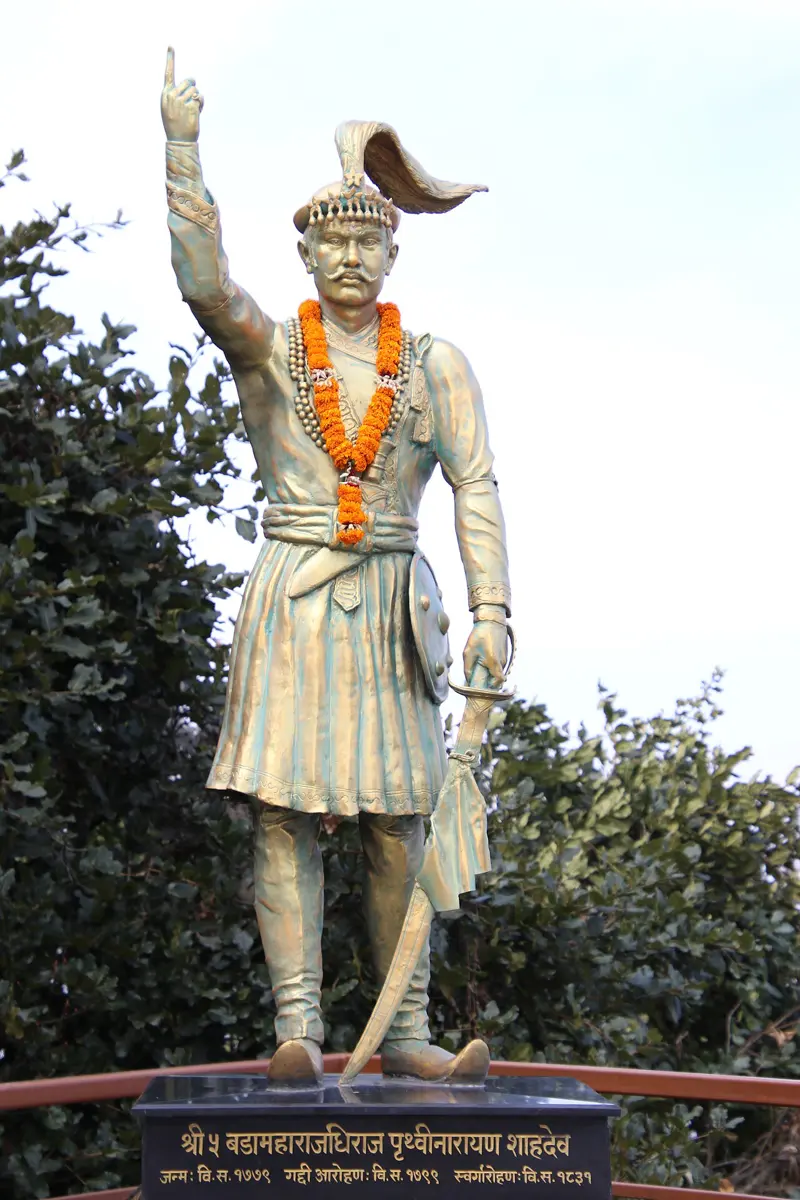
Every state chooses what to remember, and Nepal’s kings chose this. Prithvi Narayan’s statue went up at crossroads across the country, and one stands at the west gate of Singha Durbar in Kathmandu. When a college opened in Pokhara in 1960, some people wanted it named after Gaje Ghale, a Gurkha soldier from the village of Barpak who had won the Victoria Cross in Burma in the Second World War; the name chosen was Prithvi Narayan’s. His birthday, Poush 27, was a public holiday called National Unity Day.
School books did the most. From the late 1960s the government’s own books told a simple story: a brave age from the 1740s to 1816, from Prithvi Narayan to the defenders of Nalapani, then darkness under the Ranas, then development after 1951. Anything that made the story less tidy was trimmed off. The soldiers were simply “Nepalis”, not Magars or Garhwalis, and Gaje Ghale, whose story had been in a Nepali reader from Darjeeling in the 1950s, was dropped: a Nepali winning medals in a foreign army didn’t fit a story of brave Nepalis fighting for Nepal. Books printed since then still present Prithvi Narayan as the maker of the nation, and one lesson reads the garden of every jāt as a lesson in living together.
In the movement of 2006 statues were damaged, Pokhara’s among them, and after it the holiday was dropped; the monarchy itself ended in 2008. Then the memory came back into politics. A new statue went up on Chandragiri, the pass where Prithvi Narayan is said to have first looked down on the Valley, and the president unveiled it in 2017. In 2018 the government gave the day as a holiday once more, and from that year the president went each year to a ceremony at Singha Durbar. In January 2023 a new government made Poush 27 a holiday again, because the Rastriya Prajatantra Party, which favors bringing back the king, had made it a condition of its support. Another party, the Janata Samajbadi Party, objected. And in Kirtipur, as every year, some people gathered at their stone.
So the Gorkha campaign has no single memory, and it never had one. To many Nepalis it is the founding of their country, the moment dozens of small states became one and stayed free. To many others, among Newars, Limbu, Magars and Madhesis, it is also, or instead, the moment their own kingdoms ended, their land changed hands and their part in the story was left out. In Kumaon and Garhwal it is remembered mostly as a time of hardship under soldiers from elsewhere. Each of these memories has its own writers and its own evidence, and each is held by people who are citizens of the same country, or neighbors of it. Knowing the others doesn’t mean giving up your own. It means that when someone calls it unification, or conquest, or defense, you know where they are standing, and why one roundabout in Pokhara has held two different statues.
Found a mistake? Please tell us.