
Look down at almost any tiled floor: a school corridor, a temple courtyard, the bathroom at home. Copy the whole floor onto tracing paper, slide the paper along a little, and every tile on the paper sits on a tile of the floor again, all at once. Almost every floor a tiler lays repeats like that, because a tiler works from a pattern that repeats.
In November 2022 David Smith, a retired print technician in Yorkshire, England, was cutting shapes out of card. One of them, a lumpy shape with 13 sides that he nicknamed the hat, covered the table with no gaps, but the pattern never settled into a repeat. Four months later he and three others proved it: hats cover a floor as far as you like, and the pattern can’t repeat.
Guess first. A floor is covered with hats, as far as you like in every direction. You copy the whole floor onto tracing paper just as big, lay it on and slide it (no turning). What happens?
Pick an answer to see why.
What “repeats” means
The test you just used is exactly the mathematicians’ test. A floor pattern repeats, or is periodic, if you can slide the whole pattern (without turning it) some distance so that every tile lands exactly on a tile of the same kind. A floor of squares repeats by one square to the right; a honeycomb by one hexagon in several directions. Turning is not allowed: a slide only.
In Grade 8 you met the regular tessellations, floors made of one regular polygon. Only three work, and the reason is the angles at a corner: the corners of the tiles that meet at a point must add up to exactly 360°.
| Polygon | Each angle | 360° ÷ angle |
|---|---|---|
| Triangle | 60° | 6 |
| Square | 90° | 4 |
| Pentagon | 108° | 3.33… |
| Hexagon | 120° | 3 |
| Octagon | 135° | 2.67… |
Only 6 triangles, 4 squares or 3 hexagons close up round a point; pentagons always leave a gap. All three floors repeat, and so do the semi-regular ones (squares with octagons, triangles with hexagons).
Here is a surprise, though. Making a floor that doesn’t repeat is easy. Lay squares in rows, then push each row sideways by a random amount. No slide can bring the whole floor back onto itself, because the next row’s push won’t match. So “can a pattern never repeat?” is too easy a question. The real question is harder:
Can a set of tiles force every floor made from it to never repeat? Not just allow it, as squares do, but leave no way at all to make a floor that repeats. Tiles like that are called aperiodic. For a long time nobody knew whether they could exist, and then, whether a single shape could do it.
Which of these sets of tiles is aperiodic?
Pick an answer to see why.
A row that never repeats
First, a single row: the planks of a long verandah, long ones (L) and short ones (S). Start with one long plank and follow one rule, again and again:
- every long plank becomes a long plank followed by a short one: L → LS;
- every short plank becomes a long one: S → L.
| Step | The row | Long | Short | Long ÷ short |
|---|---|---|---|---|
| 1 | L | 1 | 0 | |
| 2 | LS | 1 | 1 | 1 |
| 3 | LSL | 2 | 1 | 2 |
| 4 | LSLLS | 3 | 2 | 1.5 |
| 5 | LSLLSLSL | 5 | 3 | 1.667 |
| 6 | LSLLSLSLLSLLS | 8 | 5 | 1.6 |
| 7 | 21 planks | 13 | 8 | 1.625 |
| 11 | 144 planks | 89 | 55 | 1.6182 |
The rule only ever adds to the end of the row: each row starts with the whole row before it. So the rule gives one endless row, the Fibonacci row, and the counts are the Fibonacci numbers (1, 1, 2, 3, 5, 8, 13…, each the sum of the two before). You met them in sunflowers in Why Do Sunflowers Count in Fibonacci Numbers? Make each long plank 1.618 times as long as a short one (you will see why in a moment), and slide a copy along it.
Why it can never repeat
Long stretches fit, so how can we be sure the whole row never does? Count.
Suppose the row did repeat, by some slide of k planks. Then from the start it would be one block of k planks, copied again and again: if the block has a long planks and b short ones, every stretch of whole blocks has long and short planks in the ratio exactly a to b, and longer and longer stretches settle on a/b, a fraction of whole numbers.
But the table says the ratio is heading for something else. Long ÷ short goes 1, 2, 1.5, 1.667, 1.6, 1.625… and settles on 1.618…, the golden ratio, φ (the Greek letter phi):
Why φ, and not some other number? One step of the rule turns every long plank into one long and one short, and every short plank into a long. So if a row has L long and S short planks, the next has L + S long and L short. If the ratio settles at some number r, the next step’s ratio, (L + S) ÷ L = 1 + S ÷ L = 1 + 1/r, must be r again: r = 1 + 1/r. Multiply by r: r² = r + 1, and the positive answer is (1 + √5)/2. (This is also why the long plank is φ times the short one: then one step of the rule is magnifying the row φ times and cutting, since a magnified long plank, φ × φ = φ + 1, is a long plus a short, and a magnified short is a long. The row looks the same at every scale.)
And φ is not a fraction. If it were, √5 = 2φ − 1 would be a fraction too, and √5 isn’t, by the same argument as in Can You Prove √2 Is Not a Fraction? A repeating row’s ratio would settle on a fraction, and whatever it settles on must be φ, which isn’t one; so this row doesn’t repeat. Counting proves what sliding can’t.
But notice what this row does not do. Nothing forces it. Long and short planks could just as well be laid L S L S L S…, which repeats. The rule made the row, but the planks themselves don’t care. In a floor, that is the hard part.
Penrose’s two tiles
In the 1970s Roger Penrose, a mathematician and physicist, found two tiles that do care. They are two rhombs (diamonds) with equal sides, a thick one with angles 72° and 108° and a thin one with angles 36° and 144°, every angle a multiple of 36°, the angles of a pentagon and its star.
On their own the rhombs can be laid in a repeating floor (lay thick rhombs in a row, edge to edge, like a slanted floor of squares). So Penrose marked them: each carries curves that must join up across every edge where two tiles meet (Figure 22.2). With that one rule, the tiles still cover a floor as far as you like, but only ever in a pattern that never repeats.
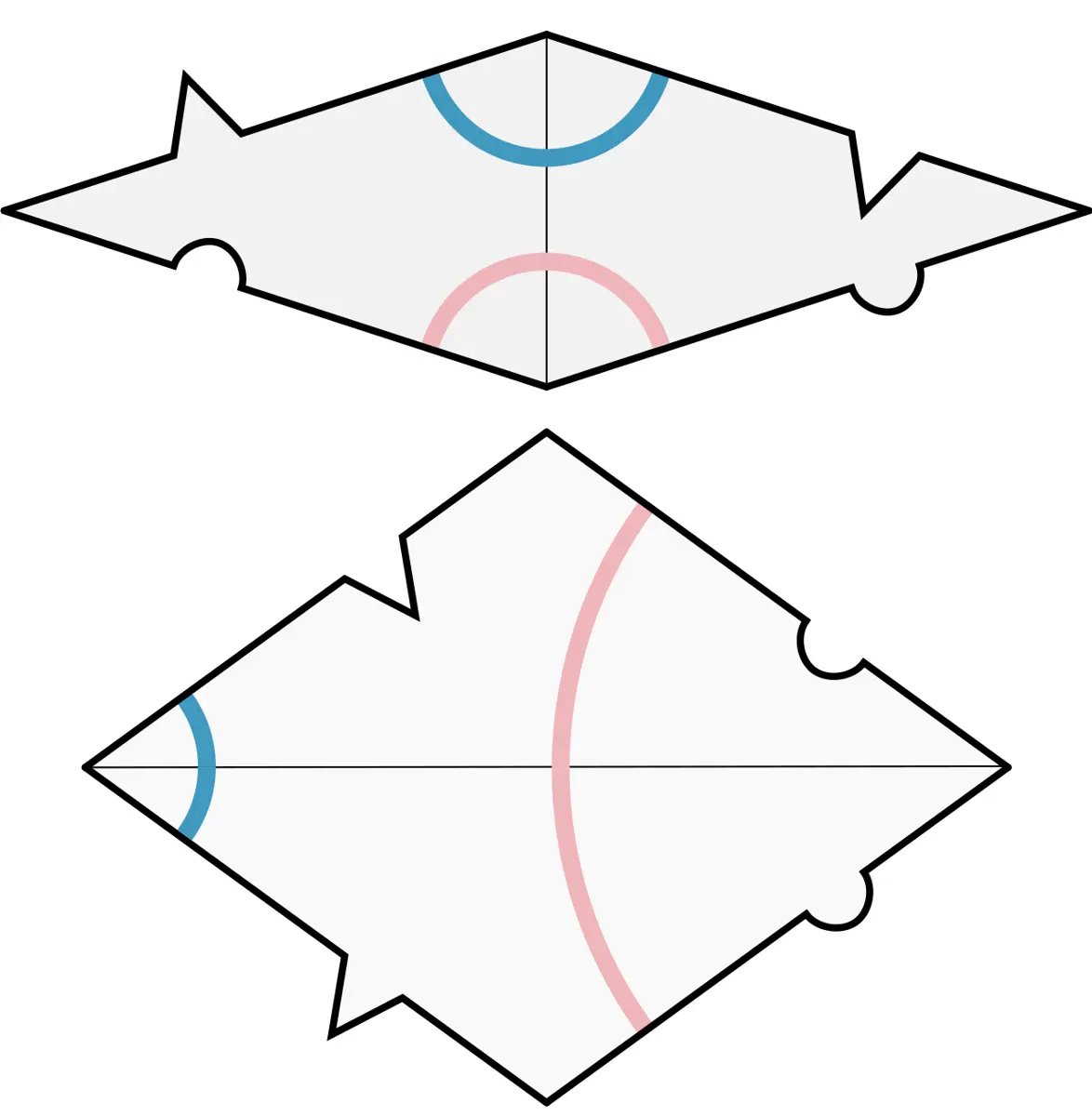
How can a rule on the edges stop a whole endless floor repeating? The proof has the same two parts as for the planks.
- The floor is built like the row. Penrose and John Conway found that a floor obeying the rule can always be grouped, in just one way, into bigger rhombs of the same two shapes, φ times as long. Those can be grouped again into still bigger ones, and so on forever. Going the other way, cutting each half-rhomb up, is how Figure 22.1 was drawn: each half of a thin rhomb becomes a half-thin and a half-thick, each half of a thick rhomb becomes two half-thicks and a half-thin.
- Count. Cutting a floor of T thick and t thin rhombs gives 2T + t thick and T + t thin. Start from one thick rhomb: (1, 0), (2, 1), (5, 3), (13, 8), (34, 21), (89, 55)… Fibonacci numbers again, and thick ÷ thin heads for φ. A repeating floor would have a fraction. So it doesn’t repeat.
The patch in Figure 22.1 has something no repeating floor can have: it looks the same after a fifth of a full turn, 72°. Why not? Take the shortest slide that fits a repeating floor, an arrow 1 unit long. (There is a shortest: a slide much shorter than a tile would move each tile onto a tile overlapping it.) If a turn of 72° also fits the floor, the arrow turned by 72° or by 144° is a slide that fits too (turn back, slide, turn again). Now slide by the arrow, then by the arrow turned 144°: together that is one slide only 2 × cos 72° = 0.618 units long, shorter than the shortest. Impossible. A similar trick rules out sevenfold and more, leaving only twofold, threefold, fourfold and sixfold turns: the crystallographic restriction. It is about to matter in chemistry.
And yet, like the planks, Penrose’s floor is never far from repeating in a small way. Every patch of tiles, however large, appears again and again, infinitely often, somewhere in the floor. What never happens is the whole floor fitting at once.
One tile: the hat
Penrose needed two tiles and a rule drawn on them. Could one shape do it alone, by its outline? Tilers called such a shape an einstein, from German ein Stein, “one stone”, a pun on the physicist’s name. For nearly fifty years after Penrose, nobody found one.
Smith’s hat is surprisingly plain. Cut a honeycomb of hexagons into kites, six to a hexagon, by lines from each center to the middles of the sides; then take 8 kites side by side (Figure 22.3). Smith found it with a puzzle program (PolyForm Puzzle Solver) and cardboard cut-outs, and wrote to Craig Kaplan, a computer scientist at the University of Waterloo in Canada. Kaplan, the software developer Joseph Myers and the mathematician Chaim Goodman-Strauss joined him, and in March 2023 the four posted their proof: “this shape tiles the plane, but never with any translational symmetries.”
One catch: some of the hats must be laid flipped over, as mirror images. Every hat floor needs both. In the floor at the top of this page the flipped hats are the darker ones, and they are sparse. How sparse?
Why the hat can never repeat
The argument is the plank row’s once more, with harder work in step 1:
- Every hat floor is built the same way. The four mathematicians proved that the hats in any floor, however it was laid, group into their four kinds of cluster, and those into bigger ones, forever, in only one way. This is the long part of the paper: a list of cases checked by two programs that two of the authors wrote separately.
- Count. In the clusters, plain hats outnumber flipped ones by a ratio that settles on φ⁴ = 6.854… (our own count, from the paper’s rule for building the clusters), which is not a fraction (φ⁴ = (7 + 3√5)/2, so √5 would be a fraction too). A floor that repeated would be one block copied, with a whole number of plain and flipped hats in it: a fraction. So no hat floor repeats.
The paper also gives a second proof that doesn’t need step 1, built on the fact that two distances between corners of a grid of triangles are never in the ratio √2. Two proofs by different routes are a good reason for confidence.
The twist: no mirror needed
Some people objected: if the hat needs its mirror image, isn’t that two tiles? A glazed ceramic tile, as the authors pointed out, can’t be turned over. Within weeks they answered that too.
The hat belongs to a family of shapes whose sides come in two lengths, in different proportions. The member with all its sides equal can make a repeating floor if mirror images are allowed, but if flipping is forbidden, none of its floors repeat. So they bent its straight edges into curves, so that a tile and its mirror image can’t fit together. In May 2023 they proved that this new shape, the spectre, covers a floor only in patterns that never repeat, every tile the same way up. One tile, no flips, no markings.
The equal-sided member of the hat’s family can make a repeating floor if mirror images are allowed. Is it aperiodic?
Pick an answer to see why.
Where this is used
A story from maths
Questions
a. ★ Which of these floors repeats?
Pick an answer to see why.
Can regular octagons alone cover a floor? Use the angles. Which shape fills the gaps if you add it, and does that floor repeat?
Hint
Answer
Follow the plank rule L → LS, S → L for two more steps after LSLLSLSLLSLLS (13 planks). Count the long and short planks each time, and check that each new row starts with the old one.
Answer
Prove that a row of long and short planks that repeats (by a slide of k planks) has long ÷ short equal to a fraction, in long enough stretches. Then explain why the Fibonacci row’s ratio can’t be a fraction p/q.
Hint
Answer
In the HatLevels widget, the counts of hats were 4, 25, 169 and 1,156 (2², 5², 13², 34²). If the pattern goes on, how many hats are in the level-5 cluster, and what would you predict for level 6? About how many times bigger in area is each level than the one before?
Answer
Where to go next
- Is the Golden Ratio Really Everywhere? The φ of this page is real; many other claims about it are not.
- Why Do Sunflowers Count in Fibonacci Numbers? (Grades 6–8) Fibonacci numbers and the golden ratio in a flower, where a turn that is not a fraction keeps the seeds from lining up.
- Can You Prove √2 Is Not a Fraction? The proof behind “φ is not a fraction”, in three ways.
- Why Are There Only Five Perfect Dice? Angles at a corner, as in the tessellations, but in three dimensions.
- Quasicrystals: order that never repeats The Nobel Prize in Chemistry 2011, the atoms that tile like Penrose’s rhombs.
- Grade 12 Computing: The Limits of Computing The problem no program can solve, which Berger’s tiles can imitate.
- Computing, Going Further: How Long Can a Tiny Machine Run Before It Stops? Small programs whose stopping nobody can predict. (Coming soon.)
Where these facts come from
- The hat: the theorem, the quoted sentence “this shape tiles the plane, but never with any translational symmetries”, the hat as eight kites of the [3.4.6.4] Laves grid, Smith working by hand with PolyForm Puzzle Solver every hat floor mixing plain and flipped hats, the four metatiles H, T, P, F and their substitution, the two proofs (one through the √2 scale factor between two related tilings, one through the clusters, with the case analysis cross-checked by two independent programs), and areas inflating by φ⁴: D. Smith, J. S. Myers, C. S. Kaplan, C. Goodman-Strauss, “An aperiodic monotile”, Combinatorial Theory 4(1), 2024, read October 2026.
- The spectre: the equal-sided member of the family, aperiodic only if reflections are forbidden, the curved-edge spectres that tile only without mixing mirror images, submitted 29 May 2023, the glazed ceramic tile that can’t be turned over, Smith’s address as “Yorkshire, U.K.”: D. Smith et al., “A chiral aperiodic monotile”, Combinatorial Theory 4(2), 2024 (CC BY 4.0), read October 2026.
- Smith as a retired print technician from Bridlington, Yorkshire; November 2022; cardboard cut-outs; the nickname from a fedora; Kaplan at Waterloo, Myers in Cambridge, Goodman-Strauss at Arkansas; the preprint of March 2023: Wikipedia, “David Smith (amateur mathematician)”, read October 2026.
- The einstein problem and the name ein Stein; the hat as eight 60°–90°–120°–90° kites; publication in 2024; the honeycombs and composites built on the hat: Wikipedia, “Einstein problem”, read October 2026.
- Wang in 1961; Berger’s 20,426 tiles (1964), then 104; Robinson’s 6 (1971); Penrose’s sets of 1973 and 1974; Ammann (1977 sets): Wikipedia, “Aperiodic tiling”, read October 2026. Wang’s conjecture and its link to an algorithm; Berger’s 1966 paper and the link to the halting problem: Wikipedia, “Wang tile”, read October 2026.
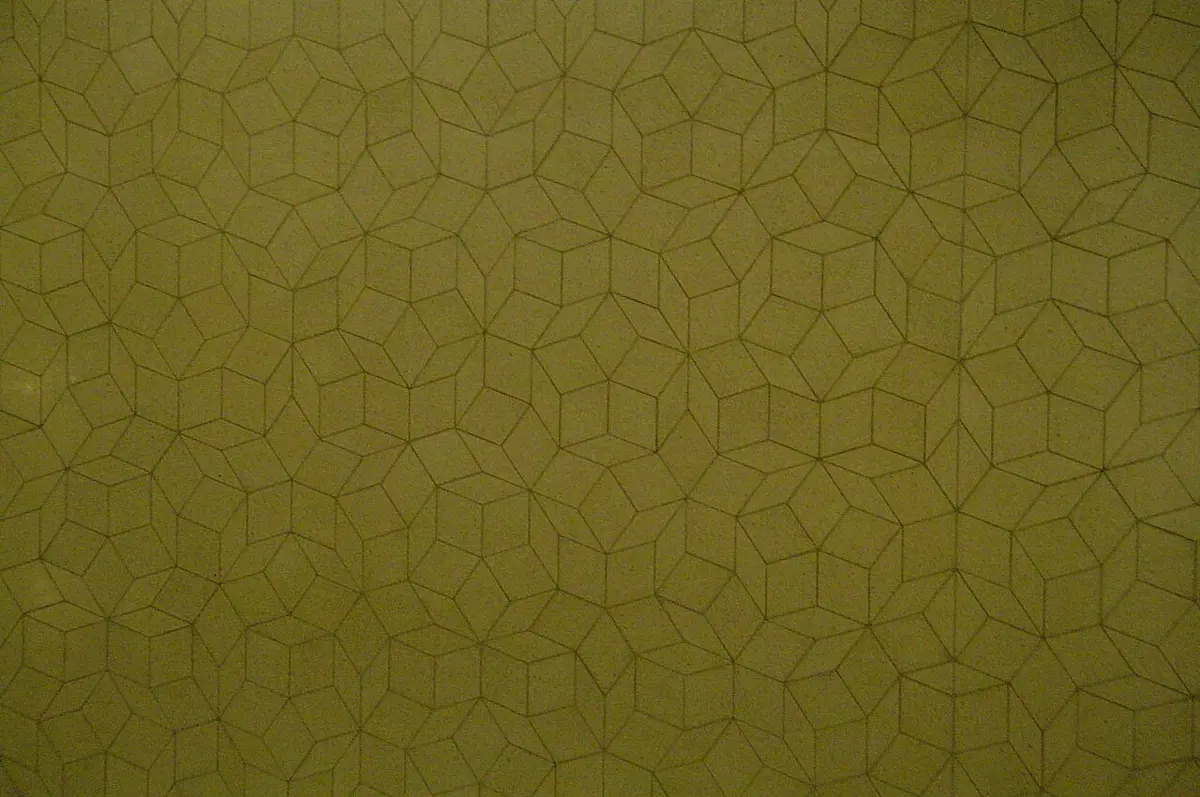
- Penrose tilings: the thick and thin rhombs, matching rules by curves or edge bumps, the rhombs found independently by Ammann in 1976, Penrose and Conway’s hierarchy, Gardner’s column of January 1977, the cutting rule for Robinson triangles, thick ÷ thin tending to φ, every finite patch occurring infinitely often, local fivefold symmetry, the floors at Oxford, Helsinki (2014), IIIT Allahabad (since 2001) and the University of Western Australia: Wikipedia, “Penrose tiling”, read October 2026.
- Only twofold, threefold, fourfold and sixfold symmetry in a repeating pattern: Wikipedia, “Crystallographic restriction theorem”, read October 2026.
- The aluminum–manganese alloy: Wikipedia, “Quasicrystal”, read October 2026. Shechtman’s discovery on 8 April 1982, being asked to leave his group, Pauling’s remark: Wikipedia, “Dan Shechtman”, read October 2026. The Alhambra and Darb-i Imam mosaics, the Swedish steel, frying pans and diesel engines: The Royal Swedish Academy of Sciences, press release, Nobel Prize in Chemistry 2011, read October 2026.
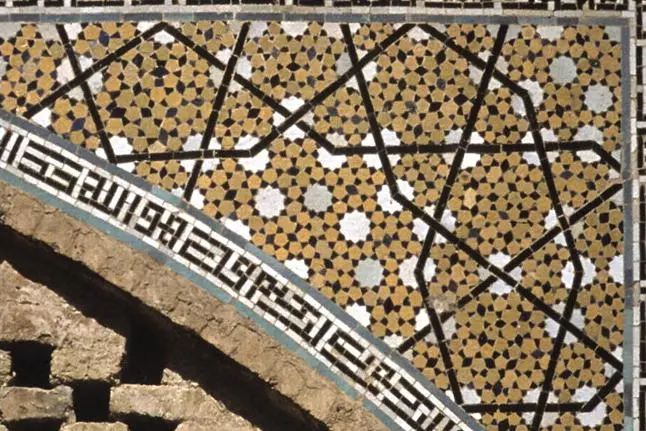
- Girih tiles, the Darb-i Imam shrine (1453), and Lu and Steinhardt’s suggestion in Science 315 (2007): Wikipedia, “Girih tile”, read October 2026.
- The hat tiling drawn in the widgets: Craig S. Kaplan’s hatviz (BSD 3-Clause License), ported to TypeScript for this page.
- Every number on this page (the polygon angles, the plank rows and their counts, the first plank where each slide breaks, the Penrose counts, the hat counts at each level and their ratio, the exact limit φ⁴ = (7 + 3√5)/2 from the clusters’ counting matrix, the best fit in the first widget, the kites in the hat, and the answers to the questions) was computed by scripts in
checks/textbooks/math-further-9-12/22/tmp/(answers.py,planks.py,slide.ts,kites.py).