
Anish runs the board-game club at his school. The club’s new box of role-playing dice has come from a shop in Kathmandu: a little pyramid with 4 faces, an ordinary cube, a die with 8 faces, one with 10, one with 12 and one with 20. On every one except the ten-sided die, all the faces are the same regular polygon: equal triangles, equal squares or equal pentagons, every edge the same length, and every corner of the die exactly like every other corner.
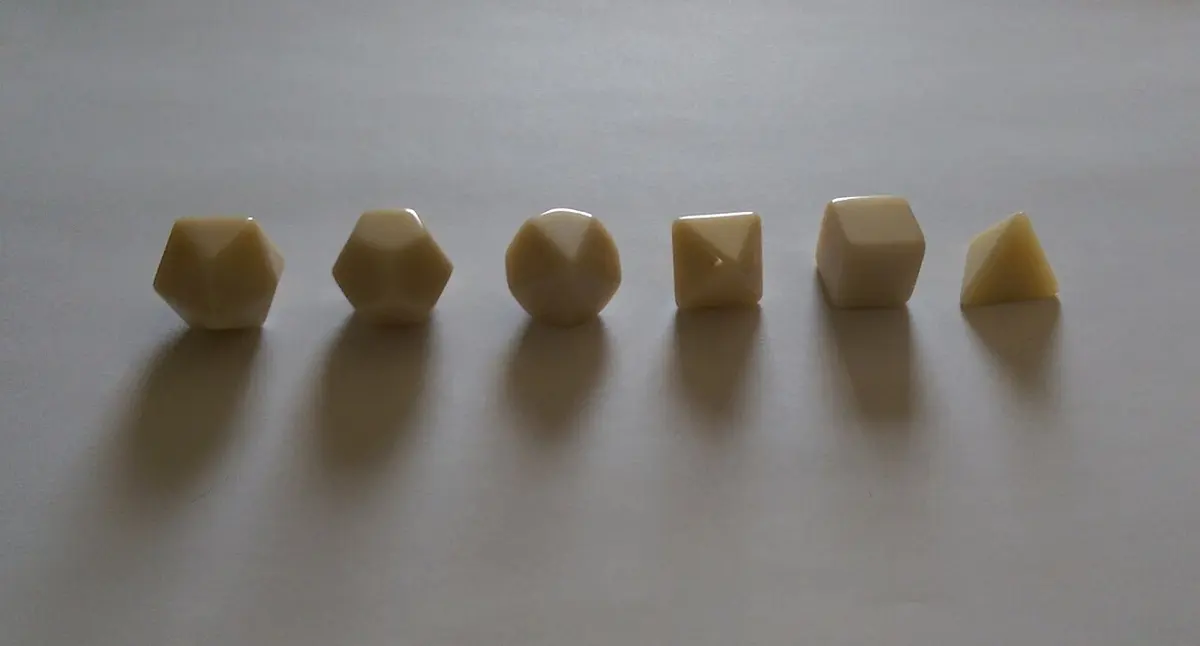
Ruchi, who likes board games with big numbers, asks the obvious thing. “Why stop at 20? Can’t someone make a perfect die with 30 equal triangles? Or one with hexagons, like a football made only of hexagons?” Call a die perfect if its faces are all the same regular polygon and its corners all look alike. How many perfect dice can there be?
Guess first. How many different shapes of perfect die are possible, counting the cube as one?
Pick an answer to see why.
Build a corner
A die is a solid, so it has corners, and every corner of a perfect die is the same. So start small: forget the whole die and build just one corner. Take some equal regular polygons, put one corner of each at a single point, side by side, and see whether they can fold up into the point of a solid.
You probably noticed the rule. Three squares leave a gap of 90°; close it and you have the corner of a cube. Four squares fill all 360°, so they lie flat, like floor tiles. Five need 450°: they can’t even fit.
The gap is what makes a corner. Cut a wedge out of a paper circle and tape the two cut edges together: you get a cone with a point, and the bigger the wedge, the sharper the point. Cut nothing out, and the paper stays flat. A corner of a die is like the point of that cone: it points outwards, so the angles of the faces meeting there must add up to less than 360°, and the gap, the wedge that is missing, is what lets the faces bend round into a point. (A dent can break this rule: a corner pushed inwards can have more than 360° round it, like a crumpled sheet. Dice have no dents.)
Why there can’t be a sixth
Now the argument, in full. It needs only one fact from Grade 8: the angles of a polygon with n sides add up to (n − 2) × 180°, because lines from one corner cut it into n − 2 triangles. In a regular polygon all the angles are equal, so each is
| Polygon | Sides | Each angle | 3 at a corner | 4 at a corner | 5 at a corner | 6 at a corner |
|---|---|---|---|---|---|---|
| Triangle | 3 | 60° | 180° | 240° | 300° | 360° |
| Square | 4 | 90° | 270° | 360° | 450° | 540° |
| Pentagon | 5 | 108° | 324° | 432° | 540° | 648° |
| Hexagon | 6 | 120° | 360° | 480° | 600° | 720° |
| Heptagon | 7 | about 128.6° | about 385.7° | 514.3° |
Every corner of a perfect die has the same number of faces, at least 3, and their angles must add up to less than 360°.
- Triangles (60°): 3, 4 or 5 at a corner. Six make exactly 360°: flat.
- Squares (90°): only 3. Four make 360°.
- Pentagons (108°): only 3. Four make 432°.
- Hexagons (120°): three make exactly 360°. No corner at all.
- Seven sides or more: each angle is more than 120°, so even three pass 360°.
That leaves just five possible corners. Once the corner is chosen, the die is fixed: the faces round the first corner make the next corners, and so on, face by face, so each corner gives at most one die. So there are at most five perfect dice, and each really can be built, as the next section shows: exactly five. The solids are called the Platonic solids, or the regular polyhedra: solids whose faces are all the same regular polygon, with the same number meeting at every corner. Their names come from the Greek for their numbers of faces: the tetrahedron (4 faces), the cube (6), the octahedron (8), the dodecahedron (12) and the icosahedron (20).
The same argument in algebra
If k regular n-gons meet at a corner, the rule “less than 360°” is
Divide by 180°, then multiply by n: k(n − 2) < 2n, that is, kn − 2k − 2n < 0. Add 4 to both sides, and the left side factorizes:
Both n and k are at least 3, so both brackets are at least 1. Two whole numbers, each at least 1, whose product is less than 4: the products can only be 1 × 1, 1 × 2, 2 × 1, 1 × 3 or 3 × 1. Those give (n, k) = (3, 3), (3, 4), (4, 3), (3, 5), (5, 3): the five again. And the product is exactly 4 for (6, 3), (4, 4) and (3, 6): hexagons, squares and triangles lying flat, the three regular floor tilings.
A friend says: “A regular heptagon has angles of about 128.6°. Three of them make about 385.7°. So a die of heptagons just needs to be made bigger, so the faces bend more.” What is wrong?
Pick an answer to see why.
Meet the five
Here they are. Turn each one, count what meets at a corner, and look at the last readout.
| Solid | Faces | Each face | Faces at a corner | Edges | Corners |
|---|---|---|---|---|---|
| Tetrahedron | 4 | triangle | 3 | 6 | 4 |
| Cube | 6 | square | 3 | 12 | 8 |
| Octahedron | 8 | triangle | 4 | 12 | 6 |
| Dodecahedron | 12 | pentagon | 3 | 30 | 20 |
| Icosahedron | 20 | triangle | 5 | 30 | 12 |
Notice the pairs. The cube and the octahedron both have 12 edges, with faces and corners swapped: 6 and 8 against 8 and 6. The dodecahedron and the icosahedron do the same with 12 and 20. That is what “Partner inside” shows: put a dot in the middle of every face of a cube, join the dots across each edge, and you get an octahedron. Each solid’s partner is called its dual. Squares, 3 at a corner, become triangles, 4 at a corner: the numbers n and k swap. The tetrahedron, with 3 triangles 3 at a corner, is its own dual.
A second proof, by counting
There is another way to find the five, using Euler’s formula, which says that for every solid without holes, corners − edges + faces = 2 (you can see why in Why Do Solids Always Obey One Rule?). Write V for the corners (vertices), E for the edges and F for the faces, so V − E + F = 2.
Suppose every face has n sides and k faces meet at every corner. Count the sides of all the faces: nF. Every edge is the side of exactly two faces, so nF = 2E. Count the edges at every corner: kV. Every edge has two ends, so kV = 2E. So
Put these into Euler’s formula, , and divide by 2E:
The right side is more than 1/2, because E is a positive number of edges. So 1/n + 1/k must be more than 1/2. With n and k at least 3, that again leaves only the five pairs, and now the formula also says how many edges each solid has.
What happens for hexagons, 3 at a corner? Then 1/6 + 1/3 = 1/2, so 1/E = 0: no number of edges is big enough. That is the honeycomb: hexagons, 3 at every corner, go on across the floor for ever and never close up into a solid. Squares 4 at a corner and triangles 6 at a corner do the same. (Floors of tiles, and the strange ones that never repeat, are in Can a Pattern of Tiles Never Repeat?.)
Every solid’s gaps add up to 720°
Look again at the widget’s last readout, All the gaps. The cube: 8 corners with gaps of 90°, 8 × 90° = 720°. The tetrahedron: 4 × 180° = 720°. The octahedron: 6 × 120°, the dodecahedron 20 × 36°, the icosahedron 12 × 60°: always 720°.
This is not luck. The gap at a corner is called its angle defect, and Descartes’ theorem says that for any solid without holes, the angle defects at all its corners add up to exactly 720°, two full turns, however many corners it has and whatever its faces are. A solid has to turn its surface right round to close up, and the corners are where all of that turning happens: the faces themselves are flat. A sharp corner uses up a lot of the 720°; a blunt one very little, so the solid needs many of them.
An old-style football has 12 pentagons and 20 hexagons, with 2 hexagons and 1 pentagon at every corner. Using Descartes’ theorem, how many corners does it have?
Pick an answer to see why.
Fair, but not perfect
A die doesn’t need to be perfect to be fair. What makes a die fair is that every face is just like every other face as part of the whole die: for any two faces, you can turn (or reflect) the die so that one lands exactly where the other was and the die looks the same as before. Then no face can be favored by the way the die is shaped. A solid like that is called face-transitive (or an isohedron). Every Platonic solid is face-transitive, but so are many solids whose corners are not all alike.
The triangular bipyramid is two triangular pyramids glued base to base: six equal triangles, any one of which can be turned onto any other. But 3 triangles meet at the top and bottom corners and 4 at each corner round the middle: the corners differ, so it isn’t perfect. The ten-sided die in Anish’s box is a pentagonal trapezohedron: ten identical kites, 5 meeting at each of its two points and 3 at each of the other ten corners. Both still obey Descartes. The bipyramid’s gaps: 2 × 180° + 3 × 120° = 720°. On a ten-sided die, made with all its corners on a sphere, the gaps are about 100.9° at the two points and 51.8° at the other ten, and they add up to 720° too.
Fair dice come in many more sizes than perfect ones: bipyramids and trapezohedra can be made with as many faces as you like, as long as the number is even. A convex face-transitive solid always has an even number of faces, so a fair die with 7 faces can’t be made that way. Game makers who want an odd number use long dice: a long prism, rolled along its length, which stops on one of its sides. The rounded ends stop it standing up.
Bending the rules
The proof used two rules: the solid has no dents, and it lives in our three dimensions. Change either, and the count changes.
Allow faces to pass through each other. Use five-pointed stars as faces, or let the faces meet round a corner in a star pattern, and four more regular solids appear, spiky and self-crossing: the Kepler–Poinsot polyhedra. Johannes Kepler found two of them in about 1619; Louis Poinsot found the other two in 1809, and three years later Augustin Cauchy proved there are no others.
Go up a dimension. In four dimensions, where a “solid” is built from three-dimensional cells as a die is built from faces, the same kind of corner-counting leaves exactly six regular shapes, as the Swiss mathematician Ludwig Schläfli found in the middle of the 19th century. In five dimensions and every dimension above, there are only three: the cousins of the tetrahedron, the cube and the octahedron.
Where this is used
Questions
★ Why is there no perfect die made of regular hexagons?
Pick an answer to see why.
Copy and complete: “In a perfect die, the angles of the faces at each corner must add up to less than ____, and at least ____ faces must meet at each corner.” Then use the rule to explain why there is no perfect die made of squares with 4 at each corner.
Answer
Use to find the number of edges, faces and corners of the octahedron (triangles, 4 at each corner). Check Euler’s formula.
Answer
The snub cube is a convex solid with 4 equilateral triangles and 1 square at every corner. How many corners does it have? Use Descartes’ theorem.
Hint
Answer
A deltahedron is a convex solid whose faces are all equilateral triangles (not necessarily the same number at each corner). Suppose a of its corners have 3 triangles, b have 4 and c have 5. (Six would be flat.)
- i.Use Descartes’ theorem to show that 3a + 2b + c = 12.
- ii.Check it for the pentagonal bipyramid (two five-sided pyramids glued base to base), and for the icosahedron.
Hint
Answer
The 12 points (0, ±1, ±φ), (±1, ±φ, 0) and (±φ, 0, ±1), where φ = (1 + √5) ÷ 2 is the golden ratio, are the corners of an icosahedron. Show that the distance from (0, 1, φ) to (1, φ, 0) is 2, the same as from (0, 1, φ) to (0, −1, φ). You will need φ² = φ + 1.
Answer
★★★ The dual of a solid has a corner in the middle of each face. If a perfect die has n-gon faces with k at each corner, what are its dual’s faces?
Pick an answer to see why.
Where to go next
- Why Do Solids Always Obey One Rule? Euler’s formula, corners − edges + faces = 2, and why it works for every solid without holes.
- Can a Pattern of Tiles Never Repeat? The flat cases: squares, triangles and hexagons that fill a floor, and a single tile that fills it without ever repeating.
- Is the Golden Ratio Really Everywhere? The golden ratio is built into the dodecahedron and the icosahedron; elsewhere it is often a myth.
- Why Do Flights to America Fly Near the North Pole? Geometry on a sphere, which curves smoothly where a solid curves only at its corners.
Where these facts come from
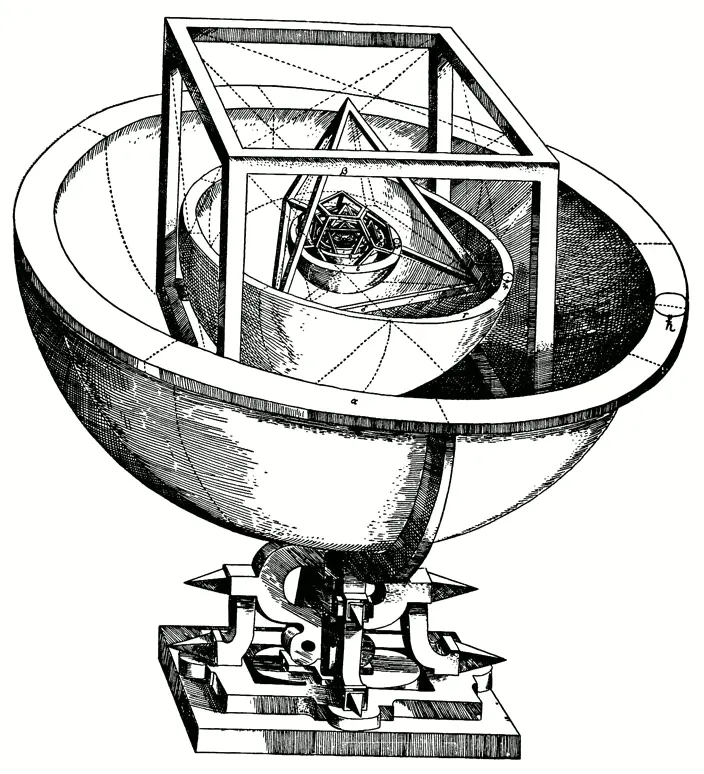
- The definition of a Platonic solid; Plato’s Timaeus (about 360 BCE) and its elements (fire tetrahedron, earth cube, air octahedron, water icosahedron, the dodecahedron for “arranging the constellations on the whole heaven”); Euclid’s Book XIII, Propositions 13–18; Kepler’s Mysterium Cosmographicum (1596), the order of the nested solids and his laws; dice in role-playing games; the four Kepler–Poinsot polyhedra; viruses such as herpes as icosahedra; no regular dodecahedral or icosahedral crystals, the pyritohedron, boron’s B₁₂ icosahedra; the counting proof with nF = 2E = kV: Wikipedia, “Platonic solid”, read October 2026.
- Euclid’s remark after Book XIII, Proposition 18 (no other figure than the five; three, four and five triangles, three squares, three pentagons; every solid angle less than four right angles; the pentagon’s angle a right angle and a fifth), retold in our words, and “a solid angle cannot be constructed with two triangles”: D. E. Joyce’s edition of Euclid’s Elements, Book XIII, Proposition 18, read October 2026.
- Theaetetus’s dates (about 417 to 369 BCE), his place in Plato’s dialogue, and his proof that there are exactly five: Wikipedia, “Theaetetus (mathematician)”; the Suda’s “the first to construct the so-called five solids” and the note thought to be Geminus’s, giving the cube, pyramid and dodecahedron to the Pythagoreans and the octahedron and icosahedron to Theaetetus: J. J. O’Connor and E. F. Robertson, “Theaetetus of Athens”, MacTutor History of Mathematics, both read October 2026.
- Kepler’s book published at Tübingen late in 1596, its six planets, its later influence on his work, the 1621 second edition, and that he never gave up its nested solids: Wikipedia, “Mysterium Cosmographicum”, read October 2026.
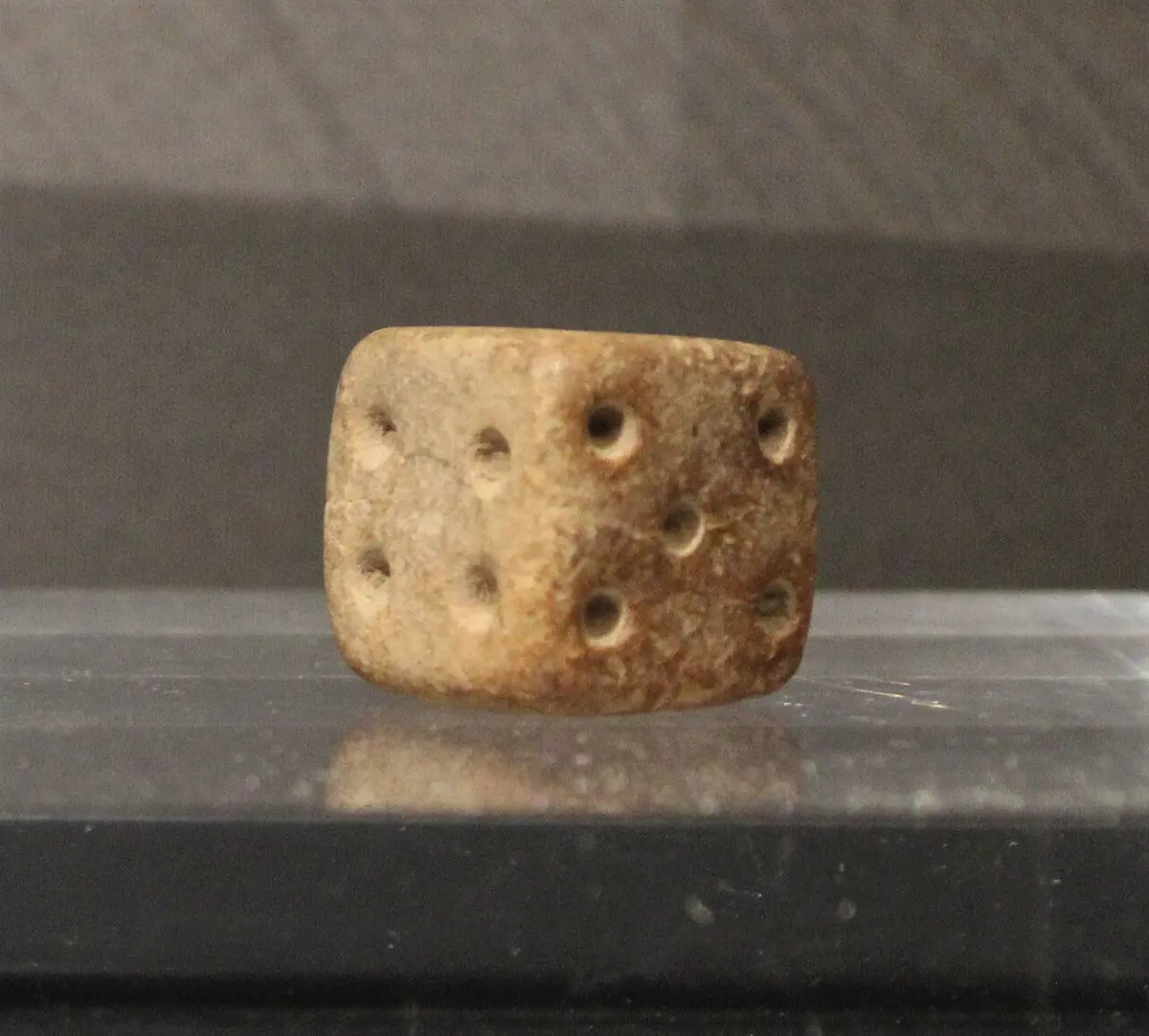
- Dice from Mohenjo-daro (2500–1900 BCE, one with opposite sides adding to seven), dice games in the Rigveda, Atharvaveda and Mahabharata, the ten-sided die as a pentagonal trapezohedron with kite faces, fair dice as face-transitive solids (bipyramids, trapezohedra), and long dice for any number of faces: Wikipedia, “Dice”, read October 2026; the die in the photo, from Mohenjo-daro, c. 2600–1900 BCE, in the Ashmolean Museum: its Wikimedia Commons description, read October 2026.
- Face-transitive (isohedral) solids as the shapes of fair dice, and an isohedron always having an even number of faces: Wikipedia, “Isohedral figure”, read October 2026.
- The pentagonal trapezohedron: ten kites, 20 edges, 12 corners, and the ten-sided die’s version with all its corners on a sphere (its kites have two 90° angles; the other two, about 51.8° and 128.2°, and its gaps computed in
checks/textbooks/math-further-9-12/24/tmp/review/d10.py): Wikipedia, “Pentagonal trapezohedron”, read October 2026. - Angle defect and Descartes’ theorem (the defects of a solid without holes add up to 720°): Wikipedia, “Angular defect”, read October 2026.
- Kepler’s two star polyhedra (about 1619), Poinsot’s two more (1809) and Cauchy’s proof three years later that there are no others: Wikipedia, “Kepler–Poinsot polyhedron”, read October 2026.
- Six convex regular shapes in four dimensions, first described by Ludwig Schläfli in the mid-19th century: Wikipedia, “Regular 4-polytope”; only three in five dimensions and above: Wikipedia, “Regular polytope”, both read October 2026.
- Dodecahedrane, C₂₀H₂₀, first made by Leo Paquette’s group at Ohio State University in 1982 in about 29 steps, for its symmetry: Wikipedia, “Dodecahedrane”, read October 2026.
- The snub cube’s 24 corners, 6 squares and 32 triangles: Wikipedia, “Snub cube”; the eight convex deltahedra (4, 6, 8, 10, 12, 14, 16 and 20 faces): Wikipedia, “Deltahedron”, both read October 2026.
- Every number in the topic (the polygons’ angles, every corner’s total and gap, the inequality (n − 2)(k − 2) < 4 checked against the angle rule for every n and k up to 100, the five solids’ counts from 1/E = 1/n + 1/k − 1/2, the gaps adding to 720° for the five, the football, the snub cube and the two fair dice, the deltahedra’s 3a + 2b + c = 12, the icosahedron’s corners and edges) was computed in
checks/textbooks/math-further-9-12/24/tmp/dice_numbers.py, and the widget’s solids measured corner by corner indice_geometry.pybeside it.
