
At the end of the monsoon, the big sunflower by Didi’s gate has dropped its petals and bowed its heavy head. Pemba cuts it off to dry the seeds, and notices something: the seeds aren’t in rows or rings. They curl out from the middle in spirals, some clockwise and some anticlockwise, criss-crossing so that every seed sits on one spiral of each kind.
“I’ll count them,” she says. Her brother laughs: “There must be hundreds.” There aren’t. And on most sunflowers, the two counts turn out to be two numbers from one short list that has nothing to do with flowers.
Guess first. Are there as many spirals going clockwise on a sunflower head as going anticlockwise?
Pick an answer to see why.
Here is a sunflower head drawn by a rule this topic will explain. Count its spirals, one way and then the other.
Count the spirals
Two heads, four numbers
If you counted carefully (or let the widget do it), you found these:
| Head | Seeds | Clockwise spirals | Anticlockwise spirals |
|---|---|---|---|
| Small | 500 | 55 | 34 |
| Big | 1,200 | 55 | 89 |
The counts aren’t the same either way, and the bigger head keeps 55 and swaps 34 for 89. Real sunflowers do the same: big heads show 55 and 89 spirals near their edge, and some giant ones 89 and 144.
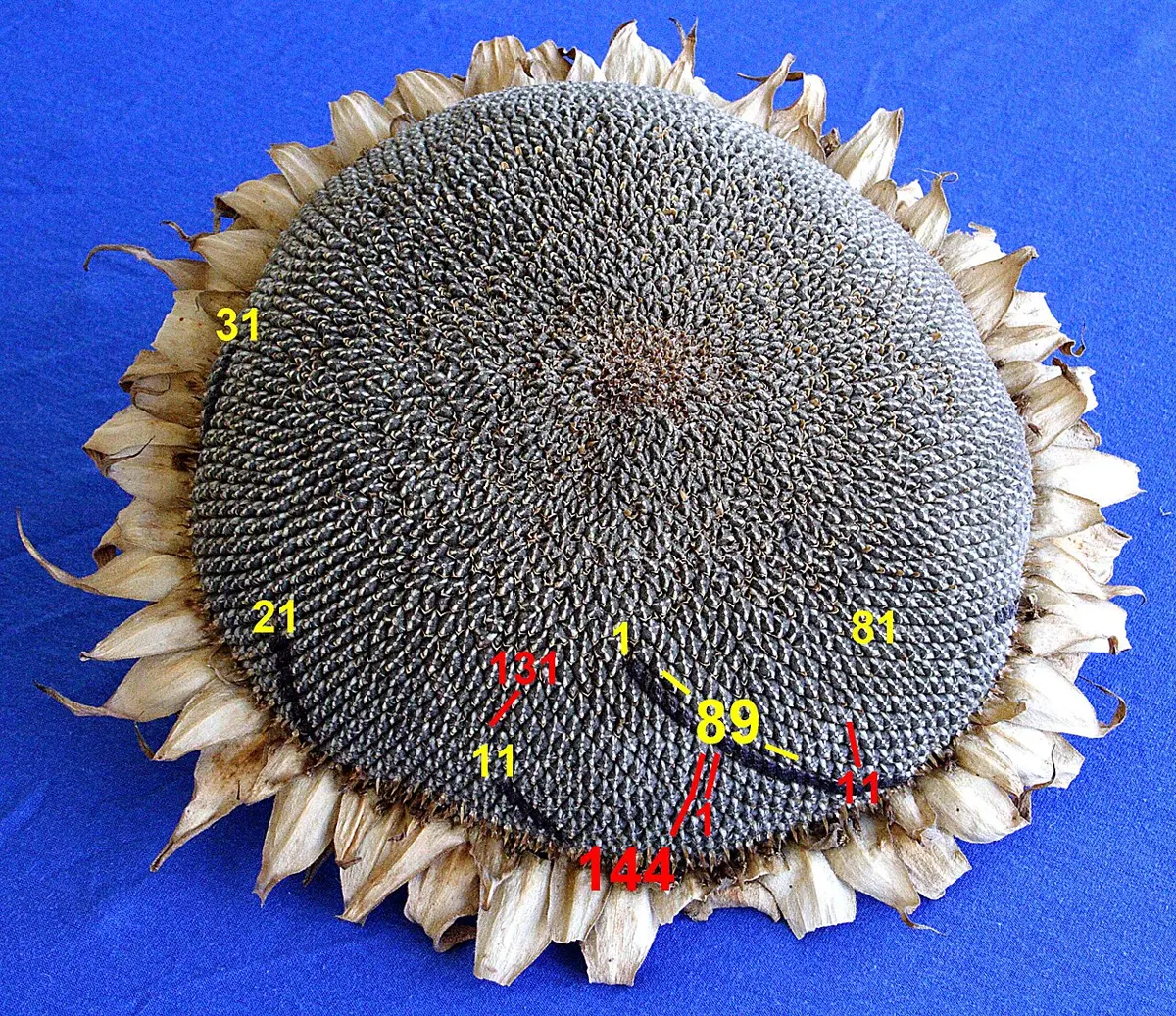
Now look at the numbers themselves: 34, 55, 89, 144. Is there a pattern? Try adding two of them.
34 + 55 = 89, and 55 + 89 = 144. Each number is the sum of the two before it. Run the rule backwards and see where it came from: 55 − 34 = 21, then 34 − 21 = 13, then 8, 5, 3, 2, 1 and 1. So the counts belong to one list that starts 1, 1 and grows by adding:
The list goes 34, 55, 89, 144. What comes after 144?
Pick an answer to see why.
Smaller spirals in other plants
Sunflowers have the biggest counts, because their heads hold the most seeds. Plants with fewer, bigger parts show smaller numbers from the same list. A pine cone’s scales also sit in spirals both ways round: a survey of pine cones from many kinds of pine tree in California found 5, 8 or 13 spirals on every one, though a later study found the odd cone that doesn’t fit. Pineapples, artichokes and the leaves of the spiral aloe show the same kind of pattern.
What’s going on
The Fibonacci numbers
The list 1, 1, 2, 3, 5, 8, 13, … is called the Fibonacci numbers, after the Italian Leonardo of Pisa, nicknamed Fibonacci, who wrote about it in 1202. Write F₁ for the first, F₂ for the second, and so on. Then the whole list comes from two starting numbers and one rule, which turns each position n into one number , so the list is a function of n:
A rule like this, which makes each number from the ones before it, is called a recursive rule: to find you need and , and they need the ones before them, down to the two 1s.
| n | 1 | 2 | 3 | 4 | 5 | 6 | 7 | 8 | 9 | 10 | 11 | 12 |
|---|---|---|---|---|---|---|---|---|---|---|---|---|
| Fₙ | 1 | 1 | 2 | 3 | 5 | 8 | 13 | 21 | 34 | 55 | 89 | 144 |
The same rule with different starting numbers makes a Fibonacci-type sequence. Start with 2 and 5 and you get 2, 5, 7, 12, 19, 31, 50, 81… Whatever two positive numbers you start with, divide each number by the one before it and the answers settle down to the same number, about 1.618, the golden ratio (for Fibonacci’s own list, 89 ÷ 55 = 1.6182 already). Where Did the Missing Square Go? shows where that ratio hides in a famous puzzle.
So why would a flower, which can’t count, put its seeds in spirals whose numbers follow an adding rule?
One seed at a time
A sunflower head doesn’t make its seeds all at once. Each seed starts as a tiny bump, one after another, and every new bump appears at a fixed turn from the one before, like the hand of a clock that jumps by the same angle each time. (On a sunflower the first bumps form near the rim and later ones nearer the middle, so the oldest seeds are at the edge; on a growing shoot, new bumps appear at the tip.) Botanists have measured that turn on many plants. It is very close to 137.5°.
Before asking why 137.5°, see what other turns would do. Choose a turn, and the widget grows 400 seeds with it, from the middle outwards.
A quarter turn (90°) is a disaster for a plant: seed 5 points the same way as seed 1, seed 6 the same way as seed 2, and the seeds line up in 4 straight spokes with wide, empty gaps between them. The same happens with any fraction of a turn. If the turn is of a turn (144°), then after 5 seeds the turns add up to exactly 2 whole turns, so every fifth seed points the same way: 5 spokes. A turn of makes 8 spokes. In lowest terms, the bottom of the fraction is the number of spokes.
Now look at the fractions in the widget that get closer and closer to the real 137.5°:
| Fraction of a turn | 1/2 | 1/3 | 2/5 | 3/8 | 5/13 | 8/21 | 13/34 | 21/55 |
|---|---|---|---|---|---|---|---|---|
| Turn | 180° | 120° | 144° | 135° | 138.46° | 137.14° | 137.65° | 137.45° |
| Spokes | 2 | 3 | 5 | 8 | 13 | 21 | 34 | 55 |
Fibonacci numbers on top, Fibonacci numbers on the bottom! And each fraction comes from the two before it by adding the tops and adding the bottoms: from and you get . The turns zigzag above and below 137.5°, each one closer than the last, and never reach it: the real turn is not a fraction at all. It is the golden angle, 137.5077…°, the share 0.381966… of a full turn that the golden ratio picks out. Cut a full turn into 137.5° and 222.5°, and the bigger part divided by the smaller is 1.618, the same as the whole turn divided by the bigger part.
The next fraction in the zigzag after 8/21 is made from 5/13 and 8/21. What is it, and how many spokes would it make?
Pick an answer to see why.
Spirals are near-misses
So the golden turn makes no spokes. Where do the spirals come from? Look closely at one seed and the seeds touching it.
In Figure 20.2, the seeds touching seed 300 are seeds 266 and 334 (34 away), 245 and 355 (55 away), and, a little farther off, 279 and 321 (21 away). None is 1, 10 or 40 away. Why Fibonacci numbers again?
Seed 300 + m has turned m × 0.381966… turns further than seed 300. If that is nearly a whole number of turns, the new seed points nearly the same way as seed 300, just a little farther out: so it is a close neighbor. Here is how near a whole number each step gets:
| Seeds later, m | 1 | 2 | 3 | 5 | 8 | 13 | 21 | 34 | 55 |
|---|---|---|---|---|---|---|---|---|---|
| Turns, m × 0.381966 | 0.382 | 0.764 | 1.146 | 1.910 | 3.056 | 4.966 | 8.021 | 12.987 | 21.008 |
| Miss from a whole turn | +0.382 | −0.236 | +0.146 | −0.090 | +0.056 | −0.034 | +0.021 | −0.013 | +0.008 |
Every step left out of the table misses by more than a smaller step already did. Try m = 4 (1.528 turns, a miss of nearly half a turn), 10 (3.820, a miss of 0.180) or 18 (6.875, a miss of 0.125). The record near-misses, each closer than any before it, happen only at the Fibonacci numbers.
And look at how the misses go: plus, minus, plus, minus, each smaller than the last. Add two neighbors and you get the next one: the miss for 13 is −0.034 and the miss for 21 is +0.021, and −0.034 + 0.021 = −0.013, the miss for 34. Of course: 34 seeds later is 13 seeds later and then 21 more, so its turns are the two added, and so are its misses. The near-misses obey the Fibonacci rule because the steps do.
Now the spirals. Seed 300 is close to seed 334, which is close to seed 368, which is close to 402, and so on outwards, each a small sideways step from the last: that chain is one spiral. Start from seed 301 instead and you get another. There are 34 starting points, seeds 0 to 33, before the chains repeat, so there are 34 spirals of that kind. The steps of 55 make 55 spirals the other way round, because their miss is the other sign. That is what you counted in the first widget.
Why does the bigger head swap 34 for 89? Farther out, the seeds go round a bigger circle, and the same sideways miss in degrees is a longer distance there, so a neighbor must miss by less to stay close. Out at the edge of the big head, the step of 34 misses by too much, and the next record, 89 with its miss of 0.005 of a turn, takes over. (The rings of seeds are also thinner out there, so a seed 89 steps later is hardly any farther out.) Real heads do this too: the Manchester team below notes that a head’s counts nearer the middle are close to the difference of its two counts at the rim, like 89 − 55 = 34, so they counted at the rim, where the numbers are biggest.
A head of seeds turned by the golden angle shows 21 and 34 spirals near its middle. Which pair are you most likely to count at its edge?
Pick an answer to see why.
Why would a plant turn by the golden angle?
The flower doesn’t measure 137.5°. In 1868 the botanist Wilhelm Hofmeister suggested a simpler rule: each new bud forms in the least crowded place round the growing tip, as far as it can get from the buds already there. In 1992 two physicists, Stéphane Douady and Yves Couder, tested whether a rule like that is enough, with no plant at all. They let drops of a magnetic liquid appear one at a time at the middle of a dish of oil, in a magnetic field that made the drops push each other away: each new drop pushed the older ones outwards and was itself pushed into the emptiest direction. The drops arranged themselves in spirals in Fibonacci numbers, all by themselves. So the golden angle isn’t a number the plant knows. It is what you get when each new thing squeezes into the biggest gap left by the ones before.
That is also why it suits a plant. Your widget showed it: any fraction of a turn eventually lines seeds up in spokes and leaves gaps, while the golden turn, which no fraction matches (mathematicians call the golden ratio the “most irrational” number), packs seeds evenly all the way out, with room for as many as possible. Biologists have found that a plant hormone, auxin, gathers where a new bud will form and drains away from the area round it, and scientists still debate which model best explains the rest.
When the count isn’t Fibonacci
Real flowers are not perfect models, and the best way to find out how often the rule really holds is to count a lot of them. In 2012, for the hundredth anniversary of Alan Turing’s birth, the Museum of Science and Industry in Manchester asked the public to grow a sunflower and count its spirals, or bring the head in to be counted. Turing, a mathematician, had studied sunflower spirals in the 1950s.
The project collected 657 sunflowers. In the clearest data the counters checked 768 spiral counts:
| What the count was | Counts | Share |
|---|---|---|
| A Fibonacci number | 565 | 74% |
| A Lucas number (2, 1, 3, 4, 7, 11, 18, 29, 47, 76…) | 41 | 5% |
| Twice a Fibonacci number (42, 68…) | 25 | 3% |
| Another Fibonacci-type number | 1 | 0.1% |
| None of these | 136 | 18% |
So about three counts in four were Fibonacci numbers, and about one in five wasn’t in any of these lists. Among those, a number one less than a Fibonacci number (such as 54 or 88) turned up 49 times, nearly three times as often as one more (17 times).
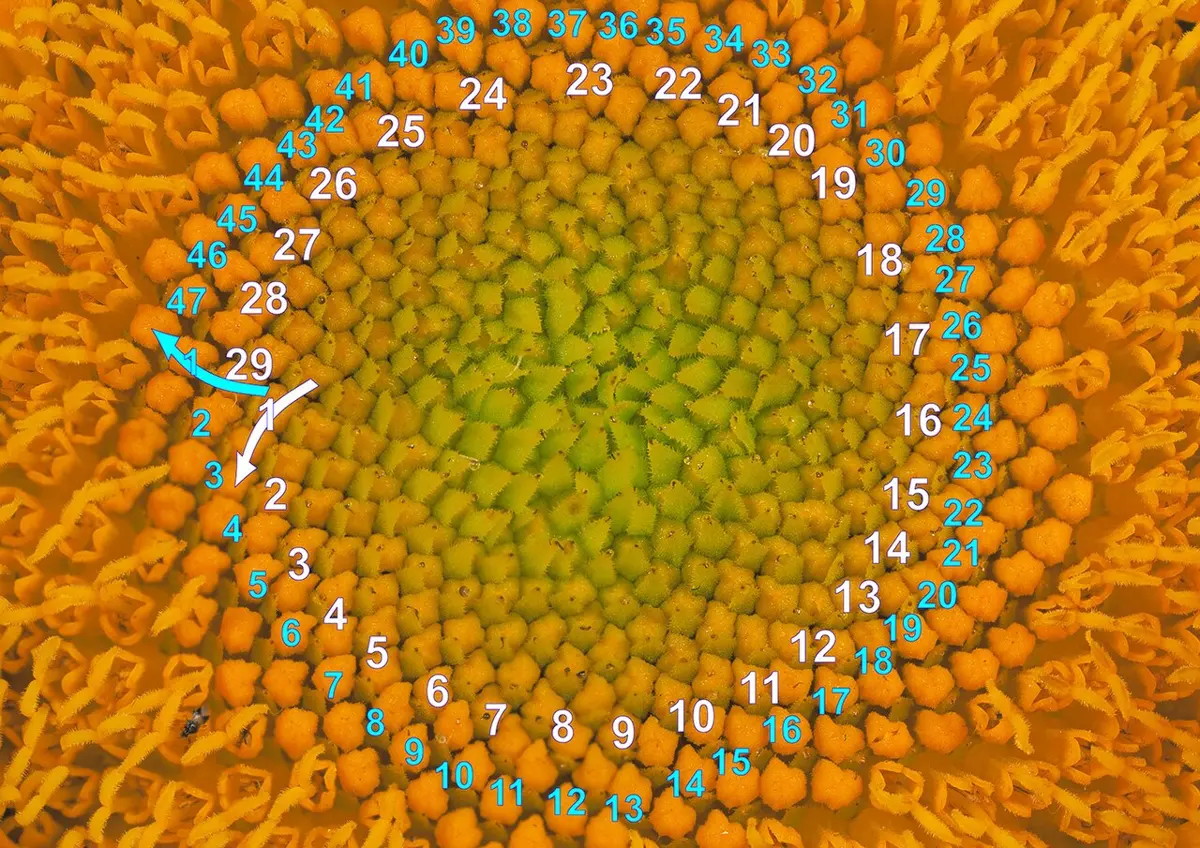
The Lucas numbers are a Fibonacci-type sequence: the same adding rule, started from 2 and 1 instead of 1 and 1. A head with 29 and 47 spirals has followed the adding rule, but from a different start, and the ratio 47 ÷ 29 = 1.62 is still close to the golden ratio.
There is a warning in that table, too. Small numbers prove very little. Of the whole numbers from 1 to 17, every one except 12, 15 and 17 is in one of these Fibonacci-type lists (Fibonacci, Lucas, twice Fibonacci, or 1, 4, 5, 9, 14…). So a flower with 4, 7 or 11 petals can be “explained” by some list, and that explains nothing. Sunflowers matter because their counts are big: 55 and 89 are hard to hit by chance.
A friend counts 29 spirals one way on a sunflower and 47 the other. What should she conclude?
Pick an answer to see why.
Where this is used
Questions
Write the first fifteen Fibonacci numbers. Which of them are even? What pattern do you see?
Hint
Answer
The rule of a Fibonacci-type sequence is “add the two numbers before”. Its third and fourth numbers are 12 and 21. What are the first two?
Hint
Answer
A plant turns each new leaf 3/8 of a full turn from the last. How many degrees is that, and in how many straight rows do the leaves line up?
Pick an answer to see why.
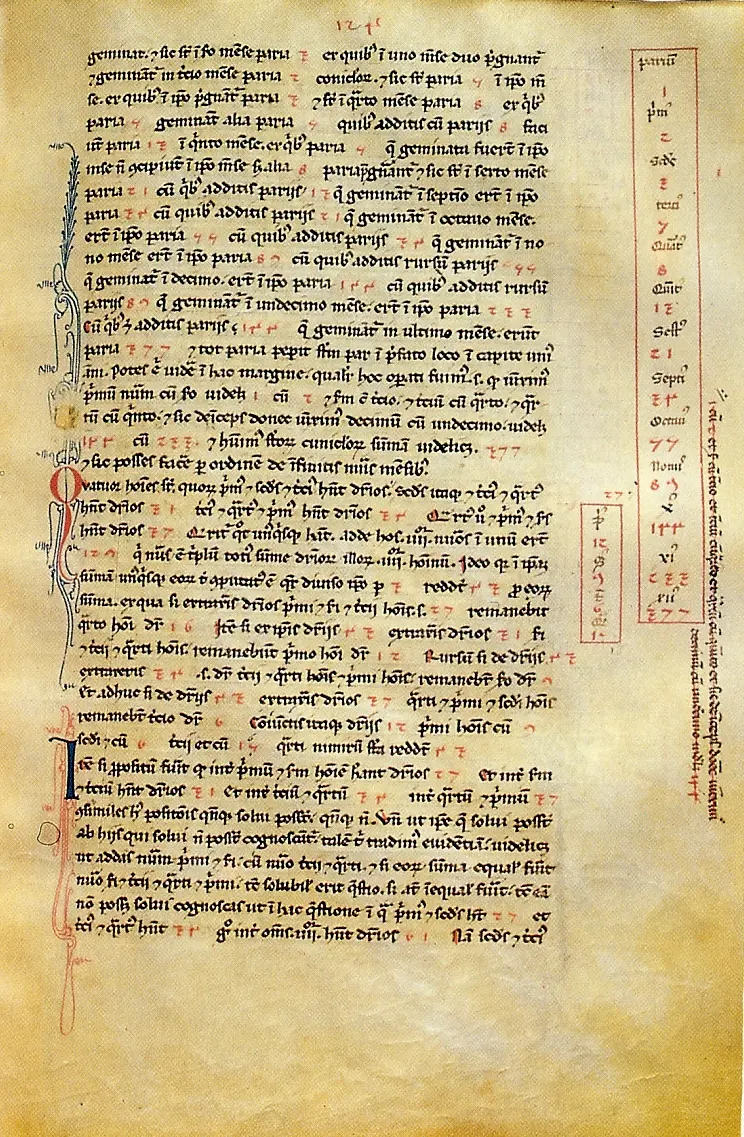
Leonardo of Pisa began his rabbit puzzle with a pair old enough to have young at once, so his list starts 1, 2, 3, 5, 8, … and ends with 377 after twelve months. Suppose instead you start with a pair born today, which can have its first young only from its second month. How many pairs are there after twelve months?
Hint
Answer
A male honey bee (a drone) hatches from an egg that wasn’t fertilized, so he has a mother but no father. A female has a mother and a father. Count a drone’s ancestors: 1 parent, then 2 grandparents. How many great-grandparents does he have, and how many ancestors in the sixth generation back?
Hint
Answer
Add the first ten Fibonacci numbers, 1 + 1 + 2 + … + 55. Compare your answer with the Fibonacci numbers just after 55. Explain why it always works this way.
Hint
Answer
A staircase has 10 steps. You climb it one or two steps at a time, in any mix. In how many different ways can you get to the top?
Hint
Answer
Two model heads are grown with turns of 5/13 of a full turn and of the golden angle. Near the middle, the two look almost the same. Explain why, and say what you would see on each farther out.
Hint
Answer
Where to go next
- Where Did the Missing Square Go? The same numbers in a puzzle where a square seems to vanish, and why the ratio of neighbors settles at 1.618.
- Is the Golden Ratio Really Everywhere? (Grades 9–12) The golden ratio in sunflowers is real; in shells, faces and famous buildings, mostly not.
- How Many Ways Can You Climb the Stairs? (Grades 9–12) Question f in full: the Fibonacci numbers as a way of counting.
- How Does the Mind-Reading Card Trick Work? (Computing, Going Further) A card trick built on binary, and a version built on Fibonacci numbers to program.
- Grade 11 Computing: Recursion Counting the ways up a stairway with a program that calls itself.
Where these facts come from
- The Fibonacci numbers in Sanskrit prosody (Virahanka, Hemachandra); Leonardo of Pisa’s Liber Abaci (1202) and its rabbit problem, with the rabbits’ rules, and the manuscript page in Florence listing the pairs up to 377; the sequence in pineapples, artichokes, the spiral aloe, pine cones and the honey bee’s family tree; Vogel’s model of the sunflower head (1979: seed n at angle n × 137.51°, distance ∝ √n), its nearest neighbors at Fibonacci steps and its spirals counted in adjacent Fibonacci numbers; Schimper and Braun (1830); any starting pair’s ratios approach the golden ratio (3, 2, 5, 7, 12…); the sum of the first n Fibonacci numbers; every third number even: Wikipedia, “Fibonacci sequence”, read October 2026.
- Leonardo born about 1170, his father a merchant and customs official at Bugia (Béjaïa), “the nine figures of the Indians”, the Liber Abaci popularizing Hindu–Arabic numerals in Europe, the name Fibonacci, short for filius Bonacci, first in a modern source in 1838: Wikipedia, “Fibonacci”, read October 2026.
- The golden angle, 137.5077…°, its definition by the golden ratio, 222.5° and 137.5°, the share 0.381966: Wikipedia, “Golden angle”, read October 2026.
- Hofmeister’s model (1868: a new primordium forms at the least crowded part of the meristem), Schimper and Braun, the Bravais brothers (1837), auxin, Douady and Couder (1992, Physical Review Letters): Wikipedia, “Phyllotaxis”, read October 2026.
- Douady and Couder’s experiment, ferrofluid drops appearing one at a time at the middle of an oil disk, repelling each other and arranging themselves in Fibonacci patterns: Hyun-Woo Lee and Leonid S. Levitov, “Universality in Phyllotaxis: a Mechanical Theory” (arXiv:2101.02652, 2021), read October 2026.
- The Lucas numbers, the same rule with different starting values, named after Édouard Lucas (1842–1891): Wikipedia, “Lucas number”, read October 2026. Lucas giving the sequence Fibonacci’s name: Martin Gardner, Mathematical Circus, as quoted there and in “Fibonacci sequence”.
- The Manchester project (Turing’s Sunflowers, Museum of Science and Industry, 2012, for the centenary of Turing’s birth), 657 sunflowers, 768 counts, 565 Fibonacci, 41 Lucas, 25 double Fibonacci, 1 of another Fibonacci-type, 136 none, one less than a Fibonacci number 49 times and one more 17, Turing’s work in the 1950s published after his death, the debate about the models, the earlier studies of Weisse and Schoute, Cooke’s warning that these sequences cover all but three of the first 17 whole numbers, the rim the oldest part of the head, and the counts nearer the middle close to the difference of the two at the rim: Jonathan Swinton, Erinma Ochu and the MSI Turing’s Sunflower Consortium, “Novel Fibonacci and non-Fibonacci structure in the sunflower: results of a citizen science experiment”, Royal Society Open Science 3: 160091 (2016, CC BY), read October 2026 (the full text from Europe PMC, PMC4892450).
- Pine cones from many kinds of pine in California all showing 5, 8 or 13 spirals (Brousseau’s 1968 survey) and his later study finding the occasional cone that doesn’t, and sunflowers with 55 and 89 spirals at the edge: Ron Knott, “Fibonacci Numbers and Nature”, University of Surrey, read October 2026.
- The sunflower layout for the mirrors of a solar power tower, PS10 near Seville, each mirror about 137° from its neighbor, 20% less land, less shading and blocking; Alexander Mitsos and Corey Noone (MIT) with Manuel Torrilhon (RWTH Aachen), in Solar Energy: Jennifer Chu, “Here comes the sun”, MIT News, January 2012, read October 2026.
- The Fibonacci lattice for measuring areas on a sphere, used for the Earth coverage of satellite constellations, reducing the root mean squared error by at least 40% against a latitude–longitude lattice, its points placed along a spiral turning by the golden angle, and the golden ratio as “the most irrational number”: Álvaro González, “Measurement of areas on a sphere using Fibonacci and latitude–longitude lattices”, Mathematical Geosciences 42 (2010), read October 2026.
- The photographs: the 89 and 144 sunflower by Josef Gräf, Gießen (dried in 2001), and the Lucas sunflower (29 and 47), and the Liber Abaci page (Florence, the 1228 edition, its margin labeled parium, primus, … XII), from their Wikimedia Commons pages, read October 2026.
- Every number in this topic (the spirals of the two model heads, the neighbors of seed 300, the golden angle and its share, the fractions and their degrees and spokes, the misses and their records, the ratios, the Manchester shares, the numbers up to 17 in no list, the rabbits, the drone’s ancestors, the sums and the stairs) was computed in
checks/textbooks/math-further-6-8/20/tmp/sunflower_numbers.pyandvogel.py.