
ब्राह्मी: the marsh herb sold for memory
ब्राह्मी · Bacopa monnieri · A creeping herb of marshes, plantain family (Plantaginaceae)
Exam week. Somebody in your class says a cousin takes ब्राह्मी (brahmi) tablets for memory and passes every test. Should you believe it?
To answer, you first have to know which plant is in those tablets, and then what happened when scientists tested it carefully, on real people, for months. This page does both.
How to know it
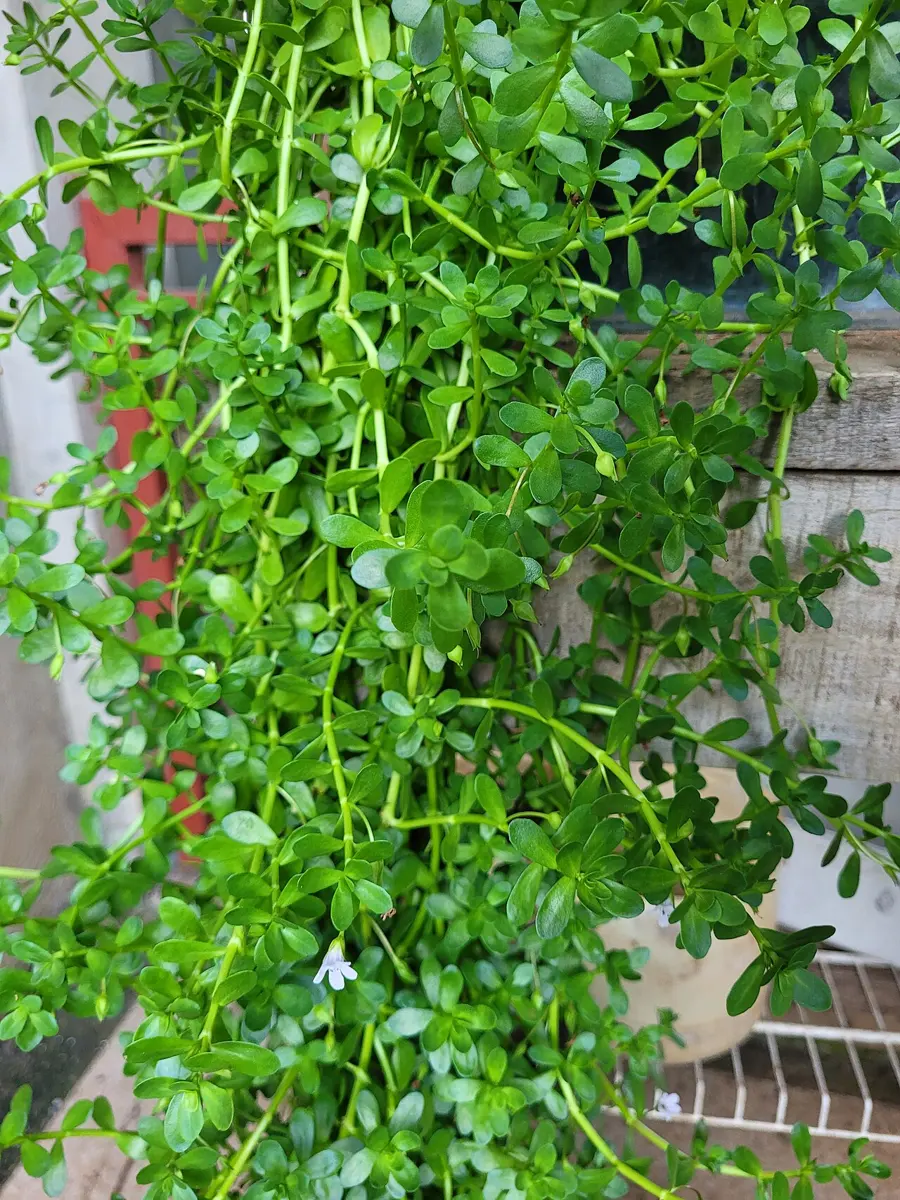
The ब्राह्मी on this page is Bacopa monnieri, a small creeping herb that spreads over wet mud and into shallow water. Look for:
- the leaves: small, thick, fleshy and glossy, oblong or oval, about 1 to 1.5 cm long, in opposite pairs, with smooth edges; crushed, they have no smell;
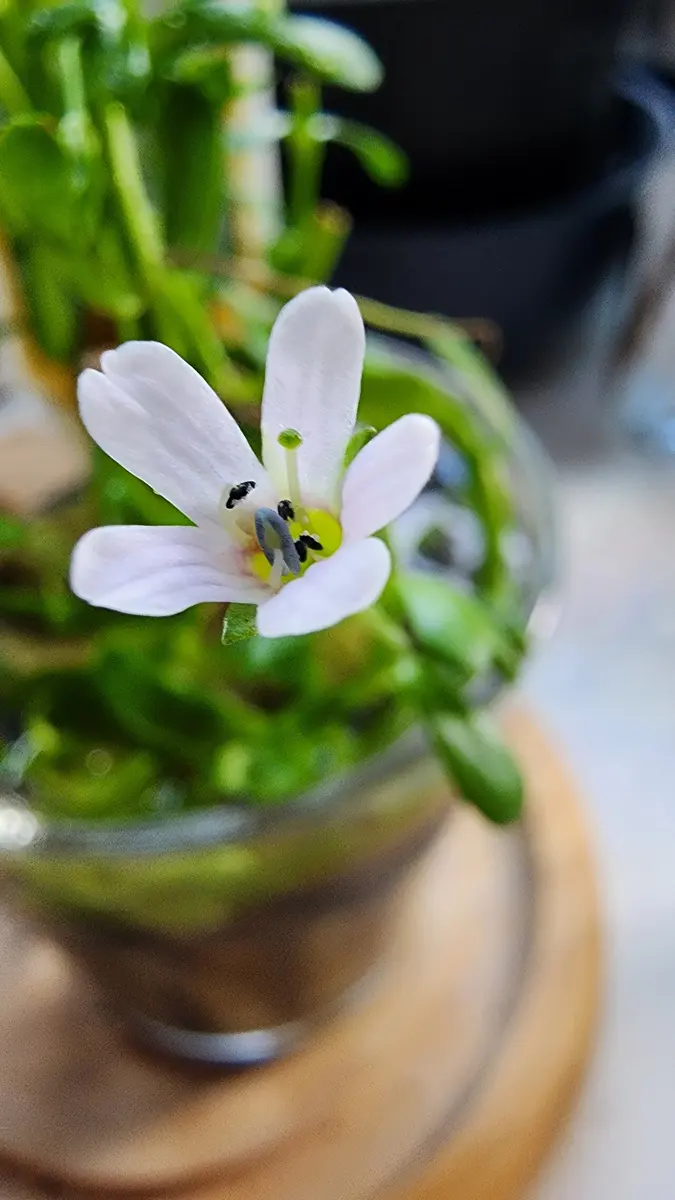
- the flowers: single, from where the leaves join the stem, bell-shaped, white to light blue or purple, with 5 petals, one a little larger than the others;
- the stems: soft and creeping, rooting as they go, so one plant soon makes a mat.
- when it flowers: in warm places, from spring until the first frost.
It belongs to the plantain family (Plantaginaceae), not to the carrot family of घोडताप्रे (ghodtapre), a plant it is often confused with (below).
Where it grows
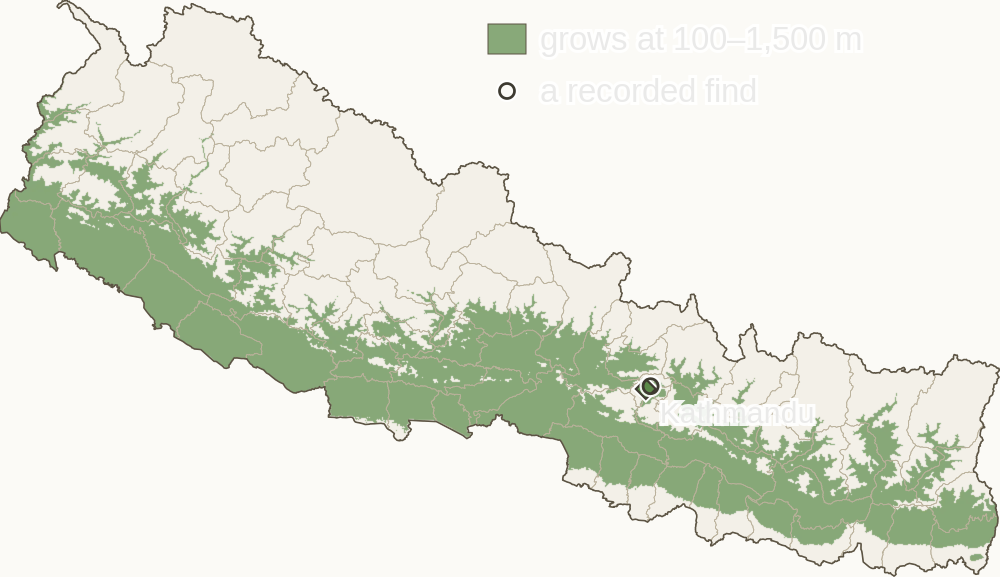
Bacopa monnieri grows in warm marshes in South and Southeast Asia, Africa, America and Australia. In Nepal, a database compiled from the floras of the Himalaya gives it from about 100 to 1,500 meters, so it is a plant of the Tarai and the lower valleys. It is also farmed: India, Nepal and Sri Lanka are its main growers.
One name, two plants
Open the Nepali dictionary at ब्राह्मी and the first meaning is a famous herb that sharpens the mind: घोडताप्रे, Centella asiatica, the creeper with round, hoof-shaped leaves. The same word also names the power of Brahma, such as the goddess सरस्वती (Saraswati), and the ancient Brahmi script from which Devanagari grew.
But across the herb trade, Brahmi often means Bacopa. Scientists who test herbal products say the name Brahmi is used for both plants, and that products are often mixed up:
- Bacopa contains bacosides; घोडताप्रे contains different chemicals, asiaticoside and madecassoside;
- in a 2025 test of six products sold as Brahmi or bacopa, real Bacopa was found in only three, and one of those held only about 4% of it, though its label said 100%: in four of the six, the scientists concluded, Bacopa had been fully or partly replaced by other plants;
- the same scientists tested 11 products of घोडताप्रे, which can also be sold as Brahmi, and found no Bacopa added to any of them.
Our page on घोडताप्रे is about the other ब्राह्मी, the one in Nepal’s dictionary.
Two plants are both called ब्राह्मी in a market. One has round leaves with toothed edges on long stalks; the other has small, thick, smooth-edged leaves in pairs and white bell-shaped flowers. Which is Bacopa monnieri?
Pick an answer to see why.
Weeks, not minutes: how memory was tested
In Ayurveda, Bacopa has been used for a very long time as a tonic for the nerves and the mind: as fresh juice, a paste, cooked in ghee, or as a powder. Today it is also sold as tablets, and companies have tried mixing it into foods from sweets and cereals to soups and drinks. The “Brahmi market” was expected to be worth about 320 million US dollars by 2026.
Testing a “memory herb” well is harder than it sounds. A fair test needs:
- many people, chosen at random to get the herb or a dummy pill (placebo) that looks the same;
- nobody, not even the testers, knowing who got which until the end;
- the same memory tests before and after, scored the same way.
That is what the trials of Bacopa did, and the reviews that combined them found:
- a 2012 review of 6 such trials, each lasting 12 weeks, at 300 to 450 mg of extract a day: Bacopa improved scores on 9 of 17 tests of free recall (remembering a list without hints), with little evidence of help for any other kind of thinking;
- a 2014 review combining 9 trials and 518 people: people taking Bacopa became a little faster on two timed tests of attention, by about 18 and 11 thousandths of a second.
The 2012 review called the research “in its infancy”; the trials used different extracts, doses and tests.
What science has tested
- Memory in adults: some evidence, from small trials lasting 12 weeks, of better free recall and slightly faster attention. Not tested as a way to pass exams, and not a substitute for sleep and study.
- Other uses: studied mostly in the laboratory and in animals.
- Safety: see the box below. The reviews’ abstracts don’t report on side effects.
Traditional uses
In Ayurveda Bacopa is valued above all as a tonic for the nerves and the mind. We found no study of the herbs people use in Nepal that records local uses of Bacopa monnieri itself; Nepal’s studies mostly record घोडताप्रे.
See it at the Science Playground
ब्राह्मी grows in our garden among the Water Plants: look for the small, thick leaves in pairs and, in the warm months, the white flowers. Our exhibit Medicinal and Culinary Herbs of Nepal shows dried herbs and spices used in Nepal. More plants in Herbs of Nepal, including घोडताप्रे.
Where these facts come from
- Pase M.P. et al., The cognitive-enhancing effects of Bacopa monnieri: a systematic review of randomized, controlled human clinical trials, Journal of Alternative and Complementary Medicine, 2012 (abstract).
- Kongkeaw C. et al., Meta-analysis of randomized controlled trials on cognitive effects of Bacopa monnieri extract, Journal of Ethnopharmacology, 2014 (abstract).
- Exploiting marker genes for reliable botanical authentication of Bacopa monnieri products, Foods, 2025.
- Suksawat M. et al., Integrated microscopic, HPTLC, and HRM analyses for differentiating Centella asiatica, Bacopa monnieri, and Hydrocotyle umbellata, Scientific Reports, 2025.
- National Parks Board, Singapore, Bacopa monnieri, Flora & Fauna Web.
- North Carolina State University Extension, Bacopa monnieri (Brahmi), Gardener Plant Toolbox.
- Bacopa monnieri in Nepal: occurrence records, GBIF (the Database of Vascular Plants of Himalaya, and iNaturalist), checked November 2026.
- ब्राह्मी and घोडताप्रे in the Nepali Brihat Shabdakosh (Nepal Academy).