
घोडताप्रे: the little herb named for a hoof
घोडताप्रे · Centella asiatica · A creeping herb of damp ground, carrot family (Apiaceae)
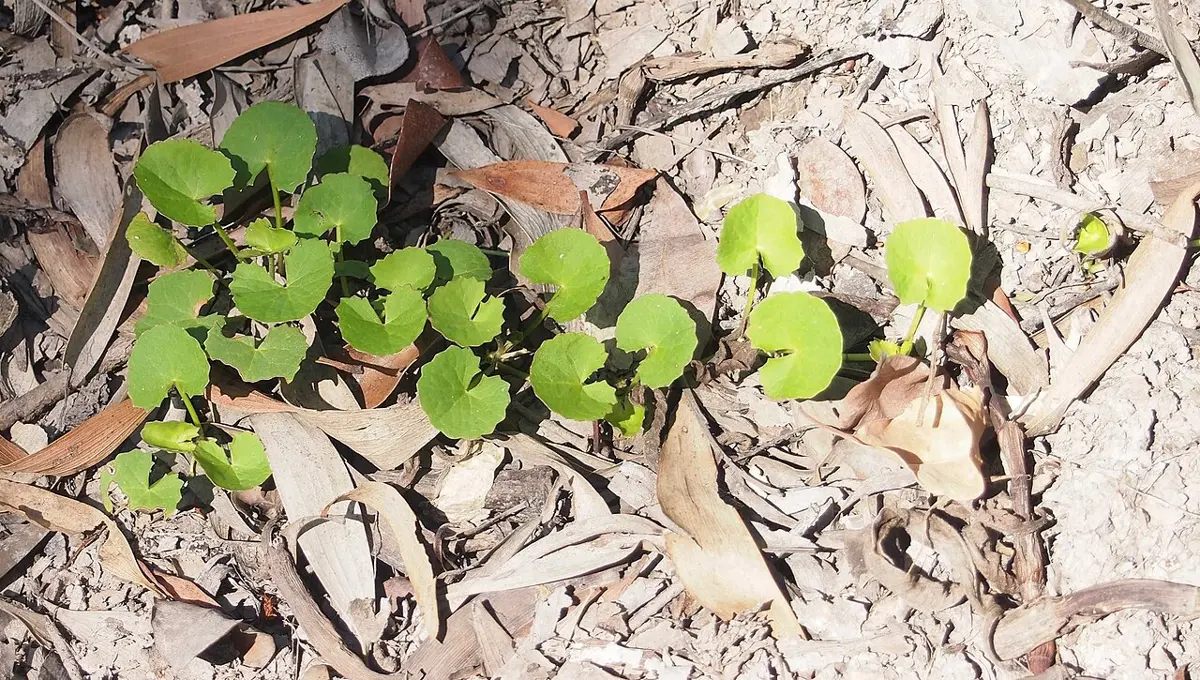
Walk along the edge of a wet field or a shady ditch in the hills, and look down. Among the grass you may see small, round, bright green leaves on long stalks, each one shaped like the print a horse’s hoof leaves in mud. That is घोडताप्रे (ghodtapre): घोडा (ghoda, horse) and टाप (tap, hoof).
It may be the most widely used medicinal plant in Nepal. A 2022 study that counted the medicinal plants used in each of Nepal’s 77 districts found घोडताप्रे used in 57 of them, more than any other plant.
How to know it
घोडताप्रे is a small herb that creeps over the ground, putting down roots at the joints of its runners. Look for:
- the leaves: almost round or kidney-shaped, 1.5 to 5 cm across, with rounded teeth along the edge and a notch where the stalk joins; each leaf stands on its own long stalk, from 1 to 14 cm;
- the flowers: tiny and easy to miss, pinkish to deep red, in little clusters of 2 to 4, close to the ground where the leaves come out;
- the fruits: flattened, about 3 mm long, strongly ridged, wrinkled when ripe;
- the taste: the dictionary notes its leaves are slightly bitter (don’t taste a wild plant to check).
It belongs to the carrot family (Apiaceae), with carrot, coriander and ज्वानो (jwano, ajwain), though it looks nothing like them.
Where it grows
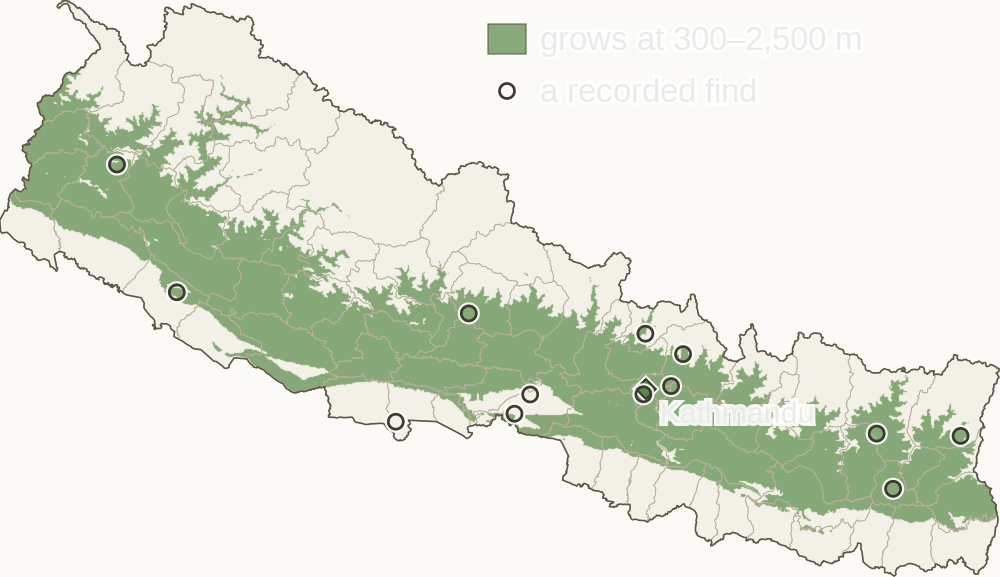
In Nepal घोडताप्रे grows from about 300 to 2,500 meters, according to a database compiled from the floras of the Himalaya. Botanists have collected it as low as Chitwan, at 150 meters, and as high as the trail to Khaptad National Park in Doti, at 2,060 meters. In nearby Bhutan, its flora describes it as common on shaded, marshy ground and in roadside ditches.
One name, two plants
Here is a puzzle. Look up ब्राह्मी (brahmi) in the Nepali dictionary, and one of its meanings is a famous herb for the mind: घोडताप्रे. The dictionary also lists मण्डूकपर्णी (mandukaparni, “frog-leaf”) as a kind of घोडताप्रे.
But in shops around the world, “Brahmi” is also the name of a quite different plant: Bacopa monnieri, a fleshy creeper of marshes, from a different family. Scientists who test herbal products say the name Brahmi is used for both, and that the two are often confused.
- The two plants contain different chemicals: घोडताप्रे mainly asiaticoside and madecassoside, Bacopa mainly bacosides.
- In a 2025 test of six products sold as Brahmi or bacopa, scientists found real Bacopa in only three; the others had been fully or partly swapped for other plants.
- In Thailand, घोडताप्रे is often confused with a lookalike pennywort, Hydrocotyle umbellata.
So “brahmi” on a label tells you little. Our page on ब्राह्मी is about Bacopa.
A bottle says “Brahmi” with no scientific name. Which plant is inside?
Pick an answer to see why.
A herb for the skin, says Europe
The chemistry of घोडताप्रे is unusual: it is rich in triterpenoids, large molecules built from 30 carbon atoms, nicknamed “centelloids”. The main ones, asiaticoside and madecassoside, are saponins, a kind of molecule found in many plants; in घोडताप्रे the saponins make up as much as 8% of the dried herb.
Those chemicals have made घोडताप्रे a medicine for the skin. In France, a sterile dressing soaked in an extract of it has been sold since 1976 to help wounds heal.
In 2022 the European Medicines Agency reviewed the herb for Europe’s list of traditional herbal medicines. Its decision is a surprise for anyone who has drunk घोडताप्रे juice:
- accepted: the dried herb, as a powder or made into an infusion, put on the skin to help minor wounds heal;
- left out: taking it by mouth, for any use. Rats given the powdered herb by mouth, at a dose like about 4 g a day for a person, had damaged livers and kidneys; there is evidence it may harm fertility; and doctors have reported people whose livers were injured after taking it, though those reports could not prove the herb was the cause.
Traditional uses
In Nepal, studies of the plants people use record घोडताप्रे as:
- the juice of the whole plant, drunk as a medicine, in Mahankal Rural Municipality, in the hills of Lalitpur;
- raw leaves on wounds to help them heal, among the Tharu near the Koshi River, who call it Bhatpurai;
- one of the plants that children in the far west help to collect, on farmland and near villages.
The dictionary describes it as a herb that Ayurveda regards as increasing memory and intelligence. The European review notes that it appears in the ancient Chinese herbal of Shennong, about 2,000 years old, and in Ayurveda, where it is often called मण्डूकपर्णी, for asthma, bronchitis, kidney troubles and many other complaints.
These are the uses of living traditions. Whether a use works in the body is a separate question.
What science has tested
- Memory and thinking: tested and not found to help. A 2017 review of 11 trials found no clear benefit over a dummy pill for memory or any other kind of thinking. People felt slightly more alert, and less angry an hour after taking it, but the evidence was weak.
- Swollen, aching legs from poor circulation in the veins: some evidence, of low quality. A 2013 review of 8 trials found an extract may help, but most trials were poorly reported, and it couldn’t rule out bias.
- Wounds: traditional use on the skin is accepted in Europe (above); good large trials are few.
Protection
घोडताप्रे is common: the IUCN Red List rates it Least Concern. It is collected near farmland and villages; we found no reliable figure for how much is traded in Nepal.
See it at the Science Playground
Our exhibit Medicinal and Culinary Herbs of Nepal shows dried herbs and spices used in Nepal. More plants in Herbs of Nepal.
Where these facts come from
- Kunwar R.M. et al., Ethnomedicinal landscape: distribution of used medicinal plant species in Nepal, Journal of Ethnobiology and Ethnomedicine, 2022.
- Royal Botanic Garden Edinburgh, Centella asiatica, Flora of Bhutan.
- Centella asiatica in Nepal: occurrence records, GBIF (herbarium specimens, iNaturalist, and the Database of Vascular Plants of Himalaya), checked November 2026.
- European Medicines Agency, Assessment report on Centella asiatica (L.) Urb., herba, EMA/HMPC/489140/2020, 2022, and Centellae asiaticae herba: EU herbal monograph.
- Suksawat M. et al., Integrated microscopic, HPTLC, and HRM analyses for differentiating Centella asiatica, Bacopa monnieri, and Hydrocotyle umbellata, Scientific Reports, 2025.
- Exploiting marker genes for reliable botanical authentication of Bacopa monnieri products, Foods, 2025.
- Puttarak P. et al., Effects of Centella asiatica on cognitive function and mood related outcomes: a systematic review and meta-analysis, Scientific Reports, 2017.
- Chong N.J. and Aziz Z., A systematic review of the efficacy of Centella asiatica for improvement of the signs and symptoms of chronic venous insufficiency, Evidence-Based Complementary and Alternative Medicine, 2013.
- Bhatt A., Timalsina B. and Ghimire N.P., Ethnobotanical knowledge and plant use patterns among the major ethnic communities of Mahankal Rural Municipality, Lalitpur District, Ethnobotany Research and Applications, 2026.
- Kutal D. et al., Ethnobotanical knowledge of Tharu people living nearby Koshi River and Koshi Tappu Wildlife Reserve, eastern Nepal, Journal of Ethnobiology and Ethnomedicine, 2026.
- Kunwar R.M. et al., Medicinal plants, traditional medicine, markets and management in far-west Nepal, Journal of Ethnobiology and Ethnomedicine, 2013.
- Centella asiatica: IUCN Red List category, GBIF (from the IUCN Red List), checked November 2026.
- घोडताप्रे, ब्राह्मी and मण्डूकपर्णी in the Nepali Brihat Shabdakosh (Nepal Academy).