
Lemongrass: a grass that smells of lemon
Cymbopogon citratus · A tall, scented grass, grass family (Poaceae)
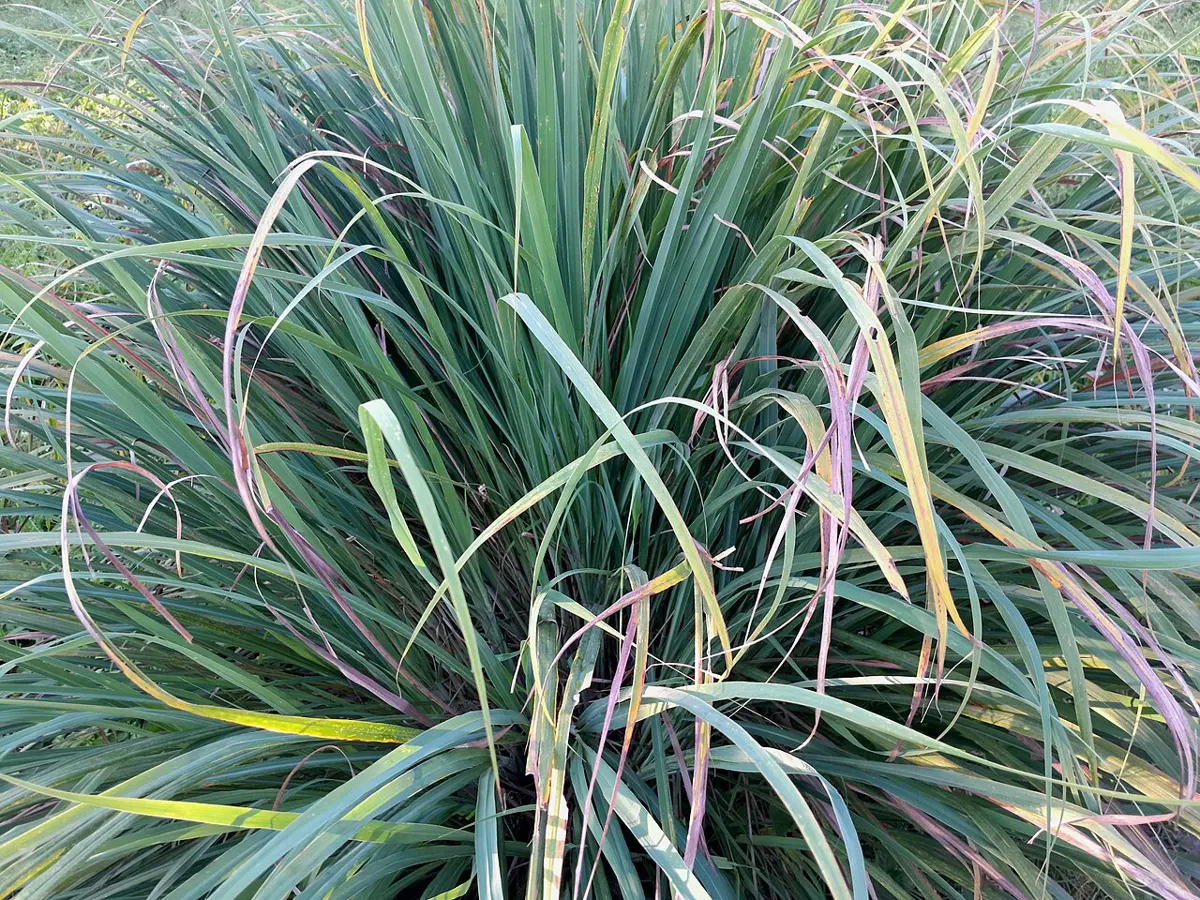
Crush a leaf of this grass between your fingers and smell it: lemon. Yet there is no lemon anywhere near it, and the plant is a grass, a cousin of rice, maize and the दुबो (dubo) on the school field.
How can a grass smell of lemon? The answer is in the oil its leaves hold. This page is about lemongrass: how to know it, and the chemistry of its smell.
How to know it
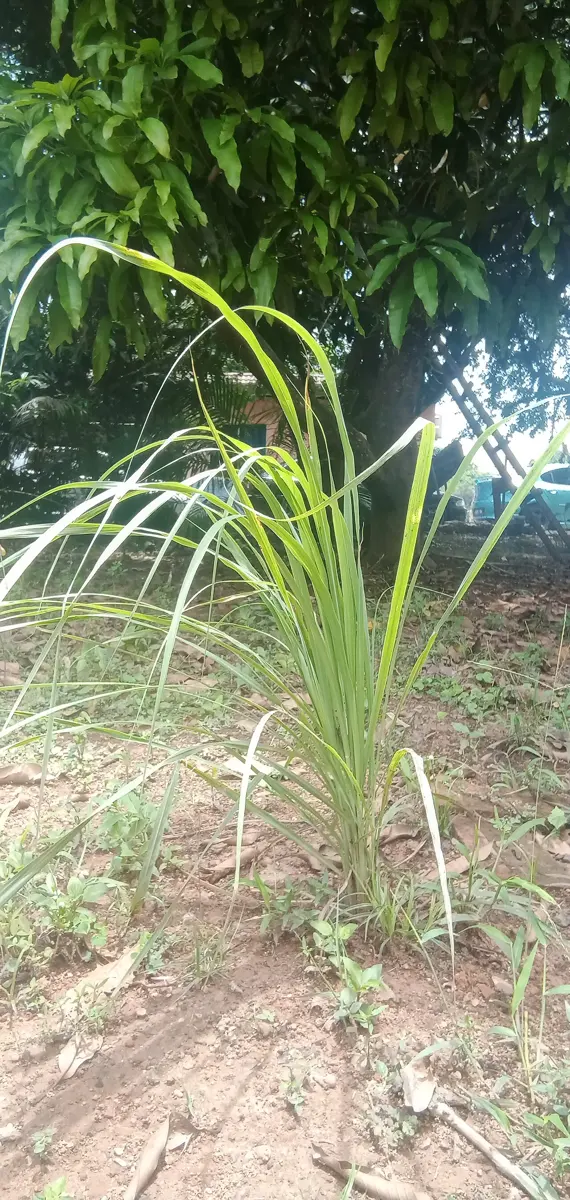
Lemongrass (Cymbopogon citratus) grows as a dense clump, up to about 2 meters tall. Look for:
- the leaves: long and narrow like a giant grass, 60 to 90 cm long and only about 1.5 to 2 cm wide, arching outward, pale blue-green, smelling strongly of lemon when crushed;
- the flowers: almost never. Lemongrass is mostly sterile: it rarely flowers, and it is usually grown from pieces of the clump.
In English it has many names: lemon grass, fever grass, oil grass, West Indian lemon grass. We found no Nepali name for it in the Nepali dictionary or in the studies of Nepal’s plants that we read: people in Mahankal, Lalitpur, simply call it “lemon grass”.
Where it grows
Lemongrass comes from India and Sri Lanka and is now grown in warm countries everywhere. It so rarely flowers that it is known almost only as a cultivated plant: in Thailand, for example, botanists know it only from gardens and farms. In Nepal it is grown in gardens and for its oil; the oils studied below came from plants in Sunsari and Surkhet.
Citral: the lemon molecule
The smell of lemongrass comes from an oil held in its leaves, about 1 to 2% of the dried leaf. Scientists in Nepal distilled the oil from lemongrass grown in Sunsari and found that almost nine-tenths of it was two molecules:
| Molecule | Share of the oil |
|---|---|
| geranial | 53.1% |
| neral | 36.1% |
| everything else | about 11% |
Together, geranial and neral are called citral, and they give lemongrass its lemony smell.
Not every lemongrass oil is the same. Oil from lemongrass grown in Surkhet had about the same neral (35.5%) but less geranial (36.0%), and more of a third molecule, geraniol (7.5%). Where a plant grows, and which kind it is, change its chemistry.
Traditional uses
Lemongrass is used first of all in the kitchen and for its smell. In Mahankal, Lalitpur, people use it to scent tea, in pickles, and in household crafts. Elsewhere, a review of the Cymbopogon grasses records it as a tea for fever in Tanzania, for colds, sore throats and indigestion in Singapore, and as an insect repellent.
What science has tested
- In people: a 2022 review of the Cymbopogon grasses reports no fair tests in people, with a group given a dummy drink to compare. What it reports in people are single studies, such as one finding that drinking lemongrass tea daily for a month raised the hemoglobin in people’s blood. The review itself says the herb’s real effect in people still needs to be worked out. So for any medical use, it is not tested in a fair way.
- In the laboratory and in animals: most of the findings, on germs, inflammation, blood sugar and stomach ulcers, come from tests on cells and animals, which don’t show what it does in people.
Lemongrass oil in Nepal
In Chisapani community forest, near Bardaghat in Nawalparasi, a women’s group of herb farmers grows citronella and lemongrass (the article doesn’t say which species) on 40 hectares of land that had been degraded. They cut the leaves about every three months, distill them, and in 2020 produced about 220 liters of the two oils a year. Lemongrass oil sold for about Rs 2,200 a liter, citronella oil for Rs 1,900.
See it at the Science Playground
Lemongrass grows in our garden among the plants of Scent, Poison and Latex: crush a leaf and smell the citral. Our exhibit Medicinal and Culinary Herbs of Nepal shows dried herbs and spices used in Nepal. More plants in Herbs of Nepal.
Where these facts come from
- A taxonomic revision of Cymbopogon (Poaceae) in Thailand, PeerJ, 2026.
- Royal Horticultural Society, Cymbopogon citratus.
- North Carolina State University Extension, Cymbopogon citratus, Gardener Plant Toolbox.
- Dangol S. et al., Essential oil composition analysis of Cymbopogon species from eastern Nepal, Molecules, 2023.
- Baranová B. et al., Potential herbicidal and insecticidal (beneficial) properties of Nepalese lemongrass essential oil, Chemistry & Biodiversity, 2025.
- Tibenda J.J. et al., Review of phytomedicine, phytochemistry, ethnopharmacology, toxicology, and pharmacological activities of Cymbopogon genus, Frontiers in Pharmacology, 2022.
- Bhatt A., Timalsina B. and Ghimire N.P., Ethnobotanical knowledge and plant use patterns among the major ethnic communities of Mahankal Rural Municipality, Lalitpur District, Ethnobotany Research and Applications, 2026.
- Now Nepal’s herbal oil in Europe, Nepali Times, 2 October 2020.
- Cymbopogon in Nepal: the Database of Vascular Plants of Himalaya and iNaturalist records, GBIF, checked November 2026.