
अश्वगन्धा: the berry in a paper lantern
अश्वगन्धा · Withania somnifera · A small shrub of the family Solanaceae
Look along the shelves of a pharmacy or herbal shop in Nepal and you will probably find ashwagandha: capsules, powders, gummies, drinks, promising better sleep and less stress.
The plant behind them is अश्वगन्धा (ashwagandha), a small, soft-leaved shrub that Ayurveda has used for a very long time. Its name joins two Sanskrit words, अश्व (ashwa, “horse”) and गन्ध (gandha, “smell”). This page is about the plant: how to know it, where it is farmed in Nepal, a trick of its fruit, what its root is used for, what careful trials found, and the warnings that come with it.
How to know it
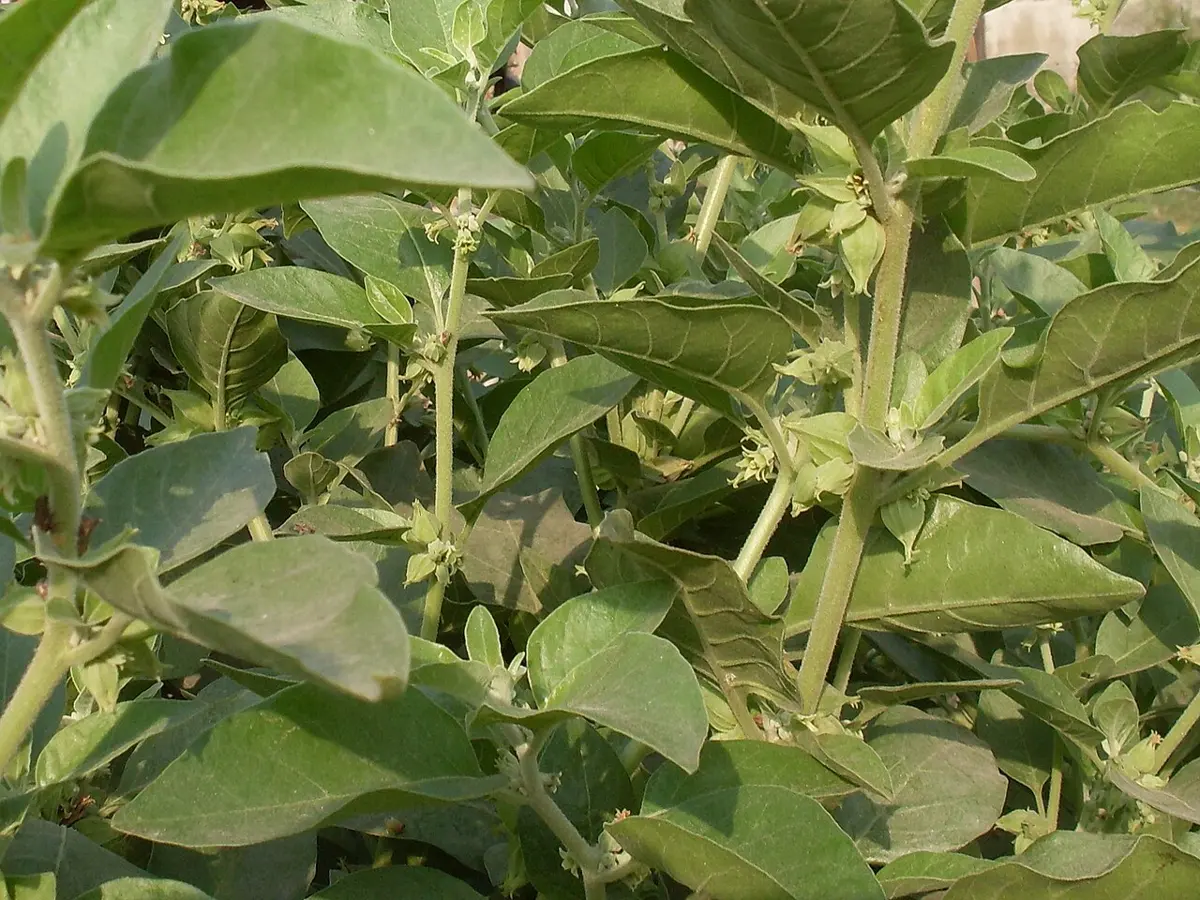
अश्वगन्धा is a small shrub, about 30 cm to 1.5 m tall, woody near the base, with many branches. The Nepali Brihat Shabdakosh describes it as a herb with long leaves and a root like a radish’s. Look for:
- soft, gray-green leaves, oval, about 2.5 to 12 cm long, covered (especially underneath) with tiny branched hairs that make them feel velvety;
- small greenish-yellow flowers, bell-shaped, only 5 to 8 mm long, in clusters of 4 to 6 where the leaves join the stem;
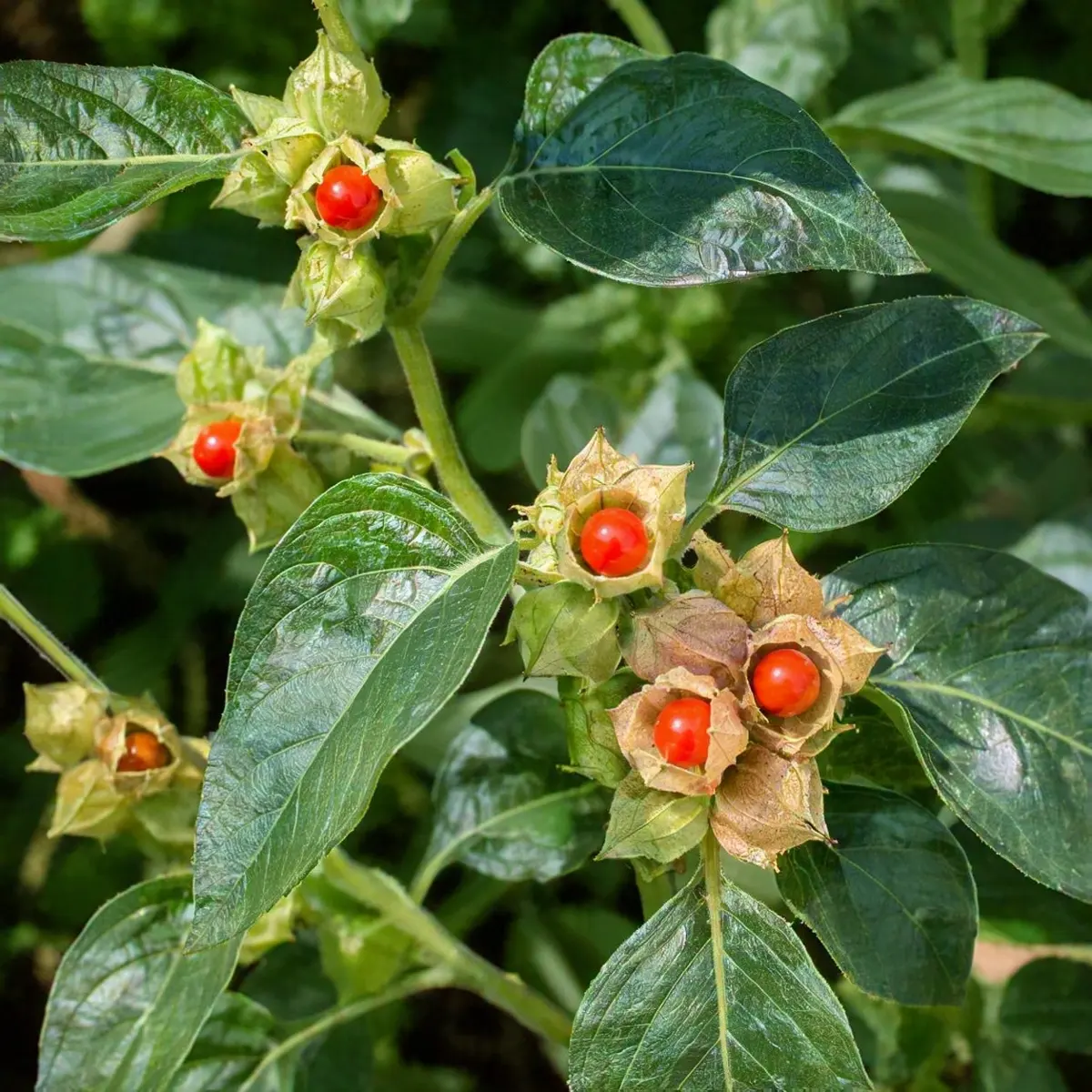
- round, shiny, scarlet berries, 5 to 8 mm across, each hidden inside a papery brown bag;
- a long, pale, fleshy root.
Where it grows
The genus Withania has a few to a couple of dozen species, depending on the botanist (about six in Flora of China, 26 in a 2025 study), from South Asia to the Mediterranean and Africa. अश्वगन्धा is an evergreen, drought-resistant shrub of tropical and subtropical climates. It is farmed widely in India, and in Pakistan it grows as high as 1,676 meters.
In Nepal it is farmed in the Terai: in Rupandehi, Morang, Chitwan, Bara, Kailali and Banke. We did not find a study recording it as wild in Nepal.
A berry in a paper lantern
Here is the trick. When an अश्वगन्धा flower is pollinated, its small green calyx (the cup of sepals that held the flower bud) does not wither as in most plants. It keeps growing, swelling into a closed bag 1 to 2.2 cm across, much bigger than the flower was. It turns brown and papery, almost see-through, and inside it the berry ripens to scarlet.
So you can walk past a fruiting plant and see only little brown lanterns, with the red berries hidden inside.
Its place in Ayurveda and tradition
Its root is used in traditional medicine, above all in Ayurveda. The root holds a group of chemicals called withanolides, among them withaferin.
In Nepal it is above all a crop for the Ayurvedic industry. A survey of the shops of Bharatpur (made in 2019, published in 2024) found 41 different ashwagandha products for sale, three out of four of them made in Nepal, and noticed that the companies still buy most of the raw root from India, because so little is grown here. Shatavari (कुरिलो) was the herb most often mixed with it.
What science has tested
Ashwagandha has been tested in people more than most herbs, mostly in small trials of extracts made from the root.
- Sleep: a systematic review (2021) combined 5 trials with 400 people. Ashwagandha extract had a small effect on sleep, larger in adults with insomnia, at 600 mg a day or more, taken for at least 8 weeks. No serious side effects were reported, but the authors said there is too little safety information to know whether long-term use is safe.
- Stress and anxiety: the US National Center for Complementary and Integrative Health (NCCIH) says some preparations may help with stress, but the evidence on anxiety is unclear.
- Long-term safety: taken for up to about three months, it is possibly safe for most adults; beyond that, no one knows.
One curious finding, so far only in mice: the sleep effect seemed to come not from the withanolides but from a simple chemical in the leaves, triethylene glycol. Results in mice often don’t carry over to people.
So, in plain words: some evidence, from small trials, for a small effect on sleep; not enough to know about most other claims.
Farming in Nepal
Some farmers in Nepal have done very well with it. In 2017 the Kathmandu Post reported that about 300 farmers in Rupandehi were growing ashwagandha commercially. One farmer in Mayadevi said he earned Rs 2.1 million in a year from the seeds grown on one bigha, against about Rs 150,000 from wheat and paddy on the same land. A herbs cooperative in Bhairahawa was paying Rs 3,000 a kilogram for seeds. The plant gives fruit within six months.
The IUCN Red List has not evaluated Withania somnifera.
A friend wants to start taking ashwagandha gummies to sleep better before exams. What is the wise step?
Pick an answer to see why.
See it at the Science Playground
Our exhibit Medicinal and Culinary Herbs of Nepal shows dried herbs and spices used in Nepal. More plants in Herbs of Nepal.
Where these facts come from
- Thapa C.B., Singh A.G. and Gyawali S.D., In vitro seed germination in Withania somnifera, Himalayan Biodiversity, 2025.
- Dhungana M., High returns lure farmers to growing ashwagandha, The Kathmandu Post, 22 August 2017.
- K.C. B. and Kafle G., Assessment of end products of Ashwagandha (Withania somnifera) and their marketing channel in Bharatpur, Chitwan, Nepal, Journal of Agriculture and Natural Resources, 2024.
- Withania and Physalis, Flora of China vol. 17, 1994.
- Cheah K.L. et al., Effect of Ashwagandha (Withania somnifera) extract on sleep: a systematic review and meta-analysis, PLoS ONE, 2021.
- National Center for Complementary and Integrative Health, Ashwagandha, updated 2023.
- Björnsson H.K. et al., Ashwagandha-induced liver injury: a case series from Iceland and the US Drug-Induced Liver Injury Network, Liver International, 2020.
- Withania somnifera: IUCN Red List category, GBIF (from the IUCN Red List), checked November 2026.
- अश्वगन्धा, अश्व and गन्ध in the Nepali Brihat Shabdakosh (Nepal Academy).