
बर्रो: the big tree behind त्रिफला
बर्रो · Terminalia bellirica · A large deciduous tree of the Combretaceae family
In villages of Kavrepalanchok, people with a cough sometimes keep a small, hard fruit in their mouth and suck it like a sweet, for a long time. The fruit is बर्रो (barro), and the same fruit, dried and ground, is one third of the famous powder त्रिफला (triphala, “three fruits”).
बर्रो’s partners in त्रिफला, हर्रो and अमला, have pages of their own. This page is about the biggest of the three trees, and about the many things people get from it besides medicine.
How to know it
बर्रो is a large deciduous tree, which can grow to 50 meters tall, with a trunk up to 3 meters across, often with buttresses (wide ridges) at its base and no branches for the first 20 meters. Look for:
- the bark: bluish or ash-gray, covered with many fine cracks running up and down;
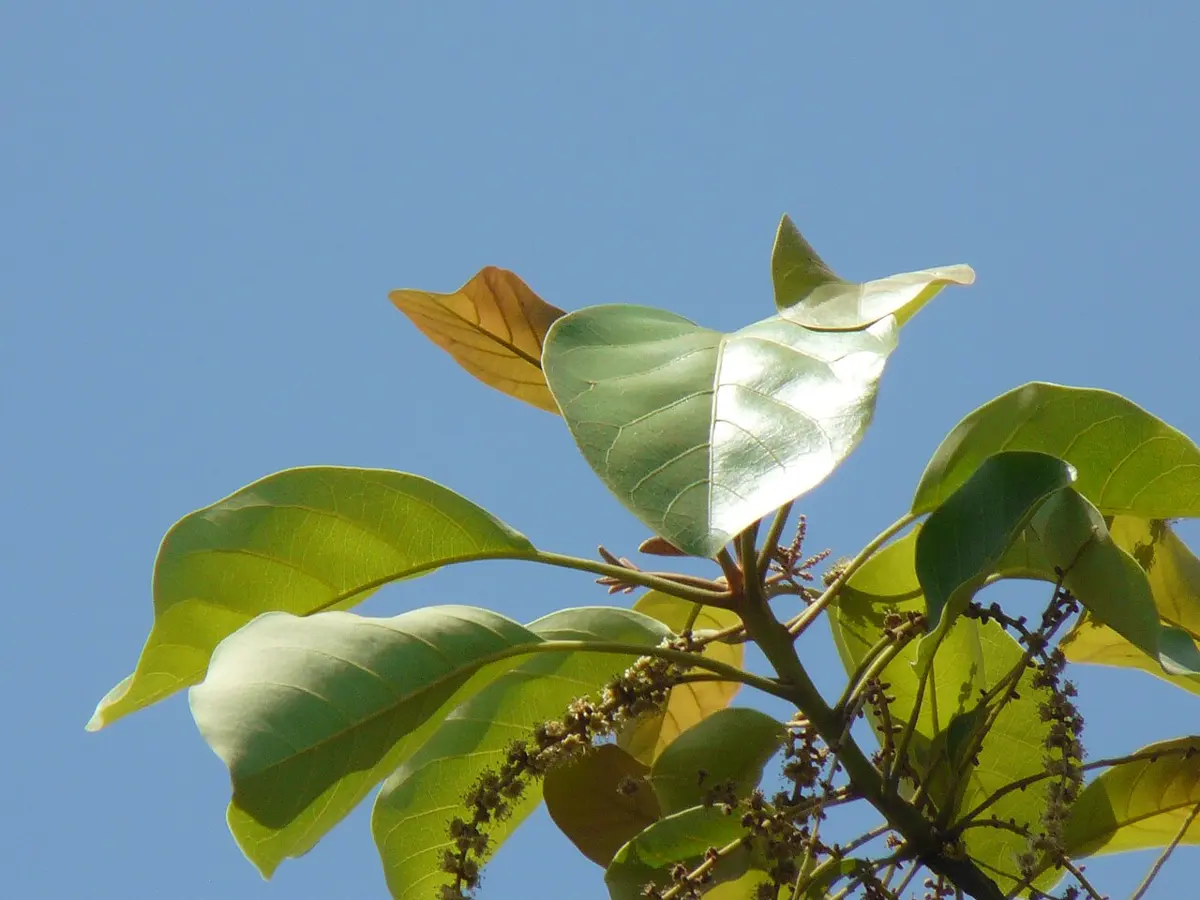
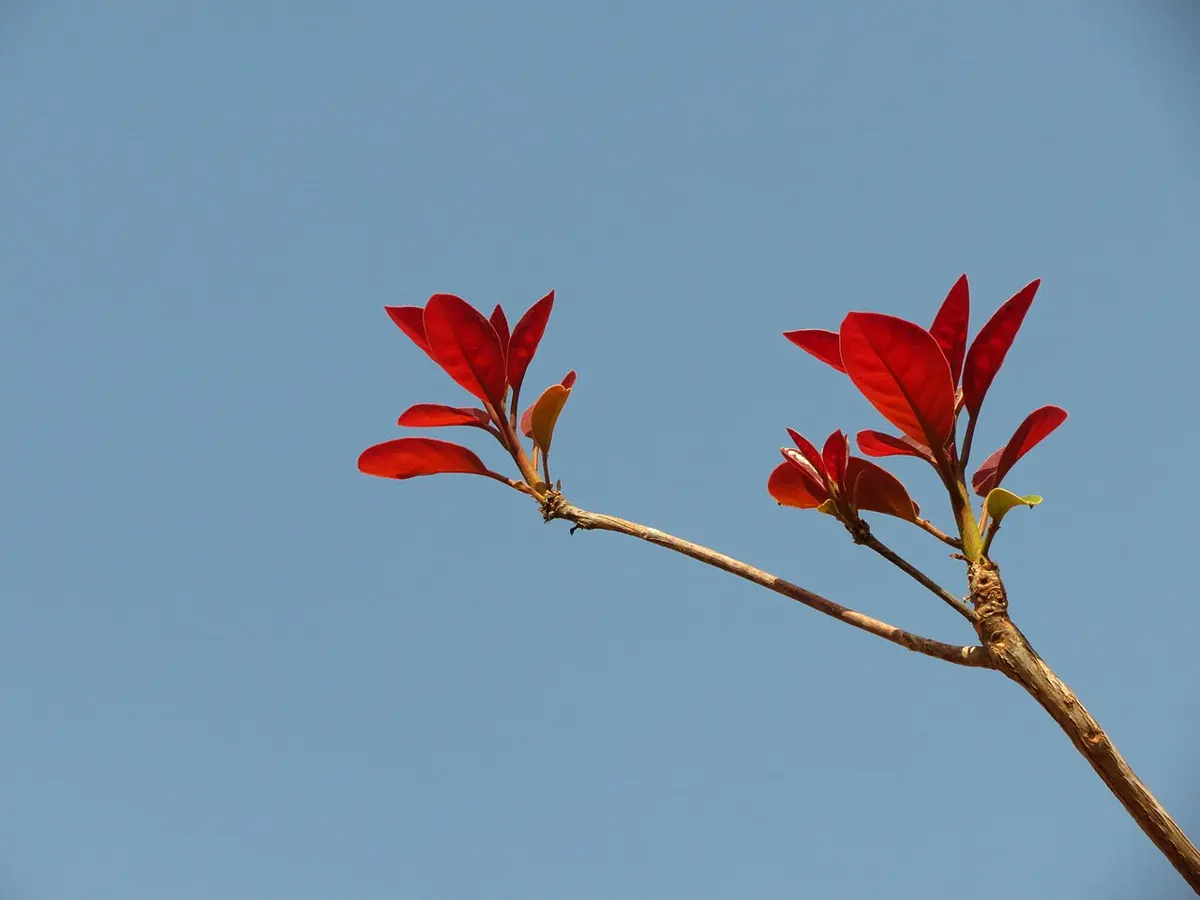
- the leaves: large, broad and smooth, about 4 to 24 cm long, on long stalks, crowded at the ends of the branches; young leaves are copper-red, then parrot green, then dark green;
- the flowers: small, greenish-white, on thin spikes, coming out together with the new leaves; one reference describes their smell as honey-like, Nepal’s register of medicinal plants as offensive (smell one and decide);
- the fruit: roundish, 2 to 4 cm long, light yellow, faintly five-angled, with a velvety skin. The Nepali dictionary describes बर्रो simply as a tree of big leaves, tiny green flowers in spikes and round yellow fruits.
Where it grows
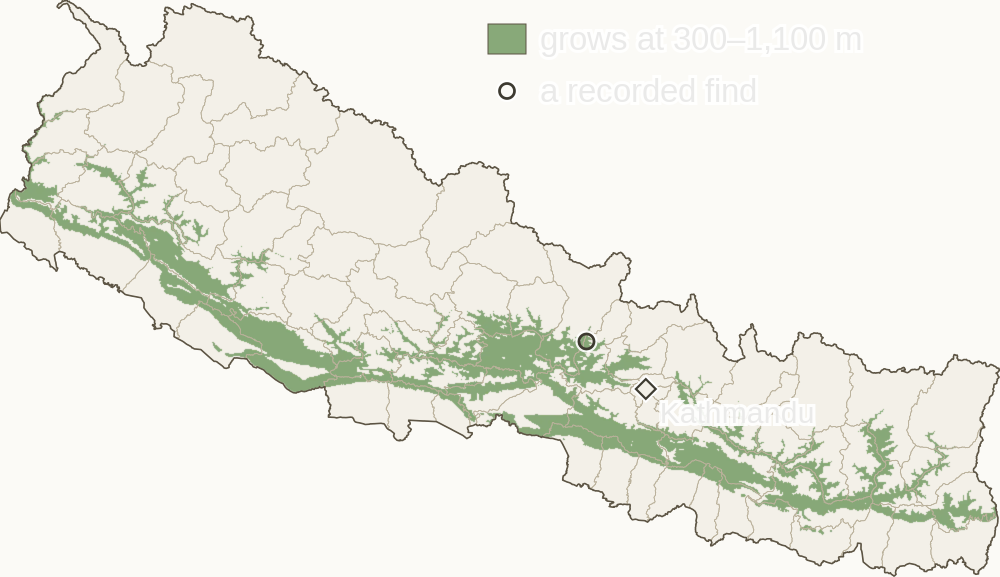
Nepal’s national register of medicinal plants records बर्रो from about 300 to 1,100 meters, in the center and east; studies also find it traded in Baitadi and Dadeldhura in the far west, and as a cultivated tree in Rupandehi in the Terai. It grows in monsoon and mixed deciduous forests, where the yearly rain is about 900 to 3,000 mm and the average temperature 22 to 28 °C. It needs plenty of light, but copes with dry spells and even poor soil.
A tree of many gifts
Most people know बर्रो as a medicine, but farmers value it for much more:
- Fodder: the leaves are highly valued as animal fodder, with 9 to 14% crude protein, and are nutritious and easy to digest. Farmers lop the side branches, leaving the main limbs, so the tree keeps growing and gives fodder again; it sprouts back well after lopping.
- Silk: the leaves can also feed tussar silkworms.
- Tannin and dye: the fruit gives tannins and dyes, used to tan leather and to dye cloth, mats and ink.
- Wood: whitish and rather soft, used for boxes, furniture and building after soaking in water to make it last; also good firewood and charcoal.
- Oil: the kernel inside the stone gives an oil used in soap and on the hair, but it is not eaten.
Traditional uses
Studies of the herbs people use in Nepal record बर्रो as:
- fruits kept in the mouth and sucked like candy for cough and stomach trouble, in Kavrepalanchok, where one local name for it is Barla;
- fruit powder for cough, colds, breathing troubles, fever and indigestion, and bark juice put on cuts, wounds and skin diseases, in Rupandehi;
- in the national register, a tonic and astringent, used for coughs, hoarseness and eye diseases, and one of the three fruits of त्रिफला.
The Sanskrit name is विभीतक (vibhitaka); the Nepali dictionary traces the word बर्रो back to Sanskrit विभीत (vibhita). How त्रिफला is made, and what tests in people found, is on the हर्रो page.
What science has tested
- बर्रो alone: fruit extracts have killed bacteria such as E. coli in the laboratory, and have been tested against liver damage in laboratory animals (rodents). In the sources we read, we found no trial of बर्रो alone in people.
- As part of त्रिफला: some evidence as a mouthwash for plaque and gum inflammation, and for constipation, from short, imperfect trials (details on the हर्रो page).
- How strong the evidence is: for बर्रो on its own, not tested in people.
Trade: three fruits, one price list
The three fruits of त्रिफला are collected from trees in forests and on farms, dried, and sold to traders. ANSAB, a Nepali organization working on forest products, publishes the prices buyers offer for good-quality dried produce. In March 2026:
| Dried fruit | Kathmandu | Nepalgunj |
|---|---|---|
| अमला | Rs 150 a kg | Rs 115 a kg |
| हर्रो | Rs 125 a kg | Rs 90 a kg |
| बर्रो | Rs 125 a kg | Rs 60 a kg |
In Kathmandu, the prices for हर्रो and बर्रो are without the seed; in other markets, the seed is included. The list says the prices are only a guide.
None of the three is threatened: the IUCN Red List rates बर्रो, हर्रो and अमला Least Concern.
See it at the Science Playground
बर्रो grows in our garden, in the healing plants: look at its big leaves, and find its partner in त्रिफला, अमला, nearby. Our exhibit Medicinal and Culinary Herbs of Nepal shows dried herbs and spices used in Nepal. More plants in Herbs of Nepal.
Where these facts come from
- IUCN Nepal, National Register of Medicinal and Aromatic Plants (revised and updated), 2004: Barro, page 29.
- Orwa C. et al., Terminalia bellirica, Agroforestree Database 4.0, World Agroforestry Centre, 2009.
- Ambu G. et al., Traditional uses of medicinal plants by ethnic people in the Kavrepalanchok District, Central Nepal, Plants, 2020.
- Singh A.G., Kumar A. and Tewari D.D., An ethnobotanical survey of medicinal plants used in Terai forest of western Nepal, Journal of Ethnobiology and Ethnomedicine, 2012.
- Kunwar R.M. et al., Medicinal plants, traditional medicine, markets and management in far-west Nepal, Journal of Ethnobiology and Ethnomedicine, 2013.
- ANSAB, NTFPs price list, March 2026.
- IUCN Red List categories from GBIF, checked November 2026: Terminalia bellirica, Terminalia chebula, Phyllanthus emblica.
- बर्रो in the Nepali Brihat Shabdakosh (Nepal Academy).