
तुलसी: the basil with clove in its leaves
तुलसी · Ocimum tenuiflorum · A scented herb of the mint family
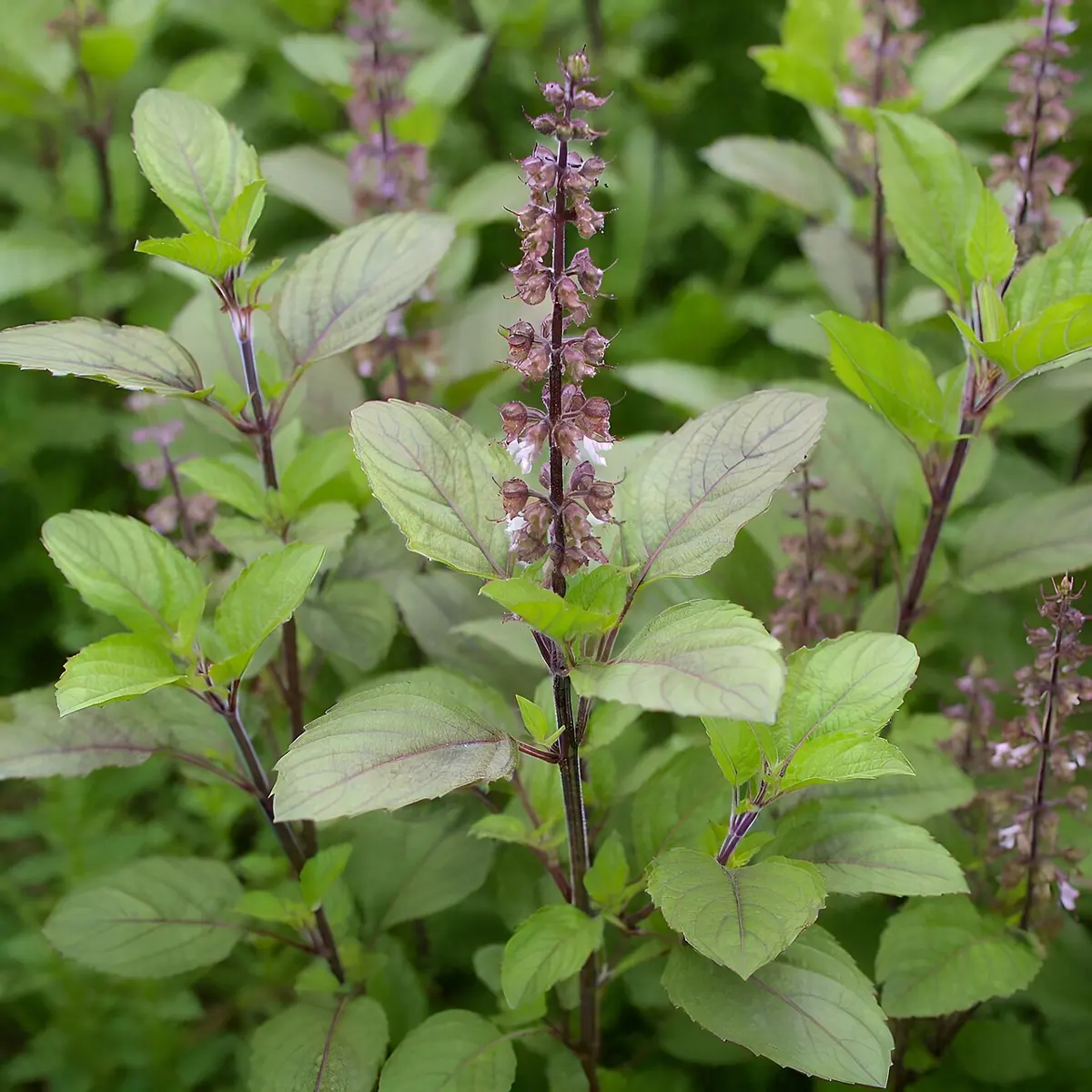
Every morning, on your way out to school, you brush past the तुलसी (tulsi) plant by the door, and for a moment the air smells warm and spicy. Later, in the kitchen, someone opens the spice box and the same smell comes out of a ल्वाङ (lwang, clove). That is no accident: tulsi leaves and cloves are full of the same chemical.
This page is about the plant that stands on a raised platform in front of so many Nepali homes: how to know it, where the smell is kept, what tradition uses it for, and what scientists have tested.
How to know it
तुलसी, holy basil, is a bushy, scented herb, up to about a meter tall, that lives for one year or a few. Look for:
- the stem: square when you roll it between your fingers, and hairy, green or purple;
- the leaves: in opposite pairs, oval, about 4 to 8 cm long, with small teeth or a smooth edge, hairy on both sides, and strongly scented when rubbed;
- the flowers: tiny, white, pale pink or lavender, in thin spikes (मञ्जरी, manjari) 4 to 12 cm long at the tips of the branches;
- the fruits: tiny nutlets, about 1 mm long, which fall and sprout by themselves around the plant.
It belongs to the mint family (Lamiaceae), the family of पुदिना (pudina, mint).
One name, several basils
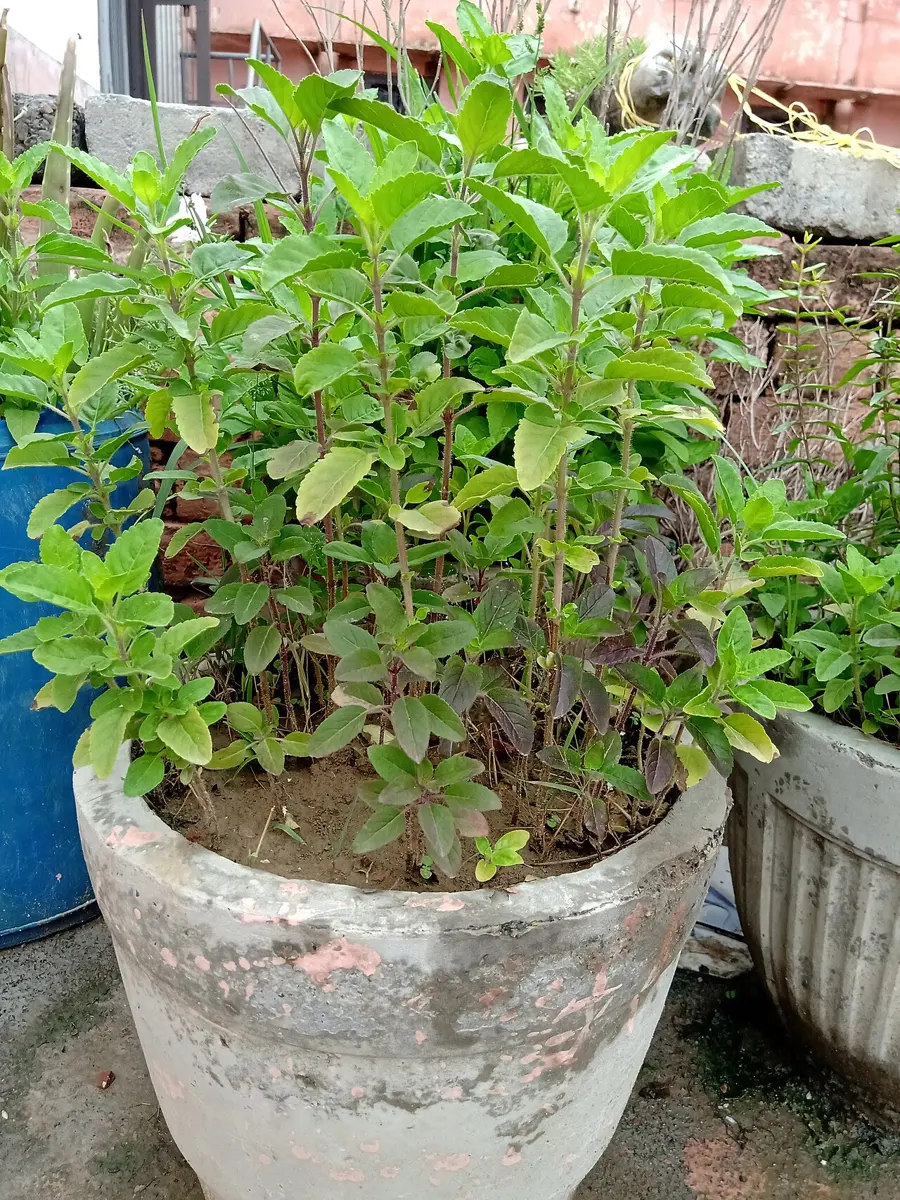
The botanists’ name is Ocimum tenuiflorum; many books still use its older name, Ocimum sanctum, for the same plant. It comes in a green form and a dark purple one, often grown side by side.
The genus Ocimum, the basils, has more than 150 species. Chemists in Nepal name four that are studied most here: tulsi, sweet basil (Ocimum basilicum), clove basil (Ocimum gratissimum) and Ocimum americanum. They look alike, but they smell different (see below), and some “tulsi” products sold in Europe have been found to contain sweet basil instead. Nepali also has the word बाबरी (babari), which the dictionary also calls वनतुलसी (vantulsi, “forest tulsi”): a scented weed with small rough leaves and tiny red flowers that smells like tulsi.
A friend shows you a plant with a square stem, leaves in pairs and a strong smell. Can you be sure it is तुलसी?
Pick an answer to see why.
Where it grows
Holy basil is a plant of tropical and subtropical South Asia, and it now grows across the warm parts of Asia. In Nepal it is above all a planted herb, grown in pots and on platforms in front of homes, from the Tarai to the hills. Scientists from Kathmandu University collected it for a study in Bardiya, at about 160 meters. It likes full sun (six hours a day or more) and moist soil that drains well; it does badly in soil that stays waterlogged.
The smell is kept in tiny balloons
Rub a tulsi leaf and smell your fingers. The smell was not inside the leaf. It was on its surface, in many tiny oil glands.
Scientists studying sweet basil, tulsi’s cousin, looked closely at these glands. Each one sits on the leaf’s skin like a flat dome: four cells in a little disc, with an oil sac above them, a space under the leaf’s waxy outer layer that slowly fills and swells with oil. In clove basil, another cousin, a full gland measured almost 80 micrometers across (a micrometer is a thousandth of a millimeter). When you brush past the plant, you break some of these balloons, and the oil escapes into the air.
Why it smells of clove
In 2025, chemists from Kathmandu University and their partners took the oil out of tulsi, sweet basil and Ocimum americanum grown in Nepal, and measured what was in it:
| Plant | Main chemicals in the oil |
|---|---|
| तुलसी (Ocimum tenuiflorum) | eugenol 32 to 35%, beta-elemene 29 to 33%, beta-caryophyllene 20 to 22% |
| Sweet basil (Ocimum basilicum) | methyl chavicol 62 to 64%, linalool about 27% |
| Ocimum americanum | camphor 51 to 66%, linalool about 10% |
| For comparison: clove | about 89% eugenol |
So the three basils, which look so alike, make quite different oils. Tulsi’s main one is eugenol, the chemical that makes up most of the oil of cloves. Your nose was right: tulsi and ल्वाङ share a smell because they share a molecule. The same study found that tulsi gave the most oil in autumn, about 1.7% of the plant’s weight.
Traditional uses
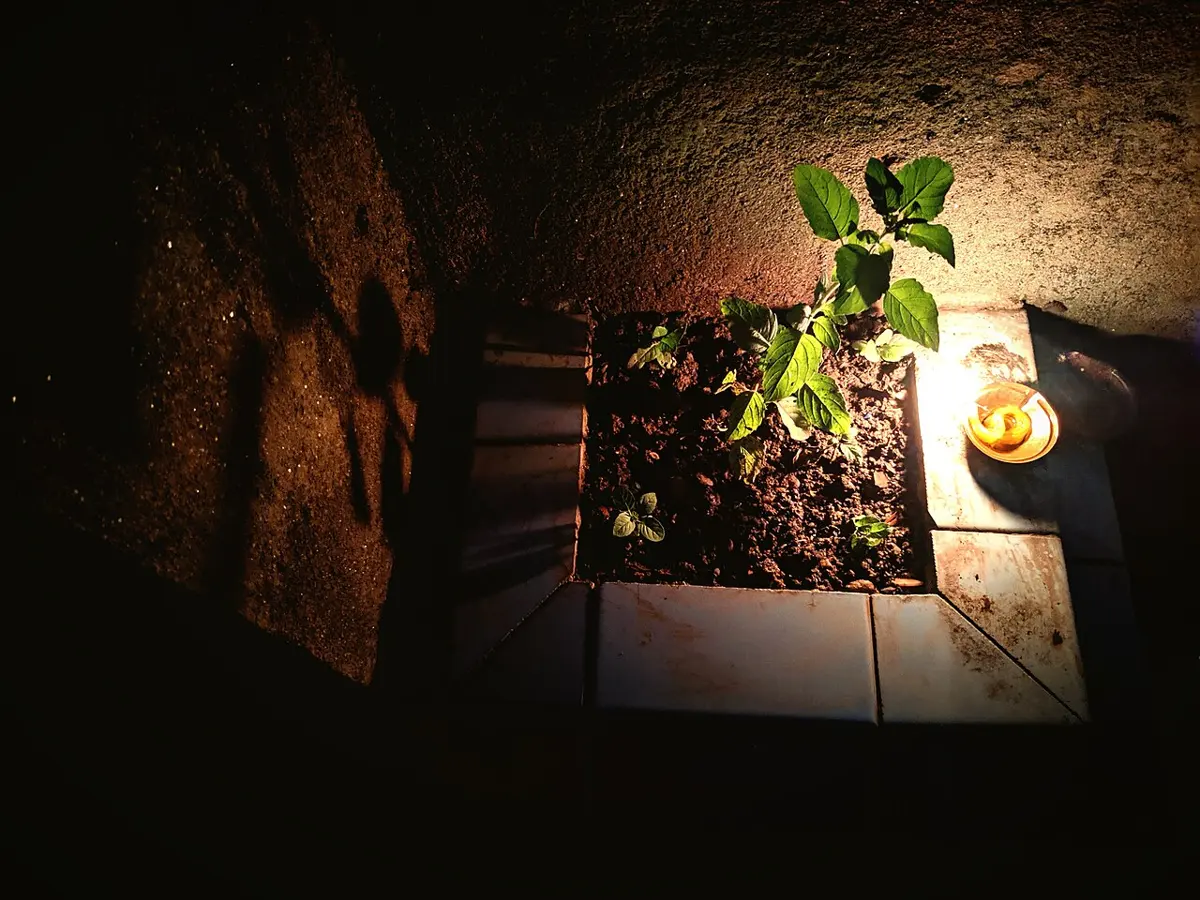
For Hindus, तुलसी is a sacred plant, worshipped as a goddess and used in the worship of Vishnu. It is grown on a तुलसीमठ (tulsimath), a raised platform made for it, usually in the courtyard or in front of the house, where a दियो (diyo, oil lamp) is often lit beside it. Its leaves go into worship, and its wood is made into beads for a जपमाला (japmala, a string of prayer beads). In the Changunarayan study, the botanists thought this was one reason it was the best-known herb there: almost every Hindu home has one.
As a home remedy, studies of the herbs people use in Nepal record it, in tradition, as:
- leaves boiled in water and drunk for fever and cough, in Changunarayan, Bhaktapur;
- a herbal tea for stomach trouble and a dry mouth, in Kavrepalanchok.
In Ayurveda, tulsi is used for coughs, asthma, fever and anxiety, and a daily cup of tulsi tea is a common habit. These are the uses of a living tradition. Whether a use works in the body is a separate question, which only careful tests in people can answer.
What science has tested
In 2017, two researchers gathered every trial of tulsi in people they could find: 24 studies, with 1,111 people in all.
- What they found: most studies reported some benefit: lower blood sugar (measured in 8 studies, many of people with type 2 diabetes), better cholesterol in some, and less stress or anxiety in three studies. Hardly anyone reported side effects; one trial noted mild nausea.
- Why it is not proof: most studies were small and short (the longest lasted 13 weeks), only 8 of the 24 compared tulsi with a dummy pill, and different studies used different forms of tulsi. The authors themselves wrote that there was not enough evidence for any tulsi product to help any one illness, and called for larger, longer trials. One of them was a paid adviser to a company that sells tulsi products.
- How strong the evidence is: some evidence, from small, short studies. Promising, but not settled.
A plant people grow
Unlike many herbs on these pages, tulsi is not picked from the wild: it is grown, in pots, platforms and fields, so collecting it doesn’t harm wild plants. It has not been assessed for the IUCN Red List. It seeds itself so easily that outside South Asia it is sometimes called an aggressive weed.
See it at the Science Playground
Our exhibit Medicinal and Culinary Herbs of Nepal shows dried herbs and spices used in Nepal’s kitchens and traditional remedies: look for the clove, and think of tulsi. More plants in Herbs of Nepal.
Where these facts come from
- Jamshidi N. and Cohen M.M., The clinical efficacy and safety of tulsi in humans: a systematic review of the literature, Evidence-Based Complementary and Alternative Medicine, 2017.
- Cohen M.M., Tulsi, Ocimum sanctum: a herb for all reasons, Journal of Ayurveda and Integrative Medicine, 2014.
- Paudel P.N. et al., Seasonal variation in essential oil composition and bioactivity of three Ocimum species from Nepal, Molecules, 2025.
- Gang D.R. et al., An investigation of the storage and biosynthesis of phenylpropenes in sweet basil, Plant Physiology, 2001.
- Hazzoumi Z., Moustakime Y. and Amrani Joutei K., Effect of arbuscular mycorrhizal fungi and water stress on ultrastructural change of glandular hairs and essential oil compositions in Ocimum gratissimum, Chemical and Biological Technologies in Agriculture, 2017.
- Cortés-Rojas D.F., de Souza C.R.F. and Oliveira W.P., Clove (Syzygium aromaticum): a precious spice, Asian Pacific Journal of Tropical Biomedicine, 2014.
- Dulal K. et al., Ethnomedicinal plants used by the local people of Changunarayan Municipality, Bhaktapur, Nepal, Ethnobotany Research and Applications, 2022.
- Ambu G. et al., Traditional uses of medicinal plants by ethnic people in the Kavrepalanchok District, Central Nepal, Plants, 2020.
- Ocimum tenuiflorum, holy basil, North Carolina Extension Gardener Plant Toolbox, NC State University.
- Ocimum tenuiflorum, holy basil, Royal Horticultural Society.
- Ocimum tenuiflorum: IUCN Red List category, GBIF (from the IUCN Red List), checked November 2026.
- तुलसी, मठ, जपमाला, सुमेरु, बाबरी and वनतुलसी in the Nepali Brihat Shabdakosh (Nepal Academy).