
अमला: the sour fruit that makes water sweet
अमला · Phyllanthus emblica · A small-leaved tree of the leafflower family, Phyllanthaceae
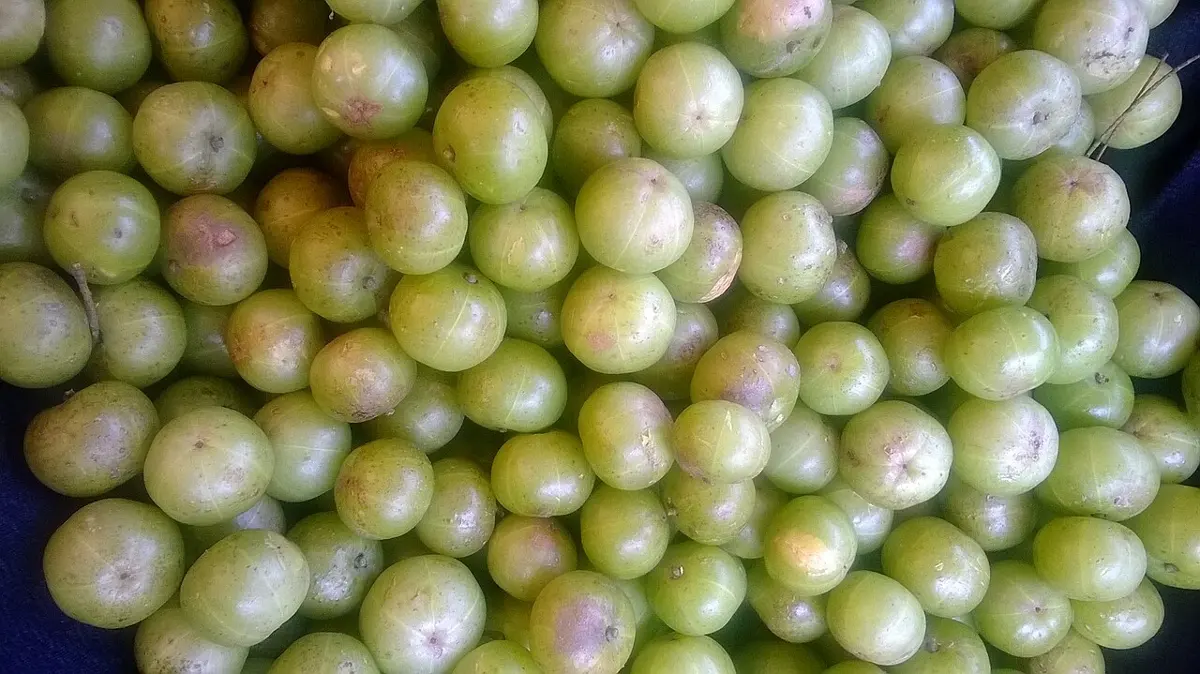
On some vegetable sellers’ carts you will find heaps of small, round, pale green fruits. Bite into one and your whole face reacts: it is sour, a little bitter, and it leaves your mouth feeling dry. Now drink a sip of water. Many people say the water suddenly tastes sweet.
The fruit is अमला (amala, often written amla). This page is about the tree it grows on: how to know it, why it plays this trick on your tongue, what it gives you, what tradition uses it for, and what scientists have tested.
How to know it
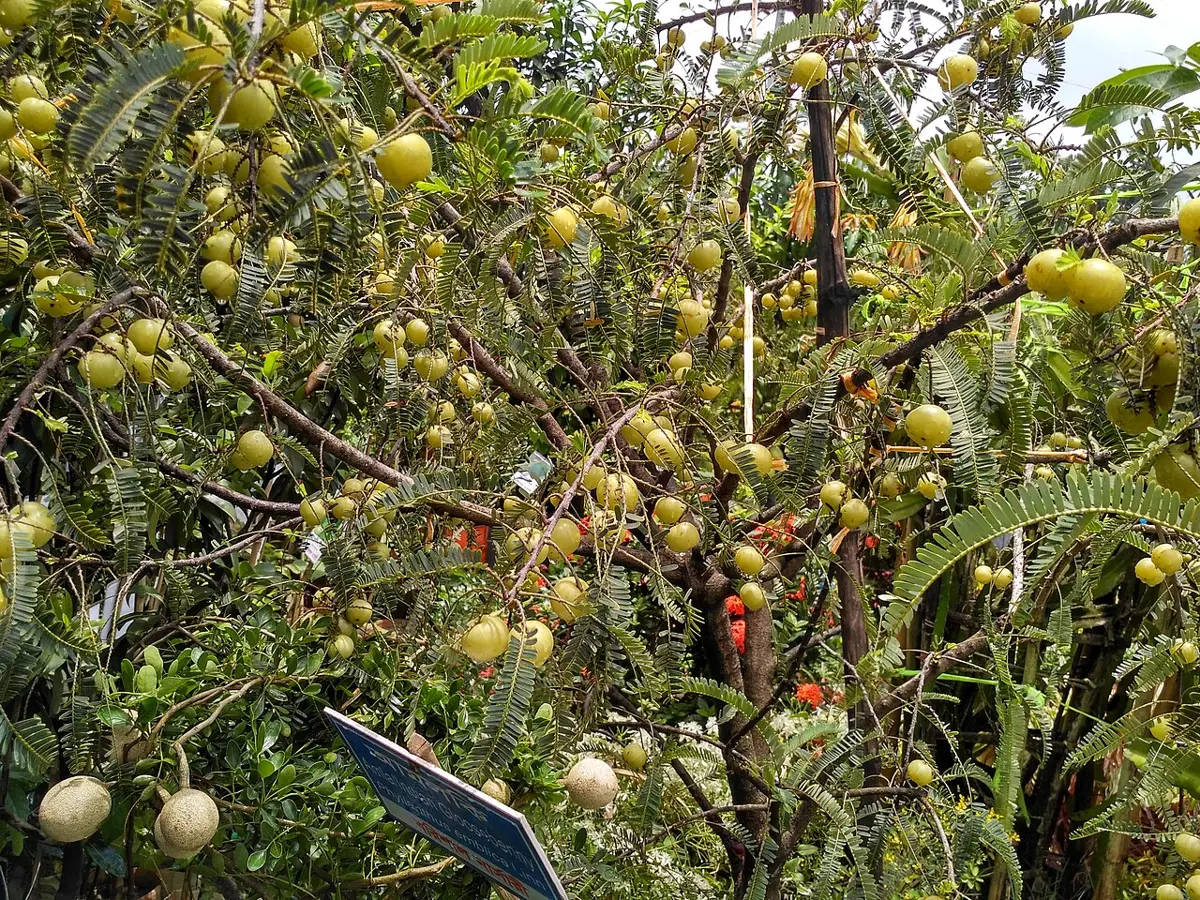
अमला is a deciduous tree, usually up to about 18 meters tall. It sheds its leaves, and even some of its small branches, but is seldom completely bare. Look for:
- the bark: fairly smooth, pale grayish-brown, peeling off in thin flakes, like a guava’s;
- the leaves: tiny and narrow, only about 1.25 to 2 cm long and 3 mm wide, set in two neat rows along very thin twigs;
- the flowers: small, greenish-yellow, in tight clusters where the leaves join the twig; in northern India it flowers from March to May;
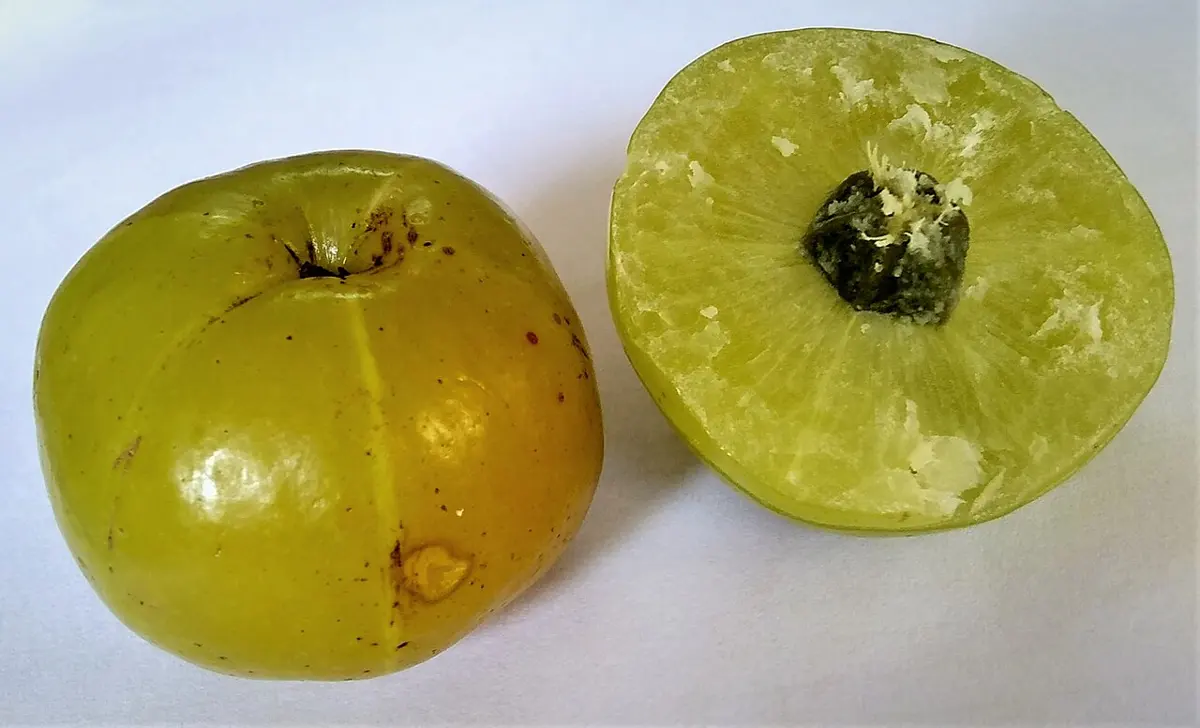
- the fruit: round, smooth and hard, light green at first and then whitish or dull greenish-yellow, with six to eight pale lines running from top to bottom, as if it were made of segments. Inside, a slightly six-sided stone holds six small seeds.
You pick up a twig of अमला with about 60 tiny leaves in two rows along it. How many leaves are you holding?
Pick an answer to see why.
Where it grows
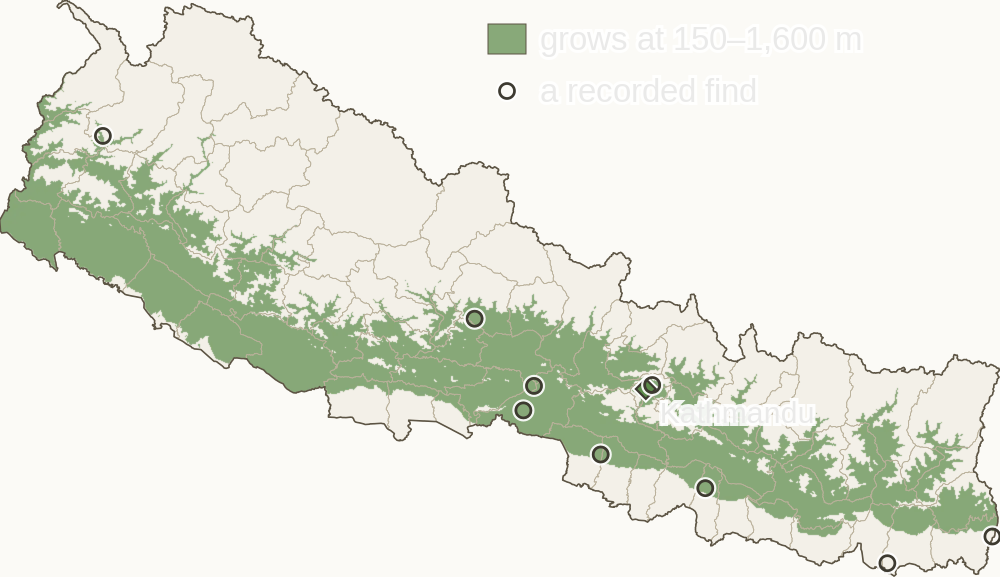
Nepal’s national register of medicinal plants records अमला from about 150 to 1,600 meters, across the west, center and east of the country. It grows in open forests and is planted by farmers: in the far west, studies found it planted on private farmland because it fetches good market prices, and in Rupandehi in the Terai, it is a cultivated tree.
It is a tough tree. It grows in dry and in humid places, and is known for thriving on soil too poor and too dry for most other fruit trees, though it needs good drainage.
Sour, then sweet: a trick on the tongue
The ripe fruit is described as astringent (drying the mouth), extremely acid, and sometimes bitter. And yet people in India say that eating a raw fruit and then drinking water leaves a sweet and refreshing aftertaste. In Southeast Asia, woodcutters eat the fruit to keep from feeling thirsty, because it makes the mouth water.
Is the sweet water real? In 2022, a team of food scientists set out to find which chemicals in the fruit cause it. They split an extract of the fruit into parts, tasted each one, and identified 15 compounds. Eleven tasted sweet in themselves. Four did something stranger: they left a sweet aftertaste. They were gallic acid, protocatechuic acid, myricetin and kaempferol.
Something similar has been known since 1972 for another plant, the artichoke. Scientists found that after the tongue meets two chemicals in artichoke, plain water tastes sweet. The chemicals don’t add sugar; they change the tongue for a short while, so that plain water sipped afterwards tastes sweet. Food scientists study such “sweet aftertaste” chemicals because they might one day help make food taste sweet with less sugar.
Full of vitamin C
The fruit’s other fame is vitamin C (ascorbic acid). Studies of different kinds of अमला have measured between 193 and 720 mg of vitamin C in 100 g of fruit; a review found the juice can hold more vitamin C than juice of apples, limes or pomegranates. During the Second World War, अमला powder, tablets and sweets were given to Indian soldiers as their vitamin C ration.
How much do we need? Britain’s National Health Service says adults need 40 mg a day, and since the body cannot store vitamin C, it has to come from food every day.
Traditional uses
The fruit is food as well as medicine: it is eaten fresh, and made into pickles, jams and sweets. Studies of the herbs people use in different districts of Nepal record अमला as:
- fruits eaten for cough and sore throat, in Kavrepalanchok; it is also one of the twelve medicinal plants found sold in the streets of the Kathmandu Valley;
- a laxative and a medicine to pass more urine, in the far west;
- bark juice for dysentery, constipation and body ache, and a fruit decoction for sore throat and as a tonic, in Rupandehi in the Terai.
In Ayurveda, the fruit’s Sanskrit names are आमलकी (amalaki) and धात्री (dhatri, “nurse”). The dried fruit is part of two famous preparations: त्रिफला (triphala, “three fruits”), made with हर्रो and बर्रो (what tests of it found is on the हर्रो page), and च्यवनप्राश (chyawanprash). Its oil goes into hair oils, and its dried fruit gives ink and hair dye.
What science has tested
- Vitamin C: well measured (above). अमला is a rich source, though the amount varies a lot from one kind of tree to another.
- Cholesterol: a 2023 systematic review collected four trials with 227 adults who had high cholesterol and took tablets or capsules of अमला extract or dummy pills for about 12 weeks. The extract lowered total and “bad” (LDL) cholesterol and raised “good” (HDL) cholesterol; side effects were mild, and happened with the dummy pills too. But the reviewers rated the evidence low certainty: few, small, quite different trials. They said larger trials, against the medicines doctors already use, are needed before anyone recommends it.
- Other effects: extracts of the fruit have been tested on blood sugar, the liver, infections and more, mostly in the laboratory and in animals, with a few small, short studies in people.
- How strong the evidence is: some evidence for cholesterol, not enough to rely on. Enjoy it as a fruit and a pickle.
A farmer’s tree
Because it fruits for decades and the fruit sells well, अमला is a good tree for a farm’s edge. Nepal’s herb traders buy the dried fruit: in March 2026, a list of buyers’ prices gave Rs 150 a kilogram in Kathmandu and Rs 115 in Nepalgunj. The price list for all three fruits of त्रिफला is on the बर्रो page.
It is not a threatened plant: the IUCN Red List rates it Least Concern.
See it at the Science Playground
अमला grows in our garden, in the healing plants: look at a twig and count its leaves, then find its partner in त्रिफला, बर्रो, nearby. Our exhibit Medicinal and Culinary Herbs of Nepal shows dried herbs and spices used in Nepal. More plants in Herbs of Nepal.
Where these facts come from
- Orwa C. et al., Emblica officinalis, Agroforestree Database 4.0, World Agroforestry Centre, 2009.
- IUCN Nepal, National Register of Medicinal and Aromatic Plants (revised and updated), 2004: Amala, page 16.
- Che X. et al., Isolation and identification of sweet substances and sweet aftertaste substances in the fruit of Phyllanthus emblica (abstract), European Food Research and Technology, 2022.
- Bartoshuk L.M. et al., Sweet taste of water induced by artichoke (Cynara scolymus) (abstract), Science, 1972.
- Gul M. et al., Functional and nutraceutical significance of amla (Phyllanthus emblica L.): a review, Antioxidants, 2022.
- Yan X. et al., Current advances on the phytochemical composition, pharmacologic effects, toxicology, and product development of Phyllanthi Fructus, Frontiers in Pharmacology, 2022.
- Acampado L.R.T. et al., Efficacy and safety of aqueous fruit extract of Emblica officinalis in adults with dyslipidemia: a systematic review and meta-analysis, Acta Medica Philippina, 2023.
- NHS, Vitamin C, checked November 2026.
- Ambu G. et al., Traditional uses of medicinal plants by ethnic people in the Kavrepalanchok District, Central Nepal, Plants, 2020.
- Kunwar R.M. et al., Medicinal plants, traditional medicine, markets and management in far-west Nepal, Journal of Ethnobiology and Ethnomedicine, 2013.
- Singh A.G., Kumar A. and Tewari D.D., An ethnobotanical survey of medicinal plants used in Terai forest of western Nepal, Journal of Ethnobiology and Ethnomedicine, 2012.
- Peterson C.T., Denniston K. and Chopra D., Therapeutic uses of Triphala in Ayurvedic medicine, Journal of Alternative and Complementary Medicine, 2017.
- ANSAB, NTFPs price list, March 2026.
- Phyllanthus emblica in GBIF: its family and IUCN Red List category (from the IUCN Red List), checked November 2026.
- अमला in the Nepali Brihat Shabdakosh (Nepal Academy).