
Batuli gets on a bus. It sits still, then the engine roars and it creeps forward, faster and faster. On the bends of the hill road the driver turns the wheel; when he brakes, Batuli’s body jerks forward. At the end of the day she has traveled 74 km along the road, yet the map says her home is only 25.5 km away in a straight line.
Every part of that ride is in this unit. How do we describe motion with numbers (speed, velocity, acceleration)? How do we predict it (the equations of motion) and draw it (motion graphs)? And why does anything start, stop or turn at all? The answer to the last question is Isaac Newton’s: force. You will finish with his three laws of motion, and with what force does to the shape of things: elasticity and plasticity.
The bus journey of Batuli
Batuli travels by bus from place A to place B. The bus is at rest when she gets on. The engine pushes it, so it starts to move slowly; then it speeds up (it accelerates). Each time the driver brakes, her body lurches forward. The road bends, and the driver turns the steering wheel to change the direction of the bus. (What would happen if the steering broke on a bend?)
The roadside milestones tell her how far the bus has come:
| Time (minutes) | 10 | 25 | 30 | 40 | 50 | … |
|---|---|---|---|---|---|---|
| Distance (km) | 5 | 10 | bus stopped (10) | 15 | 20 | … |
On a straight stretch, the speedometer in front of the driver steadily reads 50 km/h: the bus is in uniform motion. At the end, the distance along the road from A to B is 74 km. Batuli divides the total distance by the total time to find the average speed. Then she opens a map on a phone and finds that B is 25.5 km to the south of A in a straight line. That straight-line distance, with its direction, is called the displacement.
Speed and velocity
Distance and displacement
Distance is the total length of the path an object has traveled, whatever its shape. It has a size (a magnitude) but no direction, so it is a scalar quantity.
Displacement is the shortest, straight-line distance from the starting point to the end point, in a stated direction. It has both a magnitude and a direction, so it is a vector quantity.
On the map below, a bus goes from A along the winding road through B, C, D and E to F. The distance is the whole length of road ABCDEF. The displacement is the straight arrow AF, towards the north-east. However the road twists, the displacement only cares where you started and where you are now.
A boy walks 3 m east and then 4 m north. What is his displacement?
Pick an answer to see why.
Speed and velocity
The distance an object covers in one unit of time is its speed. The distance it covers in a particular direction in one unit of time (its displacement per unit time) is its velocity. The SI unit of both is the meter per second (m/s); in daily life we also use km/h.
At B on that map, the bus covers 10 m every second towards the east: its velocity is 10 m/s east. At C it is going faster, 20 m/s, and in a new direction; between D and F it does 15 m/s towards the north-east.
Speed is a scalar; velocity is a vector. That means velocity can change even when the speed does not: a bus going round a bend at a steady 40 km/h has a constant speed but a changing velocity, because its direction changes.
Average speed and average velocity
A real bus goes fast and slow and stops: in equal intervals of time it covers different distances. This is variable (non-uniform) motion. For a whole journey we use averages:
Positive and negative velocity
Along a straight line, we choose a reference point (call it 0) and a positive direction. Motion one way is then given a + sign and motion the other way a − sign.
Car: publicdomainvectors.org, CC0, via Wikimedia Commons
So a negative velocity is not “slower than zero”: it just means moving in the opposite direction. Speed, which has no direction, is never negative.
A ball rolls 6 m to the right and then 2 m back to the left, taking 4 s altogether. Which is right?
Pick an answer to see why.
Acceleration
Objects do not always move with uniform velocity. A bus speeds up and slows down; a marble rolling down an even slope, pulled by gravity, gains velocity every second. The rate of change of velocity, the change in velocity in each unit of time, is called acceleration:
Its SI unit is m/s ÷ s = m/s² (meters per second, per second). An acceleration of 3 m/s² means the velocity grows by 3 m/s every second. Like velocity, acceleration is a vector.
When the velocity decreases, as when a bus brakes, is negative and so is the acceleration. A decrease of velocity per unit time is called retardation (or deceleration, or negative acceleration).
Acceleration due to gravity
An object falling freely is pulled by the Earth’s gravity, and gains velocity at a steady rate. This acceleration is the acceleration due to gravity, written g. Near the Earth’s surface its average value is 9.8 m/s²: a falling stone goes 9.8 m/s faster every second.
Here are the measurements for an object falling freely from rest, every second:
| Time, t (s) | Distance fallen, y (m) | Velocity, v (m/s) | Acceleration, a (m/s²) |
|---|---|---|---|
| 0 | 0 | 0 | 9.8 |
| 1 | 4.9 | 9.8 | 9.8 |
| 2 | 19.6 | 19.6 | 9.8 |
| 3 | 44.1 | 29.4 | 9.8 |
A car’s velocity changes from 10 m/s to 25 m/s in 5 s. What is its acceleration?
Pick an answer to see why.
A cyclist’s acceleration is −2 m/s². What is happening?
Pick an answer to see why.
Equations of linear motion
Suppose an object moves in a straight line with uniform acceleration a. In time t its velocity changes from the initial velocity u to the final velocity v, and it covers a displacement s. These five quantities, u, v, a, t and s, are linked by three equations. Here is where each one comes from.
1. Relation among u, v, a and t
By the definition of acceleration,
Multiply both sides by t:
2. Relation among u, v, a and s
For uniform acceleration, the average velocity is , so
From (i), . Put this in (ii):
(using ). Multiply both sides by 2a:
3. Relation among u, a, t and s
From (ii), . Put from (i):
A stone is dropped from a bridge and hits the water after 3 s. Which equation finds the bridge’s height most directly?
Pick an answer to see why.
Graphs of linear motion
A graph shows a whole journey in one picture. We use two kinds: displacement–time graphs and velocity–time graphs. Time always goes along the horizontal x-axis.
Displacement–time graph
Rohan and Binaya are in a school race. At the start, Rohan is ahead of Binaya; a little later, Binaya overtakes him. Figure 7.4 shows the race as a graph, with displacement (s) up the y-axis and time (t) along the x-axis.
A displacement–time graph (s–t graph) shows how the displacement of an object changes with time: displacement on the y-axis, time on the x-axis.
- The slope of the line gives the velocity of the object.
- A steeper line means faster motion; a gentler line, slower motion.
- Where two lines cross, the two objects are at the same place at the same time.
The slope of a line is its “rise over run”:
(Δ, the Greek capital letter delta, means “change in”.)
In Figure 7.5, between 1 s and 3 s the displacement rises from 4 m to 12 m:
So the body is moving with a uniform velocity of 4 m/s. The slope of an s–t graph is the velocity.
So, on a displacement–time graph:
- a line parallel to the x-axis (flat) means the displacement does not change: the object is at rest;
- a straight sloping line means uniform velocity;
- a curved line means a variable velocity: curving upwards, speeding up; curving over, slowing down.
On a displacement–time graph, a straight line slopes downwards. What does it show?
Pick an answer to see why.
Velocity–time graph
When the velocity of a moving object is plotted against time, the graph is a velocity–time graph (v–t graph): time on the x-axis, velocity on the y-axis. It shows at a glance whether a body is at rest, moving steadily, speeding up or braking.
- The slope of a velocity–time line is the acceleration: .
- A flat line (parallel to the x-axis): the velocity doesn’t change, so the object moves with uniform velocity and no acceleration.
- A straight sloping line: uniform acceleration (sloping up) or uniform retardation (sloping down).
- A curved line: variable (non-uniform) acceleration.
- Comparing the slopes of two lines tells you which velocity is changing faster.
A velocity–time graph is a straight line sloping upwards from the origin. What is the object doing?
Pick an answer to see why.
On a velocity–time graph, what does a line parallel to the time axis at v = 10 m/s mean?
Pick an answer to see why.
Inertia
Talk about these in class: what is going on, and why?
- On a swing, it takes a little while to get the swing moving, and a while for it to come to rest again.
- A ceiling fan doesn’t reach full speed the moment you switch it on, and doesn’t stop the moment you switch it off.
When the forces on an object are balanced (they cancel out), its state of motion doesn’t change: its velocity stays the same in size and direction. To start it, stop it, or change its speed or direction, an unbalanced force must act on it. Objects “resist” any change in their state: a body at rest tends to stay at rest, and a moving body tends to keep moving in the same direction with the same velocity.
This property of a body, its inability to change by itself its state of rest or of uniform motion in a straight line, is called inertia.
Relation between mass and inertia
Every object has inertia, and the inertia of an object depends on its mass: the greater the mass, the greater the inertia. Mass is, in fact, the measure of inertia. That is why it is much harder to start, stop or turn a loaded truck than a bicycle.
Which has the most inertia?
Pick an answer to see why.
Types of inertia
1. Inertia of rest
The tendency of a body at rest to stay at rest is called inertia of rest. Examples:
- i.Dust comes out of a carpet when it is hung up and beaten with a stick: the carpet moves suddenly, but the dust stays at rest and separates from it.
- ii.When the branches of a mango tree are shaken, the mangoes fall: the branches move, but the mangoes tend to stay at rest, and their stalks break.
- iii.When the bottom coin of a pile of carrom men is struck hard with the striker, only that coin flies out; the rest of the pile stays where it is and drops straight down.
- iv.When a bus starts suddenly, a standing passenger falls backwards: the feet move with the bus, but the upper body tends to stay at rest.
2. Inertia of motion
A cyclist’s front wheel hits a stone. The bicycle is stopped suddenly, but the rider’s body tends to go on moving forward at the same speed, so the rider is thrown over the handlebars. The tendency of a moving body to keep moving with the same velocity in the same direction is called inertia of motion. Examples:
- i.A bicycle keeps rolling for some time after the rider stops pedaling.
- ii.When a moving bus brakes suddenly, the passengers are thrown forward.
- iii.When a bus turns sharply on a bend, the passengers lean towards the outside of the bend: their bodies tend to keep going straight.
- iv.Jumping off a moving bus is dangerous: your feet stop when they touch the ground, but your body keeps moving forward, so you fall.
- v.A long-jumper runs up before jumping: the speed she has gained carries her farther through the air.
Newton’s laws of motion
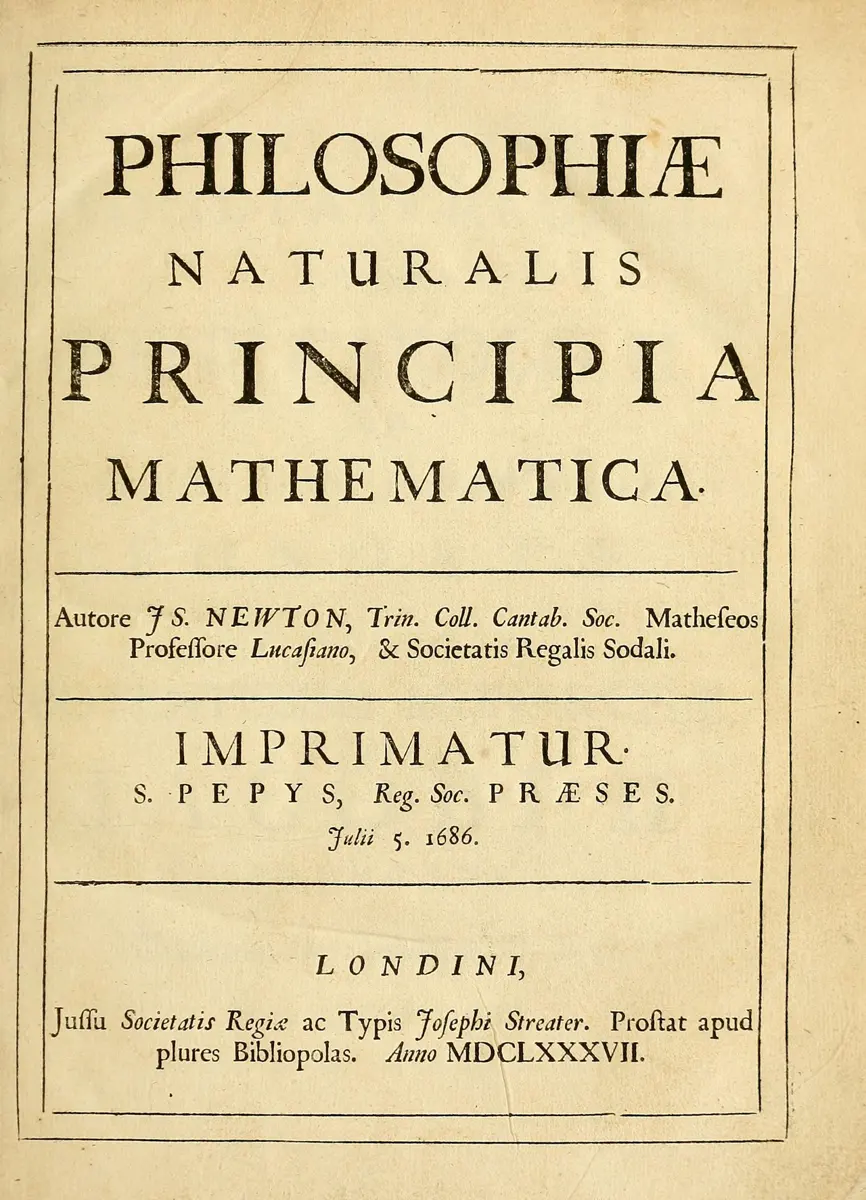
Sir Isaac Newton (1643–1727), an English physicist and mathematician, set out three laws of motion in 1687, in his book Principia. The first law tells us what a force is. The second law relates the force on a body to its mass and its acceleration, so it lets us measure force. The third law tells us a property of forces: they always come in pairs.
Newton’s first law of motion
Long before Newton, Galileo Galilei had found the law of inertia: a ball rolling on a smooth level surface would roll on for ever if nothing slowed it. Newton made it the first of his laws.
Newton’s first law of motion: an object at rest remains at rest, and an object in motion continues to move in a straight line with uniform velocity, unless an unbalanced (resultant) force acts on it.
So if the resultant force on a body is zero, it carries on as it is. To bring a body from rest to motion, or from motion to rest, or to change its speed or direction, an unbalanced force is needed. This gives us the meaning of force: a force is what changes, or tries to change, the state of rest or of uniform motion of a body. Because the first law describes the property of matter to stay at rest or in uniform motion, it is also called the law of inertia.
A puck slides across perfectly smooth ice with nothing at all acting on it sideways. What happens to it?
Pick an answer to see why.
Newton’s second law of motion
Think about this: a cyclist starts from rest. How will her acceleration change if a friend sits on the carrier? And on a level road, how will it change if she pushes the pedals harder?
If the force on the pedals stays the same, the acceleration is smaller when the mass is greater (two people). If the mass stays the same, the acceleration is greater when the force is greater. Here are more examples:
| Acceleration changes with the mass | Acceleration changes with the force |
|---|---|
| We can walk faster if we put down our load. | We run faster when our muscles push harder. |
| A loaded truck on a steep uphill road speeds up more easily once it is unloaded. | When the engine pushes harder, a vehicle accelerates more. When the brakes press harder, it slows down faster. |
| An empty wheelbarrow is easier to push into motion than a loaded one. | To make a ball go fast, we must kick it harder. |
From the activity:
- with the mass kept the same, the acceleration increases when the pulling force increases: (mass constant) ...(i)
- with the force kept the same, the acceleration decreases when the mass increases: (force constant) ...(ii)
Newton’s second law of motion: the acceleration produced in a body by a force is directly proportional to the force and inversely proportional to the mass of the body.
Putting (i) and (ii) together:
where k is a constant of proportionality. The unit of force is chosen to make k = 1: one newton (1 N) is the force that gives a body of mass 1 kg an acceleration of 1 m/s². Putting F = 1 N, m = 1 kg and a = 1 m/s² in (iii) gives 1 = k × 1 × 1, so k = 1, and
The same force acts on a 2 kg ball and on a 6 kg ball. How do their accelerations compare?
Pick an answer to see why.
Newton’s third law of motion
Can you walk forward without pushing the ground with your feet? Try it, on a polished floor in socks, or think of walking on ice.
When one object pushes or pulls a second object, the second always pushes or pulls back on the first, with a force equal in size and opposite in direction. One force of the pair is called the action and the other the reaction. When two balls collide, ball A pushes B and ball B pushes A, equally and oppositely, even when one ball is much bigger than the other. A volleyball player’s hands push the ball up, and the ball pushes her hands down.
Newton’s third law of motion: to every action there is an equal and opposite reaction. If body A exerts a force on body B, then B exerts an equal force on A in the opposite direction.
The action and the reaction are equal and opposite, yet they don’t cancel each other out, because they act on two different objects. Forces cancel only when they act on the same object. That is why things can move at all: when you push the ground backwards, the ground’s forward push acts on you, and you walk forward.
A horse pulls a cart. By the third law, the cart pulls back on the horse with an equal force. So why do they move?
Pick an answer to see why.
Elasticity and plasticity
What things come to mind when you hear the word “elastic”? And “plastic”? Make two lists.
When you pull a rubber band gently, it gets longer; let go and it goes back to its original length. A pressed rubber ball or balloon changes shape and springs back when the force is removed.
Forces applied to a body from different directions act together like a single resultant force, and a resultant force can change the shape and size of a body. How much it changes depends on what the body is made of, and on the size and direction of the forces. A force that changes the shape or size of a body is called a deforming force.
Does a steel spring go back to its shape if it is stretched as far as possible? No: there is a limit. A body deformed up to a certain extent goes back to its original shape and size when the deforming force is removed. That extent is its elastic limit.
Elasticity is the property of matter by which a body regains its original shape and size when the deforming force is removed. When a body is deformed, a restoring force develops inside it, which pulls it back.
The elasticity of different materials is different. The more elastic a material is, the harder it is to change its shape or size, and the better it returns. Steel is very elastic, so it is used in buildings, bridges and machines.

If the deforming force goes beyond the elastic limit, the body cannot regain its shape: it is permanently deformed. Plasticity is the property of matter by which a body keeps its new, deformed shape even after the deforming force is removed. Plasticity is the opposite of elasticity. Wet mud, clay and dough are very plastic: that’s why mud can be pressed into bricks and clay shaped into pots. Pushed further still, a deformed body breaks.
Which of these uses plasticity?
Pick an answer to see why.
Exercise
1. Choose the correct answer
a. In a velocity–time graph, what does the slope of the line give?
Pick an answer to see why.
b. Which of the graphs i–iv above is a displacement–time graph of an object moving with uniform velocity?
Pick an answer to see why.
c. Stepping down from a moving bus is dangerous. Which of these explains it?
Pick an answer to see why.
d. Which statement about action and reaction is true?
Pick an answer to see why.
e. Which of the following is an application of elasticity?
Pick an answer to see why.
f. A loaded truck and a car are moving at the same velocity on a road. Brakes are applied to both with equal force. Which statement is true?
Pick an answer to see why.
2. State the differences between
A displacement–time graph and a velocity–time graph
Answer
Inertia of rest and inertia of motion
Answer
Elasticity and plasticity
Answer
3. Give reasons
It takes different lengths of time to bring a motorcycle, a car, a bus and a train, all moving with the same uniform velocity, to rest.
Answer
When the branches of a tree are shaken, its leaves and fruits fall.
Answer
A bag placed in the aisle of a bus slides forward when the bus suddenly slows down or stops.
Answer
A gun must be held firmly against a strong support when it is fired.
Answer
Two rubber balls of the same size are dropped on the floor, and one bounces higher than the other.
Answer
A rubber band should not be stretched beyond a certain limit.
Answer
4. Answer the following questions
Define average velocity and acceleration.
Answer
Prove these equations of linear motion:
- a.
- b.
- c.
Answer
Draw a displacement–time graph and a velocity–time graph for a body moving in a straight line with uniform velocity.
Answer
Draw a displacement–time graph from this data. From the slope of the line, describe the motion. Find the average velocity of the object in the first 4 s from the slope.
| Time (s) | 0 | 2 | 4 | 6 | 8 | 10 | 12 | 14 |
|---|---|---|---|---|---|---|---|---|
| Displacement (m) | 0 | 4 | 8 | 8 | 12 | 8 | 4 | 0 |
Answer
The graph shows the motion of the hare and the tortoise from the famous story. Study it and tell the story again, step by step, from the start to the finish.
Answer
Define inertia. Give two examples each of inertia of rest and inertia of motion.
Answer
State the relation between mass and inertia.
Answer
State Newton’s first law of motion.
Answer
Give two examples of a resultant force changing the state of motion of an object.
Answer
Using high speed and the first law of motion, explain why bus accidents are more likely on winding roads in hilly areas.
Answer
State Newton’s second law of motion and prove that F = ma.
Answer
State Newton’s third law of motion.
Answer
Give two examples from daily life for each of the three laws of motion.
Answer
Find two uses of each of Newton’s first, second and third laws, and explain them in a table.
Answer
Name the action and the reaction in each activity: (a) a tennis racket hitting a ball; (b) a man stepping from a boat on to the bank.
Answer
Define elasticity and plasticity, with examples.
Answer
5. Numerical problems
A plane starts from rest and runs south along a runway, taking off after 30 s. Its acceleration during the run is 1.5 m/s². Find the distance it runs along the runway, and its velocity at take-off.
Answer
Rohan dropped a stone from a bridge into the river below, and Suraj saw that the stone took 2 s to reach the water. Taking the acceleration of the falling stone as 9.8 m/s², find the height of the bridge above the water.
Answer
Suraj has a mass of 50 kg and his bicycle 12 kg. Cycling down a hill, they have an acceleration of 2 m/s². Find the resultant force acting on them.
Answer
A car of mass 1500 kg is moving at 72 km/h. The driver brakes, and its speed falls to 10 km/h over a distance of 50 m. Find the resultant force on the car.
Answer
The velocity–time graph of a bus is shown.
- i.Name the segments of uniform velocity, uniform acceleration, variable acceleration and retardation.
- ii.Among the segments of uniform acceleration, in which does the bus’s velocity change fastest?
- iii.Find the acceleration from C to D.
- iv.Find the displacement of the bus from C to D.
Hint
Answer
Worksheet: Force and Motion: describing motion (PDF, 4 pages)
Worksheet: Force and Motion: inertia, Newton’s laws and elasticity (PDF, 4 pages)
Quiz yourself: Force, Motion and Machines, Grades 5–10 →
Practice every question in the book, and keep track of the ones you miss →
A companion to your textbook, not a replacement for it: study from the book your school uses, and where the two differ, follow your teacher. Found a mistake? Please tell us.