
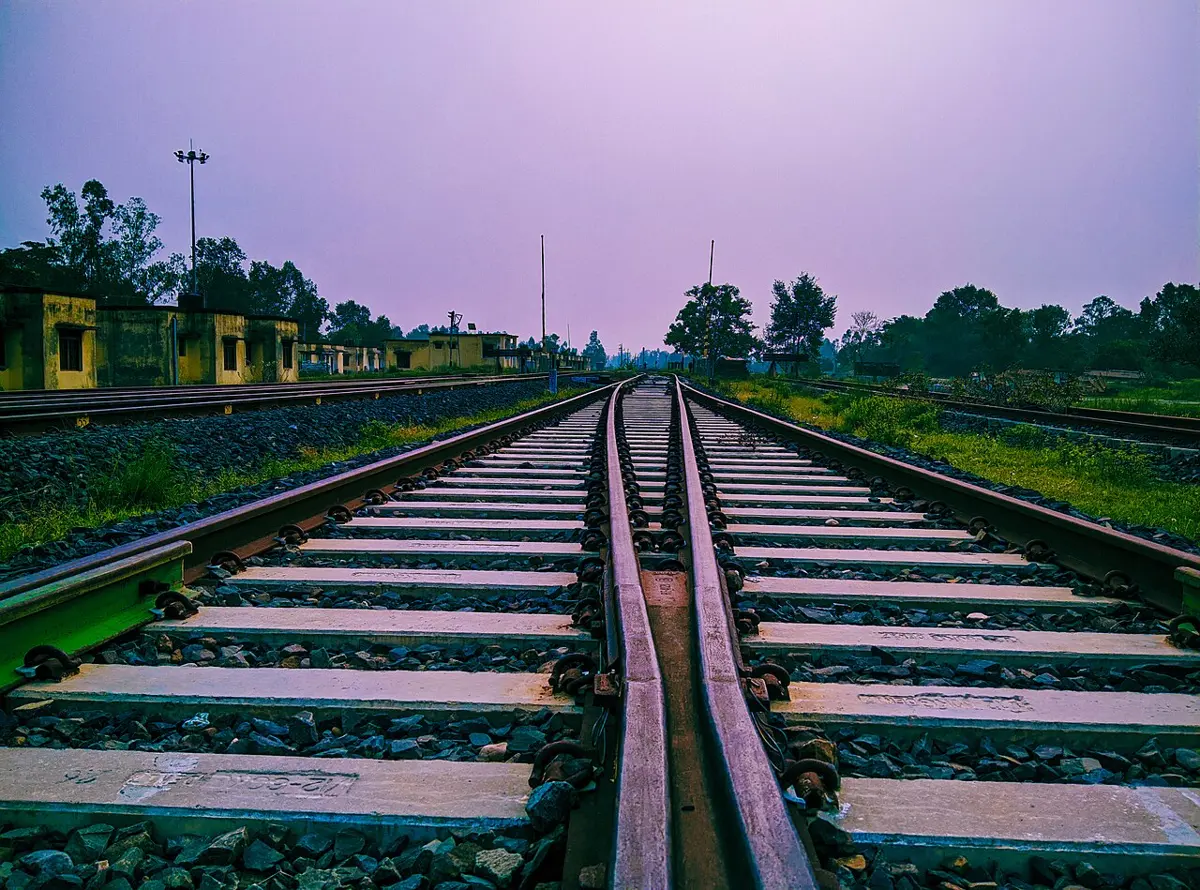
A road crosses a railway at a slant. Its edge meets the first rail at 65°. What angle does it make with the second rail, 1.676 m further on?
You could walk over with a protractor. But there is a stranger question behind this one. On a straight stretch of track, the two rails must never meet and never drift apart, kilometer after kilometer. Nobody can follow two lines forever to see that they never meet. So how can anyone ever know that two lines are parallel?
This unit answers both questions with one idea: draw a line across the two lines, and measure just two angles. By Back to the crossing you will know all eight angles of the crossing from that one 65°, and you will see how two simple angles test any two lines for being parallel.
13.0 Review
Look at these six things. Where are the parallel lines in each? Discuss in pairs before reading on.
The edges of the door, the road, the bridge and the table are straight, and they keep the same distance all along, so they are parallel lines. The river’s banks and the garden’s rings keep a steady gap too, but they curve. They give the feeling of parallel lines, and in mathematics we keep the word for straight lines.
If two straight lines never meet, however far they are extended in both directions, and the perpendicular distance between them is the same everywhere, they are called parallel lines. In Figure 13.3, AB and CD are parallel. We write or AB//CD, and we mark the lines with matching arrows.
So there are two ways to say it, and they mean the same for straight lines on a flat page: the lines never meet, or the distance between them never changes.

Two facts from earlier grades will be needed in this unit, so check that you remember them. When a line stands on a straight line, the two adjacent angles add up to 180°. When two straight lines cross, the angles opposite each other are equal: they are vertically opposite angles.
Which pair is made of parallel lines?
Pick an answer to see why.
13.1 Straight lines and Transversal
A line that cuts two or more lines at different points is called a transversal. The other lines may be parallel or not: a transversal doesn’t care.
What it means: a transversal is the ruler you lay across two lines to compare them. The road is one across the two rails, and so is each sleeper. Comparing two far-apart lines is hard, but each line makes an angle with the transversal, and two angles are easy to compare.
Two lines cross at a point O. A third line passes through O too. Is the third line a transversal of the first two?
Pick an answer to see why.
13.1.1 Angles formed when a transversal intersects straight lines
Eight angles appear when a transversal cuts two lines: four at each crossing. The four that lie between the two lines are interior angles, and the four outside are exterior angles. In Figure 13.8, angles 3, 4, 5 and 6 are interior, and 1, 2, 7 and 8 are exterior. Two angles are adjacent when they sit side by side at one crossing, sharing an arm. The pairs below are all non-adjacent: one at each crossing.
Alternate angles are non-adjacent interior angles on opposite sides of the transversal: ∠AGH and ∠DHG; ∠BGH and ∠CHG.
Corresponding angles are non-adjacent angles on the same side of the transversal, one interior and the other exterior: ∠AGE and ∠CHG; ∠BGE and ∠DHG; ∠CHF and ∠AGH; ∠BGH and ∠DHF. They sit in the same corner of each crossing.
Co-interior angles are non-adjacent interior angles on the same side of the transversal: ∠AGH and ∠CHG; ∠BGH and ∠DHG.
In Figure 13.8, what are angles 4 and 6?
Pick an answer to see why.
Which pair in Figure 13.8 is corresponding?
Pick an answer to see why.
13.2 Parallel lines and transversal
Now the question that matters. When the two lines are parallel, what happens to these pairs? We will find out as mathematicians do: measure first, then explain why.
13.2.1 Relationship between the alternate angles when two parallel lines are cut by a transversal
Conclusion: when two parallel lines are cut by a transversal, the alternate angles are equal.
So this works in both directions, and that is what makes it a test:
- If the lines are parallel, the alternate angles are equal.
- If the alternate angles are equal, the lines are parallel.
- If they aren’t equal, the lines aren’t parallel.
Now you can answer the question from the start. To know whether two lines ever meet, you don’t need to follow them. Lay one line across and compare two angles.
13.2.2 Relationship between the corresponding angles when two parallel lines are cut by a transversal
Conclusion: when two parallel lines are cut by a transversal, the corresponding angles are equal.
Use Corresponding on the widget in 13.2.1 to see it happen.
Here is why it is true, and not just what the protractor says. A crossing is four angles. Slide the whole crossing along the transversal, without turning it.
This sliding is exactly what you do when you draw parallel lines with a set square and a ruler. The set square slides along the ruler and never turns, so its edge keeps the same angle to the ruler: the corresponding angles are equal, so the two lines drawn along that edge are parallel.
The slide does take one thing for granted: through the point Q there is only one line parallel to AB, so the sliding copy and a parallel CD must be the same line. Nobody can prove that from simpler facts. On a flat surface it is a starting rule, and the story at the end of 13.2.3 tells how long people tried.
A transversal cuts two lines. One of a pair of corresponding angles is 48° and the other is 50°. What can you say?
Pick an answer to see why.
13.2.3 Relationship between the co-interior angles when two parallel lines are cut by a transversal
Conclusion: when two parallel lines are cut by a transversal, the sum of the co-interior angles is two right angles, 180°.
Press Co-interior on the widget in 13.2.1 and turn CD.
Finding unknown angles
When the lines are known to be parallel, the same three facts work the other way: they find angles you haven’t measured. Write the reason beside each step.
What it means: all eight angles take just two values, and those two add up to 180°. So with parallel lines, one angle tells you everything. That is the answer for the road and the rails.
. One of a pair of co-interior angles is 3x and the other is 2x. What is x?
Pick an answer to see why.
Why a triangle’s angles make 180°
You have probably been told that the three angles of a triangle add up to 180°. Alternate angles prove it, for every triangle at once, without measuring any.
Take any triangle ABC, and draw the line XY through C, parallel to AB.
- ∠XCA = ∠CAB (alternate angles are equal)
- ∠YCB = ∠CBA (alternate angles are equal)
- (they make the straight line XY)
So . The three corners of the triangle have been carried to one straight line. You will use this fact all through the next unit.
Back to the crossing
The road’s edge makes 65° with the first rail. The rails are parallel, so that is enough.
- The angle at the second rail is 65° (corresponding angles are equal).
- The angles beside each 65° are 115° (adjacent angles on a straight line).
- The angles opposite are equal to them (vertically opposite angles).
So every angle of the crossing is 65° or 115°. You didn’t need to walk over with a protractor.
And the stranger question? The railway’s builders can’t follow the rails forever, and they don’t have to. Every sleeper is a transversal, laid at right angles to both rails. The rails on the Janakpur line are 1,676 mm apart, and they are fixed to each sleeper at that distance. When two lines make equal corresponding angles with a line across them, they are parallel. So two angles at one spot tell you what can never be seen: what the lines do forever.
Where this is used
- Drawing parallel lines. A set square sliding along a ruler keeps the corresponding angles equal. A drafter’s tools work on the same idea, and so does a parallel ruler, two straight edges joined by two hinged arms, invented about 1584 and used by navigators to carry a direction across a chart.
- Ruled paper and road marks. The lines of an exercise book, the stripes of a zebra crossing and the rows of bricks in a wall are made parallel, and a slanting line across them makes the same angle with each one.
- Bridges. In a Warren truss, patented in 1848, the top and bottom beams are parallel and the slanting bars between them zigzag. Each Z in the steel has equal alternate angles, so the slanting bars can all be made the same length.
- Sunlight. The Sun’s rays reach us parallel, so a pole and its neighbor throw shadows at the same angle. That is how Eratosthenes could use alternate angles.
How the exam asks it
The model paper’s question on this unit is 4 marks, in three parts. Here is one of that kind.
In the figure, AB cuts the straight lines LM and PQ at E and F, and G is a point on PQ, joined to E.
Write a pair of co-interior angles in the figure. [1]
Answer
Find the value of x. [2]
Answer
What must ∠MEG be for LM and PQ to be parallel? [1]
Answer
Where marks are lost
- Using “alternate angles are equal” when the lines aren’t known to be parallel.
- Mixing up adjacent and non-adjacent angles, or the same side of the transversal and opposite sides.
- Making co-interior angles equal instead of adding them to 180°.
- Reading the wrong scale of the protractor: start counting from the 0 on the arm of your angle.
- Leaving out the reason beside a step.
Exercise 13.1
Question 1
Fill in the blanks.
If the two lines are parallel, the alternate angles are ……
Answer
If the two lines are parallel, the corresponding angles are ……
Answer
If the two lines are parallel, the sum of the co-interior angles is ……
Answer
Question 2
Write the pairs of alternate angles, corresponding angles and co-interior angles from the figure.
Answer
Question 3
Determine whether the lines are parallel by finding the measurement of the angles. Copy each figure with tracing paper and use a protractor, or use the one in the widget.
Answer
Answer
Answer
Question 4
Draw a transversal across each of these pairs of lines. Determine whether the lines are parallel by finding the measurement of the angles. Copy each pair into your notebook first.
Answer
Answer
Answer
Question 5
Draw the line CD such that . Copy each figure first.
Here is one way, with a protractor. Measure the angle the line to C makes with AB. At C, draw the same angle so that the two make a Z: they are alternate angles, so the line you draw is parallel to AB. Or use a set square and a ruler, or copy the angle with a compass. D can be any point on the new line.
Answer
Answer
Answer
Answer
Answer
Answer
Question 6
Find the value of the unknown angle in each figure.
Answer
Answer
Answer
Answer
Answer
Answer
Answer
Question 7
Find the value of x in each figure.
Answer
Answer
Answer
Answer
Answer
Answer
Answer
Answer
Hint
Answer
Printable PDFs
- Study notes 2 pages
- Harder practice questions 2 pages Answer key
Practice every question in the book, and keep track of the ones you miss →
Where these facts come from
- The exam (For the exam, How the exam asks it): CDC, विशिष्टीकरण तालिका (कक्षा ६-८) गणित – नमुना प्रश्नहरु (Geometry 15 marks in three questions; Grade 8 model question 9, read on the PDF page); our question is our own.
- The common mistakes (careful boxes, Where marks are lost): CDC, शिक्षक निर्देशिका कक्षा ८ गणित (२०८१), the lesson on lines and angles (using the parallel lines’ relations when the lines aren’t parallel; adjacent and non-adjacent angles; same side and opposite sides of the transversal; starting a measurement from 0°).
- Nepal’s railway (the opening, Back to the crossing): Wikipedia, “Jaynagar–Bardibas railway” (1,676 mm broad gauge, closed in 2014 and reopened in 2022, Kurtha on the line, 47 road crossings), read November 2026.
- Euclid and the fifth postulate (story in 13.2.3): Wikipedia, “Parallel postulate” (Ibn al-Haytham, Khayyam, al-Tusi; Lobachevsky 1829; Bolyai 1831; Gauss published nothing; on a sphere two lines meet, and the postulate’s converse fails), “Elliptic geometry” and “Euclid’s Elements” (about 300 BC; estimated second only to the Bible in editions), read November 2026.
- Eratosthenes: Wikipedia, “Eratosthenes” (Syene, Alexandria, 7.2°, alternate angles), read November 2026.
- The vanishing point (fact in 13.0): Wikipedia, “Vanishing point”, read November 2026.
- The parallel ruler (Where this is used): Wikipedia, “Parallel rulers” (invented about 1584, in common use in Europe by the 18th century), read November 2026.
- The Warren truss (Where this is used): Wikipedia, “Warren truss” (patented in 1848; equilateral triangles), read November 2026.
- The sizes in the opening drawing: a road 6 m wide and sleepers 2.75 m long are typical values chosen for the drawing, not measurements of one crossing.
- Every answer: worked out here and checked by a computer program. Every angle marked in a figure is computed from the directions of its lines.
A companion to your textbook, not a replacement for it: study from the book your school uses, and where the two differ, follow your teacher. Found a mistake? Please tell us.