Skip to content

← Grade 9 Math

Indices

Unit 12 · CDC textbook pages 236–250

Hide the stories, facts, photos, activities and interactives, for revising before an exam
In this unit 7 sections
  1. 12.0 Review
  2. 12.1 Indices
  3. 12.2 Laws of indices
  4. 12.3 Simplification of problems related to indices
  5. Exercise 12.1
  6. How the exam asks it
  7. Mixed exercise

Take a sheet of paper 0.1 mm thick and fold it in half: 2 layers. Fold again: 4. Again: 8. How many folds would it take for the stack to reach the Moon, 3,84,400 km away?

It sounds impossible, but every fold doubles the stack. After n folds there are 2×2×⋯×2=2n 2 \times 2 \times \cdots \times 2 = 2^n layers, and numbers written this way, with a small raised index, grow faster than you expect. By Back to the paper you will answer the question with the laws of this unit, in two lines, and see why 42 is enough. On the way you will find out what 20 2^0 , 2−3 2^{-3} and 81/3 8^{1/3} mean.

Try it

Fold it again

Move the slider to fold the sheet. Each step up the scale is 10 times the one below, so a sheet of paper, Mount Everest and the Sun fit in one picture.

1 mm1 m1 km1,000 km10 lakh km100 crore kmone sheet, 0.1 mmthe record, 12 folds: 41 cmMount Everest, 8,849 mSpace Station, 400 km upthe Moon, 3,84,400 kmthe Sun, 14,96,00,000 km
Layers
210 = 1,024
Thickness
10.2 cm

Each fold doubles the layers: 2, 4, 8, 16… After n folds there are 2ⁿ layers.

Real paper stops long before that: in 2002 Britney Gallivan folded a 1.2 km strip of paper in half 12 times, the record then. Sources at the end of the unit.

12.0 Review

The distance from the Earth to the Sun is about 1,49,60,00,00,000 m, and light travels 30,00,00,000 m in one second. Discuss in your class:

  • a.How can we write the distance from the Earth to the Sun in a short form?
  • b.How can we write the speed of light in a short form?
  • c.Which format is used to write large numbers in a short form?

Short forms are not only shorter: they make sums easy. How long does sunlight take to reach us?
1.496×10113×108=1.4963×10¹¹−8≈0.499×103=499 s \begin{aligned} \frac{1.496 \times 10^{11}}{3 \times 10^8} &= \frac{1.496}{3} \times 10^{11 - 8} \\ &\approx 0.499 \times 10^3 = 499 \text{ s} \end{aligned}
That is about 8 minutes 19 seconds. What it means: the Sun you see is the Sun as it was eight minutes ago. Notice the step 1011÷108=103 10^{11} \div 10^8 = 10^{3} : the indices were simply subtracted. Why that works is the subject of this unit.

12.1 Indices

When the same number or variable is multiplied by itself several times, we write it once, as the base, with a small raised number, the index (plural indices), which counts how many times it is multiplied:
a×a×a×⋯×a⏟n times=an \underbrace{a \times a \times a \times \cdots \times a}_{n \text{ times}} = a^n
an a^n is read “a to the power n”, and the whole an a^n is called a power of a. The index is also called the exponent. So 25=2×2×2×2×2=32 2^5 = 2 \times 2 \times 2 \times 2 \times 2 = 32 : the base is 2, the index 5, and 32 is the value.

In 74 7^4 , which is the base and which is the index?

Pick an answer to see why.

Which is bigger, 25 2^5 or 52 5^2 ?

Pick an answer to see why.

12.2 Laws of indices

The laws below are not rules to memorize blindly: each one is just counting how many times the base is multiplied. Throughout, the base a (or b) is not zero.

Try it

Count the a’s

Each power of a is drawn as its a’s, one tile each. Choose a law, then change the indices and count.

a3×a2=a5, 5 a’s in one rowaaaaaaaaaa
The law
a3 × a2 = a3 + 2 = a5
a’s in all
5

Count the a’s: the first power’s, then the second’s. Multiplying puts them in one row, so the indices add.

a. Multiplication law

a3×a2=(a×a×a)×(a×a)=a5 a^3 \times a^2 = (a \times a \times a) \times (a \times a) = a^5
Three a’s and then two more: five in all. In general, m of them and then n more:
am×an=am+n a^m \times a^n = a^{m + n}
To multiply powers of the same base, add the indices. The same holds for more than two: am×an×ap=am+n+p a^m \times a^n \times a^p = a^{m + n + p} .

b. Division law

a5÷a3=a×a×a×a×aa×a×a=a×a=a2 a^5 \div a^3 = \frac{a \times a \times a \times a \times a}{a \times a \times a} = a \times a = a^2
Each a below cancels one a above; 5 − 3 = 2 are left. In general:
aman=am−nwhen m>n \frac{a^m}{a^n} = a^{m - n} \quad \text{when } m > n
aman=1an−mwhen n>m \frac{a^m}{a^n} = \frac{1}{a^{n - m}} \quad \text{when } n > m
To divide powers of the same base, subtract the indices. When there are more a’s below, what is left stays below the line: a3a5=1a2 \dfrac{a^3}{a^5} = \dfrac{1}{a^2} .

c. Power law

(a3)2=a3×a3=a3+3=a6 (a^3)^2 = a^3 \times a^3 = a^{3 + 3} = a^6
Two copies of three a’s: six. In general, n copies of m a’s:
(am)n=am×n (a^m)^n = a^{m \times n}
A power of a power: multiply the indices. Two more follow from the same counting, because the order of multiplying doesn’t matter:
(ab)m=ab×ab×⋯⏟m times=ambm (ab)^m = \underbrace{ab \times ab \times \cdots}_{m \text{ times}} = a^m b^m
(ab)m=ambm \left(\frac{a}{b}\right)^m = \frac{a^m}{b^m}
So (2x)3=8x3 (2x)^3 = 8x^3 and (23)2=49 \left(\dfrac23\right)^2 = \dfrac49 .

What is x4×x3 x^4 \times x^3 ?

Pick an answer to see why.

d. Law of negative indices

In the division law, try a3÷a5 a^3 \div a^5 . By canceling it is 1a2 \dfrac{1}{a^2} ; by subtracting the indices it is a3−5=a−2 a^{3 - 5} = a^{-2} . For the law to give the right answer every time, the two must be the same thing:
a−m=1amand soam=1a−m a^{-m} = \frac{1}{a^m} \qquad \text{and so} \qquad a^m = \frac{1}{a^{-m}}
A negative index means “one over”: 2−3=123=18 2^{-3} = \dfrac{1}{2^3} = \dfrac18 . It does not make the number negative.

e. Law of zero index

Now try a4÷a4 a^4 \div a^4 . Every a cancels, so it is 1; and by subtracting, it is a4−4=a0 a^{4 - 4} = a^0 . So
a0=1 a^0 = 1
for every base that isn’t 0: 50=1 5^0 = 1 , b0=1 b^0 = 1 , x0=1 x^0 = 1 , (abx)0=1 (abx)^0 = 1 . The same comes from the pattern below: each step to the left divides by the base, so the step left of a1=a a^1 = a is a ÷ a = 1.

Try it

Steps of the same size

Choose a base and move the index from 3 down to −3. Each step to the left divides by the base; watch what happens at 0 and below. (The half steps are part f, next.)

×2×2×2×2×2×218141212482−32−22−120212223≈
Base:
Power
2−2
Exactly
1/4
About
0.25

Each step to the right multiplies by 2, so 2-2 is -2 2s multiplied together.

One step left of 21 divides 2 by 2: so 20 = 1, and the same happens with every base.

Each step to the left divides by 2, past 1 as well: 2−2 = 1 ÷ 22. The values get small but never reach 0.

Half a step: two half steps make one step, ×2, so a half step multiplies by √2 (√2 × √2 = 2). That is why 21/2 = √2.

What is 3−2 3^{-2} ?

Pick an answer to see why.

f. Root law

What could a1/2 a^{1/2} mean? If the laws are to hold, then
a1/2×a1/2=a1/2+1/2=a1=a a^{1/2} \times a^{1/2} = a^{1/2 + 1/2} = a^1 = a
So a1/2 a^{1/2} is the number that, multiplied by itself, gives a: the square root. In the same way, three copies of a1/3 a^{1/3} multiply to a, so a1/3=a3 a^{1/3} = \sqrt[3]{a} , the cube root. In general:
a1/n=an,amn=am/n=(an)m a^{1/n} = \sqrt[n]{a}, \qquad \sqrt[n]{a^m} = a^{m/n} = \left(\sqrt[n]{a}\right)^m
In am/n a^{m/n} , the denominator is the root and the numerator the power: 82/3=(83)2=22=4 8^{2/3} = \left(\sqrt[3]{8}\right)^2 = 2^2 = 4 . Take the root first when it is a whole number: the numbers stay small.

What is 253/2 25^{3/2} ?

Pick an answer to see why.

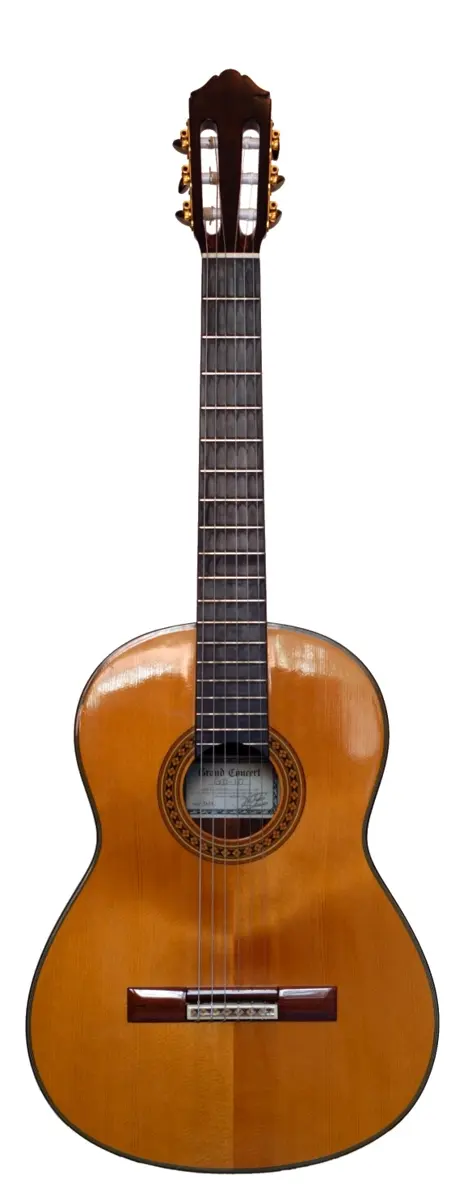
A classical guitar seen from the front on a white background: a honey-brown wooden body with a round sound hole, and a dark neck crossed by thin metal frets that get closer together towards the body
Figure 12.2 A classical guitar. Its neck joins the body at the 12th fret, halfway between the nut at the top and the bridge on the body: the string’s halfway point, one octave up. Measure the gaps between the frets from the top: each is the one before divided by about 1.06. Photo: The original uploader was Piero Sagnibene at Italian Wikipedia ., CC BY-SA 2.0 de

To simplify, the plan is nearly always the same: write every number as a power of a prime, every bracket as one power, then add or subtract the indices. Prime bases worth knowing by heart: 4=22 4 = 2^2 , 8=23 8 = 2^3 , 16=24 16 = 2^4 , 32=25 32 = 2^5 , 64=26 64 = 2^6 , 128=27 128 = 2^7 ; 9=32 9 = 3^2 , 27=33 27 = 3^3 , 81=34 81 = 3^4 , 243=35 243 = 3^5 ; 25=52 25 = 5^2 , 125=53 125 = 5^3 .

When the indices are letters, the same laws turn each bracket into one power of x; then the indices are added, and the identities of Unit 9 often make the sum 0.

After 42 folds the sheet has 242 2^{42} layers. A handy fact: 210=1024≈103 2^{10} = 1024 \approx 10^3 . So
242=22×(210)4≈4×(103)4=4×10¹² \begin{aligned} 2^{42} &= 2^2 \times (2^{10})^4 \\ &\approx 4 \times (10^3)^4 = 4 \times 10^{12} \end{aligned}
Each layer is 0.1 mm=10−4 0.1 \text{ mm} = 10^{-4} m thick, so the stack is
4×1012×10−4=4×10¹²−4=4×10⁸ m 4 \times 10^{12} \times 10^{-4} = 4 \times 10^{12 - 4} = 4 \times 10^8 \text{ m}
that is about 4,00,000 km (exactly, 4,39,805 km). 42 folds take the stack past the Moon, 3,84,400 km away. 41 folds give half of that, about 2,20,000 km: not enough.

What it means: each fold adds only 1 to the index, but doubles the thickness. Growth like this, where a quantity is multiplied by the same number at each step, is called exponential growth: it is how money grows at compound interest, how bacteria multiply, and how a rumor or a virus can spread.

Exercise 12.1

Question 1

a.

Find the value of 35×3−5 3^5 \times 3^{-5} .

Answer
b.

Find the value of 94×193 9^4 \times \dfrac{1}{9^3} .

Answer
c.

Find the value of 53×152 5^3 \times \dfrac{1}{5^2} .

Answer
d.

Find the value of 642/3 64^{2/3} .

Answer
e.

Find the value of (813)1/3 \left(\dfrac{81}{3}\right)^{1/3} .

Answer
f.

Find the value of 11253 \sqrt[3]{\dfrac{1}{125}} .

Answer
g.

Find the value of (2764)−2/3 \left(\dfrac{27}{64}\right)^{-2/3} .

Answer
h.

Find the value of {(216125)−1/3}2 \left\{\left(\dfrac{216}{125}\right)^{-1/3}\right\}^2 .

Answer
i.

Find the value of (1128)1/7+(164)1/6 \left(\dfrac{1}{128}\right)^{1/7} + \left(\dfrac{1}{64}\right)^{1/6} .

Answer
j.

Find the value of (116)1/4×84/3 \left(\dfrac{1}{16}\right)^{1/4} \times 8^{4/3} .

Answer
k.

Find the value of (13)−3+(13)−1+(12)−3+(18)0 \left(\dfrac13\right)^{-3} + \left(\dfrac13\right)^{-1} + \left(\dfrac12\right)^{-3} + \left(\dfrac18\right)^0 .

Answer

Question 2

a.

Simplify (125m3÷27b−3)−2/3 \left(125m^3 \div 27b^{-3}\right)^{-2/3} .

Answer
b.

Simplify (64a3÷125b−3)−2/3 \left(64a^3 \div 125b^{-3}\right)^{-2/3} .

Answer
c.

Simplify xa−b×xb−c×xc−a x^{a - b} \times x^{b - c} \times x^{c - a} .

Answer
d.

Simplify xb2−c2×xc2−a2×xa2−b2 x^{b^2 - c^2} \times x^{c^2 - a^2} \times x^{a^2 - b^2} .

Answer
e.

Simplify xab×xbc×xca×x−ab×x−bc×x−ca x^{ab} \times x^{bc} \times x^{ca} \times x^{-ab} \times x^{-bc} \times x^{-ca} .

Answer
f.

Simplify x2m+3n×x3m+6nx2m+3n×x4m−4n \dfrac{x^{2m + 3n} \times x^{3m + 6n}}{x^{2m + 3n} \times x^{4m - 4n}} .

Answer
g.

Simplify a9n+3×a−4na2n+10×a3n−7 \dfrac{a^{9n + 3} \times a^{-4n}}{a^{2n + 10} \times a^{3n - 7}} .

Answer
h.

Simplify 7n+1×7n2−17n2−n×72n+2 \dfrac{7^{n + 1} \times 7^{n^2 - 1}}{7^{n^2 - n} \times 7^{2n + 2}} .

Answer

Question 3

a.

Find the value of (278)−1/3[(8116)1/4÷(425)−1/2] \left(\dfrac{27}{8}\right)^{-1/3}\left[\left(\dfrac{81}{16}\right)^{1/4} \div \left(\dfrac{4}{25}\right)^{-1/2}\right] .

Answer
b.

Find the value of (2516)−1/2[(12564)1/3÷(827)−1/3] \left(\dfrac{25}{16}\right)^{-1/2}\left[\left(\dfrac{125}{64}\right)^{1/3} \div \left(\dfrac{8}{27}\right)^{-1/3}\right] .

Answer
c.

Find the value of (278)1/3[(24332)1/5÷(23)−2] \left(\dfrac{27}{8}\right)^{1/3}\left[\left(\dfrac{243}{32}\right)^{1/5} \div \left(\dfrac23\right)^{-2}\right] .

Answer
d.

Find the value of 34×273×95816×33×9−2 \dfrac{3^4 \times 27^3 \times 9^5}{81^6 \times 3^3 \times 9^{-2}} .

Answer
e.

Find the value of 24×83×45166×23×4−2 \dfrac{2^4 \times 8^3 \times 4^5}{16^6 \times 2^3 \times 4^{-2}} .

Answer

Question 4

a.

Simplify 11+xa−b+11+xb−a \dfrac{1}{1 + x^{a - b}} + \dfrac{1}{1 + x^{b - a}} .

Answer
b.

Simplify 11−ax−y+11−ay−x \dfrac{1}{1 - a^{x - y}} + \dfrac{1}{1 - a^{y - x}} .

Answer
c.

Simplify (xa+b)2×(xb+c)2×(xc+a)2(xa⋅xb⋅xc)4 \dfrac{(x^{a + b})^2 \times (x^{b + c})^2 \times (x^{c + a})^2}{(x^a \cdot x^b \cdot x^c)^4} .

Answer
d.

Simplify (ax+y)3×(ay+z)3×(az+x)3(ax⋅ay⋅az)6 \dfrac{(a^{x + y})^3 \times (a^{y + z})^3 \times (a^{z + x})^3}{(a^x \cdot a^y \cdot a^z)^6} .

Answer
e.

Simplify 273a+1×243−4a/59a+5×33a−7 \dfrac{27^{3a + 1} \times 243^{-4a/5}}{9^{a + 5} \times 3^{3a - 7}} .

Answer
f.

Simplify 322n/5×22n+14n+1×22(n−2) \dfrac{32^{2n/5} \times 2^{2n + 1}}{4^{n + 1} \times 2^{2(n - 2)}} .

Answer

Question 5

a.

Simplify (xbx−a)b−a×(xax−c)a−c×(xcx−b)c−b \left(\dfrac{x^b}{x^{-a}}\right)^{b - a} \times \left(\dfrac{x^a}{x^{-c}}\right)^{a - c} \times \left(\dfrac{x^c}{x^{-b}}\right)^{c - b} .

Answer
b.

Simplify (x−bx−a)a+b×(x−cx−b)c+b×(x−ax−c)c+a \left(\dfrac{x^{-b}}{x^{-a}}\right)^{a + b} \times \left(\dfrac{x^{-c}}{x^{-b}}\right)^{c + b} \times \left(\dfrac{x^{-a}}{x^{-c}}\right)^{c + a} .

Answer
c.

Simplify (xmx−n)m2−mn+n2×(xnx−l)n2−nl+l2×(xlx−m)l2−ml+m2 \left(\dfrac{x^m}{x^{-n}}\right)^{m^2 - mn + n^2} \times \left(\dfrac{x^n}{x^{-l}}\right)^{n^2 - nl + l^2} \times \left(\dfrac{x^l}{x^{-m}}\right)^{l^2 - ml + m^2} .

Answer
d.

Simplify (xa+bxc)a−b×(xb+cxa)b−c×(xc+axb)c−a \left(\dfrac{x^{a + b}}{x^c}\right)^{a - b} \times \left(\dfrac{x^{b + c}}{x^a}\right)^{b - c} \times \left(\dfrac{x^{c + a}}{x^b}\right)^{c - a} .

Answer
e.

Simplify xa2−b2a+b×xb2−c2b+c×xc2−a2c+a \sqrt[a + b]{x^{a^2 - b^2}} \times \sqrt[b + c]{x^{b^2 - c^2}} \times \sqrt[c + a]{x^{c^2 - a^2}} .

Answer
f.

Simplify (xa2+b2x−ab)a−b×(xb2+c2x−bc)b−c×(xc2+a2x−ca)c−a \left(\dfrac{x^{a^2 + b^2}}{x^{-ab}}\right)^{a - b} \times \left(\dfrac{x^{b^2 + c^2}}{x^{-bc}}\right)^{b - c} \times \left(\dfrac{x^{c^2 + a^2}}{x^{-ca}}\right)^{c - a} .

Answer
g.

Simplify (xbxc)1/(bc)×(xcxa)1/(ca)×(xaxb)1/(ab) \left(\dfrac{x^b}{x^c}\right)^{1/(bc)} \times \left(\dfrac{x^c}{x^a}\right)^{1/(ca)} \times \left(\dfrac{x^a}{x^b}\right)^{1/(ab)} .

Answer
h.

Simplify {(ax⋅ay)x−y(ayaz)y+z}×(azax)z+x \left\{(a^x \cdot a^y)^{x - y}\left(\dfrac{a^y}{a^z}\right)^{y + z}\right\} \times \left(\dfrac{a^z}{a^x}\right)^{z + x} .

Answer

Question 6

a.

Prove that xbxcbc×(xcxa)1/(ca)×xaxbab=1 \sqrt[bc]{\dfrac{x^b}{x^c}} \times \left(\dfrac{x^c}{x^a}\right)^{1/(ca)} \times \sqrt[ab]{\dfrac{x^a}{x^b}} = 1 .

Answer
b.

Prove that xaxb×xbxc×xcxa=1 \sqrt{\dfrac{x^a}{x^b}} \times \sqrt{\dfrac{x^b}{x^c}} \times \sqrt{\dfrac{x^c}{x^a}} = 1 .
The textbook prints the roots as the c-th, a-th and b-th. Then the index is a−bc+b−ca+c−ab \frac{a - b}{c} + \frac{b - c}{a} + \frac{c - a}{b} , which is not 0 in general (a = 1, b = 2, c = 3 gives −13 -\frac13 ), so the book’s numbers don’t work. With square roots for all three, as the Nepali edition prints it and as here, the statement is true.

Answer
c.

Prove that xb/cxc/bbc×xc/axa/cca×xa/bxb/aab=1 \sqrt[bc]{\dfrac{x^{b/c}}{x^{c/b}}} \times \sqrt[ca]{\dfrac{x^{c/a}}{x^{a/c}}} \times \sqrt[ab]{\dfrac{x^{a/b}}{x^{b/a}}} = 1 .

Answer
d.

Prove that 11+xa−b+xc−b+11+xb−c+xa−c+11+xc−a+xb−a=1 \dfrac{1}{1 + x^{a - b} + x^{c - b}} + \dfrac{1}{1 + x^{b - c} + x^{a - c}} + \dfrac{1}{1 + x^{c - a} + x^{b - a}} = 1 .

Answer
e.

Prove that (p+1q)m×(p−1q)m(q+1p)m×(q−1p)m=(pq)2m \dfrac{\left(p + \frac1q\right)^m \times \left(p - \frac1q\right)^m}{\left(q + \frac1p\right)^m \times \left(q - \frac1p\right)^m} = \left(\dfrac pq\right)^{2m} .

Answer
f.

Prove that (x2−1y2)a×(x−1y)b−a(y2−1x2)b×(y+1x)a−b=(xy)a+b \dfrac{\left(x^2 - \frac{1}{y^2}\right)^a \times \left(x - \frac1y\right)^{b - a}}{\left(y^2 - \frac{1}{x^2}\right)^b \times \left(y + \frac1x\right)^{a - b}} = \left(\dfrac xy\right)^{a + b} .
The textbook prints x2+1y2 x^2 + \frac{1}{y^2} and y2+1x2 y^2 + \frac{1}{x^2} . These don’t factorize, and then the two sides are not equal (x = 3, y = 2, a = 1, b = 2 gives about 3.19 against 3.375), so the book’s numbers don’t work. With minus signs, as the Nepali edition prints them and as in Example 5, they are.

Answer
g.

Prove that (a2−1b2)x×(a−1b)y−x(b2−1a2)y×(b+1a)x−y=(ab)x+y \dfrac{\left(a^2 - \frac{1}{b^2}\right)^x \times \left(a - \frac1b\right)^{y - x}}{\left(b^2 - \frac{1}{a^2}\right)^y \times \left(b + \frac1a\right)^{x - y}} = \left(\dfrac ab\right)^{x + y} .

Answer

Question 7

7.

If p3+q3+r3=1 p^3 + q^3 + r^3 = 1 , prove that (xpx−q)p2−pq+q2×(xqx−r)q2−qr+r2×(xrx−p)r2−rp+p2=x2 \left(\dfrac{x^p}{x^{-q}}\right)^{p^2 - pq + q^2} \times \left(\dfrac{x^q}{x^{-r}}\right)^{q^2 - qr + r^2} \times \left(\dfrac{x^r}{x^{-p}}\right)^{r^2 - rp + p^2} = x^2 .

Answer

Question 8

8.

If x2+y2+z2=xy+yz+zx x^2 + y^2 + z^2 = xy + yz + zx , prove that (axay)x−y×(ayaz)y−z×(azax)z−x=1 \left(\dfrac{a^x}{a^y}\right)^{x - y} \times \left(\dfrac{a^y}{a^z}\right)^{y - z} \times \left(\dfrac{a^z}{a^x}\right)^{z - x} = 1 .
The textbook prints the condition as x2+y2+z2=2(xy+yz+zx) x^2 + y^2 + z^2 = 2(xy + yz + zx) . Then the left side comes to a2(xy+yz+zx) a^{2(xy + yz + zx)} , not 1, so the book’s numbers don’t work. Without the 2, as the Nepali edition prints it and as here, it is 1.

Answer

Question 9

9.

If g + h + f = 0, prove that 11+mg+m−h+11+mh+m−f+11+mf+m−g=1 \dfrac{1}{1 + m^g + m^{-h}} + \dfrac{1}{1 + m^h + m^{-f}} + \dfrac{1}{1 + m^f + m^{-g}} = 1 .

Answer

Question 10

10.

If r + s + t = 0, prove that 11+xr+x−s+11+xs+x−t+11+xt+x−r=1 \dfrac{1}{1 + x^r + x^{-s}} + \dfrac{1}{1 + x^s + x^{-t}} + \dfrac{1}{1 + x^t + x^{-r}} = 1 .

Answer

Question 11

11.

If xyz = 1, prove that 11+x+y−1+11+y+z−1+11+z+x−1=1 \dfrac{1}{1 + x + y^{-1}} + \dfrac{1}{1 + y + z^{-1}} + \dfrac{1}{1 + z + x^{-1}} = 1 .

Hint
Answer

How the exam asks it

Grade 9’s final exam is set to CDC’s specification grid for Compulsory Mathematics, Grades 9–10. There, Algebra is 15 marks in three questions. In the grid’s Grade 9 model paper, indices are question 9b, beside the HCF in 9a (Unit 10):

Part Level Marks What it asks
b. application 3 simplify three brackets with letters in the indices

The three marks go with three steps: one bracket at a time to a single power (division law), the indices multiplied out with an identity (power law), and the sum of the indices with x0=1 x^0 = 1 . Write each step, even when you can see the answer is 1. Here is one of our own in that shape.

Mixed exercise

This exercise mixes all of algebra: factorization Grade 9: Unit 9, HCF and LCM Grade 9: Unit 10, linear equations Grade 9: Unit 11 and indices.

Question 1

a.

Factorize 216a3+18 216a^3 + \dfrac18 .

Answer
b.

Factorize 8x3−125y3 8x^3 - 125y^3 .

Answer
c.

Factorize (x+2)3 (x + 2)^3 .

Answer
d.

Factorize (x−3)3 (x - 3)^3 .

Answer
e.

Factorize 16m4−65m2n2+49n4 16m^4 - 65m^2n^2 + 49n^4 .

Answer
f.

Factorize 9x4−2x2y2+19y4 9x^4 - \dfrac{2x^2}{y^2} + \dfrac{1}{9y^4} .

Answer
g.

Factorize 64−144a+108a2−27a3 64 - 144a + 108a^2 - 27a^3 .

Answer
h.

Factorize a4−5a2b2+4b4 a^4 - 5a^2b^2 + 4b^4 .

Answer

Question 2

a.

Find the HCF of x2+2x−8−y2−6y x^2 + 2x - 8 - y^2 - 6y , x2+2xy+y2−16 x^2 + 2xy + y^2 - 16 and x2+xy+4x x^2 + xy + 4x .

Answer
b.

Find the HCF of 9(a+b)2+a+b−8 9(a + b)^2 + a + b - 8 , a2+2ab+b2−1 a^2 + 2ab + b^2 - 1 and a2+ab+a a^2 + ab + a .

Answer
c.

Find the HCF of x2−10x+24+6y−9y2 x^2 - 10x + 24 + 6y - 9y^2 , x2+6xy+9y2−36 x^2 + 6xy + 9y^2 - 36 and x2+3xy−6x x^2 + 3xy - 6x .

Answer
d.

Find the HCF of x4y4+1+y4x4 \dfrac{x^4}{y^4} + 1 + \dfrac{y^4}{x^4} , x3y3+y3x3 \dfrac{x^3}{y^3} + \dfrac{y^3}{x^3} and x3y2−x+y2x \dfrac{x^3}{y^2} - x + \dfrac{y^2}{x} .

Answer

Question 3

a.

Find the LCM of a5+2a4−9a3−18a2 a^5 + 2a^4 - 9a^3 - 18a^2 , a5−2a4+8a2−4a3 a^5 - 2a^4 + 8a^2 - 4a^3 and a4−4a2 a^4 - 4a^2 .

Answer
b.

Find the LCM of x4−8x2−33−14y−y2 x^4 - 8x^2 - 33 - 14y - y^2 , (x2+y)2−9 (x^2 + y)^2 - 9 and x3+xy+3x x^3 + xy + 3x .

Answer
c.

Find the LCM of x2+2xy+y2−z2 x^2 + 2xy + y^2 - z^2 , y2+2yz+z2−x2 y^2 + 2yz + z^2 - x^2 and z2+2zx+x2−y2 z^2 + 2zx + x^2 - y^2 .

Answer
d.

Find the LCM of a(a + c) − b(b + c), b(a + b) − c(c + a) and c(b + c) − a(a + b).

Answer

Question 4

4.

The HCF and LCM of two algebraic expressions are 2u + 5v and 3u(2u + 5v)(2u − 5v). If one expression is 4u2−25v2 4u^2 - 25v^2 , find the other.

Answer

Question 5

a.

Find the HCF and LCM of (p+3)3 (p + 3)^3 , p2+6p+9 p^2 + 6p + 9 and 2p3+18p2+54p+54 2p^3 + 18p^2 + 54p + 54 .

Answer
b.

Find the HCF and LCM of q2−6q−40+14r−r2 q^2 - 6q - 40 + 14r - r^2 , q2−2qr+r2−16 q^2 - 2qr + r^2 - 16 and q2−qr+4q q^2 - qr + 4q .
The textbook prints the third expression as q2−qr+4r q^2 - qr + 4r , which has no factor in common with the other two, so the book’s numbers don’t fit its own answer. q2−qr+4q=q(q−r+4) q^2 - qr + 4q = q(q - r + 4) , as here, does.

Answer

Question 6

a.

Solve by substitution: 2x + 3y = 8, 3x + 2y = 7.

Answer
b.

Solve by substitution: 23x+2y=1 \dfrac23x + 2y = 1 , x3−y3=1 \dfrac x3 - \dfrac y3 = 1 .

Answer
c.

Solve by substitution: 5x − 2y = 10, 4x − 3y = −6.

Answer

Question 7

a.

Solve by elimination: x6−y=−6 \dfrac x6 - y = -6 , 3x4−1=y \dfrac{3x}{4} - 1 = y .

Answer
b.

Solve by elimination: x+y2=3x−5y4 \dfrac{x + y}{2} = \dfrac{3x - 5y}{4} , x−3y2=x−13 \dfrac{x - 3y}{2} = \dfrac{x - 1}{3} .

Answer

Question 8

8.

Muna’s present age is 4 years more than twice Umesh’s. Umesh’s present age is 2 years more than 25 \dfrac25 of Muna’s. Find the difference between their ages.

Answer

Question 9

9.

The present ages of Tilak and Bimala are in the ratio 5 : 7. Eight years ago the ratio was 7 : 13. Find their present ages.

Answer

Question 10

10.

In a two-digit number the ones digit is three times the tens digit. If 36 is added to the number, its digits change places. Find the number.

Answer

Question 11

11.

Zeenat is setting up a new office. At a shop, 3 tables and 2 chairs cost Rs 1,900, and 2 tables and 4 chairs cost Rs 1,800. Find the price of a table and of a chair, and the cost of one table and four chairs.

Answer

Question 12

12.

Simplify (xmxn)m−p+n×(xnxp)n−m+p×(xpxm)p−n+m \left(\dfrac{x^m}{x^n}\right)^{m - p + n} \times \left(\dfrac{x^n}{x^p}\right)^{n - m + p} \times \left(\dfrac{x^p}{x^m}\right)^{p - n + m} .

Answer

Question 13

13.

Simplify 11+xp−q+xp−r+11+xq−p+xq−r+11+xr−p+xr−q \dfrac{1}{1 + x^{p - q} + x^{p - r}} + \dfrac{1}{1 + x^{q - p} + x^{q - r}} + \dfrac{1}{1 + x^{r - p} + x^{r - q}} .

Answer

Question 14

14.

Simplify (9x2−19y2)3x(3x−13y)3y−3x(9y2−19x2)3y(3y+13x)3x−3y \dfrac{\left(9x^2 - \frac{1}{9y^2}\right)^{3x} \left(3x - \frac{1}{3y}\right)^{3y - 3x}}{\left(9y^2 - \frac{1}{9x^2}\right)^{3y} \left(3y + \frac{1}{3x}\right)^{3x - 3y}} .
The textbook prints the last bracket as 3y+13y 3y + \frac{1}{3y} . Then nothing cancels and the answer isn’t a single power (x = 2, y = 1 gives about 439 instead of 512), so the book’s numbers don’t work. With 3y+13x 3y + \frac{1}{3x} , as here, it is Example 5 again.

Answer

Question 15

15.

If 1ab+1bc+1ca=0 \dfrac{1}{ab} + \dfrac{1}{bc} + \dfrac{1}{ca} = 0 , prove that (1+xa+x−b)−1+(1+xb+x−c)−1+(1+xc+x−a)−1=1 (1 + x^a + x^{-b})^{-1} + (1 + x^b + x^{-c})^{-1} + (1 + x^c + x^{-a})^{-1} = 1 .

Answer
Where these facts come from
  • Folding paper (the opening, PaperFolds, Back to the paper): Wikipedia, “Britney Gallivan” (January 2002, a 1,200 m strip of toilet paper folded in half 12 times; her formula for the length needed), read November 2026. The Moon’s average distance, 3,84,400 km, and 1 au, 14,96,00,000 km: NASA. Everest, 8,848.86 m: the Nepal–China survey announced in December 2020. The Space Station’s height, about 400 km: NASA. Office paper about 0.1 mm thick (80 g/m² paper).
  • The guitar (fact in 12.2): Wikipedia, “Fret” (the twelfth fret divides the string in two halves; successive frets in the ratio of the twelfth root of two, about 1.059463), read November 2026.
  • Unit prefixes and the red blood cell: the SI prefixes (BIPM, The International System of Units); Wikipedia, “Red blood cell” (about 6.2–8.2 micrometers across), read November 2026.
  • The story: Wikipedia, “Exponentiation” (Chuquet’s notation in the 15th century; “exponent” coined by Stifel in 1544; Descartes, 1637, “aa, or a²”) and “Nicolas Chuquet” (Triparty, 1484; may have been the first to recognize zero and negative numbers as exponents), read November 2026.
  • Kepler’s third law (fact in 12.3): Wikipedia, “Kepler’s laws of planetary motion” (published 1619); Jupiter’s orbit, 5.2 au and 11.86 years, NASA’s Jupiter fact sheet.
  • The exam’s question (For the exam, How the exam asks it): CDC, Specification Grid, Compulsory Mathematics, Grades 9–10 (Algebra 15 marks in three questions) and its Grade 9 model question 9b (3A); our question is our own.
  • Every answer: worked out here and checked with a computer algebra program (SymPy).

A companion to your textbook, not a replacement for it: study from the book your school uses, and where the two differ, follow your teacher. Found a mistake? Please tell us.