
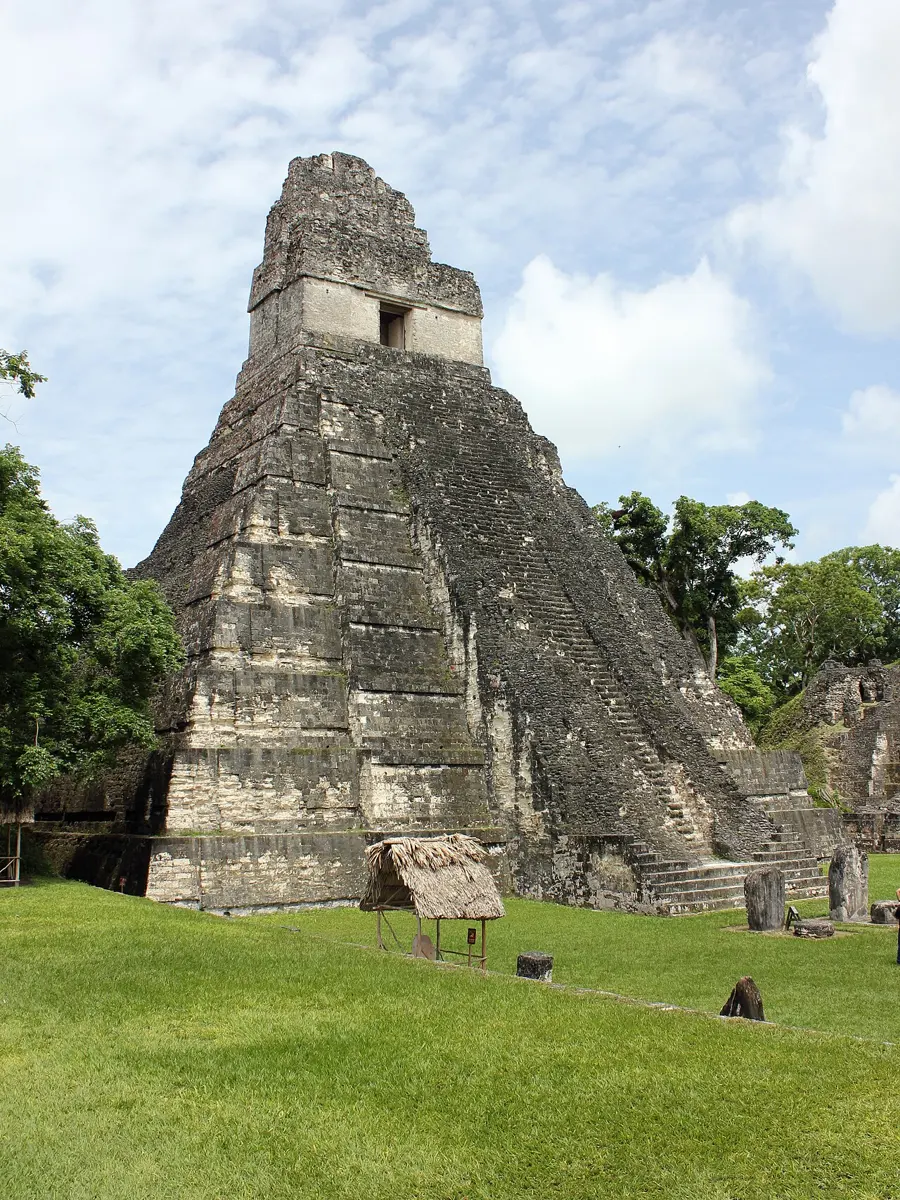
In the rainforest of northern Guatemala, stone temples taller than a fifteen-storey building rise above the trees. More than a thousand years ago, tens of thousands of people lived around them. Then, one by one, the cities of the southern Maya emptied, and the forest grew back over their plazas. Nobody wrote down why.
This unit is about history and civilization: how we became human, the rise and fall of the Maya, and how people went from swapping cattle to paying by phone in The History of Money. You will learn to talk about old habits with used to, to tell a story in the past simple, past continuous and past perfect, to write stories from outlines and an essay on why history matters, and to use the semicolon. You will listen to a poem by Thomas Hood, written two hundred years ago, about the house where he was born.
Getting started
The unit opens with a famous kind of picture: five figures walking in a line from left to right, each a little more upright than the one before. They are labelled Australopithecus afarensis, Homo habilis, Homo erectus, Homo neanderthalensis and Homo sapiens. The first is hairy, stooped and ape-like; the last is a modern person, standing straight.
These are scientific names: the first word is the genus (Homo means “human” in Latin), the second the species. Habilis means “handy”, because this species was thought to have made the first stone tools; erectus means “upright”; sapiens means “wise”: that is us.
Look at the picture and talk about human evolution.
A model answer
Reading I: The Maya Empire
Before you read
The reading starts with a photo of a huge round stone, carved all over in rings of signs and pictures, with a face in its middle.
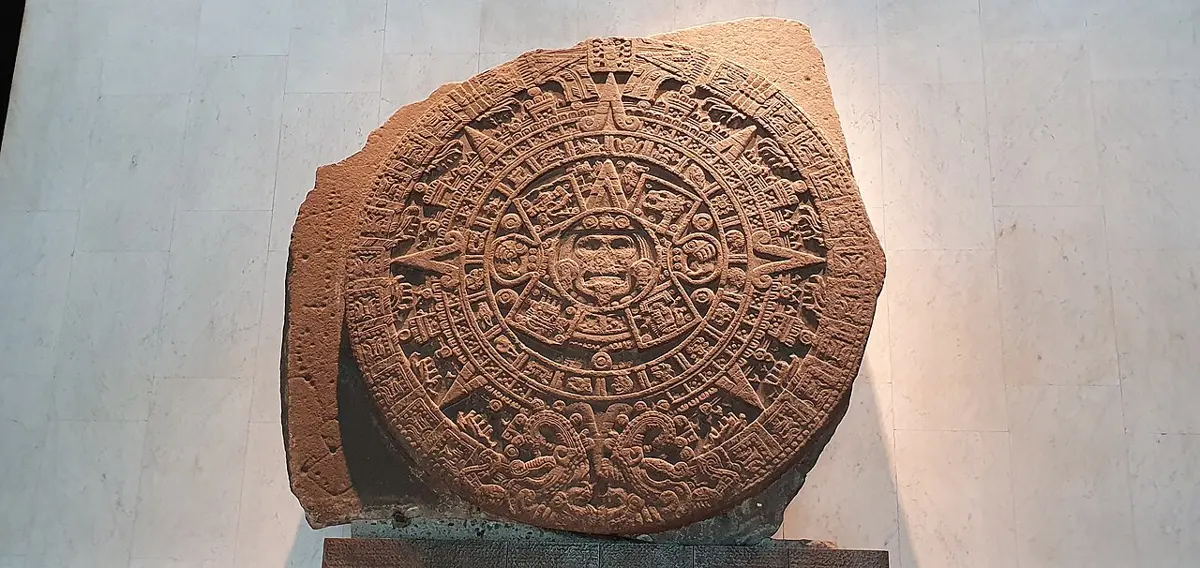
- a.What is the name of the invention shown in the picture?
- b.Who was it developed by?
Model answers
What kind of text it is
The Maya Empire is a history text: it gives facts about a people of the past, mostly in the past simple (The Maya excelled at…, Most of the great cities were abandoned…). It is in eight short paragraphs, numbered I to VIII, each about one topic. That is why task D asks you to match each paragraph to its topic: in a well-written text, every paragraph has one main idea, usually given in its first sentence.
The text, part by part
I. The Maya at their height
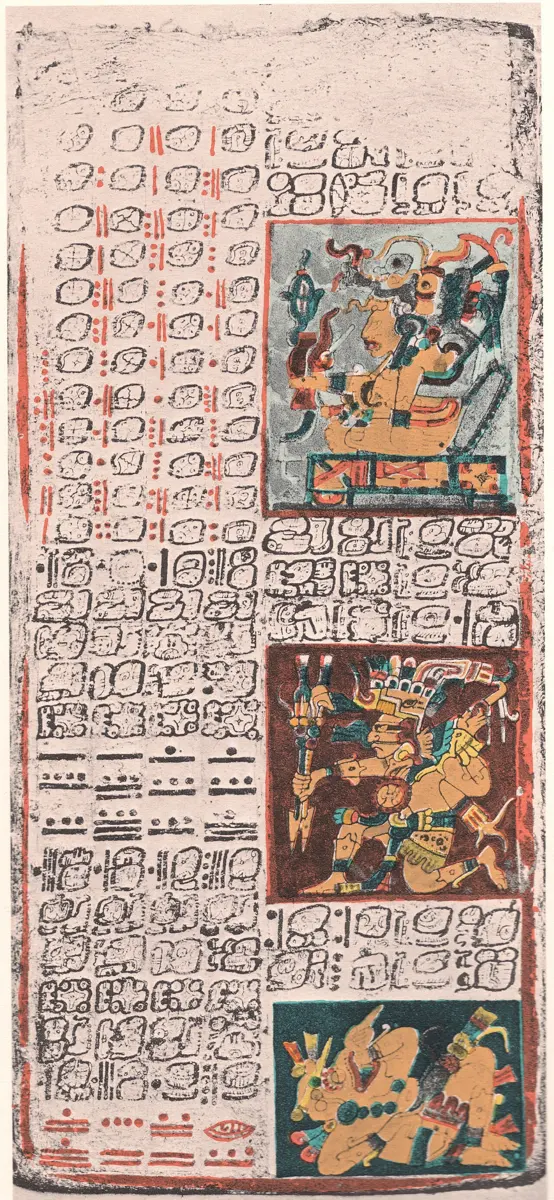
The Maya lived in the tropical lowlands (hot, low, forest land) of what is now Guatemala, in Central America. Their power and influence reached their peak around the sixth century AD. They excelled at (were very good at) farming, pottery, hieroglyph writing (writing in picture signs), making calendars and mathematics, and they left an astonishing number of buildings and works of art. Yet most of their great stone cities were abandoned (left empty) by 900 AD.
II. Where they lived
The Maya were one of the most dominant (powerful and important) indigenous (native) peoples of Mesoamerica, the region of today’s Mexico and Central America. Other peoples there were scattered; the Maya lived together in one block of land: the whole Yucatán Peninsula, Guatemala, Belize, parts of the Mexican states of Tabasco and Chiapas, and the west of Honduras and El Salvador. Living close together, in one area, kept them relatively safe from invasion by other Mesoamerican peoples.
III. Three regions
Their land had three sub-areas, each with its own environment and culture:
- the northern lowlands, on the Yucatán Peninsula;
- the southern lowlands, in the Petén district of northern Guatemala and the nearby parts of Mexico, Belize and western Honduras;
- the southern highlands, in the mountains of southern Guatemala.
The Maya of the southern lowlands are the most famous. They reached their peak in the Classic Period (250 to 900 AD) and built the great stone cities and monuments that have fascinated explorers and scholars ever since.
IV. The beginnings
The first Maya villages date from about 1800 BC. The earliest Maya were farmers, growing corn (maize), beans, squash (a kind of pumpkin) and cassava. From about 300 BC they spread through the highlands and the lowlands. In the same early period rose the first great civilization of Mesoamerica, the Olmecs, and the Maya took from them many religious and cultural ideas, including their number system and their famous calendar. Already in this Pre-classic time the Maya were building pyramids and cities and carving words into stone monuments.
V. The golden age
The Classic Period, from about 250 AD, was the Maya’s golden age. There were about 40 cities, each with 5,000 to 50,000 people; at its peak the whole population may have reached 2 million. Excavations (digging carefully to find old buried things) have uncovered plazas (open squares), palaces, temples, pyramids and courts for a ball game, which mattered in Maya religion and politics. Around every city lived a large population of farmers who fed it.
VI. Religion, kings and learning
The Maya were deeply religious. They worshipped many gods of nature: of the Sun, the Moon, rain and corn. At the top of society were kings, who claimed to be related to the gods, and the throne passed from father to son (hereditary succession). The kings were thought to be mediators (go-betweens) between the gods and the people, and they led the elaborate (detailed and complicated) ceremonies of Maya religion.
The Maya built temples and palaces as stepped pyramids, decorated with carved pictures (reliefs) and writing (inscriptions), which made them famous as the great artists of Mesoamerica. Their religion also drove their science: they made great advances in mathematics and astronomy, used the zero, and kept a calendar of 365 days.
Early researchers thought the Maya were a peaceful people of priests and writers. But a thorough (careful and complete) study of their carvings showed a less peaceful side: the city-states fought each other, and torture and human sacrifice were part of their religion.
VII. The mystery of the fall
From the late eighth to the end of the ninth century, something unknown shook Maya civilization to its foundations. One by one, the Classic cities of the southern lowlands were abandoned, and by 900 AD civilization there had collapsed. Nobody knows exactly why, but scholars have several competing theories. The first: by the ninth century the Maya had exhausted (used up) their environment so badly that it could no longer feed so many people.
VIII. More theories
The second theory: constant war between the city-states broke down the alliances (friendly agreements) of war, family and trade that held them together, and the old system of royal families with them. As the holy lords lost their stature (importance), their complex rituals fell into chaos. The third: a terrible change in the environment, such as a very long, severe drought. Cities like Tikal, which needed rainwater both for drinking and for watering crops, would have been hit hardest. The text ends by saying that all three may have played a part in the downfall of the southern Maya.
Which paragraph would you read to find out what the Maya grew?
Pick an answer to see why.
According to the text, which is not one of the theories for the Maya collapse?
Pick an answer to see why.
Words from the text
Words linked here open in English Vocabulary, where you can see an example and practice them in the word game. The meanings below are the ones the words have in this text.
| Word | Meaning here |
|---|---|
| excel | to be very good at doing something |
| hieroglyph | a picture or sign that stands for a word, a syllable or a sound |
| abandon | to leave a place for good |
| dominant | more powerful or important than the others |
| indigenous | belonging to a place from the earliest times; native |
| concentration | a lot of something in one place |
| invasion | an army or a large group entering a place by force |
| excavation | digging the ground to find old buried buildings or objects |
| hereditary | passed from parent to child |
| succession | people or things that follow one another in order; the passing of a title (such as king) to the next person |
| elaborate | very detailed and complicated |
| thorough | careful and complete, missing nothing |
| sacrifice | killing an animal or a person as a gift to a god |
| exhaust | to use something up completely |
| alliance | an agreement between groups to work together for their good |
| stature | the importance and respect a person has |
| chaos | complete disorder and confusion |
| catastrophic | causing terrible damage |
| drought | a long time with little or no rain |
| downfall | the loss of power, wealth or importance; a fall from a high position |
A. Match the words
Match the following words with their meanings.
- a.drought
- b.excel
- c.hieroglyph
- d.dominant
- e.concentration
- f.invasion
- g.excavation
- i.an instance of a large number of people or things arriving somewhere
- ii.a picture representing a word, syllable or sound
- iii.to be very good at doing something
- iv.digging ground to look for old buried buildings or objects
- v.a long period of time when there is little or no rain
- vi.a lot of something in one place
- vii.more important, powerful or easy to notice than other things
Answer
B. Crossword
Find the words in the text and fill in the crossword puzzle.
Across: 2. people who follow each other in time or order 4. a loss of power, prosperity or status 5. complete with regard to every detail 6. a union or association formed for mutual benefit
Down: 1. complete disorder and confusion 3. very complicated and detailed 7. to use all of something so that there is none left
Answer
C. Choose the correct answer
When did the Maya civilization reach its height?
Pick an answer to see why.
Why were the Maya unlikely to be invaded by other Mesoamerican peoples?
Pick an answer to see why.
What has fascinated researchers about the Maya of the southern lowlands?
Pick an answer to see why.
Which period of the Maya civilization is considered the golden age?
Pick an answer to see why.
Whom did the Maya consider their gods?
Pick an answer to see why.
According to scholars, which of the following is NOT a cause of the Maya downfall?
Pick an answer to see why.
D. Match the paragraphs
Match the paragraph numbers with the information.
a. I b. II c. III d. IV e. V f. VI g. VII h. VIII
- i.occupation of the earliest Maya society
- ii.number of people in the Maya civilization
- iii.achievements of the Maya civilization in different sectors
- iv.places where the Maya lived
- v.categories of the places where the Maya lived
- vi.spirituality of the Maya people
- vii.fights with the neighboring states as a possible cause of the downfall
- viii.time when the downfall of the Maya civilization started
Hint
Answer
E. Why study history?
Why is the study of history important to us? Prepare a mind map of your thoughts and discuss with your friends.
A model mind map
Pronunciation: word stress
In every English word of two or more syllables, one syllable is said louder, longer and higher: it is stressed. Dictionaries mark it with a small raised mark ˈ before the stressed syllable. Here, the stressed syllable is in capitals.
| Word | Syllables | Stress on |
|---|---|---|
| succession | suc-CES-sion /səkˈseʃn/ | the 2nd |
| excavation | ex-ca-VA-tion /ˌekskəˈveɪʃn/ | the 3rd |
| inscription | in-SCRIP-tion /ɪnˈskrɪpʃn/ | the 2nd |
| concentration | con-cen-TRA-tion /ˌkɑːnsnˈtreɪʃn/ | the 3rd |
| excel | ex-CEL /ɪkˈsel/ | the 2nd |
| architecture | AR-chi-tec-ture /ˈɑːrkɪtektʃər/ | the 1st |
| cultural | CUL-tur-al /ˈkʌltʃərəl/ | the 1st |
| exhausted | ex-HAUST-ed /ɪɡˈzɔːstɪd/ | the 2nd |
Two patterns help with thousands of words:
- Words ending in -tion or -sion are stressed on the syllable just before it: suc-CES-sion, in-SCRIP-tion, ex-ca-VA-tion, con-cen-TRA-tion (and ed-u-CA-tion, in-for-MA-tion).
- Endings like -al, -ed and -ing don’t move the stress: CUL-ture → CUL-tur-al; ex-HAUST → ex-HAUST-ed.
Speaking: then and now
A. A village, ten years later
The two photos show the same place ten years apart. In the first, a few small white houses stand among hills and green fields, with railway tracks curving through the middle. In the second, the fields are gone: the valley is full of new buildings with grey-tiled roofs, a large red building and a pond, with forested hills behind.
To compare a past state or habit with now, use used to (or didn’t use to) for the past and the present simple for now:
- There used to be fields here, but now there are houses.
- There didn’t use to be a big building, but now there is one.
The pictures show the changes that have taken place in a village over a period of ten years. Talk about the changes using used to / didn’t use to.
Model sentences
B. Six pictures, one story
The six pictures are mixed up. All take place on a narrow log bridge over a river, wide enough for only one animal:
- Top left: a white goat with orange patches and a plain white goat walk towards each other from the two ends of the log.
- Top right: a brown goat and a white goat butt heads in the middle of the log, front legs in the air.
- Middle left: the white goat lies down on the log, and the goat with orange patches steps over it.
- Middle right: a brown goat and a white goat start across the log from opposite ends.
- Bottom left: the log is empty; two goats struggle in the water below.
- Bottom right: the two goats walk away from each other at the two ends of the log: the patched goat has crossed to the right, the white one to the left.
The given pictures tell a story, but they are not in the correct order. Rearrange them into the correct order by writing the numbers 1–6, and narrate the story.
Hint
Answer
A model story: The Goats on the Bridge
Grammar I: used to
Used to + the base verb talks about a habit or a state in the past that is no longer true:
- I used to play the piano. (I played it regularly then; I don’t now.)
- There used to be a forest around the village. (It was there then; it isn’t now.)
| Form | Example | |
|---|---|---|
| Positive | subject + used to + base verb | She used to travel a lot. |
| Negative | subject + didn’t use to + base verb | She didn’t use to drink tea. |
| Negative (stronger) | subject + never used to + base verb | She never used to read newspapers. |
| Question | Did + subject + use to + base verb? | Did you use to swim in the river? |
| Wh-question | Wh-word + did + subject + use to + base verb? | What did you use to do after school? |
So used to has the -d in a positive sentence; after did or didn’t it is use to, without the d, because did already shows the past (just as did you go?, not ✗ did you went?).
Used to has no present form: for a habit now, use the present simple (I usually walk to school), never ✗ I use to walk to school.
……… people in your village grow rice before the canal was built?
Pick an answer to see why.
Choose the correct sentence.
Pick an answer to see why.
A. Samita, then and now
Here is what Samita said five years ago and what she says today:
Five years ago: “I travel a lot.” “I play the piano.” “I’m very lazy.” “I don’t like cheese.” “I’ve got a dog.” “I’m a hotel receptionist.” “I’ve got lots of friends.” “I never read newspapers.” “I don’t drink tea.” “I go to a lot of parties.”
Today: “I eat a lot of cheese.” “I work very hard these days.” “I work in a bookshop now.” “I don’t know many people these days.” “I don’t go away much these days.” “My dog died two years ago.” “I read a newspaper every day.” “I haven’t been to a party for ages.” “I haven’t played the piano for years.” “Tea’s great! I like it now.”
Compare what Samita said in the past and what she says now. Make sentences using used to / didn’t use to / never used to, as in the example.
Example: She used to travel a lot, but she doesn’t go away much these days.
Hint
Answer
B. Rewrite with used to
Rewrite the following sentences using used to or didn’t use to.
- a.I lived with my parents.
- b.Did you swim in the river every summer?
- c.He never smoked.
- d.I played tennis at school.
- e.Villagers walked for hours to reach the nearest health post.
- f.There was a dense forest around the village.
- g.What did you do in your childhood?
- h.I didn’t write stories.
- i.Did people travel by airplane?
- j.Where did you go to deposit your money?
Answer
Writing I: stories
A. The Fox and the Stork
A fable is a short story, usually with animals that talk, that teaches a lesson, its moral. This one is told in Aesop’s fables, from ancient Greece.
The story, in short. A fox who always laughed at a stork’s looks invites him to dinner, planning a trick. He serves soup in a shallow (not deep) dish: the stork can only wet the tip of his long bill, while the fox laps it all up and makes a show of enjoying it. The stork is hurt but stays calm. Not long after, he invites the fox to dinner and serves a fish dinner that smells delicious, in a tall jar with a narrow neck. The stork eats easily with his long bill; the fox can only lick the outside of the jar. When the fox loses his temper, the stork calmly tells him not to play tricks on his neighbors unless he can stand the same treatment himself.
Like every good story, it has these parts:
| Part | In The Fox and the Stork |
|---|---|
| Title | names the story (to be given in task A) |
| Characters | the fox, the stork |
| Setting | a forest; two dinners |
| Beginning | the fox plans a trick and invites the stork |
| Problem | the soup in a shallow dish: the stork goes hungry |
| Turning point | the stork invites the fox back |
| Ending | the fish in a narrow jar: the fox goes hungry |
| Moral | do not play tricks on others unless you can bear the same yourself |
Read the story carefully. Then give it a suitable title.
Model titles
B. Stories from outlines
An outline gives only the bones of a story. To write it, keep every point in order, add names, a place and a time, join the points with time words (one day, then, after that, at last), add what people said and felt, and finish with the moral.
Develop readable stories based on the given outlines.
- a.A king … enemies defeat him six times … hides in a cave … sees a spider … climbing the wall … fails six times … succeeds on the 7th attempt … the king learns a lesson … collects courage and attacks the enemies … succeeds … moral
- b.Two friends meet a bear … one climbs a tree … the other lies down as if dead … the bear smells his limbs … goes away … the first man comes down and asks … what the bear said … “beware of friends who run away in danger” … moral
A model story (a): The King and the Spider
A model story (b): The Two Friends and the Bear
Reading II: The History of Money
Before you read
The three pictures are a Nepali one-thousand-rupee note with elephants on it, a gold-colored Nepali coin with a farmer ploughing, and a United States hundred-dollar note with the face of Benjamin Franklin.
- a.What are these currencies?
- b.What would happen if we didn’t have money?
Model answers
What kind of text it is
The History of Money is an informative article that follows one thing, money, through time, from the oldest form to the newest. So it is full of dates, given as BCE (Before the Common Era, the same years as BC) and CE (the Common Era, the same as AD), and of time words: before, subsequently, eventually, by the 1970s.
The article, part by part
Money is a means of exchange
The use of money is as old as civilization. Money is a means of exchange: something everyone accepts in return for goods, so coins and notes are only items of exchange. Its form has changed many times, and it is still changing.
Barter, cattle and grain
Before money, commerce (buying and selling) was barter: direct exchange of one product for another. Subsequently (later), livestock, especially cattle, and plant products such as grain came to be used as money in many societies. Cattle are probably the oldest money of all, because people domesticated animals before they cultivated crops (the article’s reason; in fact, farming and herding began at roughly the same time). The earliest evidence of banking is in Mesopotamia (today’s Iraq), between 3000 and 2000 BCE, where temples stored grain and other valuables used in trade.
Money from nature
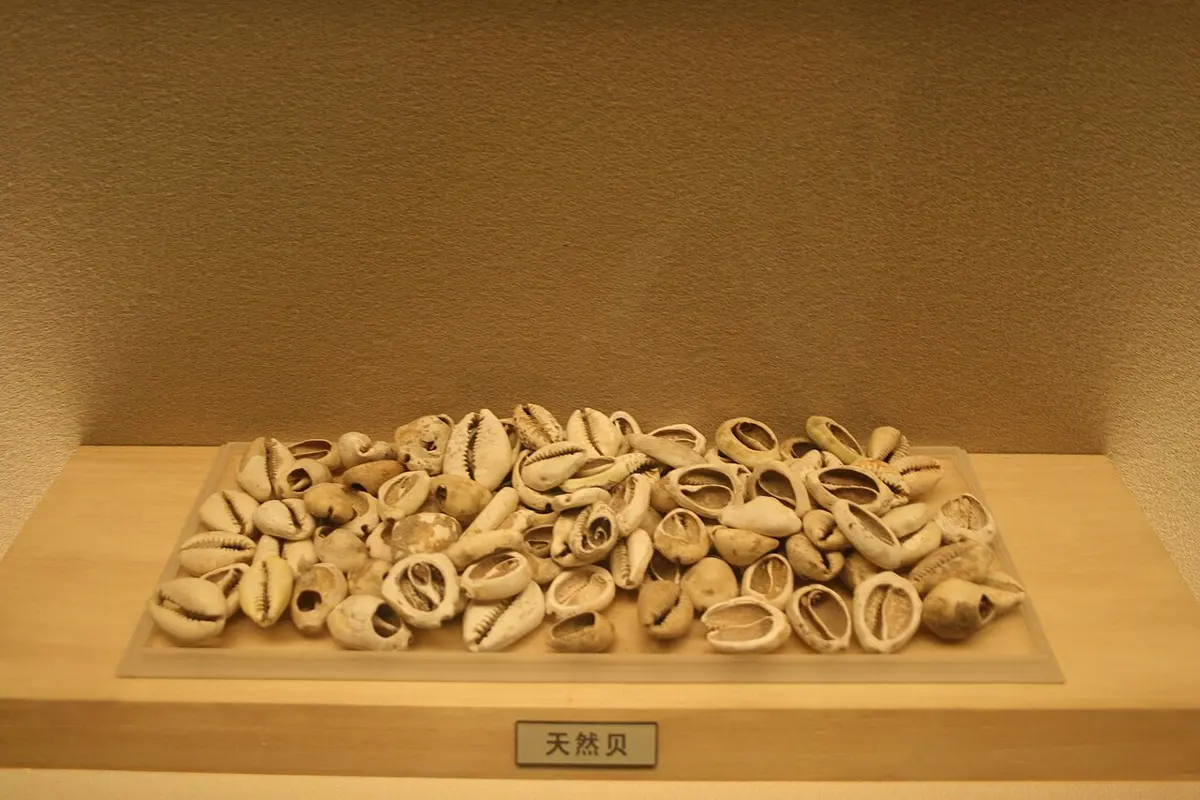
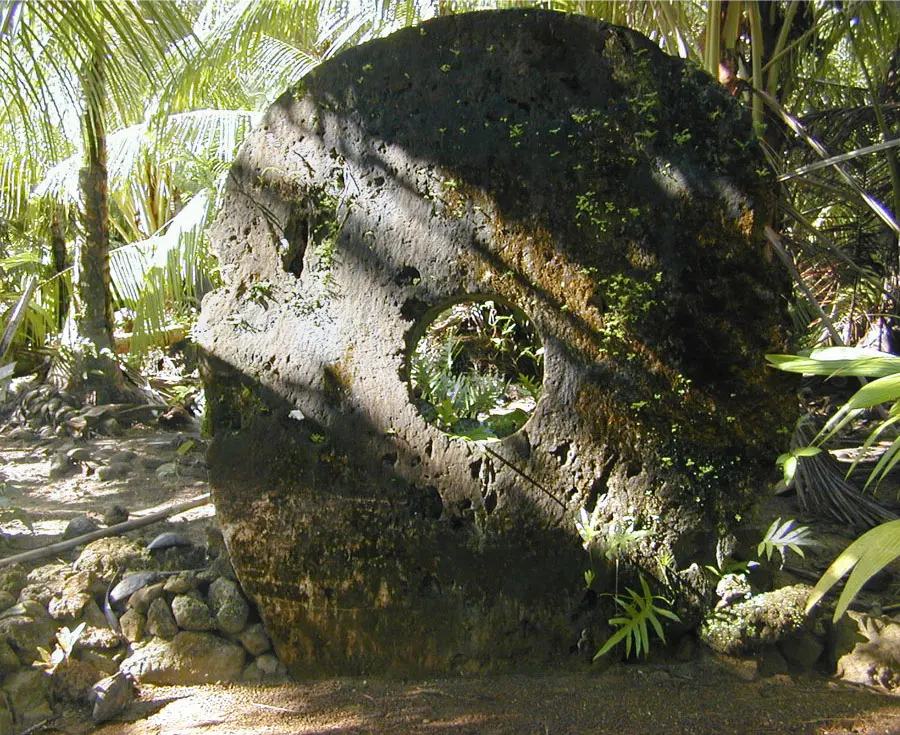
Some of the first currencies came from nature. Cowrie shells were first used as money about 1200 BCE. They may seem a strange choice, but they had real advantages: they were similar in size, small and durable (they last a long time). The mollusks (soft-bodied sea animals) that make them live in the warm coastal waters of the Indian and Pacific Oceans, yet trade carried them so far that even some European countries accepted them. Other money from nature: wampum (strings of shell beads) among Native Americans, whale teeth in Fiji, and huge limestone disks on Yap Island in the Pacific, which are still part of the island’s culture.
The first coins
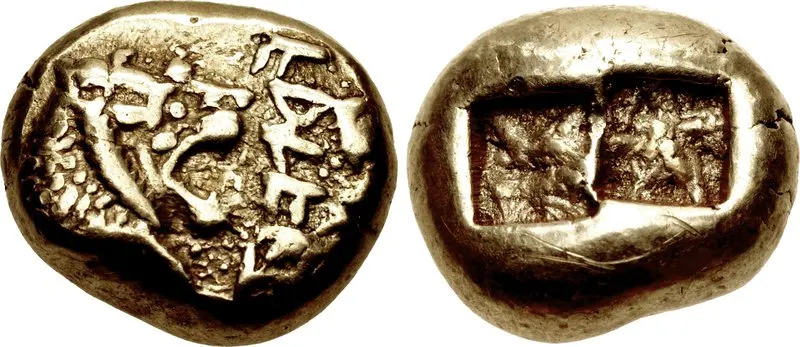
Metal was used as money in Babylon before 2000 BCE, but standardized coins (all of a fixed weight, certified, that is, guaranteed by a ruler) probably came only in the 7th century BCE. Many historians say the first regulated coins were made in the kingdom of Lydia, in present-day Turkey, under King Alyattes (610–560 BCE). They were of electrum, a natural mix of gold and silver, roughly shaped like beans, and stamped with the royal symbol, a lion. His son, Croesus, reformed the money, making separate coins of pure gold and pure silver. Soon coins appeared elsewhere.
Leather money
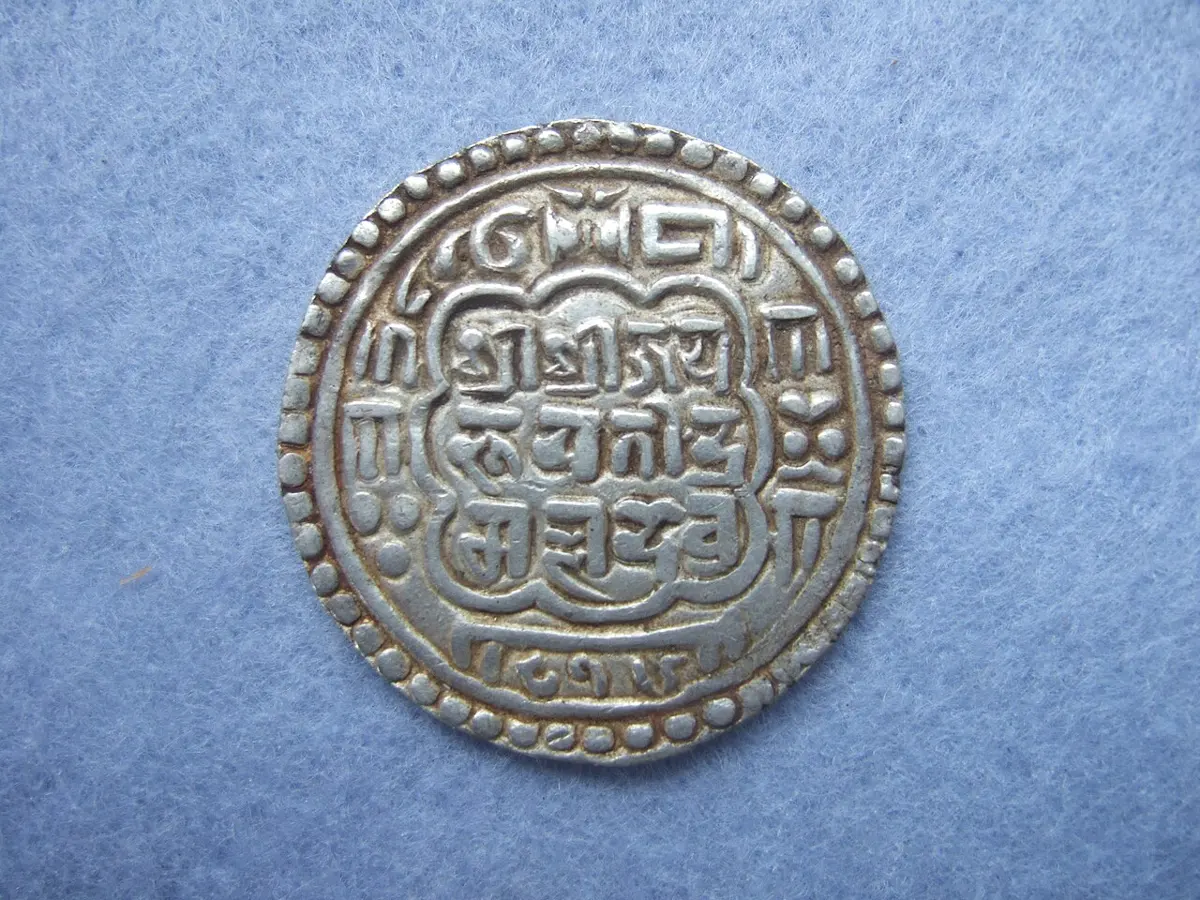
From about the 6th century BCE, leather and animal hide were made into money. Early Rome is said to have used it, and it was also found in Carthage, in what is now France, and in Russia, which is believed to have used leather money until the reign of Peter the Great (1682–1725 CE). The Chinese emperor Wudi (141–87 BCE) made money from the skins of the white stags (male deer) in his own park, fringed (with a border of hanging threads) and decorated with elaborate designs. Leather money is no longer used, but it may have left a lasting legacy: the idea of money that is worth something only because a ruler says so, like our paper notes.
Paper money
Paper was invented in China, so it is fitting that China also introduced paper money, probably during the reign of Emperor Zhenzong (997–1022 CE). It was made from the bark of mulberry trees: “so, in a sense, money really did grow on trees!”, the article jokes. By the late 18th and early 19th centuries paper money had spread round the world. But most of it was not money in the old sense: it was a set of promissory notes, written promises to pay a fixed amount of gold or silver, and these were key to the growth of banks.
Fiat money and the gold standard
Money brings problems. One is fiat money: currency issued on the order of a sovereign government (fiat is Latin for “let it be done”), which, unlike a gold or silver coin, has no intrinsic value (nothing valuable in itself: a note is only paper). A country can print as much as it likes, and some did, until their money was almost worthless. So in 1821 the United Kingdom, then the leader of world finance, adopted the gold standard: each unit of money was kept equal to a fixed amount of gold, so a government couldn’t print too much, and countries trusted each other’s money in trade. Germany, France and the United States followed. But the system had drawbacks: it tied every country to the others, so a depression (a long period when business is very bad) or inflation (prices rising) abroad spread at home. After the Great Depression (1929–1939 CE), countries rethought it, and by the 1970s no country’s money was tied to gold any longer.
Money today
The 21st century has brought new forms: digital payment and virtual currency such as bitcoin. The article ends with a question: will paper notes and coins soon disappear?
Why were cowrie shells good money?
Pick an answer to see why.
What does a currency with no intrinsic value mean?
Pick an answer to see why.
Words from the text
| Word | Meaning here |
|---|---|
| barter | trading by exchanging goods, not money |
| subsequently | later; afterwards |
| precede | to happen before something |
| domestication | taming animals (or plants) to live with and serve people |
| durable | lasting a long time without breaking |
| mollusk | a soft-bodied animal, usually with a shell, such as a snail or a clam |
| regulate | to control something by means of rules |
| reign | the time during which a king, queen or emperor rules |
| crudely | simply, without much skill or detail |
| fringe | to form a border around something |
| legacy | something handed down from the past |
| promissory note | a written promise to pay a sum of money |
| fiat | an official order from someone in authority |
| sovereign | free to govern itself; completely independent |
| intrinsic | belonging to a thing itself; essential |
| inflation | a general rise in prices, so money buys less |
| depression | a long time when business is very bad and many people have no work |
A. Find the words
Find the words from the text that have the following meanings.
- a.r……… the period during which a king, queen, emperor, etc. rules
- b.p……… to happen before something
- c.r……… to control something by means of rules
- d.c……… simply and without much skill or attention to detail
- e.f……… to form a border around something
- f.l……… something handed down from people or events of the past
- g.f……… an official order given by somebody in authority
- h.s……… free to govern itself; completely independent
- i.i……… belonging naturally; essential
Answer
B. The timeline of money
Complete the table below with the correct information about the development of money.
| Timeline | Events |
|---|---|
| 1200 BCE | cowrie shells used as money |
| 2000 BCE | |
| 6th century BCE | |
| 997–1022 CE | |
| 1821 CE | |
| 21st century |
Answer
C. Answer the questions
What did people use to make a trade before the invention of money?
Answer
How were temples used as banks in the past?
Answer
What was the benefit of using cowrie shells as money?
Answer
Describe the first coins made in Lydia, in present-day Turkey.
Answer
Why did the leader in international finance introduce the gold standard in currency?
Answer
What form of money is being used in the 21st century?
Answer
D. Money in twenty years
How might people trade in the next 20 years? What form of money might be used? Talk to your friends.
A model answer
Listening: I Remember, I Remember
A. Before you listen
Answer the following questions.
- a.Write any three most memorable things about your early childhood days.
- b.Do you wish you could be a young child again? Why?
Model answers
The recording
You will hear a famous poem, I Remember, I Remember, by the English poet Thomas Hood (1799–1845). A man remembers the house where he was born and the garden around it: the window where the morning sun came in, the flowers, a tree his brother planted, a swing, and tall fir trees. Then, in the last lines of each stanza, he compares that happy boy with the sad man he is now. Read the questions in B and C first, then listen, as many times as you need.
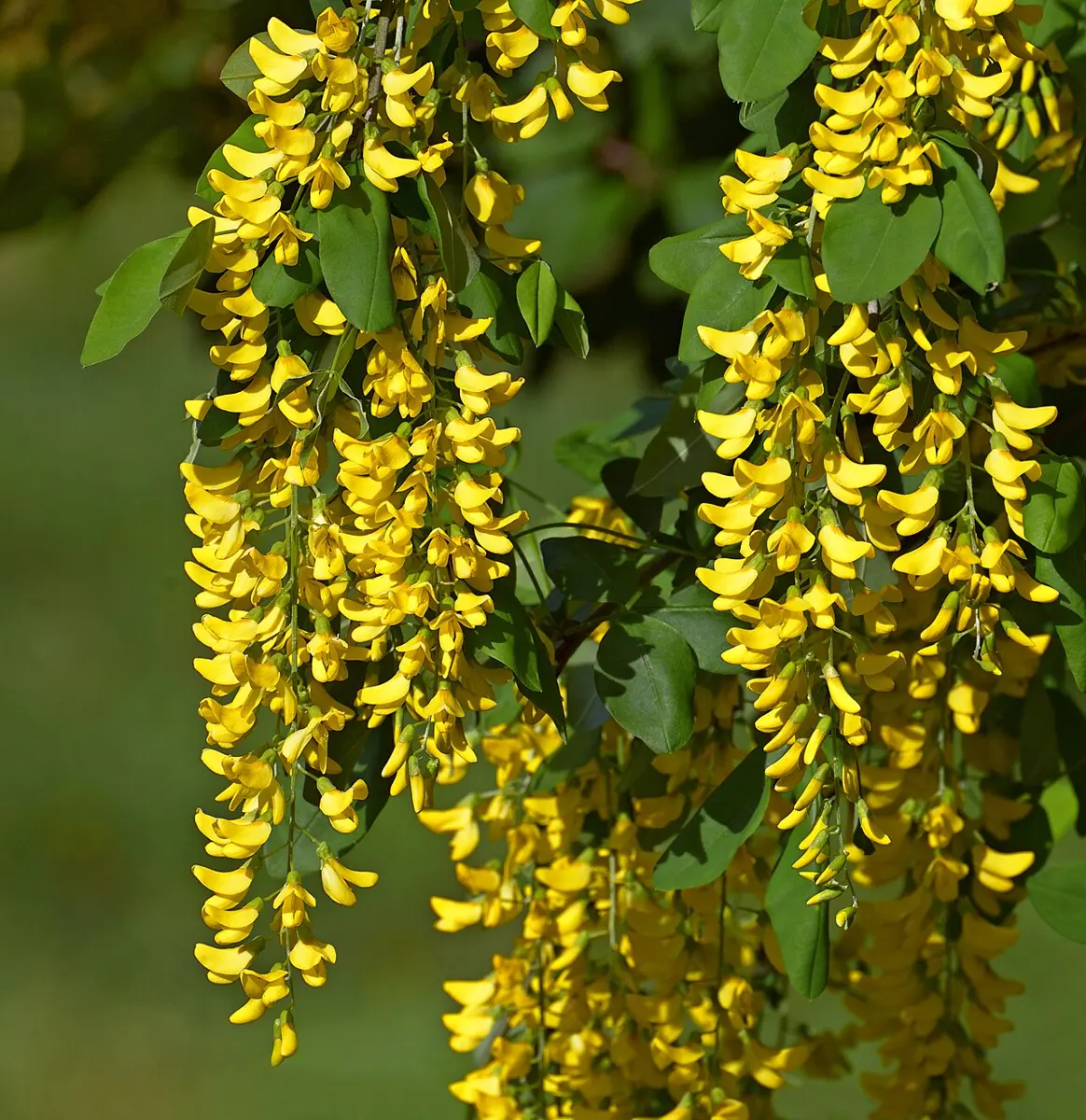
Words you will hear: morn (morning, in poems); a wink (a very short moment); borne … away (carried away; to bear); lily-cups (lily flowers, shaped like cups); lilac (a bush with sweet-smelling purple or white flowers); robin (a small brown bird with a red breast); laburnum (a small tree with hanging yellow flowers); swallow (a small, fast bird with a forked tail); fir (a tall, cone-shaped evergreen tree); brow (forehead); ’tis (it is); heav’n (heaven).
B. Complete the sentences
Listen to the audio and complete the sentences with the correct words/phrases.
- a.The speaker remembers the house where he ………
- b.The Sun used to come ……… at the window in the morning.
- c.It used to wake him neither too ……… nor late.
- d.The roses were ……… in color.
- e.The laburnum tree was set by his brother on ………
- f.Now, he thinks that he is ……… from heaven than he was as a boy.
Answer
C. Choose the correct answers
Listen to the audio again and choose the correct answers.
- a.Where did the robin build its nest? i. the lilacs ii. the laburnum tree iii. the treetops
- b.Which tree is still living? i. fir ii. lilac iii. laburnum
- c.How did the speaker feel while swinging? i. like the robin ii. like the sparrow iii. like the swallow
- d.Which of the flowers is NOT mentioned by the speaker? i. rose ii. tulip iii. lily
- e.What is his spirit like now? i. cool ii. heavy iii. light
- f.What did the speaker think about the fir treetops? i. They flew like swallows. ii. They almost touched the sky. iii. They used to swing.
- g.How does he feel when remembering his boyhood? i. He is filled with little joy. ii. He is filled with sadness. iii. He is filled with absolute happiness.
Answer
D. Your favorite memory
Recall your favorite memory from your early childhood and describe it to your friends.
A model answer
The poem, stanza by stanza
Here is what each of its four stanzas says.
Stanza 1. The poet remembers the little window where the morning sun looked in, never too early and never making the day too long: as a child, every day was just right. But now, he often wishes he had died in the night (the night had borne my breath away). The sudden turn from a happy picture to a wish to die shows how unhappy his grown-up life is.
Stanza 2. He remembers the garden’s flowers, so bright that they seemed made of light, the lilacs where a robin built its nest, and the laburnum his brother planted on his birthday. That tree is still alive: the things of his childhood go on, though the child he was is gone.
Stanza 3. He remembers his swing: flying through the air, he felt as free as a swallow, and his spirit was as light as feathers. Now it is heavy, and he has a fever (from worry, or real illness: Hood was often sick) that even summer pools could hardly cool.
Stanza 4. As a child, he thought the tops of the tall fir trees touched the sky. Now he knows that was childish ignorance (a child’s not knowing). But knowing more brings him little joy: he feels farther from heaven now than when he was a boy, both further from the sky and further from the innocence and happiness of childhood.
Grammar II: past simple, past continuous and past perfect
To tell what happened in the past, English has three main tenses. Each tells the reader when an action happened compared with the others.
| Tense | Form | Use | Example |
|---|---|---|---|
| Past simple | verb in the past (V2): phoned, began | a finished action; actions one after another | Karen phoned me three times. |
| Past continuous | was/were + -ing | an action in progress at a past moment; often interrupted | While I was studying, Karen phoned me. |
| Past perfect | had + past participle (V3) | an action finished before another past action or time | When we got to the party, most people had already left. |
Put them on one line of time:
- The past continuous is the long background: They were playing football…
- The past simple is the event that happens in it: …when the storm started.
- The past perfect is something already over before that: I had finished the shopping when I met Manoj. (First the shopping, then the meeting.)
Words that go with each:
- while usually goes with the longer action, in the past continuous: While she was working in India, she began to learn Hindi.
- when usually goes with the short action, in the past simple: I was doing my homework when the telephone rang.
- already, just, ever, never, by the time and before often go with the past perfect: It was the best movie I’d ever seen. (I’d here is I had.)
- since with the past perfect counts from an even earlier time: She had known him since they were children.
When Sapana reached the bus park, the last bus to Dhulikhel ………, so she took a taxi.
Pick an answer to see why.
I ……… a shower when the earthquake shook the house.
Pick an answer to see why.
A. Study the sentences
Study the following sentences and notice the past simple, past continuous and past perfect.
- a.While I was studying, Karen phoned me three times.
- b.They were playing football when the storm started.
- c.While she was working in India, she began to learn Hindi.
- d.I had finished the shopping when I met Manoj.
- e.When we got to the party, most people had already left.
- f.It was the best movie I’d ever seen.
- g.He had already read the book, so I gave it to his sister.
- h.She had known him since they were children.
- i.In 2005, I was living in Biratnagar.
- j.She called me yesterday.
Answer
B. Complete the sentences
Use the past simple, past continuous or past perfect forms of the verbs in brackets to complete the following sentences.
- a.Mr. Singh ……… (wait) for me when I reached the station.
- b.A: What ……… (do) this time yesterday? B: I was reading a novel.
- c.A: ……… (go) out last night? B: No, I was too busy to go out.
- d.A: Was Sapana at the party? B: Yes, she ……… (dance) with Ravi.
- e.A: What ……… (do) when the earthquake occurred? B: I was cooking a meal.
- f.He ……… (fall) off the wall when Sanam pushed him.
- g.I ……… (be) really in a difficult situation when I lost the job.
- h.When I was young, I ……… (want) to become a doctor.
- i.I ……… (do) my homework when the telephone rang.
- j.When I last saw Kiran, he ……… (work) in his garden.
Answer
C. Correct the story
Find the mistakes in the story below and correct the verb forms throughout.
This happens to me when I was in India. I used to go to my office by train. One particular evening, I hurry to my station but when I reached there, the train has already gone. I bought a newspaper and a packet of biscuits and sit on the bench. While I am reading, a man came and sits down opposite me. There was nothing special about him, except that he is very tall. I was still reading when my eyes catch a very strange sight. The man reached over the table, open my packet of biscuits, took one, dip it into his coffee and popped it into his mouth. I couldn’t believe my eyes. But I didn’t want to make a fuss, so I ignored it. I just take a biscuit myself and went back to the newspaper. While I was pretended to be very interested in the news, the man took a second biscuit. After a couple of minutes I casually put a biscuit in my mouth and decide to leave. I was ready to go when the man stood up and hurriedly leave. I folded my newspaper and stand up. And there on the table, where my newspaper had been, was my packet of biscuits.
Hint
Answer
Writing II: The Importance of History
An essay gives your ideas on one topic in organized paragraphs:
- an introduction: what the topic is, and your main idea (history is worth learning, because…);
- body paragraphs, one reason each, with an example;
- a conclusion: your main idea again in new words, and a final thought.
Use linking words (firstly, moreover, for example, however, in conclusion), the present simple for general truths (history teaches…) and the past for examples (the Maya cut down…).
Do students need to learn history? Why? Write an essay on “The Importance of History”.
Hint
A model essay
Project work: your ancestors
The semicolon
A semicolon (;) is stronger than a comma and weaker than a full stop. It has two main jobs.
1. Joining two complete sentences that are closely linked, without and, but or so:
- The participants in the first batch were paid; those in the second were unpaid.
- The southern cities were abandoned; the northern ones went on for centuries.
Each side must be a complete sentence (an independent clause: a subject and a verb that could stand alone). The semicolon shows that the two ideas belong together, often as a contrast.
2. Separating items in a list when the items already have commas inside them:
- The color order was red, yellow, blue; blue, yellow, red; or yellow, red, blue.
- The team visited Bhaktapur, Nepal; Tikal, Guatemala; and Sardis, Turkey.
Here commas alone would make a muddle (Bhaktapur, Nepal, Tikal, Guatemala…: how many places?); the semicolons mark where each item ends.
Which sentence uses the semicolon correctly?
Pick an answer to see why.
Exercise
Practice on this unit in the style of the final exam. Try each one as in the exam, then open the answer.
Read the text and answer the questions.
Lumbini, in Rupandehi district, is the birthplace of Siddhartha Gautama, the Buddha. For centuries the site lay forgotten under the forest. In 1896, a team of archaeologists uncovered a stone pillar there. The Indian emperor Ashoka had set it up more than two thousand years earlier, after he had visited the place, and its inscription records that the Buddha was born there. Today Lumbini is a UNESCO World Heritage Site, and pilgrims and tourists from all over the world visit it every year.
- a.Where is Lumbini?
- b.What did the archaeologists find in 1896?
- c.Who had set up the pillar?
- d.Find a word in the text that means “people who travel to a holy place for religious reasons”.
Answer
Rewrite the sentences using used to or didn’t use to.
- a.Grandmother carried water from the stone spout every morning.
- b.There wasn’t a road to our village.
- c.Did Tilak play football at school?
- d.My brother never ate green vegetables.
Answer
Complete the story with the past simple, past continuous or past perfect of the verbs in brackets.
Last winter Srijana a. ……… (walk) home from school when it b. ……… (start) to snow. By the time she reached her house, the snow c. ……… (cover) the whole path. Her mother d. ……… (make) tea in the kitchen. She e. ……… (never see) so much snow before.
Answer
Put a semicolon in the right place in each sentence.
- a.The museum opens at ten it closes at five.
- b.We visited Janakpur, Dhanusha Gorkha, Gorkha and Ilam, Ilam.
- c.Yasmin wanted to see the excavation however, the site was closed.
Answer
Develop a readable story from the given outline, and give it a title and a moral. (about 150 words)
A thirsty crow … looks everywhere for water … finds a pot … water at the bottom … beak can’t reach … thinks hard … drops pebbles one by one … water rises … drinks … flies away happily … moral
A model story
Practice every question in the book, and keep track of the ones you miss →
A companion to your textbook, not a replacement for it: study from the book your school uses, and where the two differ, follow your teacher. Found a mistake? Please tell us.