
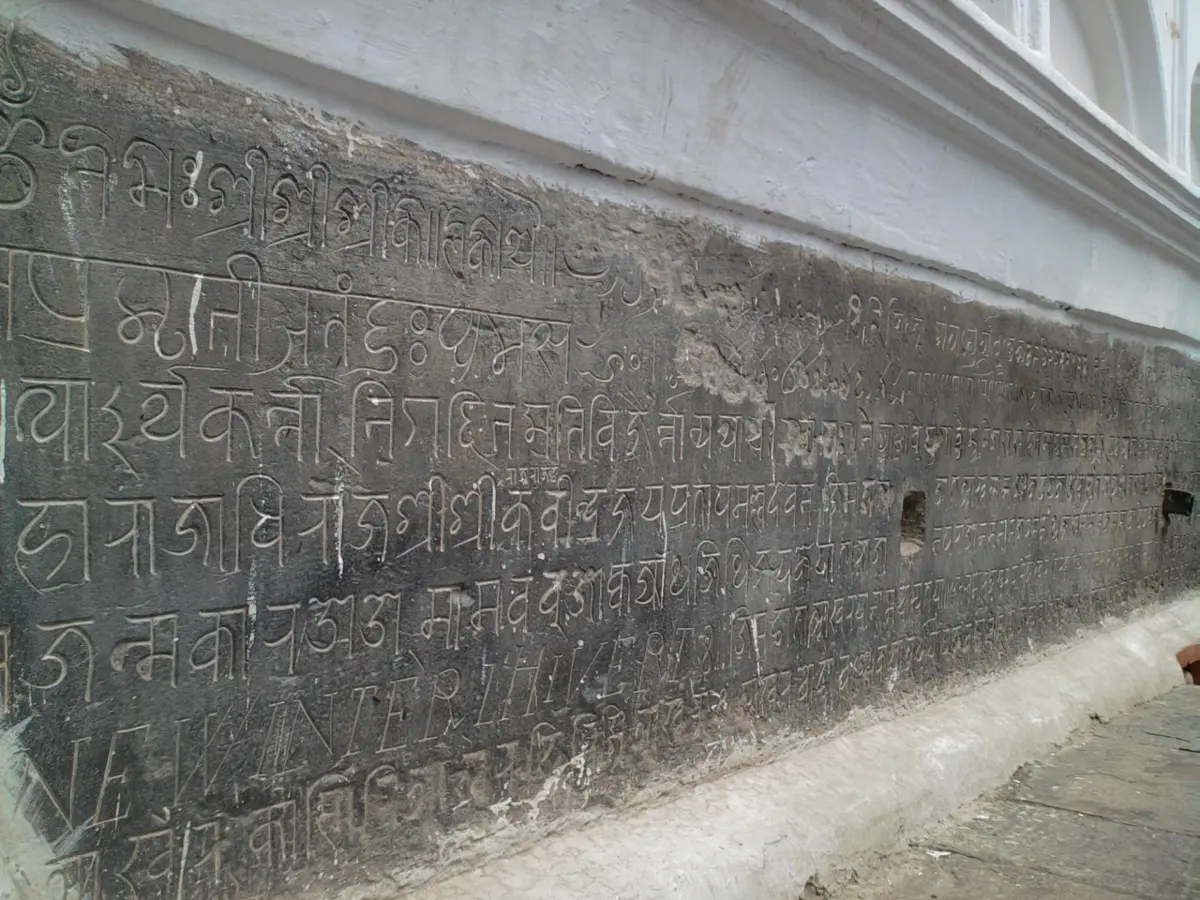
Walk through Kathmandu Durbar Square and you are walking through one king’s plans: the red Hanuman at the gate, the stone inscription in many scripts, the pond his queen wept beside. History is not only in books. It is in the streets you cross, the festivals you keep, and even in the flowers people give each other.
This unit reads about King Pratap Malla of Kantipur, the poet-king who built much of what visitors still come to see, and about what flowers mean in Russian culture. Along the way you will learn to tell a story in the past with the past simple, past continuous and past perfect (When I arrived, Dad was preparing snacks), and you will write about Nepal’s road from Panchayat to multiparty democracy, an opinion on studying history, and two stories.
Getting started
The unit opens with four photos from Nepal. Here is what each shows and why it matters.
| Picture | What it is | Its historical and cultural importance |
|---|---|---|
| A small pagoda temple among bare trees and snow | Muktinath, in Mustang, about 3,700 m up | One of the holiest places for both Hindus and Buddhists: a sign of how the two faiths share sacred places in Nepal. |
| A long brick palace on a green hilltop, snow peaks behind | Gorkha Durbar, the palace of the kings of Gorkha | Prithvi Narayan Shah was born here and set out from here to unify Nepal in the eighteenth century. |
| A group in traditional dress, drums hung from their shoulders, dancing in a procession | a folk dance with drums at a festival | Dances like this pass a community’s songs, steps and stories from old to young; each of Nepal’s many peoples has its own. |
| A girl in red with a golden crown and a painted third eye | the Kumari, the living goddess | Worshipped by Hindus as the goddess Taleju, she is chosen from a Buddhist Shakya family: another meeting of the two faiths. Her chariot festival is part of Indra Jatra. |
Reading I: Pratap Malla
Before you read
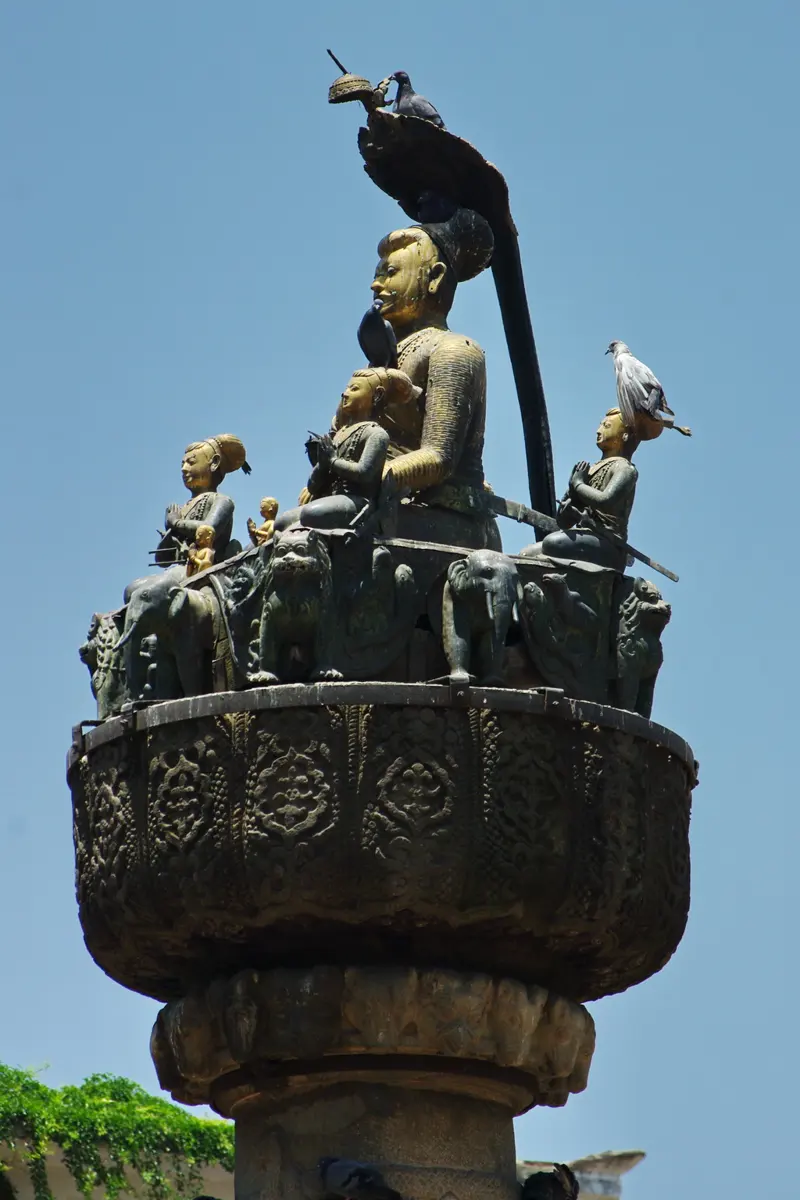
The picture shows a bronze statue of a king kneeling on top of a pillar, hands joined in prayer, a cobra spreading its hood above his head.
What kind of text it is
The text is a short history, taken from a history book (The History of Ancient and Medieval Nepal in a Nutshell, by D. B. Shrestha and C. B. Singh). It is a biography of one king, told in the order a history writer likes: how he came to power, how he ruled, what he built, what kind of man he was, his family, his death, and what his reign meant for the country. It is written in the past simple, the tense of history (he built, he renovated, he had five sons).
The text, part by part
How he came to the throne
Pratap Malla was one of the most famous kings of the Malla dynasty (a family of rulers), and built many fine buildings around Kathmandu. The way he became king was controversial (people disagree about whether it was right): he already had experience of ruling while his father, Lakshmi Narasimha Malla, was alive, and when his father’s mental illness grew worse, he imprisoned him and ruled Kantipur as a regent (someone who rules in place of a king who cannot).
An able ruler
He was a good administrator, and Kantipur grew rich under him. Trade with Lhasa in Tibet went well. He was also clever with his neighbors: by tact (careful, skillful handling of people) he played the kings of Lalitpur and Bhaktapur against each other, siding with one and then the other, so that neither could threaten him.
What he built
Pratap Malla was a religious man, and the list of what he built is long:
- a temple at Guhyeshwari, with a fence around it;
- repairs to Pashupatinath, with a new pinnacle (a pointed top) over it;
- temples at Swayambhu, and a great gilded copper vajra (the thunderbolt symbol) there;
- repairs to the temples of Basuki, Bhimsen, Taleju and Degutale;
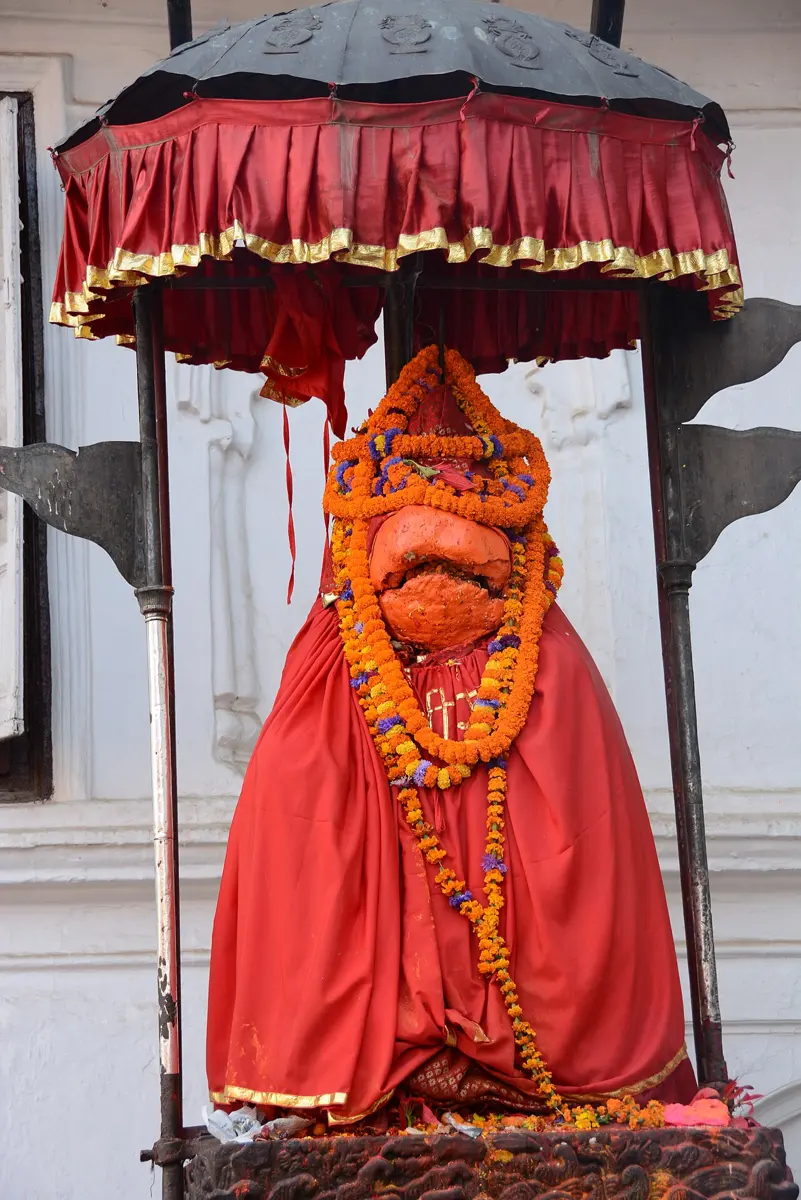
- an image of Hanuman, the monkey god, by his palace gate to ward off (keep away) evil, which gave the palace its name, Hanuman Dhoka (dhoka means gate);
- images of Narasimha, Kal Bhairav and Vishwarup near the palace, and the palace’s Sundari Chowk and Mohan Chowk (courtyards);
- a pond at Bhandarkhal, filled with water brought from Budhanilkantha, with a sleeping Narayan in it, a replica (exact copy) of the one at Budhanilkantha.
The poet-king
He was very learned and a poet: he wrote poems in Sanskrit, Nepal Bhasa, Nepali, Bengali and Hindi, and knew other scripts too. Proud of his poems, he conferred on himself (gave himself) the title Kavindra (also spelled Kabeendra), “king of poets”. Like the Mughal emperor Akbar, he kept a “galaxy” of scholars at court and patronized them (supported them with money and honor): among them Lambakarna Bhatta from Maharashtra, Narasimha Thakur from Bihar and Jamana Gurubhaju of Kantipur. Musicians were welcome too.
His sons and Ranipokhari
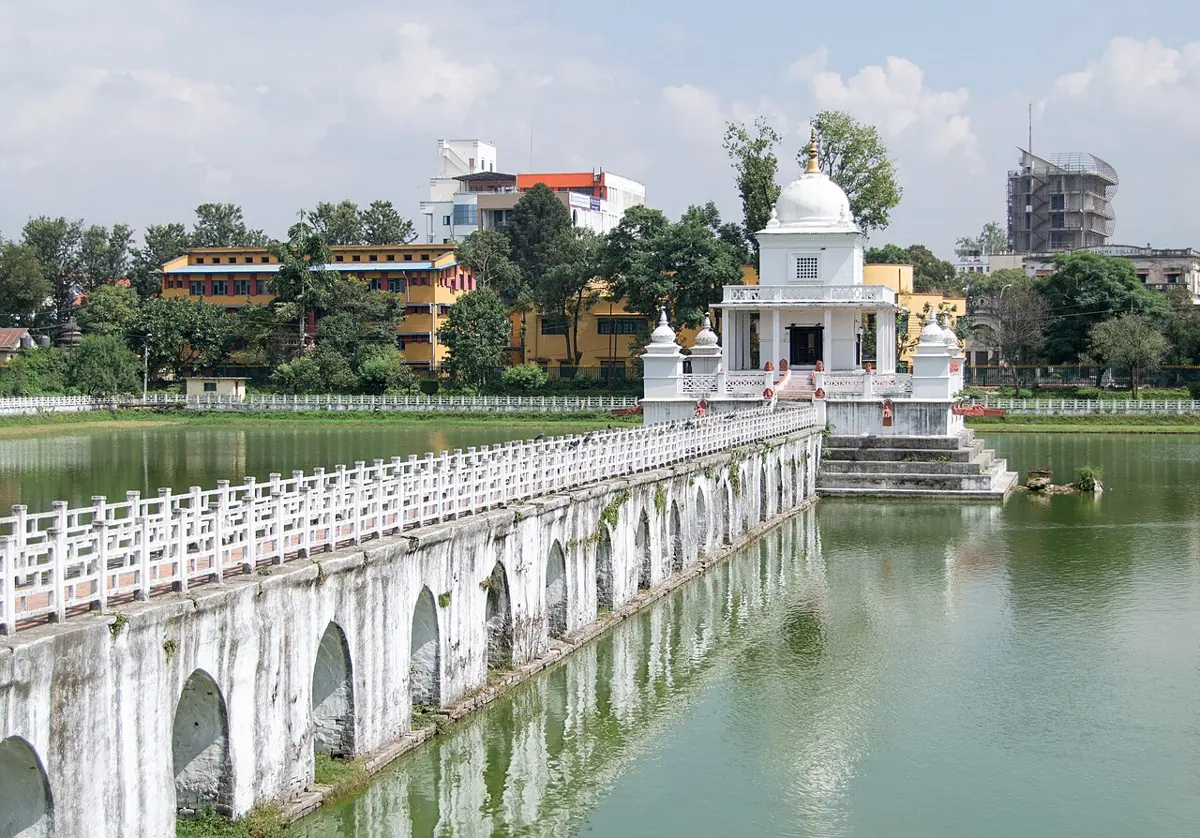
He had five sons, and wanted each to learn to rule while he was alive, so he made them rule for a year each in turn. But his second son, Chakravartendra, died the day after he took over. The king and queen were heartbroken, and to console (comfort) the queen, he built a great pond in front of what is now Tri-Chandra College: Ranipokhari, “the queen’s pond”.
His death and his reign
He died suddenly while watching the religious dance of Harisiddhi. In his 33 years on the throne (1641 to 1674), the text says, the country did well in every field: peace and prosperity at home, no threats from outside, rich trade with India and China, art and literature flourishing (growing strongly), and no neighboring king dared to invade Kantipur.
Words from the text
| Word | Meaning here |
|---|---|
| dynasty | a family whose members rule a country one after another |
| controversial | causing disagreement; some think it right, some wrong |
| regent | a person who rules in place of a king who is too young, ill or away |
| tact | skill in dealing with people without upsetting them |
| renovate | to repair an old building and make it like new |
| pinnacle | a pointed top on a roof or tower |
| ward off | to keep something bad away |
| replica | an exact copy |
| confer | to give a title, degree or honor to someone |
| patronize | to support artists or scholars with money and protection (it also means to talk down to someone, a different sense) |
| hail from | to come from a place |
| console | to comfort someone who is sad |
| prosperity | being rich and successful |
| flourish | to grow and do very well |
| invade | to enter a country with an army to take it |
A. Complete the sentences
Complete the sentences with the correct words from the text.
- a.Queen Rajendra Laxmi ruled the country as a ……… because her son Rana Bahadur Shah was too young.
- b.Many buildings were ……… as they were destroyed by the earthquake.
- c.Many temples had their ……… made of gold.
- d.As the original trophy was stolen, they made an exact ……… of it.
- e.Madhav Prasad Ghimire was ……… the title “Rastrakavi” in 2003.
- f.The government ……… Jhamak Kumari Ghimire for her contribution to Nepali literature.
- g.The British soldiers tried to ……… Nepal, but the brave Nepali people chased them away.
Answer
B. Choose the best answers
Why did Pratap Malla keep his father in jail?
Pick an answer to see why.
What made Kantipur a strong state during Pratap Malla’s reign?
Pick an answer to see why.
Which of these was not renovated by Pratap Malla?
Pick an answer to see why.
According to the text, which of these did not happen during Pratap Malla’s reign?
Pick an answer to see why.
C. Answer the questions
Name two countries that had trade with Kantipur.
Answer
How did Pratap Malla keep his kingdom safe from Lalitpur and Bhaktapur?
Answer
Where did Pratap Malla place the image of Lord Hanuman? Why?
Answer
Pratap Malla gave himself the title “Kavindra”. Do you think this title suits him? Give reasons.
A model answer
Pratap Malla used to invite intellectuals to his palace. What does this show about his personality as a king?
Answer
D. What he left us
Pratap Malla contributed a lot to Nepali culture during his reign. Can you name some of his works that still exist?
Answer
Pronunciation: the possessive ’s
The possessive ’s (Ram’s book) is said in three ways, by the same rule as plural -s:
| The noun ends in… | ’s sounds | Examples |
|---|---|---|
| a hissing sound: /s/, /z/, /ʃ/, /ʒ/, /tʃ/, /dʒ/ | /ɪz/ (an extra syllable) | Ramesh’s, Thomas’s, bus’s, James’s, coach’s, princess’s |
| another voiceless sound: /p/, /t/, /k/, /f/, /θ/ | /s/ | Dick’s, the aircraft’s, a week’s |
| any other voiced sound (a vowel, /n/, /l/, /r/…) | /z/ | Luna’s, Lisa’s, Nepal’s, my brother’s, children’s |
A plural ending in -s takes only an apostrophe, and nothing is added to the sound: the girls’ /ɡɜːlz/, the ladies’ /ˈleɪdiz/, my parents’ /ˈpeərənts/. Old names that end in /iːz/, like Socrates’ and Ulysses’, are also usually written with the apostrophe alone and not given an extra syllable.
Say these phrases aloud, then put them in the right columns: /s/, /z/ or /ɪz/.
Dick’s house, Luna’s pet, Ramesh’s phone, Lisa’s essay, Nepal’s border, my brother’s book, children’s shoes, the aircraft’s black box, a week’s work, Thomas’s job, the bus’s arrival, James’s office, the girls’ excitement, my parents’ wedding, the ladies’ room, Socrates’ philosophy, Ulysses’ friends, coach’s decision, princess’s necklace
Answer
Speaking: telling what happened
A. Your holidays
Aleena tells about her winter holidays: excited and nervous when school closed, she called her mother, had a good journey with beautiful views, was met at the bus station at 4:30 by her father and brother, then watered the garden and visited friends. Notice her past simple verbs (called, went, saw, reached, found, did, enjoyed) and her time words (when, so, once home).
Narrate what you did during your recent holidays.
A model answer
B. What did they do?
Make conversations as in the example. A: What did Tony do last week? B: He went to the dentist last week.
b. grandparents / eat ice cream / yesterday afternoon c. Sima / send message / an hour ago d. Manu / wash hands / 5 minutes ago e. Father / watch football match / last night f. Lunibha / feed the cat / yesterday g. Kate and Tim / clean room / last weekend
Answer
C. A party
Tell about a party you have recently attended: who invited you, where, why the party was organized, and anything you gave or received.
A model answer
Grammar I: Past simple and past continuous
Two past tenses
The past simple tells a finished action, or one action after another: I reached the town at 4:30 and found my father waiting.
The past continuous (was/were + -ing) tells an action that was going on at a moment in the past, in the middle, not finished: At 4:30, my father was waiting at the bus station.
They often come together: the longer action in the past continuous, the short one that happened in the middle of it in the past simple.
- The telephone rang while I was having dinner. (Dinner was going on; the ring came in the middle.)
- While I was walking home, I saw an old friend.
- I was doing my homework when the light went out.
Usually while goes with the longer action (past continuous), when with the short one (past simple). Two actions one after another are both past simple: When the teacher asked, Brinda replied.
Choose the correct sentence.
Pick an answer to see why.
When I reached the station, the train ……… , so I jumped on just in time.
Pick an answer to see why.
A. Match and complete
Find the second part of each sentence, then put each verb in the correct form.
- a.The alarm (go) b. As soon as the teacher (ask) the question, c. I (do) my homework d. When the doors (open), e. When we (wake),
- i.Brinda (reply) to her. ii. while Trishna (sleep). iii. we (see) the sun shining brightly. iv. when the telephone (ring). v. the audience (rush) into the stadium.
Answer
B. Complete the sentences
Write the correct form of each verb.
- a.When I ……… (arrive) home, my dad ……… (prepare) snacks for me.
- b.That day, when we ……… (leave) home, the sky ……… (be) overcast and it ……… (drizzle).
- c.Last week, we ……… (book) a hotel online. The hotel ……… (be) really wonderful. The staff ……… (stand) at the gate to welcome us when we ……… (reach) there.
- d.……… (the children/sleep) when you ……… (reach) home that night?
- e.Something very strange ……… (happen) on my way home yesterday. I ……… (walk) along the road. Suddenly, I ……… (see) my grandfather following me. But he had died a year ago.
- f.We ……… (travel) to Chitwan when the police stopped us on the way. According to them, there ……… (be) a bomb there. So, we ……… (have) to wait for an hour.
Answer
C. Make sentences
Make sentences with the words given, using the past simple or past continuous. Example: the telephone / ring several times / while I / have dinner → The telephone rang several times while I was having dinner.
- a.it / begin to snow / while we / return home
- b.Kamal / fall off / while he / play on the veranda
- c.Amit / wait for me / when I / reach the station
- d.Simran / take my photos / while I / not look at the camera
- e.what / you do / yesterday when I / call you?
- f.I / break the glass / while I / wash it
- g.the teacher / enter the class / while some students / dance in the class
- h.I / find the lost purse / while I / clean the room
- i.Dipisha / finish her homework / while her brother / watch TV
Answer
Writing I: History in paragraphs
A. From Panchayat to multiparty democracy
Here are seven dates in the Nepali calendar (Bikram Sambat), each with its date in the Western calendar, which an English text should also give:
| B.S. | A.D. | What happened |
|---|---|---|
| 1 Poush 2017 | 15 December 1960 | King Mahendra dismissed the elected government, suspended parliament, jailed the prime minister (B. P. Koirala) and ministers, and took all power |
| 22 Poush 2017 | 5 January 1961 | political parties were banned; the partyless Panchayat system began |
| 10 Jestha 2036 | 24 May 1979 | after student protests, King Birendra announced a referendum (a vote of the people on one question) |
| 20 Baishakh 2037 | 2 May 1980 | the referendum: a reformed Panchayat won, with about 55 percent of the votes, over the multiparty system |
| 10 Jestha 2042 | 23 May 1985 | a non-violent civil disobedience movement began |
| 7 Falgun 2046 | 18 February 1990 | the People’s Movement (Jana Andolan) began |
| 26 Chaitra 2046 | 8 April 1990 | the ban on parties was lifted: the multiparty system was restored |
Write a couple of paragraphs about Nepal’s journey from Panchayat to multiparty democracy.
A model answer
B. Is studying history a waste of time?
Some people think studying history is just a waste of time, while others think it is essential. What do you think? Write your opinion in about 200 words.
A model answer
Reading II: Flowers in Russian Culture
Before you read
What kind of text it is
An informative article about cultural customs, the kind written for travelers. It begins with something everyone shares (we all like getting flowers), then shows how Russia differs, one flower at a time. Each paragraph follows the same pattern: a flower, what it means, and where the meaning comes from or what to do about it.
The article, part by part
Flowers everywhere, rules in Russia
Flowers are a staple (a basic, ordinary item) of gift-giving: most of us don’t mind which flowers we get, as long as they have a pleasant aroma (smell) and a pretty palette (range of colors). Russians also give flowers to show love, but Russia has strict flower etiquette (rules of polite behavior): the right flowers for a romantic gift are very different from those for a visit to someone’s home, and breaking the rules can offend.
Carnations: red and white
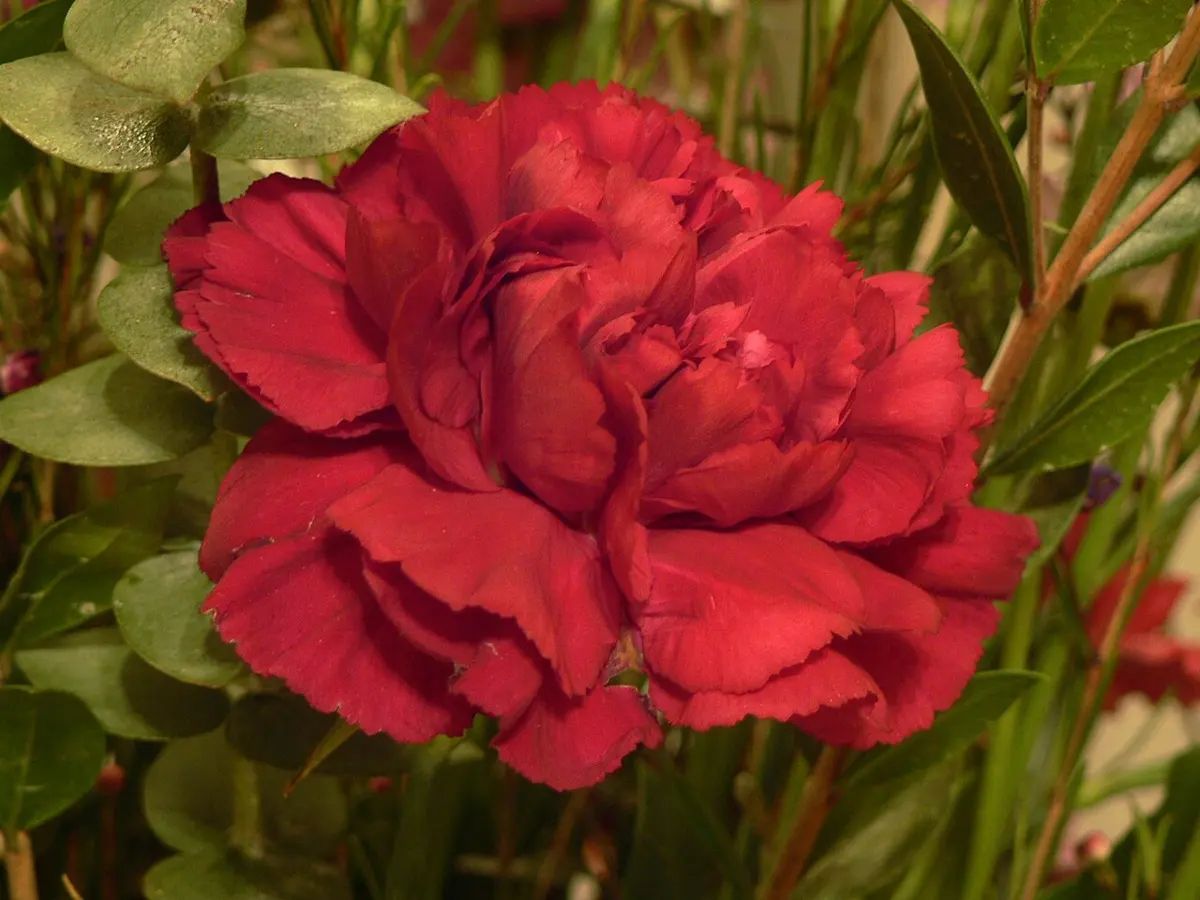
Red carnations stand for patriotism (love of one’s country). This goes back to the February Revolution of 1917: the Bolsheviks made masses of cardboard badges shaped like red carnations, which became a symbol of resistance to the Provisional Government. (Red carnations were later laid at war memorials, especially on Victory Day.)
White carnations are the opposite: a bad omen (a sign of bad luck). Their pale petals are believed to take away the holder’s luck and talent, so never give them to a performer. Yet a white carnation under your pillow is believed to leave you inspired in the morning.
Poppies
A red poppy stands for weakness and fleeting (short-lived) love, so giving one to a loved one contradicts (goes against) the wish for a long relationship. But poppy seeds are different: at traditional weddings they are eaten as a symbol of happiness, and sometimes put in the bride’s and groom’s shoes as a symbol of procreation (having children).
Yellow flowers
In many cultures yellow is cheerful and stands for friendship. In Russia, yellow flowers mean sadness and dishonesty, so a bunch of yellow flowers to a beloved means an inevitable (certain) break-up, as in a famous Russian song about yellow tulips.
Chamomile
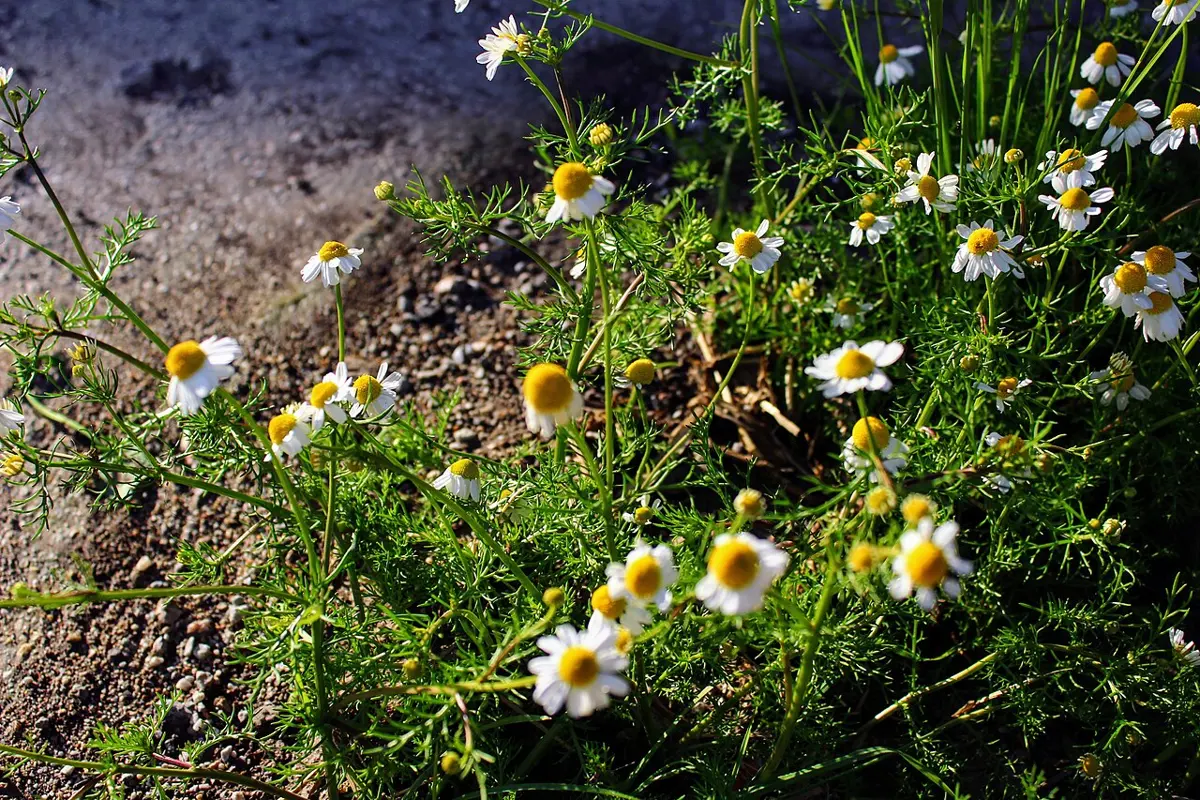
Chamomile, white petals around a yellow center, is often called Russia’s national flower. Russians drink it as tea and use it in aromatherapy (treatment with scented oils), and many believe it has great healing powers. A lesser-known belief says it is a repellent (keeps away) for mosquitoes and flies: throwing a bunch on a fire is meant to deter (stop) insects. Girls use it for fortune-telling: pulling off one petal at a time, “he loves me, he loves me not”, until the last petal decides.
Lily of the valley and calla lilies
The lily of the valley is used for fortune-telling too, with “it will happen, it won’t happen”. And the elegant white calla lily, which looks as if it would suit a white wedding dress, must never be taken to a Russian wedding: it stands for death and is believed to foreshadow (be a sign of) the couple’s split.
Words from the text
| Word | Meaning here |
|---|---|
| staple | a basic, ordinary item that is always used |
| gesture | something you do to show a feeling |
| aroma | a pleasant smell |
| palette | a range of colors |
| etiquette | the rules of polite behavior |
| immensely | very greatly |
| patriotism | love of one’s country |
| omen | a sign of what will happen |
| fleeting | lasting only a short time |
| contradict | to go against, to be the opposite of |
| procreation | producing children |
| inevitable | certain to happen |
| encapsulate | to enclose as if in a capsule; also to sum up in a few words |
| aromatherapy | treatment using scented oils, smelled or massaged into the skin |
| repellent | something that keeps insects or animals away |
| deter | to stop or discourage something |
| foreshadow | to be a sign of something that will come |
A. Find the words
Find single words from the text for these meanings.
- a.a strong, usually pleasant smell
- b.different colors of paint, especially as used by an artist
- c.to a great degree
- d.lasting only a short time
- e.the act of producing children or baby animals
- f.to enclose something in, or as if in, a capsule
- g.a treatment which involves massaging the body with special fragrant oils
- h.something that keeps insects away
- i.to be a sign of something that will happen in the future
Answer
B. Compound words
A compound word is two (or more) words joined to make one, written as one word (cardboard), with a hyphen (gift-giving), or as two words (wedding dress).
Make a list of compound words from the text.
Answer
C. Complete the sentences
Complete the sentences with the correct information from the text.
- a.People do not care which flowers they receive as long as the flowers are beautiful and give ……… .
- b.Flowers are gifted worldwide to express ……… .
- c.Following the strict flower ……… while gifting flowers in Russia saves you from offending people.
- d.Red carnations symbolize ……… ; red carnation badges were produced by the Bolsheviks.
- e.Russian people believe that the white carnation ……… , so we should not give them to performers.
- f.Russian people do not give red poppy flowers to their ……… because they think it makes their love weak.
- g.When Russians want to break up with their beloved, they give ……… .
- h.Russians believe chamomile has great ……… value, so it can treat diseases.
- i.We should not take a white lily bouquet to a Russian wedding, as it symbolizes ……… .
Answer
D. Answer the questions
Mention any two reasons for which people give flowers to others.
Answer
How do people feel when they are given flowers?
Answer
What decides the choice of flowers for gifting in Russia?
Answer
Which event in Russian history is reflected by the red carnation?
Answer
Do Russians like to keep a white carnation under their pillow? Why?
Answer
Why is the red poppy connected with fragile love?
Answer
Why do Russians eat poppy seeds at weddings?
Answer
Would you like to grow chamomile in your garden? Why?
A model answer
What color is chamomile?
Answer
Write the names of two flowers used for fortune-telling.
Answer
Which flower is mostly used in Russian weddings?
Answer
E. Flowers as gifts
Do you know other flowers that are commonly given as gifts? Write their names and the occasions on which they are given.
Answer
Listening: Gurkhas guard the palace
The textbook’s listening task is a news report on Gurkha soldiers training to guard the British royal palaces. CDC’s own recording is below: read the tasks in B and C first, then listen, as many times as you need. The answers are hidden under the tasks; after that, practice with a talk of our own that your browser reads aloud.
A. Before you listen
B and C. The textbook’s audio: answers
Complete the sentences.
- a.The Queen’s Windsor Castle is being protected by the ……… soldiers.
- b.The Gurkhas began to work for the British Crown ……… ago.
- c.The soldiers have been preparing to take up their duty in the month of ……… .
- d.Drill is all about putting everyone into ……… .
- e.The soldiers are in training for ……… weeks.
- f.This is the ……… time the Gurkhas are guarding Buckingham Palace.
Answer
Answer the questions.
- a.When did the Gurkhas begin to guard the Queen?
- b.Name two places which are guarded by the Gurkhas.
- c.What will each soldier carry in the parade?
- d.How long is the training course in total?
- e.How did the soldier’s family feel about their son joining the British Army?
Answer
Do you know other countries where Gurkhas serve? Share in class.
Answer
Practice listening alone
Grammar II: The past perfect
Before another past action
When two things happened in the past and you want to show that one came before the other, use the past perfect (had + past participle) for the earlier one:
- The train had left before we reached the station. (First the train left; then we arrived. We missed it.)
- I had had my breakfast before I went to work.
- She found that the thief had taken only Rs. 450.
Compare: When we reached the station, the train left. (We arrived, then it left: we saw it go.) When we reached the station, the train was leaving. (It was moving as we arrived.) Try all three in the timeline in Grammar I, with the past perfect button.
With before and after, the order is already clear, so the past simple is also correct: I had my breakfast before I went to work. The past perfect is needed when nothing else shows the order: When I got home, Mother had cooked dinner (it was ready) is not the same as When I got home, Mother cooked dinner (she started then).
A time ago goes with the past simple, never the past perfect or present perfect: The children arrived five minutes ago.
When the guests arrived, we ……… dinner, so they ate with us.
Pick an answer to see why.
Rina couldn’t open the door because she ……… her key at school.
Pick an answer to see why.
A. Complete the sentences
Complete with the correct forms of the verbs.
- a.The children ……… five minutes ago. (arrive)
- b.Ramchandra ……… the ticket before he went to the cinema. (buy)
- c.Alexander ……… a vast empire before he was thirty. (conquer)
- d.When she came out of the airport, nobody ……… for her. (wait)
- e.I found a thousand-rupee note in my pants pocket while I ……… them. (wash)
- f.Somebody ……… at my door while I was taking a rest. (knock)
- g.Every year, he ……… some money, which he later spent on a new house. (save)
- h.I ……… my breakfast before I went to work. (have)
- i.The train ……… before we reached the station. (leave)
Answer
B. Complete the story
Complete the story with the correct forms of the verbs.
A young woman ……… (enter) a shop in Birendranagar, Surkhet. She ……… (put) a few items of food in a bag. She ……… (choose) a time when not many people ……… (be) in the street. She ……… (wait) for the moment when no one else would see her running away. When the shopkeeper ……… (check) the goods, she gave him a thousand-rupee note. As soon as the shopkeeper ……… (open) the cash box, she ……… (snatch) all the money from it. She ……… (run) out of the shop before the shopkeeper ……… (realize) what ……… (happen). When the shopkeeper ……… (check) the amount in the box, he ……… (find) that the thief ……… (take) only Rs. 450. As the thief ……… (leave) a thousand-rupee note behind, the theft ……… (cost) her Rs. 550.
Answer
Writing II: Stories
How to write a story
A story in the SEE is written from outlines (a list of events) or from a first sentence. In about 150–200 words:
- Give it a title.
- Beginning: who, where, when, and the problem.
- Middle: the events in order, in the past simple (past continuous for background, past perfect for what happened earlier), with a little dialogue to bring it alive.
- End: how the problem is settled, then the moral (the lesson) in one line, if it is a fable.
Join the events with one day, then, soon, meanwhile, at last, from that day on.
A. The Bat, the Birds and the Beasts
Write a story from these outlines: a great conflict between the birds and the beasts … two armies collected … the bat refuses to join … says he is a beast … beasts ask … says he is a bird … peace made, no battle … rejoicing … bat wishes to join … both turn against him … threaten to tear him to pieces … bat flies away … moral.
A model story
B. The owl and the grasshopper
Write a story that begins: “One warm summer afternoon an old owl was dozing when a grasshopper disturbed it with a very raspy song.”
A model story
Project work
Loanwords
English has borrowed words from languages all over the world: more than half of the words in a large English dictionary came from French and Latin alone. A word borrowed from another language is a loanword. Here are the book’s examples, with where each came from:
| Word | From | Word | From |
|---|---|---|---|
| anonymous | Greek | cigar | Spanish |
| loot | Hindi | cookie | Dutch |
| safari | Swahili, from Arabic safar “journey” | metropolis | Greek |
| lemon | Arabic (through Persian and French) | avatar | Sanskrit |
| ketchup | Chinese (Hokkien), through Malay | entrepreneur | French |
| utensil | French, from Latin | catalog | French, from Greek |
| justice | French, from Latin | massage | French (perhaps from Portuguese or Arabic) |
| vigilante | Spanish | pizza | Italian |
| language | French, from Latin lingua “tongue” | noodle | German |
| alcohol | Arabic al-kuḥl | karma | Sanskrit |
| amen | Hebrew | chess | French, from Persian shāh “king” |
| bungalow | Hindi-Urdu banglā “of Bengal” | boycott | the name of Captain Boycott, a land agent in Ireland |
| husband | Old Norse | zombie | a West African language, through Haitian Creole |
The word boycott comes from:
Pick an answer to see why.
Exercise
SEE-style practice on this unit. Try each one as in the exam, then open the answer.
Read the text and answer the questions.
Bhaktapur’s Nyatapola temple, five storeys high, was built in 1702 by King Bhupatindra Malla. Its five plinths are guarded by pairs of figures, from wrestlers at the bottom to goddesses at the top, each pair said to be ten times stronger than the pair below. When the great earthquake of 1934 destroyed much of the city, the temple was only slightly damaged, and it came through the 2015 earthquake too. Engineers believe its broad base and wide steps help it stay steady.
- a.Who built the Nyatapola temple?
- b.When was it built?
- c.Which figures guard the lowest plinth?
- d.What happened to the temple in 1934?
- e.Why do engineers think it survives earthquakes?
Answer
Complete the text with the correct forms of the verbs in brackets.
Last Saturday, we (a) ……… (visit) Kathmandu Durbar Square. When we (b) ……… (arrive), a guide (c) ……… (tell) a group of tourists about the Hanuman statue. He said that Pratap Malla (d) ……… (set) it up in 1672. While we (e) ……… (look) at the inscription, it (f) ……… (start) to rain. By the time we reached the bus stop, the rain (g) ……… (stop).
Answer
Choose the correct words.
- a.I (saw / was seeing) an accident while I (walked / was walking) to school.
- b.When we reached the cinema, the film (already started / had already started).
- c.What (did you do / were you doing) at nine last night?
- d.My grandfather (died / had died) ten years ago.
- e.She (cooked / was cooking) when the gas ran out.
Answer
Write a short paragraph (about 100 words) on a historical place in your district: where it is, who built it and when, what you can see there, and why it should be protected.
A model answer
Practice every question in the book, and keep track of the ones you miss →
A companion to your textbook, not a replacement for it: study from the book your school uses, and where the two differ, follow your teacher. Found a mistake? Please tell us.