
Take three bamboo sticks and tie their ends together to make a triangle. Now take four sticks and tie them into a square. Hold each frame by one corner and give it a push.
The square leans over: its sides stay the same length, but its corners close up and it becomes a slanted shape. The triangle doesn’t move at all. This is why the frames of bridges, roofs and bicycles are made of triangles. Why is a triangle so stiff when a square is so floppy?
In this unit you will learn to sort triangles by their sides and by their angles, and to sort four-sided shapes: the rectangle, the square, the parallelogram, the rhombus and the trapezium. In Back to the bamboo frame you will see the answer.
15.0 Review
A shape drawn on a flat surface, like a page, is a plane shape. A plane shape closed in by straight lines is named by how many sides it has: three sides make a triangle and four sides make a quadrilateral.
15.1 Classification of triangles
Triangles can be sorted in two ways: by their sides and by their angles.
Classification of triangles on the basis of sides
So there are three kinds of triangle by their sides:
- If all three sides of a triangle are equal, it is an equilateral triangle.
- If any two sides of a triangle are equal, it is an isosceles triangle.
- If all three sides of a triangle are different, it is a scalene triangle.
Classification of triangles on the basis of angles
So there are three kinds of triangle by their angles:
- If one angle of a triangle is 90°, it is a right-angled triangle.
- If all three angles of a triangle are acute (less than 90°), it is an acute-angled triangle.
- If one angle of a triangle is obtuse (more than 90°), it is an obtuse-angled triangle.
In Activity 2, △ABC is acute-angled, △PQR is right-angled and △XYZ is obtuse-angled. (The sign △ stands for “triangle”.)
Every triangle has two names: one by its sides and one by its angles. A triangle with two equal sides and a right angle is a right-angled isosceles triangle; the corner of a square cut along its diagonal is one. Drag the corners and see which pairs of names you can make.
Exercise 15.1
Question 1
Fill in the blanks with the right words.
In an equilateral triangle, all angles are ……
Answer
A triangle whose sides are all unequal is called a …… triangle.
Answer
On the basis of sides, there are …… types of triangles.
Answer
A triangle with one angle greater than 90° is called an …… triangle.
Answer
A triangle that is equilateral on the basis of sides is always an …… triangle on the basis of angles.
Answer
Question 2
Classify these triangles on the basis of their sides. (Their sides have been measured for you.)
Triangle ABC
Answer
Triangle DEF
Answer
Triangle GHI
Answer
Triangle LMN
Answer
Question 3
Classify these triangles on the basis of their angles. (Their angles have been measured for you.)
Triangle ABC
Answer
Triangle DEF
Answer
Triangle GHI
Answer
Triangle LMN
Answer
Question 4
Look at the figure. ABCD is a rectangle. Write the names of two acute-angled triangles, two right-angled triangles and two obtuse-angled triangles in it.
Answer
Question 5
Draw each triangle and measure its other two angles with a protractor.
A triangle POQ with ∠POQ = 120°.
Answer
A triangle XYZ with ∠XYZ = 60°.
Answer
A triangle LMN with ∠LNM = 90°.
Answer
Question 6
Discuss your answers to Question 5 with your friends. What do you notice about the kind of each triangle?
Answer
15.2 Quadrilaterals
A quadrilateral is a closed plane shape with four straight sides. It has four vertices (corners) and four angles.
Look at the frames of the windows and doors of your classroom, the cover of a book, a bench and the board. How many edges and corners does each have? Most of them are quadrilaterals. In this section you will learn the names of five special ones.
Rectangle
A quadrilateral whose opposite sides are equal and whose angles are each 90° is called a rectangle. ABCD below is a rectangle.
Square
A quadrilateral whose sides are all equal and whose angles are all 90° is called a square. ABCD below is a square.
A square has everything a rectangle has (opposite sides equal, all angles 90°), and more: all its sides are equal. So every square is a rectangle, but not every rectangle is a square.
Parallelogram
Two lines are parallel if they always stay the same distance apart and never meet, like the two rails of a ladder. In a figure, matching arrowheads on two sides show that they are parallel.
A quadrilateral whose opposite sides are parallel is called a parallelogram. ABCD below is a parallelogram.
The opposite sides of a parallelogram are equal, and its opposite angles are equal.
So a rectangle and a square are parallelograms too: their opposite sides are parallel.
Rhombus
A quadrilateral whose four sides are all equal is called a rhombus. Its opposite sides are parallel, so a rhombus is a parallelogram.
Trapezium
A quadrilateral with only one pair of opposite sides parallel is called a trapezium. ABCD below is a trapezium.
How the quadrilaterals are related
The five special quadrilaterals fit inside one another, like boxes in boxes.
Drag the corners and watch the names light up. Can you make a shape that has four names at once?
Making quadrilaterals with a tangram
A tangram is an old Chinese puzzle: a square cut into seven pieces, which can be put together into many shapes.
Exercise 15.2
Question 1
True or false?
a. All sides of a square are equal.
Pick an answer to see why.
b. A square and a rhombus are the same.
Pick an answer to see why.
Question 2
Classify these quadrilaterals by their sides and angles. (They have been measured for you. In (d), the dashed lines from C and from F down to DE are both 2 cm long.)
ABCD
Answer
HFEG
Answer
KNML
Answer
CFED
Answer
HIRA
Answer
PSRQ
Answer
Mixed exercise
Question 1
Anjila said, “A quadrilateral with all sides equal is a rectangle.” Prajwal disagreed and said, “A quadrilateral with opposite sides equal and all angles 90° is a rectangle.” Which of these figures supports Prajwal?
Answer
Question 2
Study the figure and answer the questions.
Write the names of four pairs of intersecting lines.
Answer
Write the names of two pairs of parallel lines.
Answer
Measure the angles ∠LIJ, ∠IJK, ∠ILK and ∠LKJ.
Answer
What kind of quadrilateral is IJKL?
Answer
What kind of quadrilateral would it be if ∠ILK and ∠LKJ were 90°?
Answer
When would the quadrilateral IJKL be a square?
Answer
Printable PDFs
- Study notes 2 pages
- Harder practice questions 2 pages Answer key
Practice every question in the book, and keep track of the ones you miss →
Back to the bamboo frame
Why did the square of sticks lean over while the triangle stayed stiff?
Try to make a different triangle from the same three sticks. You can’t: once you know the three sides, there is only one triangle they can make, so its angles are fixed. Push on it, and it has nowhere to go.
Four sticks are different. Four sides don’t fix the angles. The same four equal sticks can make a square, or a rhombus that leans a little, or one that leans a lot: every one of them has four equal sides. So the frame slides from one to the next when you push it.
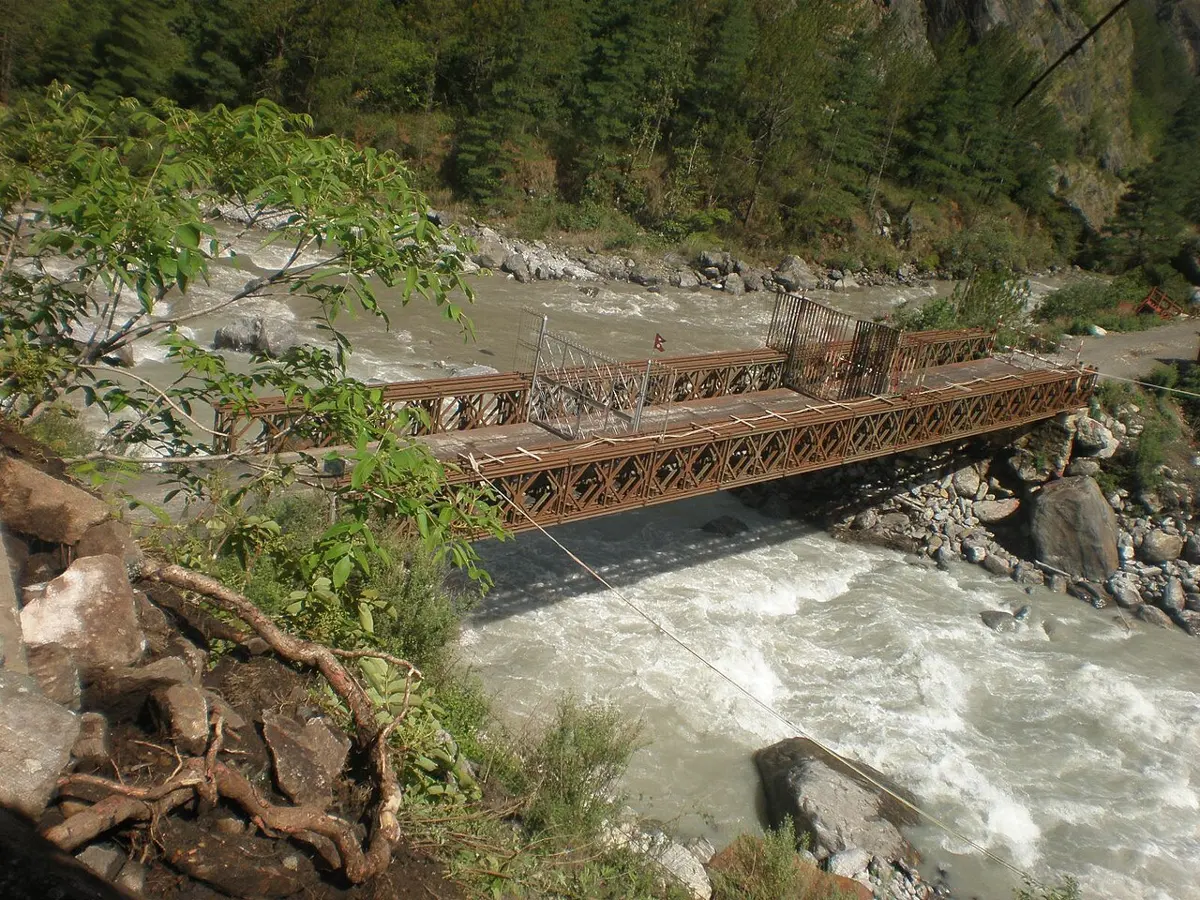
The fix is to add one more stick, a diagonal, from corner to corner. Now the square is made of two triangles, and each triangle is stiff. That is why bridges, roofs, towers and gates are built from triangles.
Where this is used
- Bridges, roofs and towers. A frame of triangles, called a truss, can’t change shape when its sides are fixed. Steel bridges, the wooden frames under roofs and electricity towers are built this way.
- Bicycles. A bicycle’s frame is two triangles side by side, so it stays stiff with a rider on it.
- Tiles and paper. Rectangles and squares fit side by side with no gaps, so floor tiles, bricks, books and sheets of paper are made in these shapes. You will see why in Unit 19.
Where these facts come from
- Triangles and trusses: Wikipedia, “Truss” (“a triangle is the simplest geometric figure that will not change shape when the lengths of the sides are fixed”; the diamond frame of a bicycle), read November 2026.
- The tangram: Wikipedia, “Tangram” (seven flat pieces cut from a square: five triangles, a square and a parallelogram; first recorded in China), read November 2026.
- Kinds of triangle and quadrilateral: Wikipedia, “Triangle” and “Quadrilateral” (the names by sides and by angles; the rhombus as a quadrilateral with four equal sides, of which the square is a special case), read November 2026.
A companion to your textbook, not a replacement for it: study from the book your school uses, and where the two differ, follow your teacher. Found a mistake? Please tell us.