
Look at an old wooden cart wheel. It has a hub in the middle, where the axle goes through, spokes going out from the hub, and a rim round the outside that touches the ground.
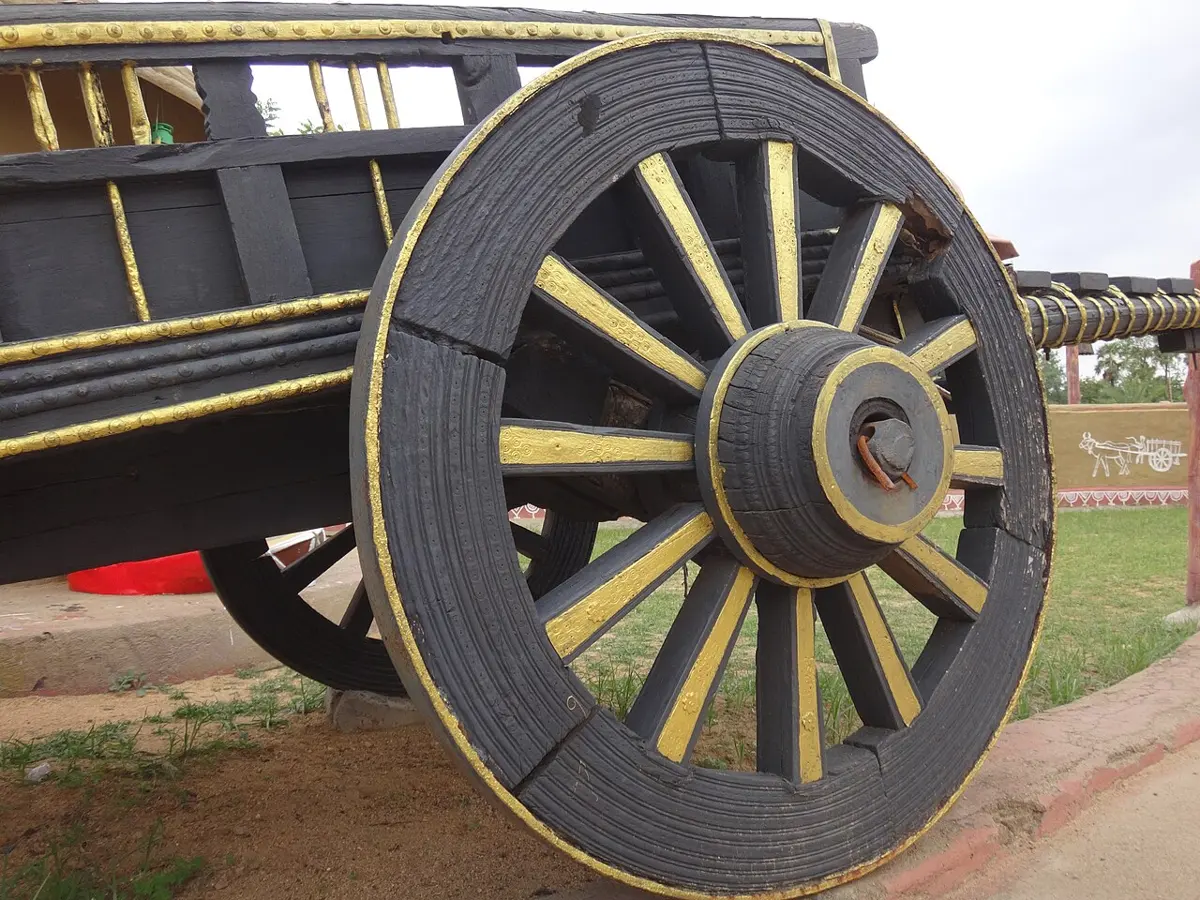
Wheels on carts, bicycles, buses and the great chariots of Bhaktapur’s Bisket Jatra are all round. Why round? Why not a square wheel, or an oval one? A square wheel can turn too, after all.
In this unit you will learn what makes a circle a circle, and the names of its parts. At the end, in Back to the wheel, you will see why only a round wheel lets a cart roll smoothly.
16.0 Review
16.1 Introduction to circle
Drawing round a coin only works if you have a coin of the size you want. A compass draws a circle of any size. It has two legs joined at the top: one ends in a sharp needle, the other holds a pencil.
While you turned the compass, its legs did not open or close. So the pencil’s tip stayed the same distance from the needle all the way round. That is what a circle is.
A circle is the path of a point that moves so that its distance from a fixed point stays the same. The fixed point is the center, and the distance is the radius.
Rohan’s compass is opened to 3 cm. He draws a circle with it. How far is each point of his circle from its center?
Pick an answer to see why.
16.2 Different parts of a circle
Every part of a circle has a name. In each little figure below, the part is drawn on a circle with center O.
Center
The center is the point inside a circle that is the same distance from every point of the circle. In the figure, O is the center.
Radius
A radius is a line segment joining the center to a point on the circle. In the figure, OA is a radius. Every radius of a circle has the same length. The plural of radius is radii.
Circumference
The circumference is the closed boundary of a circle, the curve that goes all the way round its center. In the figure, the circumference is the curve through A, B and C. The word also means the length of that curve.
Chord
A chord is a line segment joining any two points on the circumference. In the figure, CD is a chord.
Diameter
A diameter is a chord that passes through the center. In the figure, AB is a diameter. It is made of two radii, OA and OB, end to end, so
It is also the longest chord of the circle. Try it below.
Sector
A sector is the part of a circle between two radii, like a slice of a round pizza. In the figure, BOF is a sector.
Semicircle
A semicircle is half of a circle, cut off by a diameter. In the figure, ABC is a semicircle. (“Semi” means half.)
Arc
An arc is a part of the circumference. In the figure, the arc AB is the part of the circumference from A to B. We write it .
Which of these is the longest chord of a circle of radius 5 cm?
Pick an answer to see why.
A circle has a diameter of 14 cm. What is its radius?
Pick an answer to see why.
Exercise 16.1
Question 1
True or false?
a. A circle has two centers.
Pick an answer to see why.
b. A diameter of a circle passes through its center.
Pick an answer to see why.
c. A line segment joining any two points of the circumference of a circle is called its radius.
Pick an answer to see why.
d. The part of a circle between any two radii is called a sector.
Pick an answer to see why.
e. Not all chords of a circle are diameters.
Pick an answer to see why.
f. A circle has only one diameter.
Pick an answer to see why.
g. A diameter of a circle is twice its radius.
Pick an answer to see why.
Question 2
What is the center of a circle? Draw a figure to show it.
Answer
Question 3
What is the circumference of a circle? Show it with a figure.
Answer
Question 4
What is the difference between the diameter and the radius of a circle? Show it with a figure.
Answer
Question 5
Define a sector of a circle.
Answer
Question 6
What is the difference between the diameter and a chord of a circle? Show it with a figure.
Answer
Question 7
How many semicircles are there in a circle? Show them in a figure.
Answer
Question 8
Write the names of the parts of this circle.
Answer
Printable PDFs
- Study notes 1 page
- Harder practice questions 2 pages Answer key
Practice every question in the book, and keep track of the ones you miss →
Back to the wheel
Why are wheels round? Because the axle is at the center, and every point of the rim is the same distance from the center: the radius. Whichever part of the rim is touching the ground, the axle stays at the same height above it. So the cart rolls along level.
Now try a square wheel with sides 40 cm long and its axle at the middle. When a side lies flat on the ground, the axle is 20 cm up. But to turn, the wheel has to stand on a corner, and then the axle is about 28 cm up. Each time a corner comes round the cart is lifted and dropped: bump, bump, bump. An oval wheel is no better: its axle goes up and down too.
Where this is used
- Wheels and gears. Wheels, pulleys and gear wheels are circles turning about their center, so the axle doesn’t go up and down.
- Manhole covers. Round lids can’t fall into their round holes.
- Drawing and building. A compass, or a peg and a string, draws circles for round pillars, wells, tables and the round tops of windows.
- Pottery. A potter centers the clay on the wheel, so every part of the pot is the same distance from the middle and the pot comes out round.
Where these facts come from
- The oldest wheel: Wikipedia, “Ljubljana Marshes Wheel” (found in 2002 near Ljubljana, Slovenia; about 5,100 to 5,350 years old; ash wood, about 70 cm across; an oak axle with a square end, so wheel and axle turned together), read November 2026.
- Manhole covers: Wikipedia, “Manhole cover” (a round cover cannot fall through its round opening; a square one can if turned diagonally), read November 2026.
A companion to your textbook, not a replacement for it: study from the book your school uses, and where the two differ, follow your teacher. Found a mistake? Please tell us.