
Ask a friend to open the classroom door “a little”. Then ask another friend to open it “a little” too. Did they open it the same amount? Probably not. “A little”, “wide” and “nearly shut” mean different things to different people.
A carpenter making a door frame can’t work with “a little”. Nor can someone building a ramp for a wheelchair, or a clock maker. They need one number that everyone agrees on.
That number is the size of an angle, measured in degrees. In this unit you will measure angles and draw them with a protractor. You will sort them into right, acute and obtuse angles. And you will draw lines that meet at a square corner, and lines that never meet at all.
1.0 Review
You met angles in Grade 4. Let’s remember the words.
A straight line with two ends, like AB, is a line segment. When two line segments start from the same point, they make an angle. The two lines are the arms of the angle. The point where they meet is its vertex.
We name an angle with three letters, and we write the sign ∠ in front: ∠ABC. The vertex always goes in the middle. So this angle can also be called ∠CBA, but never ∠BAC.
In ∠PQR, which point is the vertex?
Pick an answer to see why.
1.1 Measuring and drawing angles with a protractor
The protractor
Open your geometry box. The half circle of clear plastic is a protractor. It measures angles.
A whole turn, all the way round, is 360°. A protractor is half a turn, so it goes up to 180°.
Measuring an angle
To measure an angle, follow three steps.
- Put the center of the protractor exactly on the vertex.
- Lay the base line of the protractor along one arm.
- Find the 0 that lies on that arm. Count up from it to where the other arm crosses the edge. That number is the angle in degrees.
The third step is where people go wrong. Every mark has two numbers. Read the row whose 0 is on your base arm.
Drawing an angle
A protractor can draw angles too. Drawing an exact angle is called constructing it.
Construct it: Angles with a protractor
Exercise 1.1
Question 1
First estimate each angle: make a careful guess of its size. Then measure it with a protractor. How close was your estimate?
∠ABC
Answer
∠PQR
Answer
∠XYZ
Answer
∠MNO
Answer
Question 2
Draw angles of these sizes with a protractor, and name each one.
35°
Answer
45°
Answer
60°
Answer
75°
Answer
90°
Answer
115°
Answer
120°
Answer
130°
Answer
180°
Answer
47°
Answer
89°
Answer
153°
Answer
Question 3
Draw these angles with a protractor.
Answer
Answer
Answer
Answer
Answer
Answer
Answer
Question 4
Measure each angle. Then draw an angle of the same size.
∠PQR
Answer
∠MNO
Answer
∠AOB
Answer
Question 5
Which angle in each pair is bigger? Guess first, then measure both angles with a protractor.
∠MNO (i) and ∠PQR (ii)
Answer
∠XYZ (iii) and ∠AOB (iv)
Answer
Question 6
In each picture, find ∠AOC and ∠BOC in degrees.
Picture a
Answer
Picture b
Answer
Question 7
Find the corners where angles are made in this shape, and measure each angle.
Where are the angles, and how big is each one?
Answer
Question 8
In each picture, measure ∠AOC, ∠COB, ∠BOD and ∠DOA.
Picture a
Answer
Picture b
Answer
Picture c
Answer
1.2 Angles of triangles and quadrilaterals
A triangle has three corners. A quadrilateral (a shape with four straight sides) has four. At each corner the two sides make an angle. These are the shape’s inside angles (interior angles).
Prarthana: I can measure ∠ABC, ∠BCA, ∠PQR and ∠QRS. The bottom side makes a good base line. But how do I measure ∠BAC, ∠QPS and ∠RSP?
Teacher: You can turn the protractor. Either arm can be the base line. For ∠RSP, put the center on S and the base line along SP.
Teacher: Read the row whose 0 is on SP. So . Now measure the others the same way.
Exercise 1.2
Question 1
Measure all the inside angles of these triangles and quadrilaterals with a protractor.
In the answers, ∠A is a short way to write the angle at corner A, when there is only one angle there.
Triangle ABC
Answer
Triangle PQR
Answer
Quadrilateral MNOP
Answer
Quadrilateral STUV
Answer
Quadrilateral EFGH
Answer
Triangle IJK
Answer
Question 2
Measure the inside angles of each triangle. Then add up the angles of each triangle.
Triangle ABC
Answer
Triangle PQR
Answer
Question 3
Measure all the inside angles of each quadrilateral and add them up.
Quadrilateral PQRS
Answer
Quadrilateral ABCD
Answer
Question 4
The quadrilateral PQRS is made of two triangles, PQS and QSR.
Find all the inside angles of the quadrilateral.
Answer
Find all the inside angles of the triangle PQS.
Answer
Find all the inside angles of the triangle QSR.
Answer
How are ∠PQS, ∠RQS and ∠PQR related?
Answer
How are ∠PSQ, ∠QSR and ∠PSR related?
Answer
Question 5
The quadrilateral ABCD is made of two triangles, ABC and ACD.
Measure ∠ABC and ∠ADC.
Answer
Measure ∠CAB and ∠BCA.
Answer
Is ∠DAC + ∠CAB = ∠DAB? Check by measuring.
Answer
1.3 Right, acute and obtuse angles
Set squares
Yangchen: Teacher, we used the protractor from our geometry box. What are the two triangle-shaped tools for?
Teacher: Good question, Yangchen. Measure all the angles of both of them with your protractor.
Yangchen: One angle of mine is 90°. The other two are both 45°.
Abinash: Mine has 90° too. Its other two angles are 30° and 60°.
Teacher: Both of you are right. These tools are called set squares. Each has one angle of 90°. The one with two 45° angles is the 45° set square. The other is the 30°–60° set square.
Abinash: What do we use them for?
Teacher: Mostly to draw perpendicular and parallel lines. Today we use their square corner to test an angle: is it exactly 90°, less than 90°, or more? Watch, then everyone draw an angle in your exercise book and give it to the friend next to you to test.
Testing with a set square
Put the square corner of the set square on the vertex. Lay one of its edges along one arm. Now look at the other arm.
- It lies along the set square’s other edge: the angle is exactly 90°.
- It is inside the set square: the angle is less than 90°.
- It is outside the set square: the angle is more than 90°.
Rehan: Is there a way to test an angle without a protractor or a set square?
Teacher: Yes. You can make a tester from any scrap of paper. Fold it once to get a straight edge. Then fold it again, so that the straight edge lies exactly on itself. The new corner is a square corner, 90°.
Rehan: So we can test an angle even without a geometry box!
Three kinds of angles
These three kinds of angles have names.
- An angle of exactly 90° is a right angle. It is a square corner. We mark it with a small square instead of an arc.
- An angle more than 0° and less than 90° is an acute angle. It is sharp, like the tip of a pencil.
- An angle more than 90° and less than 180° is an obtuse angle. It is blunt and wide open.
In Activity 7, ∠ABC is a right angle, ∠XYZ is acute and ∠LMN is obtuse.
What about exactly 180°? Its arms make a straight line, so it is not acute, right or obtuse. You will learn its own name in Grade 6.
True or false? An angle of 95° is acute.
Pick an answer to see why.
Exercise 1.3
Question 1
Guess the angle in each picture. Is it a right angle, less than 90° or more than 90°? Check with a protractor or a set square.
| Thing | Right angle | Less than 90° | More than 90° |
|---|---|---|---|
| a.dividers | ✓ | ||
| b.two sticks | |||
| c.scissors | |||
| d.a clock at 10:10 | |||
| e.a board’s corner |
Fill in the rest of the table.
Answer
Question 2
Is each angle right, acute or obtuse? Guess first. Then test your guess with a set square.
∠ABC
Answer
∠XYZ
Answer
∠TAP
Answer
∠CAR
Answer
∠POT
Answer
∠DOG
Answer
Question 3
Sort these angles into the table: 125°, 25°, 45°, 90°, 75°, 135°, 150°, 165°, 105°
| Acute angle | Right angle | Obtuse angle |
|---|---|---|
Fill in the table.
Answer
Question 4
Write the name of each angle in the figure, and say whether it is acute, right or obtuse.
Triangle ABC
Answer
Quadrilateral PQRS
Answer
Question 5
Measure all the inside angles of these shapes with a protractor. Is each one acute, right or obtuse?
Triangle XYZ
Answer
Quadrilateral PQRS
Answer
Triangle PQR
Answer
Question 6
Where are angles made in these letters? Is each angle acute, right or obtuse?
Find the angles in M, A, T and H.
Answer
Question 7
Here is Nepal’s national flag. Where are angles made? Are they right, acute or obtuse?
Find the angles of the flag.
Answer
Question 8
Look at this scarecrow (बुख्याँचा). Find the places where angles are made.
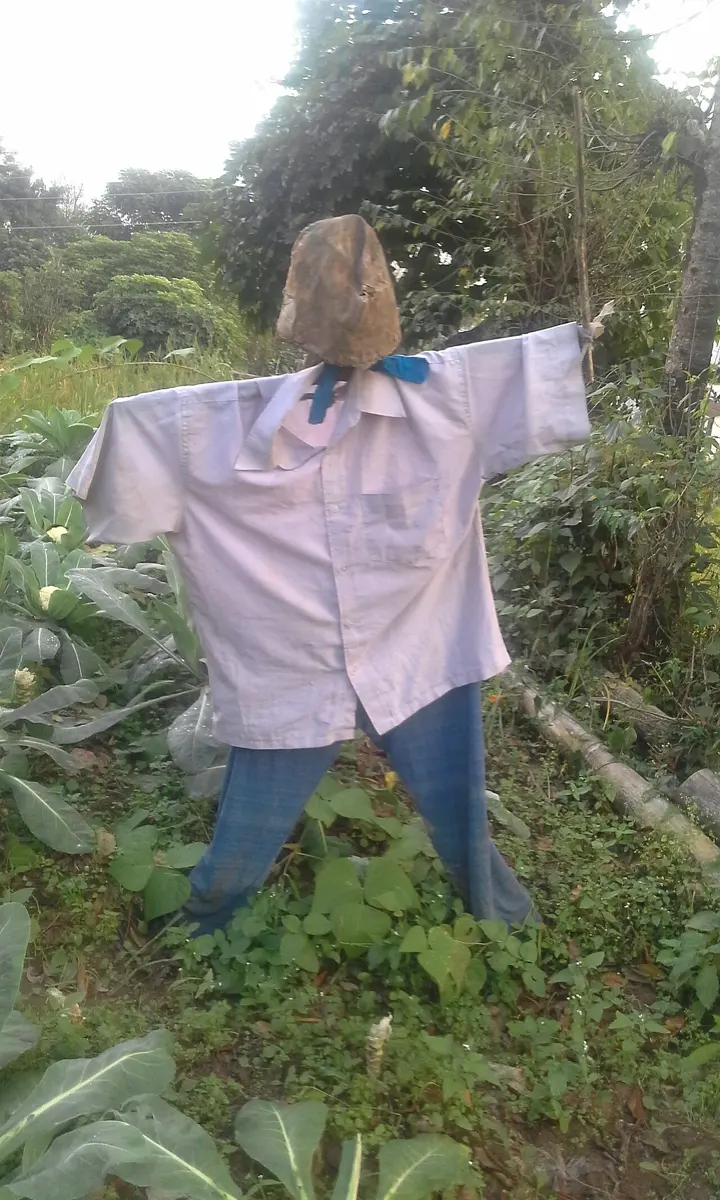
Where are acute angles made?
Answer
Where are obtuse angles made?
Answer
Where are right angles made?
Answer
1.4 Perpendicular and parallel lines on a square grid
Perpendicular lines
Lines going straight up and down the page are vertical (upright). Lines going straight across are horizontal (level). On squared paper, every vertical line meets every horizontal line at 90°. So ∠XYA, ∠XYB, ∠POA, ∠POB, ∠RSA and ∠RSB are all 90°.
Two lines that meet at 90° are called perpendicular lines. We write the sign ⊥ for “is perpendicular to”. Here, XY ⊥ AB, PO ⊥ AB and RS ⊥ AB.
Parallel lines
The gap between AB and CD is 4 squares at one end and 4 squares at the other. The gap stays the same all along. Lines like this are parallel lines. Even if you make them longer at both ends, they never meet. We write AB ∥ CD (some books write AB // CD).
On squared paper, all the level lines are parallel to each other. So are all the upright lines.
On squared paper, a level line and an upright line are…
Pick an answer to see why.
Construct it: Perpendicular and parallel lines on squared paper
Exercise 1.4
Question 1
Fill in the blanks.
The distance between two parallel lines is always ……
Answer
Two parallel lines, made longer at both ends, never …… each other.
Answer
Lines that meet at a right angle are called …… lines.
Answer
Two perpendicular lines meet at an angle of …… degrees.
Answer
Question 2
Look at the pictures. Which lines are perpendicular, and which are parallel?
AB and CD
Answer
XY and PQ
Answer
CD and EF
Answer
PQ and RS
Answer
NM and PO
Answer
QR and TS
Answer
Question 3
Draw these lines on squared paper.
AB ⊥ CD
Answer
RX ⊥ HD
Answer
PQ ∥ AB
Answer
XY ∥ ST
Answer
Question 4
Draw lines parallel to the given lines. One square is one unit.
Draw lines 2 units to the left and 2 units to the right of SV, parallel to it.
Answer
Draw lines parallel to KD: (i) 2 units above it, (ii) 3 units above it, (iii) 2 units below it, (iv) 4 units below it.
Answer
Question 5
Draw the letter T on squared paper, as in the picture. Write the pairs of parallel lines and the pairs of perpendicular lines.
Find the parallel and perpendicular pairs.
Answer
Printable PDFs
- Study notes 2 pages
- Harder practice questions 2 pages Answer key
Practice every question in the book, and keep track of the ones you miss →
Back to the door
Remember the door opened “a little”? Now you can say exactly how much. Put a protractor on the floor at the hinge, with its base line along the wall, and read where the door crosses the scale. A door opened 30° is acute and only just open. At 90° it stands at a right angle to the wall. Everyone who reads the protractor gets the same number.
Where this is used
- Ladders. Safety rules in many countries say a ladder should lean at about 75° to the ground: one step out from the wall for every four steps up. Steeper, and it can tip back; flatter, and its foot can slide.
- Ramps for wheelchairs. A ramp must be gentle enough to push a wheelchair up. One common rule allows a rise of 1 for every 12 along, an angle of less than 5°.
- Carpenters and masons. They check that the corners of door frames, windows and walls are right angles with a try square, a large square corner made of steel and wood, just as you test angles with a set square.
- Clocks. The minute hand turns 360° in an hour, so it moves 6° every minute. The hour hand moves only 30° in an hour.
- Maps and roads. Streets drawn on a plan often cross at right angles, and the two sides of a straight road are parallel lines.
Where these facts come from
- CDC, Mathematics, Grade 5 (2080), Unit 1, pages 1–27.
- Why 360 degrees: Wikipedia, “Degree (angle)” (the reason for 360 is unknown; one idea is the roughly 360-day year, another the Babylonians’ counting in sixties), read November 2026.
- Ladders: US Occupational Safety and Health Administration, rule 1926.1053(b)(5)(i): the foot of a ladder about one quarter of its working length from the wall (about 75.5°), read November 2026.
- Ramps: US Department of Justice, 2010 ADA Standards for Accessible Design, 405.2 (a ramp’s running slope not steeper than 1:12, about 4.8°), read November 2026.
- Try square: Wikipedia, “Try square”, read November 2026.
- The flag’s angles were worked out from the geometry in Schedule 1 of the Constitution of Nepal (2015): 90°, 45°, 45°, about 32° and about 58°.
- All other angles in this unit were drawn and measured for this unit.
A companion to your textbook, not a replacement for it: study from the book your school uses, and where the two differ, follow your teacher. Found a mistake? Please tell us.