
Rojan’s uncle is a carpenter in Bhaktapur. Today he is fixing two shelves to a wall and making a window frame. The shelves must be exactly parallel, or books slide off one end. The corners of the frame must be exactly square, or the window won’t close.
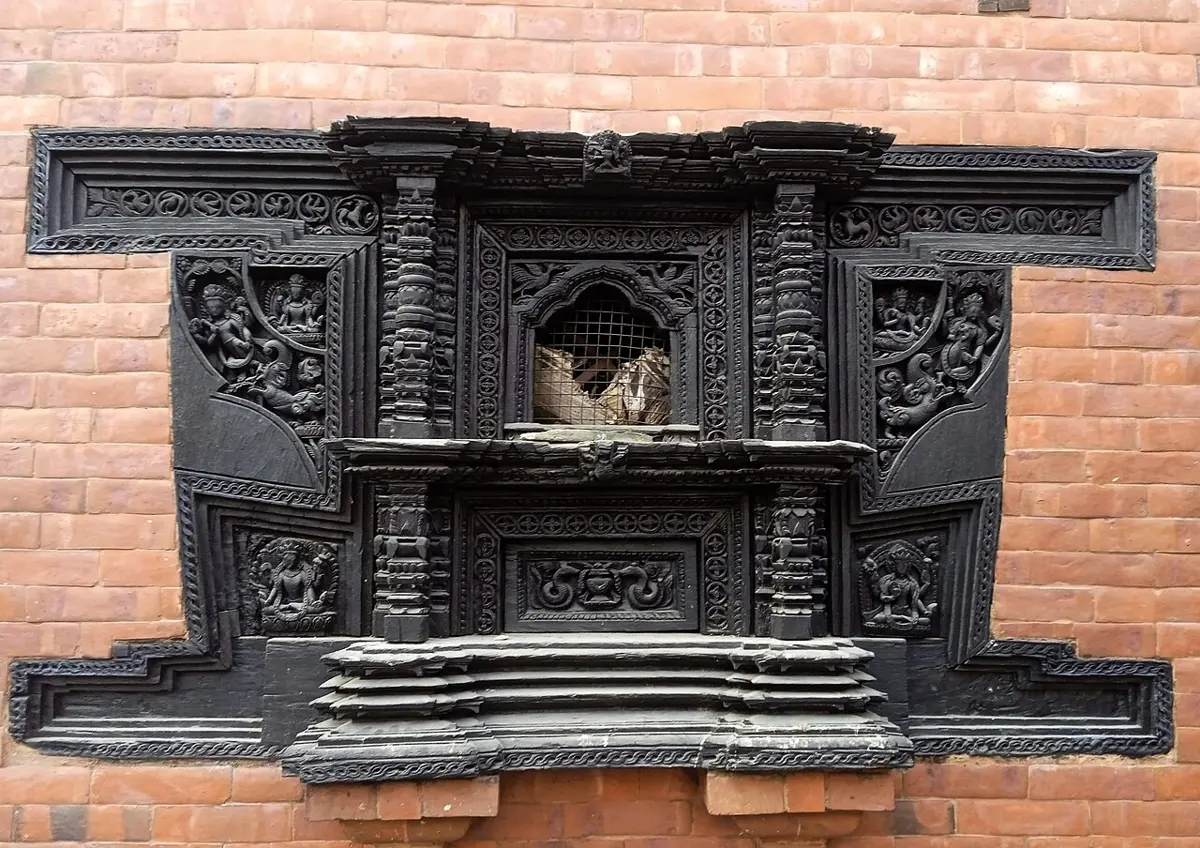
He has no fancy tools: only a ruler, a pencil and a set square, a triangle of wood with one perfect square corner. How does he check that the shelves are parallel and the corners square?
In this unit you will learn the names of pairs of lines and of angles, and how to draw them with a set square, a protractor and a compass. At the end, in Back to the carpenter, you will see how he does it.
14.0 Review
In Grade 5 you met these kinds of lines.
- A straight line goes the same way all along. A curved line keeps changing its direction as it goes.
- A line goes on for ever both ways. We can only draw a piece of it, so we put an arrowhead at each end to show that it goes on.
- A line segment is a part of a line with two end points. It has a length you can measure: AB = 4 cm.
14.1 Pair of lines
When two lines are drawn on a page, there are only a few things they can do: cross each other, or never meet. This section gives each a name.
Intersecting lines
If two straight lines cut each other at a point, they are called intersecting lines. The point where they cross is their point of intersection.
Two different straight lines can cross at only one point. Once they have crossed, they go further and further apart.
Perpendicular lines
If two straight lines intersect at an angle of 90°, they are called perpendicular lines. We write , and read it “AB is perpendicular to CD”. The small square drawn where they meet means 90°.
Perpendicular lines are intersecting lines of a special kind: they cross at a right angle. Where two lines are perpendicular, all four angles around the crossing point are right angles.
Parallel lines
If two straight lines never meet, however far they are made longer at both ends, they are called parallel lines. We write , and read it “AB is parallel to CD”. The little arrowheads drawn on them mean “these lines are parallel”.
The distance between two parallel lines is measured straight across, at right angles to both. It is the same everywhere. That is the easiest test: if two lines are the same distance apart at both ends, they are parallel.
Two straight lines on a page are 3 cm apart at their left ends and 5 cm apart at their right ends. What kind of lines are they?
Pick an answer to see why.
Exercise 14.1
Question 1
What kind of pair of lines is each of these?
Answer
Question 2
Look at the rectangle ABDC.
- a.What kind of line segments are AB and CD? Why?
- b.What kind of line segments are AC and CD? Why?
Answer
Question 3
Name the intersecting, perpendicular and parallel lines in these letters.
Answer
Question 4
When your school lines up for a parade or for morning exercise, look at the shapes the arms make. Make a short report in your group, with drawings, and show it to the class.
What you might find
14.2 Parallel and perpendicular lines with set squares
Inside a geometry box there are two plastic triangles with their middles cut out. They are called set squares. One has a right angle and two angles of 45°: the 45° set square. The other has angles of 90°, 60° and 30°: the 30°–60° set square. Both have one square corner, 90°, which is what makes them so useful.
Drawing parallel lines
Drawing perpendicular lines
Construct it: A parallel line with set squares, A perpendicular with a set square
Exercise 14.2
Question 1
Copy these line segments into your copy. Use set squares to draw a line segment parallel to each.
Answer
Question 2
Copy the same four line segments. Use set squares to draw a line segment perpendicular to each.
Answer
Question 3
Draw these line segments with a ruler. With set squares, draw one line segment parallel to each.
- a.AB = 5 cm
- b.XY = 8 cm
- c.CD = 10 cm
- d.MN = 7 cm
Answer
Question 4
Draw these line segments with a ruler. With set squares, draw a line segment perpendicular to each.
- a.PQ = 7 cm
- b.ST = 12 cm
- c.CD = 8 cm
- d.GH = 9 cm
Answer
14.3 Perpendicular bisector of a line segment
A compass draws circles and arcs. It has three parts: a pencil, a pencil holder that grips the pencil, and a needle, the sharp point that stays still.
CD cuts AB into two equal parts, and it is perpendicular to AB. A line like this is called the perpendicular bisector of AB. (To bisect means to cut into two equal parts.)
How to draw a perpendicular bisector
A. With a ruler and a set square
- a.Draw a line segment AB = 10 cm. Mark its midpoint O, at 5 cm.
- b.Lay a ruler along AB, stand the 45° set square on it with its square corner at O, and draw PO along its upright edge. PO is the perpendicular bisector of AB.
B. With a ruler and a protractor
- a.Draw a line segment AB = 10 cm.
- b.Mark the point C on AB, 5 cm from A.
- c.With the protractor, draw an angle of 90° at C. Now AC = CB = 5 cm and , so CD is the perpendicular bisector of AB.
Both ways need you to measure the midpoint first, and a measurement can be a little off. A compass finds the midpoint for you. First, see how long its arcs must be.
C. With a compass
- a.Draw a line segment AB = 10 cm.
- b.With the needle on A and a radius more than half of AB (more than 5 cm), draw long arcs above and below AB.
- c.Keep the same radius. With the needle on B, draw arcs above and below AB, cutting the first arcs.
- d.Mark the two crossing points P and Q, and join them with a ruler.
- e.Mark the point where PQ cuts AB as O. PQ is the perpendicular bisector of AB.
Why does it work? P is the same distance from A as from B: both distances are the radius you used. So is Q. Every point the same distance from A and from B lies on one line, the perpendicular bisector, so the line through P and Q is that line.
AB = 8 cm. With which radius can you draw the arcs from A and B for its perpendicular bisector?
Pick an answer to see why.
Construct it: Bisecting a line segment
Exercise 14.3
Question 1
Is XY the perpendicular bisector of AB? Measure to find out.
Answer
Question 2
Draw line segments of these lengths with a ruler, and draw the perpendicular bisector of each with a compass.
- a.PQ = 7 cm
- b.ST = 12 cm
- c.CD = 8 cm
- d.GH = 9 cm
- e.XY = 5 inches
- f.PQ = 4.5 inches
Answer
Question 3
Draw a line segment AB = 12 cm. Guess where its midpoint is, without measuring, and mark it O. Draw a line perpendicular to AB at O. Is it the perpendicular bisector of AB? Measure to test.
Answer
14.4 Classification of angles
Join two Meccano strips (or two sticks) at one end with a pin, and open their other ends wider and wider. The pair makes an angle that gets bigger as you open it. The pin is the vertex of the angle, and the strips are its arms. An angle is named by three letters with the vertex in the middle: ∠ABC has its vertex at B and arms BA and BC.
14.4.1 Acute, right and obtuse angles
- An angle of exactly 90° is a right angle.
- An angle more than 0° and less than 90° is an acute angle.
- An angle more than 90° and less than 180° is an obtuse angle.
Straight and reflex angles
- An angle of exactly 180° is a straight angle: its arms make one straight line.
- An angle more than 180° and less than 360° is a reflex angle.
In the figures above, ∠XOY is a straight angle and ∠MON is a reflex angle.
Measuring a reflex angle
A protractor measures only from 0° to 180°. How can you measure an angle bigger than that? There are two ways. Here is the reflex angle CBA, which is 230°.
Method one. Make the arm AB longer, past B, to a point D. Now , a straight angle. Measure the extra part, ∠CBD, with the protractor: 50°. So reflex .
Method two. All the way round a point is 360°. Measure the angle on the other side, ∠ABC: 130°. Then reflex .
14.4.2 Bisecting an angle
The bisector of an angle is the line that cuts it into two equal angles. Here are three ways to draw it.
Method one: fold the paper. Draw an angle MAN on paper and cut it out. Fold it through the vertex A so that the arm AM lies exactly on the arm AN. Press the fold, open it, and draw a line AP along it. Measure ∠MAP and ∠NAP: they are equal. So AP is the bisector of ∠MAN.
Method two: use a protractor. Draw an angle PQR and measure it: say . Half of it is . With QR as the base, draw an angle of 35° at Q: . Measure ∠PQS: it is also 35°. So QS is the bisector of ∠PQR.
Method three: use a compass.
- a.Draw an angle ABC. With the needle on B, draw an arc that cuts the arm BA at D and the arm BC at E.
- b.With the needle on D, and then on E, draw arcs of the same radius inside the angle, crossing at F.
- c.Join BF. It is the bisector of ∠ABC. Check by measuring ∠ABF and ∠CBF.
. QS bisects it. What is ∠PQS?
Pick an answer to see why.
Which of these is a reflex angle?
Pick an answer to see why.
Construct it: Angles with a protractor, Bisecting an angle
Exercise 14.4
Question 1
Fill in the blanks.
- a.In ∠ABC, ____ is the vertex, and ____ and ____ are the arms.
- b.One right angle is ____ degrees.
- c.Two right angles make a ____ angle.
- d.An angle bigger than a straight angle and less than 360° is called a ____ angle.
- e.At a quarter to eleven, the minute hand and the hour hand of a clock make an ____ angle.
Answer
Question 2
Sort these angles into the table by their kind.
60°, 90°, 105°, 50°, 30°, 220°, 150°, 180°, 45°, 89°, 170°, 95°, 250°, 260°, 36°, 110°, 22°, 90°
| Acute | Right | Obtuse | Straight | Reflex |
|---|---|---|---|---|
Answer
Question 3
Measure these angles. Is each acute, right, obtuse, straight or reflex?
Answer
Question 4
Draw these angles with a protractor, and bisect each with a compass.
- a.50°
- b.60°
- c.100°
- d.140°
Answer
Question 5
Find the value of x in each figure.
Hint
Answer
Question 6
Draw clock faces whose hands make an acute, a right, an obtuse, a straight and a reflex angle. Write the time each one shows.
Answer
Question 7
A plow has straight parts that meet at angles. Look at the photo, and at the plow drawn as lines. Name the acute, right, obtuse, straight and reflex angles in it.

Answer
14.5 Construction of angles
60°
a. By folding paper. Take a rectangular sheet of paper. Fold it in half, left edge onto right edge, and open it: there is a crease down the middle. Now fold the bottom right corner C up so that it lands on the crease, with the fold starting at the bottom left corner B. Mark where C landed, open the sheet, and draw a line from B to the mark. In how many places do you see an angle of 60°?
The line from B to where C landed makes 60° with the bottom edge. The fold makes 60° with the left edge too (it is 30° from the bottom edge, and 90° − 30° = 60°). Why 60°? C landed on the crease, which is halfway across, at a distance from B equal to the whole width. Joining it to the bottom corners makes a triangle with three equal sides, and each of its angles is 60°.
b. With a set square. Draw a line segment OA. Put the 60° corner of the 30°–60° set square at O, with one edge along OA, and draw OB along the other edge. .
- c.With a compass and ruler.
- a.Draw a line segment OA.
- b.With the needle on O, draw a long arc that cuts OA at C.
- c.With the needle on C and the same radius, draw an arc that cuts the first arc at D.
- d.Draw the line OB through D. Measure: .
Why 60°? OC, OD and CD are all the same radius, so OCD is a triangle with three equal sides, and each of its angles is 60°.
120°
a. With set squares. Draw OA. Put the square corner of one set square at O, along OA, and the 30° corner of the other set square at O, next to it. Draw OB along the outer edge: .
- b.With a compass and ruler.
- a.Draw OA.
- b.With the needle on O, draw a long arc that cuts OA at C.
- c.With the same radius, draw an arc from C that cuts the first arc at D.
- d.With the same radius again, draw an arc from D that cuts the first arc at E.
- e.Draw OB through E: .
Each step round the arc is 60°, so two steps make 120°. What is ∠BOD? It is the second step alone: 60°.
30°
a. With a set square. Draw OB. Put the 30° corner of the 30°–60° set square at O, with one edge along OB, and draw OA along the other edge: .
- b.With a compass and ruler. 30° is half of 60°: make 60°, then bisect it.
- a.Draw OA. With the needle on O, draw an arc that cuts OA at C.
- b.With the same radius, draw an arc from C that cuts the first arc at D ().
- c.With the needle on C, and then on D, draw arcs of the same radius that cross at E.
- d.Join OE. Measure: . And the angle between OE and the 60° line OD? Also 30°: OE is the bisector.
90°
a. By folding paper. Fold a sheet in half, then in half again so that the first fold lies on top of itself. Open it out: the folds cross at four right angles. If, before opening, you fold the square corner in half once more, the new fold makes 45°. Opened out, that fold shows as a crease at 45° in each of the four quarters, because it went through all four layers.
b. With a set square. Draw OA. Put the square corner of a set square at O, one edge along OA, and draw OB along the other: .
- c.With a compass and ruler. 90° is halfway between 60° and 120°.
- a.Draw OA. With the needle on O, draw a long arc that cuts OA at B.
- b.With the same radius, step round the arc: from B cut it at C, then from C cut it at D. (C is at 60°, D at 120°.)
- c.With the needle on C, and then on D, draw arcs of the same radius that cross at E.
- d.Join OE. Measure: . And ∠DOE? It is 120° − 90° = 30°, half of the 60° between C and D.
45°
a. With a set square. Draw OA. Put a 45° corner of the 45° set square at O, with one edge along OA, and draw OB along the other: .
- b.With a compass and ruler. 45° is half of 90°: make 90°, then bisect it.
- a.Draw OA and a long arc from O that cuts it at B.
- b.Make 90° as above: step to C and D, cross arcs from them at E, and draw OE. Mark where OE cuts the first arc as F.
- c.With the needle on F, and then on B, draw arcs of the same radius that cross at H.
- d.Draw OH. Measure: .
45° also lies exactly halfway between 30° and 60°, so bisecting the angle between a 30° line and a 60° line gives 45° too.
Construct it: Angles with set squares, Angles with a compass
Exercise 14.5
Question 1
Draw these angles with a protractor.
- a.45°
- b.50°
- c.65°
- d.100°
- e.70°
- f.125°
- g.150°
Answer
Question 2
Draw these angles with set squares and a ruler.
- a.45°
- b.30°
- c.60°
- d.90°
- e.120°
- f.135°
- g.150°
Answer
Question 3
Draw these angles with a compass and ruler.
- a.60°
- b.120°
- c.90°
- d.45°
- e.30°
Answer
Printable PDFs
- Study notes 2 pages
- Harder practice questions 2 pages Answer key
Practice every question in the book, and keep track of the ones you miss →
Back to the carpenter
Square corners. Rojan’s uncle sets his square corner into each corner of the window frame. If the frame’s two pieces lie exactly along both edges of the set square, the corner is 90°. A corner that is too open or too closed leaves a gap along one edge.
Parallel shelves. He fixes a straight upright strip of wood to the wall first. Then he stands the set square on it, as you did in Activity 2 of 14.2, and draws a line along its edge for each shelf. Both lines are perpendicular to the same upright, so they are parallel to each other. To check, he measures the gap between the shelves at both ends: if the two measurements are equal, the shelves are parallel, just as in Activity 4 of 14.1.
Where this is used
- Carpentry and building. Set squares and carpenter’s squares check corners; shelves, doors and windows are fixed parallel and perpendicular.
- Roads and railways. The two rails of a railway are parallel, so the wheels always fit.
- Clocks and compasses. The hands of a clock and the needle of a direction compass are read by the angles they make.
- Maps and drawing. Plans of houses and maps are drawn with parallel and perpendicular lines, and the angle of a road or a roof is measured in degrees.
Where these facts come from
- Euclid’s Elements: Wikipedia, “Euclid’s Elements” (written about 300 BC; Book I begins with the construction of a triangle with equal sides, and its propositions include bisecting an angle, bisecting a line segment and drawing a perpendicular), read November 2026.
- Why 360 degrees: Wikipedia, “Degree (angle)”, History (the origin is unknown: one theory links 360 to the days of the year, another to the Babylonians’ base-60 numbers and the equilateral triangle), read November 2026.
- Trisecting an angle: Wikipedia, “Angle trisection” (Pierre Wantzel proved in 1837 that an arbitrary angle can’t be trisected with straightedge and compass; a 60° angle is one that can’t), read November 2026.
- The 3-4-5 corner: Wikipedia, “Pythagorean theorem” (a triangle whose sides satisfy a² + b² = c² has a right angle between a and b), and “Rope stretcher” (3-4-5 triangles, still used by modern surveyors), read November 2026.
A companion to your textbook, not a replacement for it: study from the book your school uses, and where the two differ, follow your teacher. Found a mistake? Please tell us.