
At the zoo, you must buy a ticket. You mustn’t feed the animals. You should keep your voice down. And you don’t have to see every animal if your legs are tired. Four small words, four very different meanings.
This unit is about rules: what you have to do (obligations) and what you are not allowed to do (prohibitions). You will read the rules of the Central Zoo in Jawalakhel, listen to a boy joining a cycling class, follow two friends to a museum, and learn the difference between mustn’t and don’t have to, which even grown-ups mix up.
Getting started
A. What are the pictures about?
The unit opens with four pictures.
- A boy stands at the gate of a zoo, with a giraffe, an elephant and a zebra peeping over the wall.
- A closed iron gate with a sign on it: a camera inside a red circle with a line across it.
- A young man bends down to touch the feet of an older man and woman.
- A busy road with a zebra crossing. One man walks across on the stripes, while two others cross in front of a van, away from the stripes.
Look at the pictures and say what they are about.
Model answers
B. Listen and sing
The poem is The Aim Was Song by the American poet Robert Frost, from his book New Hampshire (1923), which won the Pulitzer Prize.
Frost imagines a time before there were people. The wind blew all by itself, with no one to teach it. It roared as loudly as it could, day and night, wherever it caught on rough rocks and hills. Then people came and told the wind it was doing it wrong: it blew too hard, and it hadn’t found the right place to blow. The aim, the point of blowing, was song, and the verse ends: listen to how it ought to go! These are the first two of the poem’s four verses. In the other two, the man shows the wind how: he takes a breath of it, holds it a moment, and lets it out gently through his lips, as a tune. Untaught means not taught; the aim is the purpose.
You can read the poem as being about rules, too. Wind with no rules is just noise. Wind shaped with care becomes music, the way a flute turns breath into a song.
The rhymes: right and night, untaught and caught, wrong and song, blow and go.
Sing the poem. What did the man tell the wind?
Answer
C. Rules at a library
Imagine you are visiting a library. You have to follow various rules there. Can you think of some rules at a library? Talk to your friends.
Model answers
Reading I: Rules and Safety Guidelines at Central Zoo
Before you read
Have you ever been to a zoo?
A model answer
What can you do there?
A model answer
The notice, rule by rule
This reading is a notice: a short public text that tells everyone the rules of a place. It has a heading, a polite line asking people to abide by (obey) the rules, the rules themselves as a list with dots, a closing line, and who wrote it at the bottom. Notices use short, firm words: must, must not, not allowed, prohibited.
What the rules say, in our words:
- At the ticket counter, visitors must wait in a line.
- Visitors are obliged (made by the rules) to show their ticket whenever a zoo official asks.
- No loud noise. It frightens the animals and spoils the visit for other people.
- No plastic is allowed anywhere on the zoo’s premises (its land and buildings).
- No pets. Visitors should not bring cats or dogs inside.
- No alcohol and no smoking. Anyone caught will be punished.
- Hands off the animals. Nobody may tease, poke or feed them.
- Leave the plants alone. Picking buds or flowers, or tearing leaves, can be punished.
- Litter (rubbish) goes in the bins.
- No selling. Visitors may not sell anything inside the zoo.
The notice ends by reminding us that a zoo is a public place, and keeping it clean and safe is everyone’s duty and responsibility. It is signed by the Central Zoo, Jawalakhel, Lalitpur.
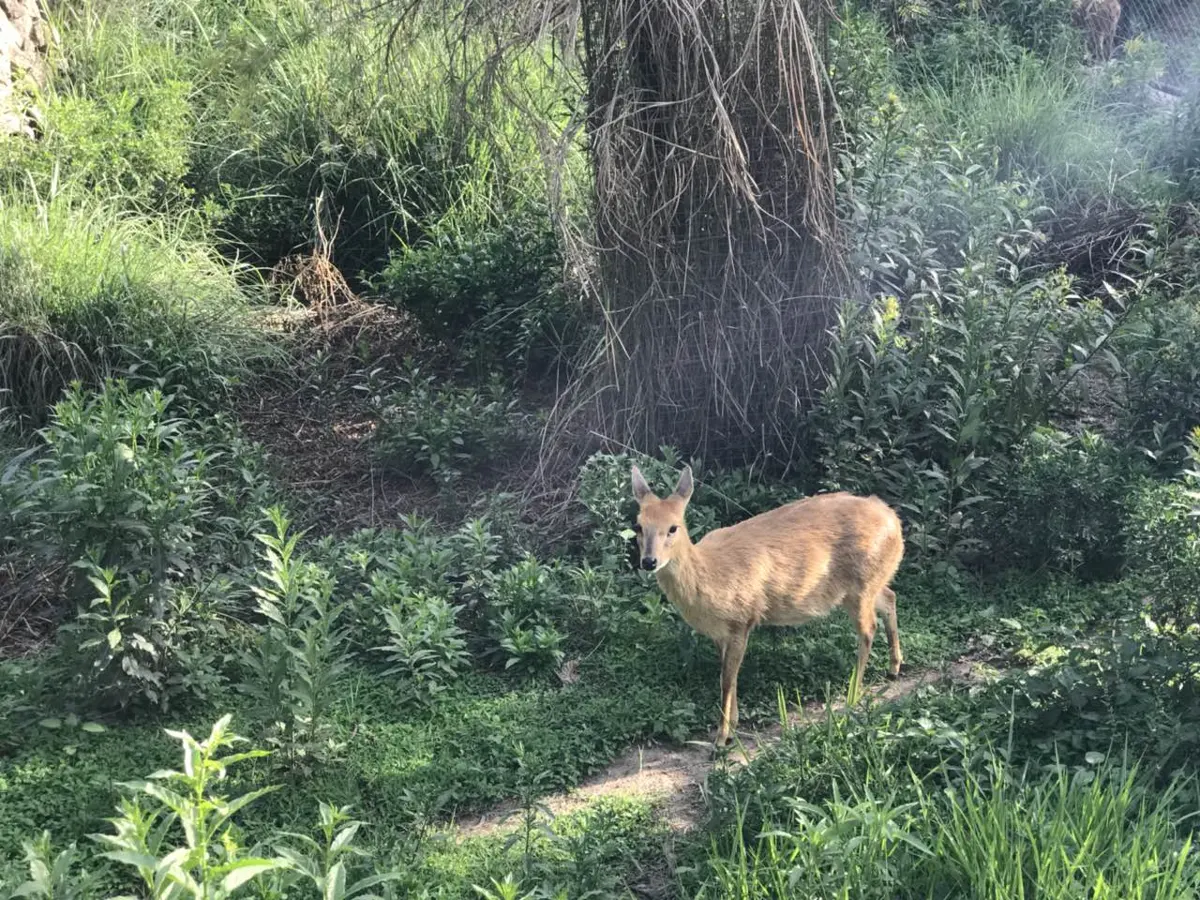
A sign says “Plucking flowers is punishable.” What does it mean?
Pick an answer to see why.
Words from the notice
| Word | Meaning |
|---|---|
| abide by | obey a rule or a law |
| obliged | made to do something by a rule or law |
| noise | a loud sound, usually unpleasant |
| premises | the land and buildings of a place |
| tease | annoy an animal or a person for fun |
| poke | push something with a finger or a stick |
| punishable | that can be punished |
| litter | rubbish dropped in a public place |
| prohibited | not allowed by a rule |
| responsibility | something it is your job to do or look after |
A. Find the words
Find the words from the text as indicated in brackets.
- a.sound (synonym)
- b.rewardable (antonym)
- c.dirt (synonym)
- d.allowed (antonym)
Answer
B. True or false?
a. Zoo officials can check tickets.
Pick an answer to see why.
b. The visitors can bring polythene bags in the zoo.
Pick an answer to see why.
c. People can take pets to the zoo.
Pick an answer to see why.
d. Smoking is allowed in the zoo.
Pick an answer to see why.
e. Visitors must keep the dirt in the bins.
Pick an answer to see why.
f. People can do business in the zoo.
Pick an answer to see why.
C. About the Central Zoo
Take help from your teacher or collect information from other sources about the Central Zoo. Then write a paragraph about it.
A model answer
D. Your favorite rule
Which rule of the zoo do you like most? Why? Explain with reasons.
A model answer
Speaking
A. In the library
In the pictures, two friends walk into a library. One is amazed at how many books there are; the other thinks there must be hundreds. Then one notices the sign: this is a silent zone, so they should keep quiet. The other understands: here they are allowed to read, but not allowed to talk. So they agree to be silent and read.
Read and act out the conversation in pairs.
A model conversation
B. Rules in six places
These are the structures to use.
| Advice | Permission | Not allowed |
|---|---|---|
| You should … | You are allowed to … | You aren’t allowed to … |
| You shouldn’t … | You can … | You can’t … |
Work in pairs. Talk to each other in the following situations using the structures.
- a.In a garden
- b.In a park
- c.In a school hostel
- d.In a zoo
- e.In a museum
- f.In a library
Model answers
Your friend says, “Can I eat my lunch in the library?” The library doesn’t allow food. What do you answer?
Pick an answer to see why.
Listening
A. Before you listen
The picture shows a boy riding a bicycle.
- a.What is the boy doing?
- b.Have you ever done this?
- c.Does it help to reduce pollution?
Model answers
The recording
Listen once for the main idea, and a second time for the day and the time.
A boy called Rehan comes to a cycling class and says he wants to learn. Sonam, who runs the class, asks whether he has ridden before. He has tried once, but doesn’t know much, so Sonam puts him in the basic course. She tells him the date today, the day and date the next class starts, the time it starts and the time he must arrive. Then she gives him a form, which needs a signature from his guardian.
B. Tick the correct answer
a. Who is going to learn cycling?
Pick an answer to see why.
b. What day of September does the class start?
Pick an answer to see why.
c. What time is the class starting?
Pick an answer to see why.
C. Write the answers
- a.When did Rehan do cycling before?
- b.Who should sign the form?
Answer
D. When you want to learn something
What do you do when you like to learn something?
A model answer
Grammar: should, have to, must, be allowed to
A. Look at the pictures
There are three scenes, each with a sentence.
- Two children see a boy who has tripped over a stone and fallen. One says: Let’s run. We should help him immediately.
- A teacher speaks to her class: Dear students, you have to be disciplined at all times. Is it okay?
- Teachers speak to the students lined up in the school compound: You are not allowed to go out of the school compound without permission.
These words come before a verb in its plain form (help, be, go) and say how necessary or allowed the action is. Here is what each one means.
| Word | What it means | Example |
|---|---|---|
| must | it is necessary; often the speaker’s own strong feeling, or a written rule | I must call my grandmother today. |
| have to / has to | it is necessary, because of a rule or someone else | We have to wear a uniform. |
| should | it is a good idea; advice | You should drink more water. |
| be allowed to / can | it is permitted | You are allowed to borrow two books. |
| don’t have to | it is not necessary, but you may if you like | You don’t have to come; it’s a holiday. |
| mustn’t / not allowed to | it is forbidden: don’t do it | You mustn’t cross here. |
Move along the line from “you must” to “you mustn’t” and see how each word changes a rule.
Tomorrow is Saturday. Which sentence fits?
Pick an answer to see why.
B. Make sentences from the table
Make as many sentences as possible from the table.
Who: We · You · They
Word: should · shouldn’t · have to · are allowed to · aren’t allowed to · must · mustn’t
Action: throw the waste materials in the dustbin · make noise in the class · play carefully in the ground · do all classwork in time · fight each other · clean the classroom daily · eat a balanced diet · write on the wall · go to the washroom with the teacher’s permission · play in the classroom
Model answers
C. have to, don’t have to or mustn’t?
Ask two questions. Is it forbidden? Then mustn’t. Is it not necessary? Then don’t have to. Is it necessary? Then have to.
Choose the correct form, have to, don’t have to or mustn’t, to complete the sentences.
- a.You …… apologize; it isn’t necessary.
- b.You …… tell the boss what happened, or he’ll fire you.
- c.I …… leave early because I am not feeling well.
- d.I …… wear a tie; I do it because I like wearing ties.
- e.You …… smoke in here; smoking is not allowed.
- f.I don’t like these clothes, but I …… wear them at work.
- g.I …… be late. It’s the most important meeting of the year.
- h.You …… go now; you can stay a bit longer.
- i.Visitors to the zoo …… feed the animals.
- j.You …… drive so fast; we have a lot of time.
- k.We …… buy more; there’s enough food.
- l.You …… put salt in her food; the doctor said she can’t eat salt.
Answer
D. and, but, because
These three words join two short sentences into one.
| Two sentences | One sentence | The word’s job |
|---|---|---|
| I bought a book yesterday. I bought a pen yesterday. | I bought a book and a pen yesterday. | adds one more thing |
| He is tall. She is short. | He is tall, but she is short. | shows a contrast |
| I didn’t come to school yesterday. I was ill. | I didn’t come to school yesterday because I was ill. | gives the reason |
When and joins two things that share words, English says the shared part once: not I bought a book and I bought a pen, but I bought a book and a pen.
Join the rules and reasons below.
E. Choose the word
Choose the correct word from the brackets to complete the sentences. (and / because / but)
- a.She was absent yesterday …… she was not feeling well.
- b.She went to the coffee shop …… had a black coffee.
- c.He was poor …… generous.
- d.Many of us were out of the classroom …… it was tiffin time.
- e.The teacher came into the classroom …… started teaching.
Answer
Reading II: Rules at the Museum
Before you read
The picture shows a girl and a boy talking, their hands open as if explaining something.
What are these children doing?
A model answer
Should we follow some rules at public places? Why?
A model answer
The conversation, part by part
- The plan. Amit asks Eshika to visit the museum on Saturday. Eshika wonders whether a museum opens on a Saturday. Amit tells her it is open on holidays and closes on Tuesday instead.
- The first rule. Eshika is excited: she wants photos of herself holding the antiques (very old, valuable objects). Amit stops her: visitors are not allowed to touch anything. They must keep their distance and only look.
- The reason. Eshika is disappointed and asks why. Amit explains that the objects are rare, and touching them could ruin them. Eshika sums it up: to save the objects, visitors must keep away from them.
- More rules. Eshika asks what they should and shouldn’t do. Amit lists them: keep silent (maintain silence), take photos only of the objects where photos are allowed, and don’t eat anything inside.
- The end. Eshika thanks him, and they agree to be ready on Saturday.
A. The crossword
Solve the puzzle here: tap a clue and type the word. The first letter of each word is given.
Look at the clues and solve the puzzle.
Across: 1. not common · 3. no office day · 6. to keep in good condition · 8. the place where historic items are kept
Down: 2. give permission · 4. length of space between two points · 5. very old · 7. destroy
Answer
B. Answer the questions
When are Eshika and Amit going to visit the museum?
A model answer
How can you say that the museum remains open for six days a week?
A model answer
Why does Amit tell Eshika the rules?
A model answer
C. Allowed or not allowed?
Read the conversation again and complete the table.
Answer
Writing: classroom rules
Rules are short and clear. Each one starts with a rule word (must, should, mustn’t, aren’t allowed to) or with a verb, as a command (Raise your hand, Don’t run). Give the most important rules first, and number them.
Write a set of classroom rules and regulations with the help of your teacher.
A model answer
Project work
Extra bit: have to, must, should
What they mean
We use have to, must and should + the plain verb (go, finish, see) to talk about obligation (things that are necessary) and to give advice (things that are a good idea).
- I must go now. (I feel it is necessary.)
- I have to finish my homework by this evening. (The teacher says so.)
- You should go to a doctor. (It is a good idea: advice.)
Read these examples and what each one means.
| Sentence | Meaning |
|---|---|
| I must remember to buy a gift for my son. | my own opinion: I feel it is necessary |
| You have to look after your wounds regularly. | someone else says so: the doctor |
| Do you have to wear a tie for school? | asking about the school’s rules |
| You mustn’t leave your bag on the bus. | it is not allowed: you have no choice |
| It’s a holiday, so you don’t have to get up early. | it isn’t necessary: you have a choice |
| In a non-smoking area you mustn’t smoke; in a smoking area you don’t have to smoke, but you can if you want to. | forbidden, then not necessary |
Has to, but always must
Have changes after he, she, it or one person’s name: has to. Must never changes.
- She has to help her children. (not she have to)
- She must fasten her seat belt. (not she musts)
Questions and negatives with have to need do or does: Do you have to go? She doesn’t have to wear a uniform.
can = are allowed to
These pairs mean the same:
- You can park here. = You are allowed to park here.
- You mustn’t speak loudly. = You are not allowed to speak loudly.
E. Put the words in order
Put the words in the correct order to make sentences.
- a.anyone · You · ! · tell · mustn’t
- b.have · early · there · to · be · we · .
- c.Dad · must · to · . · I · call · remember
- d.You · . · don’t · have · pay · to
- e.fruit · this · You · try · salad · should · !
- f.class · You · . · late · mustn’t · for · be
Answer
Exercise
Practice the whole unit. Try each one, then open the answer.
What does each sign mean? Write a rule with mustn’t or aren’t allowed to.
- a.a cigarette in a red circle with a line across it
- b.a dog in a red circle with a line across it
- c.a camera in a red circle with a line across it
Model answers
Write must, mustn’t or don’t have to.
- a.You …… wear a helmet on a motorbike. It’s the law.
- b.You …… bring lunch; the school gives free tiffin.
- c.You …… swim in the river when it is flooded.
- d.Students …… bring a pen to the exam.
Answer
Correct the mistake in each sentence.
- a.She have to get up at six.
- b.You must to finish your homework.
- c.We should not to make noise.
- d.Does he has to wear a uniform?
Answer
Give one piece of advice with should to each person.
- a.Pratik has a bad cough.
- b.Alina wants to get better marks in English.
- c.Rohan always forgets his books.
Model answers
Write four rules for visitors to a temple or a monastery near you.
A model answer
Printable PDFs
- Study notes 2 pages
- Harder practice questions 2 pages Answer key
Practice every question in the book, and keep track of the ones you miss →
A companion to your textbook, not a replacement for it: study from the book your school uses, and where the two differ, follow your teacher. Found a mistake? Please tell us.