
Whose bag is this? Whose pen is on the floor? Every day we talk about who owns what. A small word like my, her or theirs tells us at once.
This unit is about possession. Possession means owning or having something. You will learn the words that show who owns a thing: my and mine, her and hers, their and theirs. You will also visit Laura’s house in London, meet a poem about your body, and write short notes to friends.
Getting started
A. What do they own?
The unit opens with six pictures. Here is what each one shows.
- A boy in a helmet rides a bicycle.
- A family stands in front of their house.
- A girl rides a bicycle with a basket.
- A family drives in a small red car.
- A dog holds a bone in its mouth.
- A boy walks along with a mobile phone.
What things do you think they own?
Model answers
Write the correct words (his, her, their, its) under each picture. One example has been given: his bicycle.
Hint
Answer
B. Listen and sing
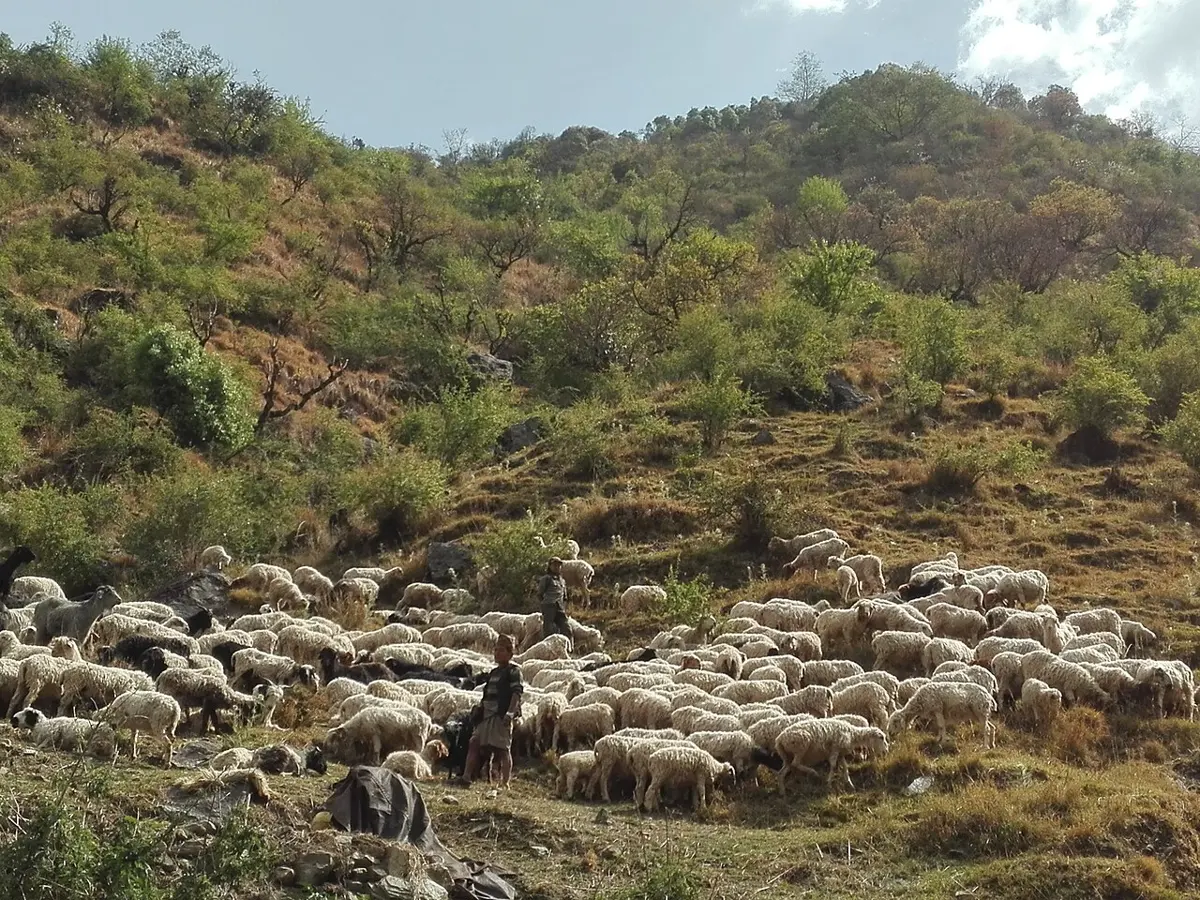
The song is about a shepherd. A shepherd is a person who looks after sheep. It has three short verses.
- His home on the mountain. The shepherd takes good care of his sheep. He has a simple tent near some trees, where he rests and sleeps.
- Danger. He keeps watch for wild leopards, so their claws don’t reach his flock (his group of sheep). If he sees one coming, he throws a big rock at it.
- A lonely life. He lives high on the mountain ridge, far from other people. When he needs supplies (food and other things he must buy), he has a long walk down to the village.
Listen for the little word his: his sheep, his way, his supplies. The sheep and the supplies belong to the shepherd.
How do you keep your possessions safe? Discuss with your friends.
A model answer
Reading I: Rooms in my House
Before you read
How many rooms do you have in your house?
A model answer
Which room is your favorite one? Why?
A model answer
Laura’s house, part by part
Laura is a girl who lives in London, the capital city of the United Kingdom. She shows us round her house.
- The house. It is small but beautiful, with two storeys (floors) and a garden full of flowers. It has a kitchen, a dining room, a living room, her father’s study room, two bedrooms and a bathroom.
- Her bedroom. It is upstairs, next to her parents’ room. She shares it with her brother. It is small, and it has no balcony, but it is her favorite room.
- In her bedroom. The bed is by the door. A big clock hangs on the wall above the bed. There is a small bedside table. Opposite the bed is a big window with pretty curtains. Her desk and chair stand beside the window, and she does her homework there.
- Whose things she uses. She uses her brother’s computer to seek (look for) information on the internet. She uses her mother’s mobile phone to have fun and to learn.
- Her parents’ room. It has a big closet for the family’s clothes, a red carpet, and many family photos on the walls.
- The living room. It is spacious (big, with lots of room) and bright. Laura keeps it tidy. The walls are blue, and the floor is salmon, a pinkish orange. There are two sofas, a coffee table, some stools, a small round table and a bookshelf full of books. A small plant in a vase sits on the bookshelf, and a big plant in a vase stands in the corner.
Notice the little words that show whose things they are: my room, my brother’s computer, my mother’s phone, our parents’ room, our clothes.
Laura says she uses her brother’s computer. Whose computer is it?
Pick an answer to see why.
Words from the text
Words linked here open in English Vocabulary, where you can practice them in a game.
| Word | Meaning |
|---|---|
| garden | land next to a house where flowers or vegetables grow |
| storey | one floor of a building (a two-storey house); American English spells it story |
| hang | to be held from above, not resting on the floor (the clock hangs on the wall) |
| bedside table | a small table next to a bed |
| seek | to look for |
| closet | a cupboard for clothes, often built into a wall |
| spacious | big, with plenty of room |
| tidy | neat, with everything in its place |
| salmon | a pinkish-orange color, like the meat of the salmon fish |
| vase | a pot or jar for flowers or plants |
A. Find the things in the picture
The unit’s picture is a bedroom with a bed, a window, a wardrobe and a shelf of toys. Our bedroom below has the same things. Find them.
Show these things in the picture: wardrobe, lamp, window, bedside table, toy, pillow, carpet, shelf.
Model answers
Now say where each thing is. The little words on, under, next to and above tell us.
B. True or false?
a. Laura’s house is a one-storey building.
Pick an answer to see why.
b. Laura and her brother live in the same room.
Pick an answer to see why.
c. Laura has no balcony in her room.
Pick an answer to see why.
d. There are two windows in the room.
Pick an answer to see why.
e. Laura also has books in the living room.
Pick an answer to see why.
f. The living room is very big.
Pick an answer to see why.
C. Answer the questions
Where does Laura live?
Answer
How many rooms are there in her house?
Answer
Which room is her favorite?
Answer
Who has got a computer?
Answer
Why does she use her mother’s mobile phone?
Answer
Where are the two vases?
Answer
D. Where do you keep your things?
Where do you keep your belongings in the house? Share with your friends.
A model answer
Pronunciation
The letters oo can make three different sounds. Say these words.
| Like moon /uː/ | Like blood /ʌ/ | Like door /ɔː/ |
|---|---|---|
| room, broom, groom, moon, soon, loop, loot, too, boot, cool | blood, flood | floor, door, poor, moor |
- In most oo words, it is a long sound, as in moon and cool.
- In blood and flood, it is short, like the u in cup.
- In floor and door, it sounds like the or in for.
Grammar I: whose is it?
A. Who do the words refer to?
Read the short paragraph about Meena. Some words in it stand for a person or a thing named before: she, her, their, they, its, our, my. Ask who? or what? to find the noun each one stands for.
Who do the words in red refer to? (She refers to Meena.)
Answer
Words that show who owns something
We can show who owns something in two ways.
1. With ’s after a name or noun: Laura’s room, my brother’s computer, the dog’s bone. For more than one owner ending in -s, add only ’: the riders’ horses, my parents’ room.
2. With a possessive word. There are two kinds.
- Possessive adjectives come before a noun: my book, her house.
- Possessive pronouns stand alone, with no noun after them: It’s mine. It’s hers.
| Person | Before a noun | Alone |
|---|---|---|
| I | my book | The book is mine. |
| you | your pen | The pen is yours. |
| he | his bag | The bag is his. |
| she | her house | The house is hers. |
| it | its tail | (none) |
| we | our school | The school is ours. |
| they | their car | The car is theirs. |
Look at the words that stand alone. Most of them end in -s: yours, hers, ours, theirs. Mine is different, and his is the same in both columns.
Is this pen ___? I found it under your desk.
Pick an answer to see why.
The cat is sleeping in ___ basket.
Pick an answer to see why.
B. Make sentences from the table
Take one part from each column to make a sentence. Make sure the sentence makes sense: It is goes with one thing, They are and Are these with more than one.
| It is | my | book. |
| This is | her | house. |
| She is | his | sister. |
| They are | their | cars. |
| We love | our | country. |
| Are these | shoes? |
Make as many sentences as possible using the table.
Some of the sentences
C. Choose the correct word
Choose the correct words and rewrite the sentences.
- a.Is this your/yours pen?
- b.He lives in hers/her house.
- c.The coffee is my/mine.
- d.I met theirs/their mother.
- e.The new bicycle is her/hers.
- f.These cakes are my/mine.
Hint
Answer
D. Complete the sentences
Complete the sentences with the correct words: his, her, my, its, their, theirs, our, hers. You can use the words more than once.
- a.This is …… book. It’s mine.
- b.Is this Ramita’s book? Yes, it’s …… .
- c.Where is …… pen which she gave you yesterday?
- d.They have bought my car. Now, it’s …… .
- e.This is Bhim’s dog. …… dog can swim well.
- f.My friends leave books in the classroom. These are …… books.
- g.The dog keeps moving …… tail.
- h.These cakes are ……, not yours.
- i.This is …… house. It’s ours.
- j.What do you call it? Do you know …… name?
Answer
Listening
A. Before you listen
Look at the picture and guess the answers. (A woman in a suit holds out a key to a man and a woman. Behind them is a house.)
- a.Who are these people?
- b.What are they doing?
Model answers
Now listen. Read the sentences in B first, so you know what to listen for.
B. Complete the sentences
Listen and complete the sentences with the words from the box: California, heating, very low, family, 300, six.
- a.The ceiling is …… in the house.
- b.The house is …… years old.
- c.Her …… lived here for nearly 80 years.
- d.There are …… bedrooms.
- e.The house has a central …… system.
- f.They feel cold because they are from …… .
Answer
A ceiling is the inside top of a room, above your head. Central heating warms every room of a house from one place, with hot water in pipes. California is a warm state on the west coast of the United States.
Why do the visitors feel cold in the old house?
Pick an answer to see why.
C. Renting or owning
To own a house is to have it as your own. To rent a house is to live in someone else’s house and pay them money every month.
Do your parents or guardians rent or own a house? What are the good and bad things about renting or owning a house? Share your ideas with your friends.
A model answer
Speaking
A. Report what they say
The pictures show four people, each saying one line. When you tell a friend what someone said, change my to his or her.
| What the person says | What you report |
|---|---|
| A woman: This is my house. | This is her house. |
| A teacher: This is Reena’s house. | This is Reena’s house. It is her house. |
| A father: This is my son. | This is his son. |
| A girl: This is my dog. | This is her dog. |
Your friend Kushal says, “This is my bicycle.” How do you report it?
Pick an answer to see why.
B. Act out the conversations
There are two short conversations. In the first, someone asks where your book is, and you say you left it at home; then someone asks if a pen is yours, and you say it is your friend’s. In the second, a teacher asks for your homework, and you say sorry, you forgot the exercise book; then the teacher asks what is in your bag, and you list your sister’s notebook, your brother’s toy car, your color pens and your lunch box.
Notice the words that show the owner: your book, my house, is it yours?, not mine, my friend’s pen, my sister’s notebook.
C. Whose are these?
Four people answer in turn. The first asks Whose …? The second answers with the owner’s name (’s). The third uses her, his, their with the noun. The fourth uses hers, his, theirs alone.
Ask and answer as in the example: pencils / Rima / her / hers. (Whose pencils are these? These are Rima’s pencils. These are her pencils. They are hers.)
- a.books / Rita’s / her / hers
- b.mobile phone / father’s / his / his
- c.earrings / mother’s / her / hers
- d.songs / Anju’s / her / hers
- e.horses / rich riders’ / their / theirs
- f.house / our / ours
Answer
D. Five things at home
Make a list of five things in your house. Talk to your friends and explain who they belong to.
A model answer
Reading II: How I am Made
Before you read
The picture shows a boy in shorts. Around him are close-ups of parts of his body, joined to him by lines.
Name the parts of the body shown in the picture.
Model answers
Choose any three parts of the body you have named and explain their functions.
Model answers
The poem, verse by verse
The poem is by Michael Salinger, an American poet. The speaker, I, tells us what each part of the body does. It has four verses.
- Feet, belly, eyes, hands. I stand on my feet. My belly (stomach) takes in the food I eat. My eyes see the world. My hands grab and hold things.
- Lungs, knees, mouth. My lungs breathe in air: you can’t see the air, but you can feel it, fresh and clear. My knees bend so I can jump. My mouth likes to gab (chat) and hum (sing with the lips closed).
- Heart and brain. My heart pumps blood, which travels to every part of the body. My brain makes everything work, so that I can learn.
- All of me. All these bits (small parts), even the ones you can’t see, are joined together. Together, they make me.
The poem’s big idea is in the last verse: no part works alone. You are all the parts working together.
Listen for the rhymes at the ends of the lines: feet rhymes with eat, and blood nearly rhymes with god. The poet also uses the word my again and again: my belly, my eyes, my hands, my lungs. The body’s parts are mine.
Words from the poem
| Word | Meaning |
|---|---|
| belly | the stomach; the front of the body below the chest |
| grab | to take hold of something quickly |
| hold | to have something in your hands and keep it there |
| lung | one of the two parts in the chest that we breathe with |
| bend | to bow or curve; to fold at a joint, as a knee does |
| gab | to chat; to talk a lot |
| hum | to sing with your lips closed |
| pump | to push liquid along, as the heart pushes blood |
| bits | small pieces or parts |
A. Match the words
Match the words in column A with their meanings in column B.
| Column A | Column B |
|---|---|
| belly | grasp and carry |
| grab | chat or talk |
| hold | stomach or tummy |
| bend | small pieces |
| gab | catch or snatch something |
| bits | bow or curve |
Answer
B. Answer the questions
What do eyes do?
Answer
Why do we need lungs?
Answer
What does the heart do?
Answer
What does the brain do?
Answer
How many parts of the body are mentioned in the poem? Make a list of them.
Answer
C. Which part works the most?
Which part of the body do you think works the most? Why?
A model answer
Writing II: short notes and messages
A note is a short piece of writing for one person, often on a small card or a sticky paper. A message can be on paper or on a phone. Every note has a purpose, a reason it is written:
- Wishing: hoping good things for someone (Happy Birthday!).
- Inviting: asking someone to come to something.
- Accepting: saying yes to an invitation.
- Thanking: saying thank you.
- Welcoming: saying you are happy someone has come.
A note has three parts: the greeting (Dear Sam,), the message, and your name at the end.
A. Label the notes
There are six notes. Here they are in our words:
- To Dad: you are my role model, my hero and my best friend; I love you; Happy Birthday! (This one is labeled Wishing for you.)
- To Lara, from Jara: you are funny; do you want to play at my house? Say yes!
- To Jara, from Lara: okay, I can come to your house; tell your mom to call my mom.
- To a teacher: wishing you joy and happiness; you are an amazing teacher; Happy Teacher’s Day!
- To Jim, from Jenny: thanks for your wonderful gift; I really liked it.
- To Sam, from Ben: welcome to our class; I am excited to have you here.
Label the notes with their correct types: Wishing, Accepting, Thanking, Welcoming, Inviting. One will be used twice.
Answer
Notes 2 and 3 go together: Jara invites, and Lara accepts. A good reply answers the note it got.
B. Write notes
Write similar short notes and messages for these situations.
- a.Invite your friend to your birthday party.
- b.Thank your friend for helping with your homework.
- c.Wish your teacher a happy wedding anniversary.
- d.Wish your friend a happy new year.
Hint
Model notes
Grammar II: pronouns
A noun is the name of a person, place or thing: Jivan, Kathmandu, dog, book. A pronoun is a short word that takes the place of a noun, so we don’t say the noun again and again: Jivan is a curious boy. He told me the news.
| As the doer (before the verb) | After the verb or after to, with, for |
|---|---|
| I | me |
| you | you |
| he | him |
| she | her |
| it | it |
| we | us |
| they | them |
- Use he for a man or boy, she for a woman or girl, it for a thing or an animal, they for more than one.
- A name and I together become we: Dawa and I → we.
Rajiv and Sneha are in my class. ___ sit in the front row.
Pick an answer to see why.
I saw Ankit at the market. I waved to ___.
Pick an answer to see why.
A. Nouns or pronouns?
What do the words in red mean? Are they nouns or pronouns?
- a.Jivan is a curious boy. He told me the news.
- b.Kristina has got a dog. She loves her dog.
- c.Karma has got a cat. He plays with it.
- d.We have got a garden. It is very beautiful.
- e.I have got a book.
- f.They have got a car.
- g.She is living in Kathmandu now.
- h.They always play together.
Answer
B. Replace the nouns
Replace the nouns in red with their correct pronouns. Example: Pema is a dancer. → She is a dancer.
- a.Ellen is an actress.
- b.Bandana is from Bhojpur.
- c.Daya, Rakesh and Dolma are good friends.
- d.Hassim has many friends.
- e.Ask Radha to come here.
- f.Rama helps Ambir.
- g.Arjun is teaching students.
- h.Did you see Nabin on the way?
- i.He and I are going to school.
- j.We have a dog. The dog can’t bark.
Answer
Do it yourself
Exercise
Practice the whole unit. Try each one, then open the answer.
Choose the correct word.
- a.This umbrella isn’t ……… (my / mine). It’s my brother’s.
- b.……… (Our / Ours) teacher is very kind.
- c.The puppy is chasing ……… (its / it’s) tail.
- d.Is that bag ……… (your / yours)?
- e.The red house is ……… (their / theirs).
Answer
Rewrite using the word that stands alone.
- a.This is my pencil. → This pencil is ……… .
- b.That is her scarf. → That scarf is ……… .
- c.These are our books. → These books are ……… .
Answer
Replace the words in bold with pronouns.
- a.Tashi and Lhamu live in Solukhumbu.
- b.I gave the letter to Anisha.
- c.The bus was late.
- d.My mother and I went to the market.
Answer
Say which oo sound each word has: like moon, blood or door.
a. food b. flood c. floor d. pool
Answer
Write a note to welcome a new student, Yugin, to your class.
A model note
Printable PDFs
- Study notes 2 pages
- Harder practice questions 2 pages Answer key
Practice every question in the book, and keep track of the ones you miss →
A companion to your textbook, not a replacement for it: study from the book your school uses, and where the two differ, follow your teacher. Found a mistake? Please tell us.