
It is your first day at a new school. You don’t know anyone. A girl smiles at you. What do you say first? And what do you say when the day is over?
This unit is about meeting people. You will learn how to greet people, how to introduce yourself and your friends, and how to say goodbye. You will also learn to use capital letters and full stops, to talk about what you do every day, and to use the small words at, on and in with times.
Getting started
A. What are they doing?
The unit opens with five pictures of people meeting and leaving. Here is what each one shows.
- A school bus is leaving. A woman by the road waves to the children on the bus.
- Two boys shake hands. One says, “Hello, my name is …”
- A boy points to his friend and says, “Meet my friend …” to another boy.
- Two schoolboys with bags wave to each other.
- A girl and a boy wave to each other with big smiles.
Look at the pictures. Guess what they are doing.
Model answers
Three words will help you all through this unit.
- To greet someone is to say hello when you meet. Namaste! Good morning! Hi!
- To introduce someone is to tell people who they are. I’m Dawa. This is my friend Rojina.
- To take leave is to say goodbye when you go. Bye! See you tomorrow!
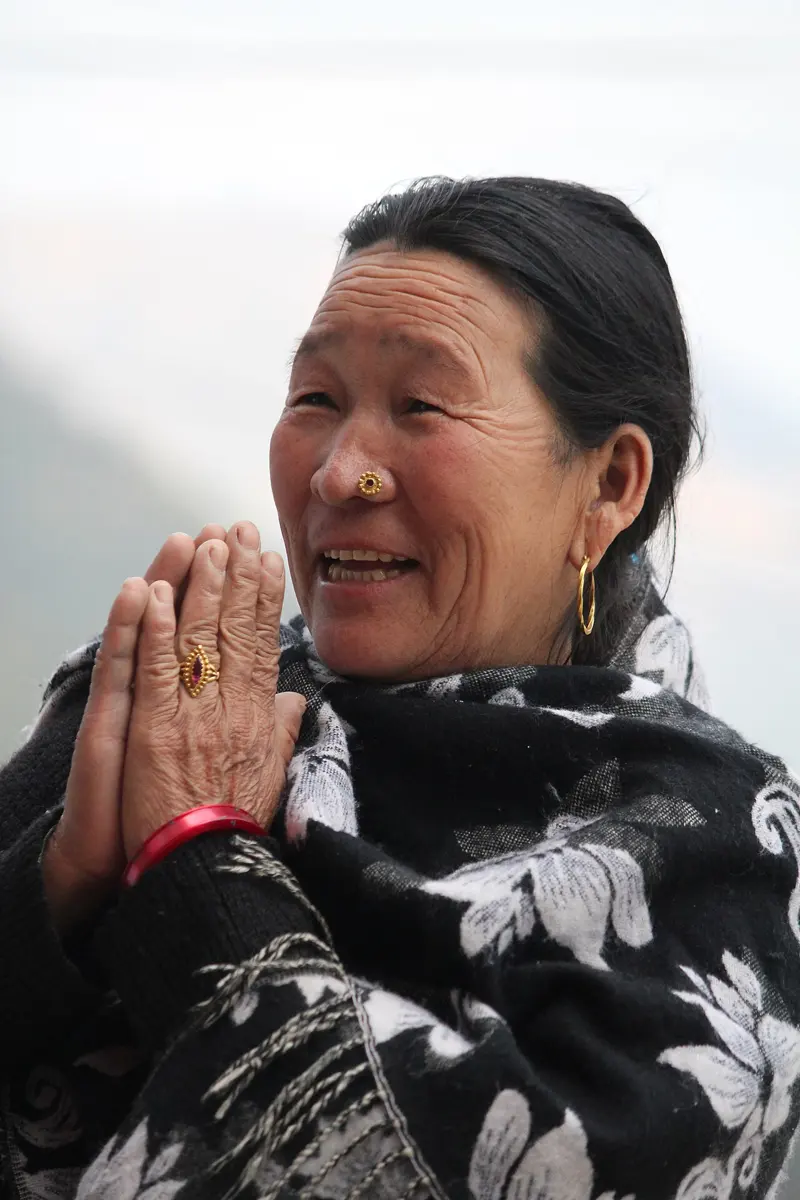
You meet your teacher in the morning. What do you say?
Pick an answer to see why.
B. Listen and sing
The song has two short verses. In the first verse, a singer says hello and asks three questions: How are you? What is your name? And what do you do? In the second verse, a child answers them: “I’m fine, thank you”, her name, and that she goes to school.
So the song is a tiny conversation. It greets, it asks, and it answers.
Sing the song again with your own name in place of Nita.
A model
Reading I: Kumari’s First Day at Saraswati Basic School
Before you read
The picture shows a big yellow school bus. Two people walk to its door, and the driver sits at the front.
Who do you think these people are?
A model answer
What do you think they are doing?
A model answer
What might they be saying to each other?
A model answer
The story, picture by picture
The story is told in eight pictures, each with one or two lines under it. Kumari is a new girl. It is her first day at Saraswati Basic School.
- At the gate. The gatekeeper salutes and welcomes Kumari and her family. A gatekeeper is the person who looks after a school’s gate.
- In the office. The headteacher says namaste and tells them her name, Dolma. A headteacher is the teacher in charge of a school.
- In the classroom. Kumari greets the class with Good morning. She says her full name, Kumari Majhi, and that she is from Kaski.
- With a new friend. A classmate greets Kumari. She introduces her friend Rita, who is from Dolakha.
- Kumari meets Rita. Kumari says she is pleased to meet her. Pleased means happy.
- Rita answers. She is happy to meet Kumari too.
- School is over. Kumari says goodbye to the whole class.
- At the door. Kumari’s friend says they had a wonderful day, and See you soon. Wonderful means very, very good.
Look at what each person does. First they greet. Then they introduce. At the end they say goodbye.
| They greet | They introduce | They say goodbye |
|---|---|---|
| Namaste! | I’m Dolma. I’m the headteacher. | Goodbye to you all. |
| Good morning, dear all. | I’m Kumari Majhi. I’m from Kaski. | See you soon. |
| Hello, Kumari. | Meet my friend, Rita. |
Kumari says, “I’m from Kaski.” What does she tell the class?
Pick an answer to see why.
Words from the story
Words linked here open in English Vocabulary, where you can practice them in a game.
| Word | Meaning |
|---|---|
| gatekeeper | the person who looks after a gate and lets people in |
| headteacher | the teacher in charge of a school (also head teacher) |
| pleased | happy |
| wonderful | very, very good |
| goodbye | what you say when you leave |
A. Complete the sentences
Complete these sentences with the correct words: wonderful, gatekeeper, headteacher, pleased.
- a.My mother works in a community school. She’s the ……… there.
- b.The ……… stopped the guests and checked their invitations.
- c.Ganesh was ……… to meet his friends yesterday.
- d.Tony’s birthday party was really ……… .
Answer
B. Answer the questions
Who did Kumari go to school with?
Answer
What is the name of Kumari’s new school?
Answer
Where is Kumari from?
Answer
How did she introduce herself?
Answer
How did Kumari say goodbye to her friends?
Answer
C. Expressions and responses
An expression is what one person says. A response is what the other person says back.
Fill in the table with suitable expressions and responses.
| Expressions | Responses |
|---|---|
| Nice to meet you. | ……… |
| ……… | See you tomorrow. |
| Hi, I’m Mahesh. | ……… |
| ……… | Nice to meet you too. |
| Hi, Diana. Meet my friend, Satyam. | ……… |
Model answers
Pronunciation
Learn to say these expressions. There are nine:
- Introducing: Hi, my name is Sundar. Hello, I’m Victor. Meet my friend, Janaki. Let me introduce myself. I’m Bindu.
- Answering: Pleased to meet you. Nice to meet you.
- Saying goodbye: See you soon. Take care. Goodbye.
Tap each one to hear it. Then say it after the voice.
In a short expression, we don’t say every word equally. The important word is louder and longer: Nice to meet you. See you soon. Little words like to, you and my are quick and soft.
Writing I: capital letters and full stops
A sentence is a group of words that makes complete sense. Every sentence starts with a capital letter (A, B, C …) and ends with a full stop ( . ).
Capital letters are also used for:
- names of people: Ishika, Abhijit, Kumari Majhi
- names of places: Nuwakot, Jhapa, Nepal
- the word I, always: I am ten. I’m from Bara.
Which sentence is written correctly?
Pick an answer to see why.
A. Capitals and full stops
Use capital letters and full stops where necessary.
hi, my name is ishika pandit i’m from nuwakot i live with my family in jhapa my mother is a government officer and my father runs a small business i have a younger brother, abhijit, who is just four my parents always give me everything i ask for i love my family very much
Hint
Answer
B. Write about yourself
Now write a similar paragraph about yourself. Use the text above as an example.
Hint
A model answer
Grammar I: the present simple
A. Study the sentences
Look at the verbs in bold in these sentences.
- The gatekeeper welcomes Kumari’s family.
- I**’m** the headteacher of this school. I am not a student.
- He studies in Grade 5. He does not like English much.
- She is from Dolakha. She is not from Kathmandu.
- They have a cute puppy, but I don’t have one.
All these verbs are in the present simple. We use it for:
- things that are true now: Kumari is from Kaski.
- things we do again and again, every day or every week: He studies in Grade 5.
The verb “be”: am, is, are
| Yes (positive) | No (negative) | |
|---|---|---|
| I | I am (I’m) a student. | I am not (I’m not) a teacher. |
| he, she, it, one name | She is (she’s) from Kaski. | She is not (isn’t) from Jumla. |
| you, we, they, two or more | They are (they’re) here. | They are not (aren’t) late. |
Other verbs: one -s for he, she and it
| Yes (positive) | No (negative) | |
|---|---|---|
| I, you, we, they | I like milk. | I don’t like milk. |
| he, she, it, one name | She likes milk. | She doesn’t like milk. |
Questions use do and does: Do you like tea? Does Emily swim on Saturdays?
How to add -s:
- Most verbs add -s: like → likes, swim → swims, work → works.
- Verbs ending in -sh, -ch, -s, -x, -o add -es: wash → washes, watch → watches, go → goes, do → does.
- A consonant + y changes to -ies: study → studies, carry → carries.
- have → has.
Which sentence is correct?
Pick an answer to see why.
My parents ___ in Butwal.
Pick an answer to see why.
Pemba ___ like spicy food.
Pick an answer to see why.
B. Answer about yourself
Answer these questions. Write complete sentences.
- a.Where do you live?
- b.Do you like tea or coffee?
- c.What does your mother do?
- d.What time do you arrive at school?
- e.What do you not want to do at school?
- f.What do you do on Saturdays?
- g.Write one thing that you do every day.
- h.Write one thing that you don’t do in the morning.
- i.Write one thing that your father or mother doesn’t do.
- j.What do you like about your school?
Hint
Model answers (from a boy called Sujan)
C. Choose the correct word
Choose the correct alternative from the brackets to complete these sentences.
- a.We often ……… English books. (reads/read)
- b.Emily ……… in the river every Saturday. (swim/swims)
- c.I like lemonade very much, but my brother ……… . (don’t/doesn’t)
- d.Janet ……… jeans (likes/doesn’t like), but she likes trousers.
- e.Mr. Tamang is a teacher. He ……… at a school. (work/works)
- f.Your house ……… (looks/look) beautiful. I like it.
- g.They ……… a party every month. (have/has)
- h.……… after school? (What do you do/What does you do)
- i.Our class teacher’s name ……… Khem. He is from Nepal. (is/are)
- j.I ……… in Grade 5. (am/are)
Answer
Listening
A. Before you listen
Look at the picture and guess the answers. (A woman in a jacket stands at a desk, a lectern, and speaks with her hands open.)
- a.Who is she?
- b.What could she be speaking about?
Model answers
Now listen. Read the questions in B first, so you know what to listen for.
B. Choose the correct answers
a. How old is Sara Lambert?
Pick an answer to see why.
b. Where is she from?
Pick an answer to see why.
c. How many children does she have?
Pick an answer to see why.
d. What can she do?
Pick an answer to see why.
e. What doesn’t she have at home?
Pick an answer to see why.
C. What do you remember?
Write as much information from the audio as you can remember. Compare your list with your friend’s.
A model list
Speaking
A. Introducing and saying goodbye
| Introducing | Saying goodbye |
|---|---|
| My name is … | Goodbye. |
| I’m … | See you tomorrow. |
| Nice to meet you. I’m … | Sorry, I’ve got to go now. |
| Jack, please meet Nicholas. | Bye. |
| I’d like you to meet Liza. | I think I must go now. |
| Lila, this is Anil. Anil, this is Lila. | See you later. |
The first three expressions introduce yourself. The last three introduce other people. When you introduce two friends, say each one’s name to the other: Lila, this is Anil. Anil, this is Lila.
Some goodbyes are short and friendly: Bye! See you! Some say why you are leaving: Sorry, I’ve got to go now.
You want two of your friends to know each other. What do you say?
Pick an answer to see why.
B. Act out the conversation
Two children meet for the first time. Here is their conversation, shortened.
Ramesh:says hi and gives his name.
Timila:says hello and gives her name.
Ramesh:asks where she is from.
Timila:says Tanahun, and asks him back: and you?
Ramesh:says Lamjung.
Timila:says it was nice meeting him.
Ramesh:says the same back, too, and goodbye.
Timila:says bye.
Notice and you? It is a short way to ask the same question back. Tanahun and Lamjung are neighbors in Gandaki Province.
C. In these situations
How do you respond in the given situations? Have conversations in pairs.
- a.You meet a stranger on the way to school. You want to introduce yourself to him or her.
- b.You want to introduce one of your friends to your classmates.
- c.Your school is over. You want to take leave of your friends.
Model conversations
Reading II: Tree Leaves
Before you read
The picture shows a tree. Its leaves look like splashes of paint: red, orange, yellow, green, blue and purple.
What do you see in the picture?
A model answer
What happens when the leaves of a tree fall down?
A model answer
The poem, verse by verse
A poem is a short piece of writing in lines. Its words are chosen for their sound as well as their meaning. This poem has three verses (groups of lines): four lines, four lines, then five. The poet speaks as I.
- The leaves fall. Leaves in four colors drop from the trees. Why? The poet’s answer is that winter called them, so they let go of their stems. (The stem is the thin stalk that holds a leaf to a twig.)
- They land on the poet. Some land on the poet’s head, some on a hand. The poet wonders where the rest will come down. To wonder is to ask yourself a question. Watching them, the poet sees them dance and play in the wind.
- They sing and say goodbye. The leaves keep falling the whole day, and the poet imagines them singing one lovely song together. At the end they come close and bid goodbye (say goodbye), then fly up towards the sky once more. The poet says this last line twice, like an echo.
Leaves can’t really dance, play, sing or say goodbye. The poet writes about them as if they were people. This makes the falling leaves feel alive and happy, not sad.
Rhyme
Say these word pairs aloud: brown, down. hand, land. They end with the same sound. Words that end with the same sound rhyme. In this poem, most pairs of lines next to each other end in rhyming words.
Rhyme is about sound, not spelling. Goodbye and sky rhyme, though one ends in -ye and the other in -y.
Which word rhymes with song?
Pick an answer to see why.
Words from the poem
| Word | Meaning |
|---|---|
| stem | the thin part that joins a leaf or flower to the plant |
| wonder | to ask yourself about something you want to know |
| land | (verb) to come down onto the ground |
| bade | said (an old past form of bid: “bade goodbye” means “said goodbye”) |
A. Rhyming words
Find the words from the poem that rhyme with the given words. Add at least one more rhyming word yourself for each of them: brown, them, hand, long, goodbye.
Answer
B. Answer the questions
What are the colors of the fallen leaves?
Answer
Why have the leaves fallen down?
Answer
Where did the leaves fall?
Answer
What did the leaves do after they fell on the ground?
Answer
Where did the leaves go again?
Answer
C. When do leaves fall?
In which season do tree leaves fall, and why? Talk to your friends.
A model answer
Grammar II: at, on and in for time
A. Study the sentences
Look at the small words in bold. They tell us when.
- Kushal came here in the morning.
- We usually go swimming on Sundays.
- My birthday is in January.
- My father always gets up at 4 a.m.
- Where were you on the 10th of Baishakh?
These little words are prepositions of time. Choose them by how long the time is.
| Word | Use it with | Examples |
|---|---|---|
| at | a clock time: a point | at 1 p.m., at 7:30, at noon, at night |
| on | a day or a date | on Friday, on Sundays, on 5th May, on my birthday |
| in | a longer time: part of a day, a month, a season, a year | in the morning, in the evening, in June, in winter, in 1960 |
| in | after a length of time from now | in ten minutes, in two days |
A small clock time gets at. A whole day gets on. Anything longer than a day gets in.
Our school sports day is ___ Friday.
Pick an answer to see why.
Rhododendrons bloom ___ spring.
Pick an answer to see why.
B. Complete the sentences
Complete the given sentences with the correct alternatives from the brackets.
- a.Can you come ……… (at/on) Friday?
- b.It rains a lot ……… (on/in) winter here.
- c.My birthday is ……… (at/on) 5th May.
- d.We usually have lunch ……… (at/in) 1 p.m.
- e.We didn’t have classes ……… (on/in) June.
- f.I will be back ……… (at/in) ten minutes.
- g.My grandfather married ……… (in/at) 1960 AD.
- h.Go and meet your father ……… (at/in) the evening.
- i.The next class is ……… (at/on) 9 a.m. ……… (on/in) Monday.
- j.We had a party ……… (at/on) my birthday.
Answer
Writing II: an email
An email is a letter sent by computer or phone. It is short and friendly. A friendly email has these parts:
- To: the email address of the person you write to.
- Subject: a few words that say what the email is about.
- Greeting: Hi, Nitish or Dear Nitish.
- Body: what you want to say, in short sentences.
- Closing line: Hope to meet you soon. or Write back soon.
- Your name.
Nitish has asked his friend Sanila about her family. Here is her reply, with five gaps.
Complete the email using suitable information from the box.
Box: He always tells good stories to me · five members in my family · My mother is a nurse · our grandfather · to talk about my family and me
Hi, Nitish,
I hope you are fine. You have asked me (a) ……… in your email. I live in Bidur, Nuwakot. There are (b) ……… . My father has a business. (c) ……… in a private hospital. My elder brother, Janak, studies in Grade 7. We live with (d) ……… . He is 80 years old. (e) ……… .
Hope to meet you soon.
Sanila
Hint
Answer
Which is the best subject line for Sanila’s email?
Pick an answer to see why.
Do it yourself
Exercise
Practice the whole unit. Try each one, then open the answer.
Write a response to each expression.
- a.Hello, I’m Yugin. Nice to meet you.
- b.Lhakpa, this is my cousin Nirjala.
- c.Sorry, I’ve got to go now.
- d.See you tomorrow.
Answer
Rewrite with capital letters and full stops.
my uncle lives in dhangadhi he has a small shop i visit him every winter
Answer
Choose the correct word.
- a.Alina ……… (live / lives) near the river.
- b.We ……… (doesn’t / don’t) go to school on Saturdays.
- c.……… (Do / Does) your sister like mangoes?
- d.I ……… (am / is) from Syangja.
- e.The shops close ……… (at / on / in) 8 p.m.
- f.Holi comes ……… (at / on / in) spring.
Answer
Make these sentences negative.
- a.Nabin likes football.
- b.They are in Grade 5.
- c.I eat meat.
Answer
Find the word that rhymes with the first one.
- a.night: (light / nice / knit)
- b.play: (plan / day / ply)
- c.tree: (true / three / tie)
Answer
Printable PDFs
- Study notes 2 pages
- Harder practice questions 2 pages Answer key
Practice every question in the book, and keep track of the ones you miss →
A companion to your textbook, not a replacement for it: study from the book your school uses, and where the two differ, follow your teacher. Found a mistake? Please tell us.