
Push your hand into the middle of a heap of freshly cut grass, a sack of sprouting potatoes, or a pile of rice straw left out after the harvest: it is warm, sometimes hot. Nobody lit a fire. The warmth comes from millions of living cells taking their food apart, slowly, step by step, and catching the energy as they go. A little of it always escapes as heat. This is respiration, and plants do it every moment of their lives, in the light and in the dark, in every living cell from the root tip to the petals.
In the last unit a leaf built sugar from carbon dioxide and water with the energy of sunlight. This unit follows that sugar back the other way: how a cell breaks it down, where in the cell each step happens, how much energy it gets, and what it does when there is no oxygen.
2.3.1 Introduction and significance of respiration
Burn a spoonful of sugar over a flame and it flares, chars and gives off all its energy at once as heat and light. A cell can’t do that: the heat would cook it, and heat can’t be used to build or pump anything. Instead, a cell takes the sugar apart in many small steps, each one controlled by its own enzyme, and at several of those steps it catches a small packet of the energy in a form it can use.
Cellular respiration is the breakdown of food materials within the cell to release energy, and the trapping of that energy to make ATP. The food is oxidized: the C–C and C–H bonds of glucose are broken, its hydrogen is taken off (and its electrons with it), and its carbon leaves as carbon dioxide. Because it breaks large molecules into small ones, respiration is a catabolic process (from Greek kata, down). Photosynthesis, which builds them up, is anabolic.
For glucose broken down completely with oxygen, the overall result is:
A mole of glucose is 180 g. So each gram releases about 16 kJ (3.8 kcal): the “4 kilocalories per gram of carbohydrate” printed on food packets.
That equation looks like burning, and the products are the same, but nearly everything else differs. Burning happens at hundreds of degrees, all at once, with no enzymes. Respiration happens at the cell’s own temperature, in about twenty separate steps, and catches roughly a third of the energy in ATP; the rest leaves as heat, which is why the grass heap is warm.
Cell drawings adapted from Servier Medical Art (smart.servier.com), CC BY 4.0
ATP, the energy currency of the cell
ATP, adenosine triphosphate, is a nucleotide: the base adenine, the sugar ribose, and a chain of three phosphate groups. Breaking off the last phosphate (hydrolysis) gives ADP (adenosine diphosphate) and inorganic phosphate, Pᵢ, and releases about 30.5 kJ per mole:
Respiration runs this the other way: it uses the energy of food to join Pᵢ back on to ADP. ATP is called the energy currency of the cell because it works like small change. A glucose molecule is a large note; a cell can’t spend it directly on one small job. Respiration changes it into about thirty ATP, each the right size for one job: one link in a protein chain, one turn of a pump in a membrane, one step in building cellulose. A busy plant cell makes and spends its own weight in ATP many times a day; ATP is never stored in bulk, only kept turning over.
Making ATP by joining phosphate to ADP is called phosphorylation. Respiration does it in two ways, which we will meet below: substrate-level phosphorylation, where an enzyme passes a phosphate straight from a food molecule to ADP, and oxidative phosphorylation, where the energy of electrons passing to oxygen is used.
| Photosynthesis | Respiration | |
|---|---|---|
| What happens | sugar is built from CO₂ and water | sugar is broken down to CO₂ and water |
| Kind of process | anabolic | catabolic |
| Energy | light energy is stored in sugar | energy of sugar is released (as ATP and heat) |
| Where | chloroplasts of green cells only | cytoplasm and mitochondria of all living cells |
| When | only in the light | all the time, day and night |
| Gases | takes in CO₂, gives out O₂ | takes in O₂, gives out CO₂ |
| Effect on dry weight | increases it | decreases it |
A potato tuber kept in a dark store loses weight slowly over the winter, even though no water is lost. Why?
Pick an answer to see why.
Significance of respiration
- Energy for building. Respiration provides the ATP to make the cell’s own materials: carbohydrates such as cellulose and starch, proteins, lipids and nucleic acids.
- Energy for every activity. It powers cell division, growth, repair and replacement of worn-out parts, active uptake of minerals by roots, loading sugar into the phloem, and the movements of cytoplasm, chromosomes and guard cells.
- Building blocks. The intermediates of respiration, especially of the Krebs cycle, are taken out and used as starting materials for other compounds: α-ketoglutaric acid for the amino acid glutamic acid (from which a plant also builds the ring of chlorophyll), oxaloacetic acid for aspartic acid, and acetyl CoA for fatty acids. So respiration is a crossroads, not only a furnace.
- Balance of gases. Together with photosynthesis it keeps the balance of carbon dioxide and oxygen in the atmosphere: photosynthesis takes in CO₂ and gives out O₂, respiration (of plants, animals and microbes) does the reverse.
- Industry. Anaerobic respiration (fermentation) by microbes is used in dairies (curd, cheese), bakeries (bread), breweries and distilleries, the making of vinegar, the tanning of leather, the retting of fibers such as jute, the paper industry and pharmaceuticals (antibiotics, vitamins, ethanol).
2.3.2 Types of respiration
Respiration takes place in two ways.
a. Aerobic respiration (Greek aer, air) uses oxygen. The food is completely oxidized to carbon dioxide and water, and all its energy is released. It occurs in most organisms: all plants and animals, and most fungi and bacteria. (Burning, too, needs oxygen; aerobic respiration is a slow, controlled oxidation of the same kind.)
b. Anaerobic respiration (an-, without) oxidizes food without using oxygen. The food is only partly broken down, to alcohol or an acid (and sometimes carbon dioxide), and only a small part of its energy is released. It is the main way of life for some prokaryotes and fungi (yeast), and a short-term emergency route for plant cells short of oxygen: roots in waterlogged soil, the inside of bulky fruits and tubers, and seeds whose coats let little air through. In microbes it is usually called fermentation.
| Aerobic respiration | Anaerobic respiration | |
|---|---|---|
| Oxygen | required | not required |
| Where it occurs | in all living cells of higher plants and animals, and most microbes | in some bacteria, certain fungi (yeast), and plant cells short of oxygen (germinating seeds, fleshy fruits, roots under water) |
| Breakdown of food | complete, to CO₂ and H₂O | partial, to alcohol or an acid (with CO₂ in alcoholic fermentation) |
| Steps | glycolysis, link reaction, Krebs cycle, electron transport chain | glycolysis, then fermentation of pyruvic acid |
| Site in the cell | cytoplasm and mitochondria | cytoplasm only |
| Energy released per mole of glucose | 2870 kJ (686 kcal) | about 200–235 kJ (about 50 kcal) |
| ATP per glucose | 38 (by the classic count) | 2 |
| Water | formed | not formed |
A sealed jar of germinating seeds has used up all its oxygen. Which is still produced inside the seeds’ cells?
Pick an answer to see why.
2.3.3 Mechanism of aerobic respiration
Aerobic respiration takes a glucose molecule apart in four stages, in two places in the cell:
| Stage | Where | What goes in | What comes out (per glucose) |
|---|---|---|---|
| 1.Glycolysis | cytoplasm | glucose | 2 pyruvic acid, 2 ATP (net), 2 NADH₂ |
| 2.Link reaction | mitochondrial matrix | 2 pyruvic acid | 2 acetyl CoA, 2 CO₂, 2 NADH₂ |
| 3.Krebs cycle | mitochondrial matrix | 2 acetyl CoA | 4 CO₂, 2 ATP (as GTP), 6 NADH₂, 2 FADH₂ |
| 4.Electron transport chain and oxidative phosphorylation | inner mitochondrial membrane (cristae) | 10 NADH₂, 2 FADH₂, 6 O₂ | water, and most of the ATP |
The carbon of glucose leaves as CO₂ in stages 2 and 3; its hydrogen is carried off by two carriers, the coenzymes NAD (nicotinamide adenine dinucleotide) and FAD (flavin adenine dinucleotide), and delivered to stage 4, where it finally meets oxygen. The loaded carriers are written here as NADH₂ and FADH₂, as in most biology books; chemists write the first more exactly as NADH + H⁺, and you will see both.
1. Glycolysis
Glycolysis (Greek glykys, sweet; lysis, splitting) is the first step of respiration: the breakdown of one molecule of glucose (6 carbons) into two molecules of pyruvic acid (3 carbons each). The pathway was worked out in the 1930s, largely by three biochemists, Gustav Embden, Otto Meyerhof and Jakub Parnas, so it is also called the EMP pathway.
- It takes place in the cytoplasm, and every living cell has its enzymes: bacteria, yeast, plants and people.
- It needs no oxygen at any step, and no CO₂ is given off.
- It has ten steps, each catalyzed by its own enzyme. Seven of them are freely reversible; three (steps 1, 3 and 10) give out so much energy that they run one way only, and these are where the cell controls how fast glycolysis goes.
The overall reaction is:
Glycolysis runs the same way with or without oxygen. What happens to its products next depends on oxygen: in aerobic respiration the two NADH₂ hand their hydrogen (protons and electrons) to the electron transport chain to make more ATP by oxidative phosphorylation, and pyruvic acid goes into the mitochondrion.
The ten steps, one at a time:
Step 1. Phosphorylation of glucose. A molecule of ATP gives a phosphate group to carbon 6 of glucose, making glucose 6-phosphate. Enzyme: hexokinase. Adding a charged phosphate traps the sugar inside the cell (it can’t leak out through the membrane) and makes it more reactive. One ATP is used.
Step 2. Isomerization. Glucose 6-phosphate is rearranged into its isomer, fructose 6-phosphate (same atoms, a five-membered ring instead of six). Enzyme: phosphohexose isomerase (phosphoglucose isomerase).
Step 3. Second phosphorylation. A second ATP gives a phosphate to carbon 1 of fructose 6-phosphate, making fructose 1,6-bisphosphate (also written fructose 1,6-diphosphate or biphosphate). Enzyme: phosphofructokinase. This is the main control point of glycolysis: when the cell has plenty of ATP, phosphofructokinase slows down.
Step 4. Splitting. The 6-carbon fructose 1,6-bisphosphate is split into two 3-carbon sugars, each with one phosphate: glyceraldehyde 3-phosphate (3-phosphoglyceraldehyde, PGAL) and dihydroxyacetone phosphate (DHAP). Enzyme: aldolase. This split gives glycolysis its name.
Step 5. Isomerization. Dihydroxyacetone phosphate is turned into a second molecule of glyceraldehyde 3-phosphate. Enzyme: triose phosphate isomerase. From here on, two molecules of glyceraldehyde 3-phosphate go through each remaining step, so every product below is formed twice per glucose.
Step 6. Oxidation. Each glyceraldehyde 3-phosphate is oxidized: two hydrogen atoms are taken off and passed to NAD, forming NADH₂. The energy released is used to attach an inorganic phosphate (from the cell, not from ATP), making 1,3-bisphosphoglyceric acid (1,3-diphosphoglycerate), which holds a high-energy phosphate bond. Enzyme: glyceraldehyde 3-phosphate dehydrogenase. This is the only oxidation in glycolysis: 2 NADH₂ per glucose.
Step 7. First ATP made. Each 1,3-bisphosphoglyceric acid gives its high-energy phosphate to ADP, forming ATP and 3-phosphoglyceric acid (3-phosphoglycerate, PGA). Enzyme: phosphoglycerate kinase. 2 ATP per glucose: this pays back the two spent in steps 1 and 3. Making ATP this way, straight from a substrate, is substrate-level phosphorylation.
Step 8. Shift of the phosphate. The phosphate moves from carbon 3 to carbon 2, making 2-phosphoglyceric acid. Enzyme: phosphoglycerate mutase.
Step 9. Removal of water. A molecule of water is removed from each 2-phosphoglyceric acid, which turns its phosphate bond into a high-energy one, forming phosphoenolpyruvic acid (PEP). Enzyme: enolase.
Step 10. Second ATP made. Each phosphoenolpyruvic acid gives its phosphate to ADP, forming ATP and pyruvic acid. Enzyme: pyruvate kinase. 2 more ATP per glucose, by substrate-level phosphorylation.
| Step | Change | Enzyme | ATP, NADH₂ (per glucose) |
|---|---|---|---|
| 1 | glucose → glucose 6-phosphate | hexokinase | −1 ATP |
| 2 | glucose 6-phosphate → fructose 6-phosphate | phosphohexose isomerase | |
| 3 | fructose 6-phosphate → fructose 1,6-bisphosphate | phosphofructokinase | −1 ATP |
| 4 | fructose 1,6-bisphosphate → glyceraldehyde 3-phosphate + dihydroxyacetone phosphate | aldolase | |
| 5 | dihydroxyacetone phosphate → glyceraldehyde 3-phosphate | triose phosphate isomerase | |
| 6 | 2 glyceraldehyde 3-phosphate → 2 1,3-bisphosphoglyceric acid | glyceraldehyde 3-phosphate dehydrogenase | +2 NADH₂ |
| 7 | 2 1,3-bisphosphoglyceric acid → 2 3-phosphoglyceric acid | phosphoglycerate kinase | +2 ATP |
| 8 | 2 3-phosphoglyceric acid → 2 2-phosphoglyceric acid | phosphoglycerate mutase | |
| 9 | 2 2-phosphoglyceric acid → 2 phosphoenolpyruvic acid + 2 H₂O | enolase | |
| 10 | 2 phosphoenolpyruvic acid → 2 pyruvic acid | pyruvate kinase | +2 ATP |
Why glycolysis matters. It is the first stage of both aerobic and anaerobic respiration, and the only part found in every living thing, so it is probably the oldest energy pathway of all, from a time before the air had oxygen. It is the only source of ATP for a cell without oxygen. Its NADH₂ feeds the electron transport chain, its pyruvic acid feeds the Krebs cycle, and its intermediates are used to build other substances (glycerol for fats from dihydroxyacetone phosphate, amino acids from 3-phosphoglyceric acid and pyruvic acid).
In which steps of glycolysis is ATP used?
Pick an answer to see why.
Glycolysis is called the EMP pathway after
Pick an answer to see why.
2. Krebs cycle
The link reaction
Pyruvic acid made in the cytoplasm is carried into the mitochondrion. There a short link reaction connects glycolysis with the Krebs cycle. In it, each pyruvic acid is oxidatively decarboxylated: it loses one carbon as CO₂ (decarboxylation) and two hydrogens to NAD (oxidation), and the 2-carbon acetyl group left is attached to coenzyme A (CoA), forming acetyl CoA. The enzyme is a large complex, pyruvate dehydrogenase.
So from the two pyruvic acid of one glucose, the link reaction gives 2 acetyl CoA, 2 CO₂ and 2 NADH₂. These are the first molecules of CO₂ released in respiration.
The cycle
The Krebs cycle is named after Hans Krebs, who worked it out in 1937. It is also called the citric acid cycle, after its first product, or the tricarboxylic acid (TCA) cycle, because citric acid has three –COOH groups. It takes place in the mitochondrial matrix, where all its enzymes are (except succinate dehydrogenase, which sits in the inner membrane).
It is a cycle because the molecule that starts it, the 4-carbon oxaloacetic acid, is made again at the end, ready to take in the next acetyl group. Each turn takes in one acetyl group (2 carbons) and gives out two carbons as CO₂; the hydrogen goes to the carriers.
The steps of one turn:
| Step | Reaction | Enzyme | What else happens |
|---|---|---|---|
| 1 | acetyl CoA (2 C) + oxaloacetic acid (4 C) + H₂O → citric acid (6 C) + CoA | citrate synthase (the condensing enzyme) | CoA set free |
| 2 | citric acid → cis-aconitic acid + H₂O | aconitase | water removed |
| 3 | cis-aconitic acid + H₂O → isocitric acid | aconitase | water added back |
| 4 | isocitric acid + NAD → oxalosuccinic acid + NADH₂ | isocitrate dehydrogenase | NADH₂ |
| 5 | oxalosuccinic acid → α-ketoglutaric acid (5 C) + CO₂ | isocitrate dehydrogenase (oxalosuccinate decarboxylase) | CO₂ |
| 6 | α-ketoglutaric acid + CoA + NAD → succinyl CoA (4 C) + CO₂ + NADH₂ | α-ketoglutarate dehydrogenase complex | CO₂, NADH₂ |
| 7 | succinyl CoA + GDP + Pᵢ + H₂O → succinic acid + CoA + GTP | succinyl CoA synthetase (succinyl thiokinase) | GTP (→ ATP) |
| 8 | succinic acid + FAD → fumaric acid + FADH₂ | succinate dehydrogenase | FADH₂ |
| 9 | fumaric acid + H₂O → malic acid | fumarase | water added |
| 10 | malic acid + NAD → oxaloacetic acid + NADH₂ | malate dehydrogenase | NADH₂; oxaloacetic acid ready for the next turn |
A few notes on the steps:
- In step 1, a condensation, the acetyl group is joined to oxaloacetic acid, using a molecule of water to release the CoA. Citric acid is the first stable product of the cycle.
- In steps 2 and 3, one enzyme, aconitase, moves the –OH group of citric acid to the next carbon by taking off water and putting it back. Isocitric acid, unlike citric acid, can be oxidized.
- In steps 4 and 5, isocitric acid is oxidized (NAD → NADH₂), and the unstable oxalosuccinic acid loses CO₂ at once, forming α-ketoglutaric acid. In the mitochondrion both are done by the same enzyme, isocitrate dehydrogenase, which uses NAD. (Another form of the enzyme, outside the mitochondrion, uses NADP; that is not part of the cycle.)
- In step 6, an oxidative decarboxylation like the link reaction, CO₂ leaves, NADH₂ is formed and CoA is attached.
- In step 7, the cycle’s one substrate-level phosphorylation, the energy of the bond to CoA makes GTP (guanosine triphosphate) from GDP, and GTP passes its phosphate to ADP: GTP + ADP → GDP + ATP. (In plants, the enzyme makes ATP directly.)
- In step 8, hydrogen passes to FAD, not NAD, because the step releases too little energy to load NAD.
Where does the CO₂ released in aerobic respiration come from?
Pick an answer to see why.
The first stable product of the Krebs cycle is
Pick an answer to see why.
3. Electron transport chain
So far one glucose has made only 4 ATP (2 in glycolysis, 2 in the Krebs cycle). Most of its energy is now held by the loaded carriers: 10 NADH₂ and 2 FADH₂. The last stage turns that into ATP.
The electron transport chain (ETC), or respiratory chain, is a series of electron carriers fixed in the inner mitochondrial membrane, on its folds, the cristae. Each carrier takes electrons from the one before and passes them to the next; at each passing (a redox reaction) a little energy is released, because each carrier holds electrons less tightly than the next. The carriers are grouped into four complexes, joined by two small mobile carriers:
- Complex I (NADH dehydrogenase) takes two electrons from NADH₂, turning it back into NAD.
- Complex II (succinate dehydrogenase, the enzyme of Krebs cycle step 8) takes two electrons from FADH₂, turning it back into FAD.
- Coenzyme Q (ubiquinone), a small molecule that moves within the membrane, carries the electrons from complex I or II to complex III.
- Complex III (cytochrome bc₁) passes them to cytochrome c, a small protein on the outer face of the inner membrane.
- Cytochrome c carries them to complex IV (cytochrome c oxidase).
- Complex IV hands them to oxygen, the final acceptor. Oxygen, with hydrogen ions from the matrix, is reduced to water: ½O₂ + 2H⁺ + 2e⁻ → H₂O.
The electron transport chain is the last step of aerobic respiration and the only stage that uses oxygen from the air. Without oxygen at the end to take the electrons, the whole chain backs up and stops, the carriers stay loaded, and the Krebs cycle stops too for lack of NAD and FAD.
Oxidative phosphorylation: how the chain makes ATP
The energy given out as electrons pass along the chain isn’t used to make ATP directly. Three of the complexes (I, III and IV) use it to pump hydrogen ions (protons, H⁺) out of the matrix, across the inner membrane, into the intermembrane space. For each pair of electrons from NADH₂, complex I pumps 4 H⁺, complex III 4 and complex IV 2. Electrons from FADH₂ enter at complex II, which pumps none, so they move fewer protons and make less ATP.
So H⁺ ions build up in the intermembrane space, and the matrix is left with few: a concentration gradient (and a difference in electric charge) across the inner membrane, like water piled up behind a dam. The membrane doesn’t let H⁺ back through, except at one place: ATP synthase, the F₀–F₁ particle (the oxysome) on the cristae. As H⁺ ions flow back down their gradient into the matrix through its F₀ base, they turn part of the enzyme like water turning a mill wheel, and its F₁ head joins ADP and Pᵢ into ATP. This way of making ATP, by the flow of H⁺ ions made by the chain, is chemiosmosis, and the whole process, ATP made using the energy of electrons passing to oxygen, is oxidative phosphorylation (also called terminal oxidation, since it is the end of the oxidation of food).
How much ATP? The balance sheet
Under the classic count, each NADH₂ passing through the chain gives 3 ATP and each FADH₂ gives 2 ATP:
| Stage | ATP made directly | Carriers loaded | ATP from the carriers in the ETC | Total |
|---|---|---|---|---|
| Glycolysis | 2 (net) | 2 NADH₂ | 2 × 3 = 6 | 8 |
| Link reaction | 0 | 2 NADH₂ | 2 × 3 = 6 | 6 |
| Krebs cycle | 2 (as GTP) | 6 NADH₂, 2 FADH₂ | 6 × 3 + 2 × 2 = 22 | 24 |
| One glucose | 4 | 10 NADH₂, 2 FADH₂ | 34 | 38 |
So aerobic respiration gives 38 ATP per glucose by this count: 4 by substrate-level phosphorylation and 34 by oxidative phosphorylation. (In some cells the NADH₂ from glycolysis, made in the cytoplasm, gives only 2 ATP each, because of how its hydrogen is brought into the mitochondrion: 36 ATP.) By modern measurements it is about 30–32, as the careful box in 2.3.2 explains. Either way, about nine-tenths of the ATP comes from the electron transport chain, which needs oxygen.
In the electron transport chain, the final acceptor of electrons is
Pick an answer to see why.
Hydrogen ions flowing through ATP synthase make ATP as they move
Pick an answer to see why.
2.3.4 Anaerobic respiration
Anaerobic respiration is the partial oxidation of food to release energy, without using molecular oxygen. It takes place in the cytoplasm only, and has two steps:
- a.Glycolysis, exactly as in aerobic respiration: one glucose gives 2 pyruvic acid, 2 ATP and 2 NADH₂.
- b.Fermentation: pyruvic acid is reduced to lactic acid, ethanol or another product, using the hydrogen of NADH₂.
Why the second step? A cell has only a small stock of NAD. Glycolysis loads it (step 6), and without oxygen the electron transport chain can’t unload it. Once all the NAD is loaded as NADH₂, glycolysis stops, and the cell has no ATP at all. Fermentation solves this: NADH₂ hands its hydrogen to pyruvic acid (or a product of it), and the NAD set free goes back into glycolysis. So fermentation makes no ATP of its own; its job is to keep glycolysis running. The cell lives on glycolysis’s 2 ATP per glucose, and most of the sugar’s energy is left in the product.
Depending on the product, fermentation is of three kinds.
a. Alcoholic fermentation
This happens in yeast and some bacteria, and in plant cells short of oxygen (roots of rice and other plants in flooded fields, the inside of apples and other bulky fruits). It is used to make bread, wine, beer and ethanol for fuel (biofuel). It goes in two steps:
- Pyruvic acid loses a molecule of CO₂ and becomes acetaldehyde. Enzyme: pyruvate decarboxylase.
- Acetaldehyde is reduced to ethanol (ethyl alcohol) by NADH₂, which becomes NAD again and goes back into glycolysis. Enzyme: alcohol dehydrogenase.
Overall, from one glucose: + 2 ATP.
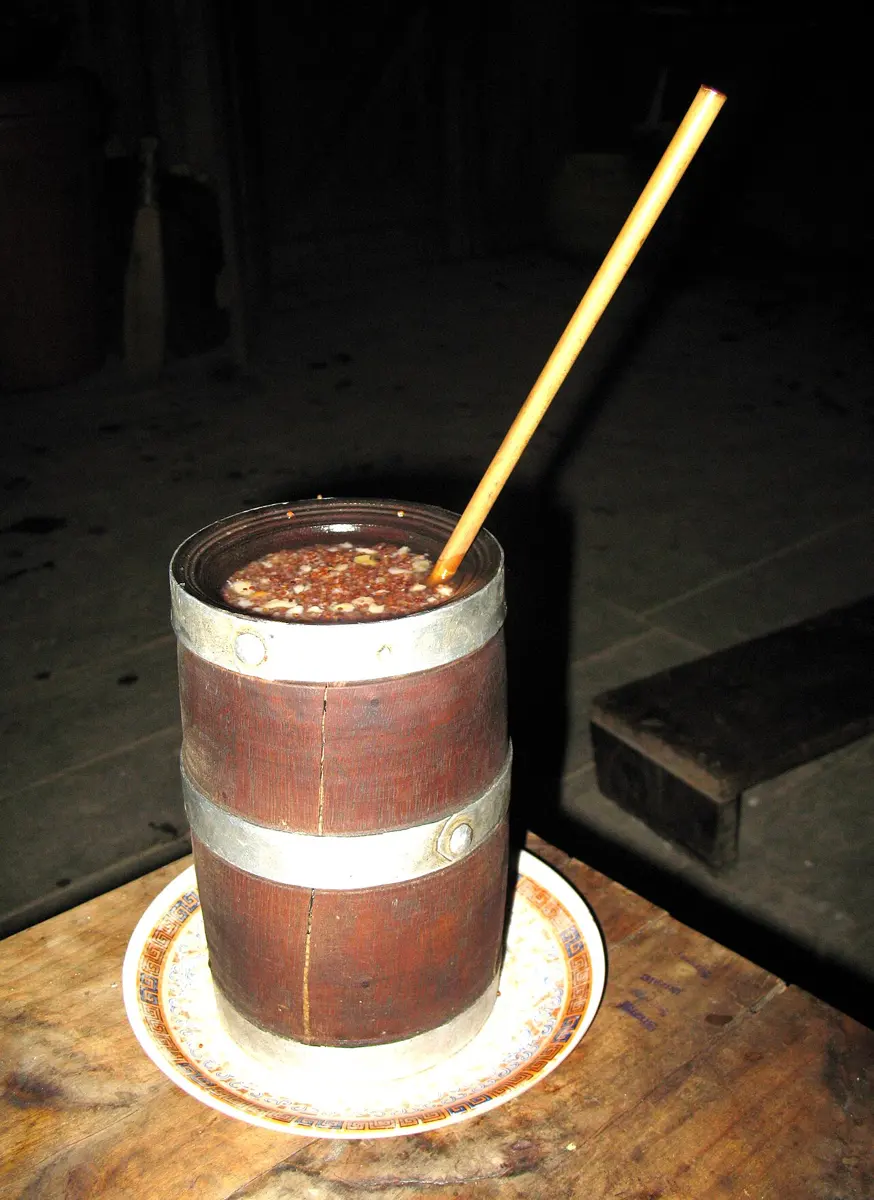
The CO₂ is what raises bread dough and makes fresh jaand fizz. Nepal’s home brews, jaand (chhyang) and the tongba of the eastern hills, start from cooked millet or rice and a starter cake called murcha, which holds molds and yeasts: the molds turn the starch into sugar, and the yeasts ferment the sugar to alcohol.
b. Lactic acid fermentation
Here pyruvic acid is reduced directly to lactic acid by NADH₂, which becomes NAD again. Enzyme: lactate dehydrogenase. No CO₂ is given off.
Overall: (lactic acid) + 2 ATP.
Bacteria such as Lactobacillus turn the sugar of milk into lactic acid; the acid makes the milk proteins set, and milk becomes curd (dahi). Bhaktapur’s famous juju dhau, the “king of curds”, is made this way. Lactic acid bacteria also sour gundruk, the fermented leaves of mustard, radish and cauliflower dried for the winter, and sinki, made the same way from radish roots.
During hard exercise, when the blood can’t bring oxygen fast enough, our muscles also get extra energy by making lactic acid. The lactic acid is carried by the blood to the liver and the heart, which turn it back into pyruvic acid (the liver makes glucose from much of it) once oxygen is plentiful again.
c. Acetic acid fermentation
Vinegar is made in two steps. First, yeast ferments sugar to ethanol, without air, as above. Then bacteria of the genus Acetobacter oxidize the ethanol to acetic acid, using oxygen from the air:
So the second step is really aerobic: acetic acid “fermentation” keeps an old name. That is why vinegar is made in open, shallow vats with plenty of air, and why an opened bottle of wine left standing turns sour.
Significance of anaerobic respiration
- It gives energy where oxygen is short or absent: in seeds whose hard coats keep air out, roots in waterlogged soil, the middle of bulky fruits and tubers, our muscles in a sprint, and microbes in mud, the gut and deep water.
- It lets organisms live without oxygen altogether, as many bacteria and yeasts can.
- It returns NAD to glycolysis, so a cell short of oxygen still makes some ATP.
- It is the basis of industries: bread, alcohol and biofuel (alcoholic), curd, cheese, pickles and gundruk (lactic), vinegar (acetic), and also the retting of jute, tanning and making biogas.
- Its drawbacks: it is wasteful (only 2 ATP per glucose), and its products are toxic in quantity (ethanol to yeast and to a plant’s own roots, lactic acid to muscle).
Which fermentation gives off no carbon dioxide?
Pick an answer to see why.
Fermentation makes no ATP of its own. Why does a cell bother with it?
Pick an answer to see why.
2.3.5 Factors affecting respiration
How fast a plant respires depends both on its surroundings (external factors) and on the state of its own cells (internal factors).
1. External factors
Temperature. This is the most important external factor, because every step of respiration is run by enzymes. Between about 5 °C and 30 °C, the rate of respiration roughly doubles with every 10 °C rise, as van ’t Hoff’s rule says for chemical reactions; the factor by which a rate rises for a 10 °C rise is called Q₁₀, about 2 here. Above about 35 °C the rate rises at first but then falls with time, as the enzymes begin to be denatured, and at about 45–50 °C respiration stops. At very low temperatures the enzymes are almost inactive (not damaged), and respiration nearly stops. That is why fruits and vegetables keep in cold storage: they respire so little that they don’t use up their sugars or ripen and rot.
Oxygen. Oxygen is needed for aerobic respiration because it is the final acceptor of electrons in the electron transport chain. As the oxygen supply falls, aerobic respiration slows and anaerobic respiration takes over; at low concentrations both go on at once, and with no oxygen only anaerobic respiration is left. (The oxygen level above which anaerobic respiration stops is called the extinction point; it is a few per cent of oxygen, different for each tissue.) Fruit stores use this too: in controlled-atmosphere storage, apples are kept cold in air with very little oxygen, low enough to slow their respiration but above the point where they start fermenting.
Water. Water is the medium for all metabolism: protoplasm is up to 90–95 % water, and water is needed for enzymes to work, for gases to diffuse and for substances to move. Dry seeds and dried fruits respire extremely slowly for lack of water, which is why they can be stored for years. When seeds absorb water, their stored starch is turned into soluble sugar and their respiration shoots up.
Light. Respiration doesn’t need light; it goes on in light and dark alike. But light affects it indirectly: it warms the plant, which speeds up respiration; it drives photosynthesis, which makes the sugar used as the respiratory substrate; and it opens the stomata, which lets oxygen in.
Carbon dioxide. A high concentration of CO₂ slows respiration (CO₂ is a product, and a high level holds the reactions back). It also closes the stomata, which cuts the oxygen supply; the plant physiologist O. V. S. Heath showed this effect of CO₂ on stomata. So too much CO₂ in the soil slows the germination of seeds and the growth of plants. Fruit stores add CO₂ deliberately to slow ripening.
2. Internal factors
Protoplasm. Young meristematic cells, at the tips of roots and shoots, have dense, active cytoplasm and respire much faster than mature cells. The activity of protoplasm depends in turn on its hydration, pH, temperature and other conditions.
Respiratory substrate. Simple sugars (glucose, fructose, and sucrose and maltose once split) are used in respiration at once. Starch and fats must first be broken down into a soluble form, sugar or fatty acids and glycerol, before they can be respired. This is why a weak patient in hospital is given glucose directly into a vein: it can be respired at once, while the ordinary diet of a healthy person is mostly starch and fat, which take time to digest. Fats and proteins can be respired too: they enter at acetyl CoA or the Krebs cycle.
Age of cells. Young cells respire much faster than mature and old ones. A seedling respires faster per gram than the tree it will become.
Wounds and injury. When a plant part is cut or bruised, its respiration rises sharply: the cells near the wound respire fast to divide and heal it. This is wound respiration. A cut potato or a bruised mango spoils faster for this reason.
Fresh vegetables last longer in a refrigerator mainly because
Pick an answer to see why.
Exercise
A. Tick the correct alternatives
- Which organelle is known as the power-house of the cell?
Pick an answer to see why.
- What does aerobic respiration involve?
Pick an answer to see why.
- What is the site of anaerobic respiration?
Pick an answer to see why.
- What is the end product of glycolysis?
Pick an answer to see why.
- What is the net gain of ATP molecules through glycolysis?
Pick an answer to see why.
- What is glycolysis also called?
Pick an answer to see why.
- What does the link reaction connect in aerobic respiration?
Pick an answer to see why.
- What is the maximum number of ATP generated from one glucose molecule through aerobic respiration?
Pick an answer to see why.
- What is the first stable product of the Krebs cycle?
Pick an answer to see why.
- How many ATP are produced when one molecule of NADH₂ passes through the electron transport chain?
Pick an answer to see why.
- Which of the following steps is common to aerobic and anaerobic respiration?
Pick an answer to see why.
- Which part of the mitochondrion generates ATP?
Pick an answer to see why.
- Which fermentation does not evolve CO₂?
Pick an answer to see why.
- Which of the following carries out anaerobic respiration?
Pick an answer to see why.
- What is the site of the Krebs cycle reactions?
Pick an answer to see why.
B. Answer the following questions
Define cellular respiration. Write its significance.
Answer
Differentiate between aerobic and anaerobic respiration.
Answer
Define glycolysis. Why is it significant in respiration?
Answer
Define fermentation and describe its types in brief.
Answer
List the external factors affecting respiration and describe any two of them.
Answer
Explain the EMP pathway of respiration with a necessary diagram.
Hint
Answer
What is the link reaction? Explain the Krebs cycle in detail with a figure.
Answer
Describe the process of anaerobic respiration and its significance.
Answer
Discuss the various factors affecting respiration.
Answer
Printable PDFs
- Study notes 4 pages
- Worksheet 4 pages Answer key
Quiz yourself: Life Processes and the Human Body, Grades 5–12 →
Practice every question in the book, and keep track of the ones you miss →
A companion to your textbook, not a replacement for it: study from the book your school uses, and where the two differ, follow your teacher. Found a mistake? Please tell us.