
Every grain of rice in your dal bhat, every log in a kitchen fire, every breath of oxygen you take, and even the petrol in a bus, began as sunlight caught by a green leaf. A leaf does, at room temperature and with no noise, what no factory can yet do as well: it takes carbon dioxide out of the air and water out of the soil and, with the energy of light, builds them into sugar, giving out oxygen.
This unit opens up that process: the pigments that catch the light, the two photosystems that turn it into chemical energy, the Calvin cycle that builds sugar, the clever tricks of maize, sugarcane and cacti, and the things that make a leaf work faster or slower.
2.2.1 Introduction and significance of photosynthesis
Photosynthesis (Greek photos, light, synthesis, putting together) is the process by which green plants, algae and some bacteria turn light energy into chemical energy. They use the light to build carbon dioxide and water into energy-rich organic compounds such as glucose, and in plants and algae give out oxygen.
It is an anabolic process: it builds large molecules (glucose, of high molecular mass) from small inorganic ones (carbon dioxide and water), and it stores energy instead of releasing it (it is endergonic).
Types of photosynthesis
Photosynthesis is of two types, depending on what supplies the electrons (the hydrogen) to reduce carbon dioxide.
a. Oxygenic photosynthesis is carried out by green plants, algae and cyanobacteria. Water is the electron (hydrogen) donor; it is split, and oxygen is given out as a by-product. It needs chlorophyll a, and it involves the photolysis of water:
b. Anoxygenic (non-oxygenic) photosynthesis is the older, simpler kind, carried out by bacteria such as the green sulphur bacteria and purple sulphur bacteria. They use a substance other than water as the electron donor, such as hydrogen sulphide (H₂S), so they give out no oxygen; with H₂S they give out sulphur instead. Their pigments are bacteriochlorophylls (such as the “Chlorobium chlorophylls” of green sulphur bacteria), which absorb mainly far-red and infrared light:
(CH₂O) stands for one carbon’s worth of carbohydrate.
Photosynthesis in plants
In plants, photosynthesis is a biochemical, anabolic and reductive process: light energy absorbed by green cells is used to make organic food from carbon dioxide and water, and carbon dioxide is reduced (it gains hydrogen) to carbohydrate. Because carbon from the air is built into the plant’s body, it is also called carbon assimilation.
- Raw materials: carbon dioxide, which enters from the air through the stomata, and water, absorbed from the soil by the roots and carried up in the xylem.
- Energy: light, absorbed by chlorophyll.
- Products: carbohydrate (first sugar, then starch and the rest), with oxygen as a by-product, from the photolysis (splitting by light) of water.
- Where: mainly in the mesophyll cells of the leaf, in their chloroplasts, sometimes called the “kitchens of the cell”.
The balanced equation:
often shortened, by canceling six waters, to 6CO₂ + 6H₂O → C₆H₁₂O₆ + 6O₂.
Significance of photosynthesis
- It makes organic food from inorganic raw materials. All the food of every living thing (except a few bacteria) comes from it, directly or through food chains.
- It takes carbon dioxide out of the air, slowing its build-up.
- It keeps the oxygen and carbon dioxide of the air in balance. Nearly all the oxygen in the air was put there by photosynthesis, over billions of years.
- Useful plant products such as fibers, timber, rubber, drugs, oils and paper are all built from its products.
- Fossil fuels, coal, petroleum and natural gas, are the remains of living things that lived on the products of photosynthesis millions of years ago: their energy is ancient sunlight.
Photosynthesis is described as an anabolic process because
Pick an answer to see why.
In the equation 6CO₂ + 12H₂O → C₆H₁₂O₆ + 6O₂ + 6H₂O, where do the atoms of the 6O₂ come from?
Pick an answer to see why.
2.2.2 Photosynthetic pigments
A pigment is a substance that absorbs some colors (wavelengths) of light and not others. The pigments of photosynthesis lie in the thylakoid membranes of the chloroplast. There are three main groups: chlorophylls, carotenoids and phycobilins.
1. Chlorophylls
Chlorophyll is the main photosynthetic pigment. It absorbs light mainly in the blue-violet and red parts of the visible spectrum, and very little in the green. The green light it doesn’t absorb is reflected or passes through, so plants look green (Figure 3.1).
A chlorophyll molecule has a flat, ring-shaped “head” (a porphyrin ring) with a magnesium atom at its center, and a long hydrocarbon “tail” (phytol) that anchors it in the thylakoid membrane. The head absorbs the light.
There are several chlorophylls:
- Chlorophyll a is the primary pigment, the only one that can pass on its excited electrons to drive photosynthesis. It is found in all organisms with oxygenic photosynthesis: plants, algae and cyanobacteria. Formula C₅₅H₇₂O₅N₄Mg, molecular mass about 893. It is blue-green.
- Chlorophyll b (yellow-green) is found with chlorophyll a in plants and green algae.
- Chlorophyll c in brown algae and diatoms, and chlorophyll d in some cyanobacteria (it was first reported from red algae, but comes from cyanobacteria living on them). Some books list a chlorophyll e too: it was reported once, from an alga, and never confirmed.
All except chlorophyll a are accessory pigments: they absorb light at wavelengths chlorophyll a absorbs poorly, and pass the energy on to chlorophyll a. Each is found only in certain groups.
2. Carotenoids
Carotenoids are yellow, orange and red accessory pigments, also in the chloroplast. They are of two kinds:
- Carotenes, orange, with the formula C₄₀H₅₆ (β-carotene, the color of carrots, from which our body makes vitamin A).
- Xanthophylls, yellow, which contain oxygen too, such as lutein, C₄₀H₅₆O₂.
Both absorb violet and blue light (roughly 400 to 500 nm), so they look yellow and orange: they reflect the yellow, orange and red they don’t absorb. Besides passing their energy to chlorophyll, carotenoids protect the chlorophyll from damage by too much light. In autumn, when a leaf breaks down its chlorophyll, its carotenoids show through as yellow and orange.
3. Phycobilins
Phycobilins are water-soluble pigments, unlike the others, which dissolve only in fats and organic solvents. They are found in red algae and cyanobacteria, where they absorb the green, yellow and orange light that chlorophyll misses.
- Phycoerythrin is red. It absorbs blue-green and green light. It is the main pigment of red algae, which can live deep in the sea, where only blue-green light reaches.
- Phycocyanin is blue. It absorbs orange-red light. It is found in cyanobacteria (the “blue-green algae”) and red algae.
Site of photosynthesis: the chloroplast
The chloroplast is the site of photosynthesis, the “kitchen of the cell”. It is a semi-autonomous organelle: it has its own DNA and its own 70S ribosomes in its stroma, and makes some of its own proteins (Grade 11). Two parts matter most for photosynthesis: the grana and the stroma.
- Grana (singular granum) are stacks of flat, disc-shaped thylakoids, like piles of coins. A granum may have 2 to 100 thylakoids; 10 to 20 is common.
- Thylakoids are flat sacs of membrane. Their membranes hold the pigments, the photosystems and the electron carriers: the light reaction happens here. There are two kinds: granal thylakoids, stacked in the grana, and stromal thylakoids (stroma lamellae), sheets that run through the stroma from one granum to the next and wrap round the grana in a spiral.
- The thylakoid lumen is the space inside each thylakoid. Protons (H⁺) are pumped into it during the light reaction, and the water-splitting enzyme faces it.
- The stroma is the fluid round the thylakoids, inside the inner membrane. It holds enzymes (above all RuBisCO), ribosomes and DNA. The dark reaction (Calvin cycle) happens here.
Photosystems
In the thylakoid membrane the pigments are not scattered: they are packed with proteins into large complexes called photosystems. Each photosystem has two parts:
- A light-harvesting complex (the antenna): some 200 to 400 chlorophyll a and b and carotenoid molecules held in proteins. When one of these pigments absorbs a photon (a particle of light), one of its electrons jumps to a higher energy level: the molecule is excited. It can’t keep the energy, and passes it on to a neighbor, and that to the next, by resonance energy transfer (the energy passes, not the electron), until it reaches the reaction center. Like a funnel, the antenna catches light over a wide area and channels it to one place.
- A reaction center: a special pair of chlorophyll a molecules (the special pair), held in proteins next to an electron acceptor. When the energy reaches the special pair, it is not passed on again. Instead, the excited special pair loses an electron to a molecule next to it, the primary electron acceptor. This is the moment light energy becomes chemical energy: an electron with energy to spare, which now begins its journey along a chain of carriers. The special pair is left short of an electron, and must get one back from an electron donor.
There are two kinds of photosystem in the thylakoids of plants, named in the order they were discovered:
- Photosystem II (PSII): its special pair absorbs best at 680 nm, so it is called P680. It lies mostly in the stacked membranes of the grana.
- Photosystem I (PSI): its special pair absorbs best at 700 nm: P700. It lies mostly in the stroma lamellae and the edges of the grana, facing the stroma.
Which pigment can pass its excited electron on to drive photosynthesis, rather than only passing on energy?
Pick an answer to see why.
Red algae can grow deeper in the sea than green algae mainly because
Pick an answer to see why.
2.2.3 Mechanism of photosynthesis
Photosynthesis happens in two linked stages:
- a.The light-dependent stage, also called the light reaction, the photochemical (primary photochemical) reaction or Hill’s reaction, in the thylakoids. It captures light energy and stores it in two energy-rich molecules, ATP and NADPH, and gives out oxygen.
- b.The light-independent stage, also called the dark reaction, Blackman’s reaction or the Calvin cycle, in the stroma. It uses the ATP and NADPH to reduce carbon dioxide to sugar.
The light reaction (photochemical phase)
The light reaction is the first stage of photosynthesis. Light energy is absorbed by the photosystems in the thylakoid membranes and is changed into chemical energy, stored as ATP (adenosine triphosphate) and NADPH. It happens in three steps.
a. Photo-excitation of the reaction centers
Light of different wavelengths is absorbed by the antenna pigments (chlorophylls, carotenoids and, in some algae, phycobilins), and its energy is handed to the reaction center by resonance. The special pair of chlorophyll a becomes energy-rich, excited: this is photo-excitation. The excited special pair gives up an energy-rich electron to the primary acceptor, and is left as an oxidized pigment (P680⁺ or P700⁺), which must get an electron back before it can be excited again. Each photon moves one electron, and the cycle repeats many times a second.
b. Photolysis of water
P680⁺, the oxidized special pair of PSII, is the strongest oxidizing agent known in living things: it pulls electrons out of water. With the help of a cluster of manganese atoms (with calcium and chloride ions) on the lumen side of PSII, called the oxygen-evolving complex, water is split into protons, electrons and oxygen. This splitting of water by light is the photolysis of water:
(Some books write it per water molecule: H₂O → 2H⁺ + 2e⁻ + ½O₂.)
- The electrons replace those lost by P680.
- The protons (H⁺) are released into the thylakoid lumen, adding to the proton gradient.
- The oxygen is a by-product: it is used by the plant’s own mitochondria in respiration, or diffuses out through the stomata.
c. Photophosphorylation and NADP reduction
The electrons from the reaction centers pass along an electron transport chain of carriers in the thylakoid membrane, each holding them a little less tightly than the one before, so that at each step some energy is released. That energy is used to pump protons (H⁺) from the stroma into the thylakoid lumen. The lumen fills with protons: it becomes about a thousand times more acidic than the stroma (pH about 5 against 8).
The protons can get back out into the stroma only through a channel in an enzyme, ATP synthase, and as they flow through, they turn it like water turning a mill wheel, and it joins ADP and inorganic phosphate (Pᵢ) into ATP:
This making of ATP with the energy of light is photophosphorylation. Because the energy passes through a gradient of protons across a membrane, the mechanism is called chemiosmosis, the theory of the British biochemist Peter Mitchell (Nobel Prize in Chemistry, 1978).
At the end of the chain, the electrons reach the enzyme NADP reductase (ferredoxin–NADP⁺ reductase), which uses two electrons and two protons from the stroma to reduce NADP⁺:
This is NADP reduction. It happens only in the non-cyclic pathway, below. ATP and NADPH together are called assimilatory power: the energy and the reducing power the Calvin cycle needs.
Photophosphorylation is of two types: non-cyclic and cyclic.
i. Non-cyclic photophosphorylation
In the non-cyclic pathway both photosystems work, one after the other.
- Light is absorbed by PSII. Its reaction center, P680, is excited and gives up electrons to its primary acceptor, pheophytin (a chlorophyll without its magnesium).
- The electrons pass to plastoquinone (PQ), a small carrier that moves within the membrane, then to the cytochrome b₆f complex (cytochromes b₆ and f), then to plastocyanin (PC), a copper protein on the lumen side. As they pass through the cytochrome complex, protons are pumped into the lumen, and this gradient is used for ATP synthesis.
- Plastocyanin hands the electrons, now low in energy, to the reaction center of PSI, P700, which has lost electrons of its own to light.
- Light absorbed by PSI re-energizes the electrons. P700 gives them to its primary acceptor, and from there through iron–sulphur centers they reach ferredoxin (Fd), an iron–sulphur protein on the stroma side, and then NADP reductase, which uses them, with H⁺, to make NADPH.
- P680 gets its lost electrons back from the photolysis of water, which gives out oxygen.
The electrons travel in a line from water to NADP⁺ and never return to P680: hence non-cyclic (linear). It makes ATP and NADPH, and gives out oxygen. Drawn on a scale of energy, the path goes up at PSII, down along the chain, up again at PSI and down to NADP⁺: the shape of a letter Z on its side, so it is called the Z-scheme.
ii. Cyclic photophosphorylation
In the cyclic pathway only PSI works; PSII is not involved.
- Light excites P700, which gives up energy-rich electrons to its primary acceptor, from which they pass through PSI’s iron–sulphur centers.
- The electrons go to ferredoxin (Fd), but instead of going on to NADP reductase they are passed back to plastoquinone (PQ), then through the cytochrome b₆f complex, which pumps protons into the lumen, to plastocyanin (PC).
- Plastocyanin returns them to P700, where they started: hence cyclic.
The proton gradient built by the cytochrome complex drives ATP synthase. So the cyclic pathway makes ATP only: no NADPH (no NADP reduction), and no splitting of water, so no oxygen.
Plants use the cyclic pathway alongside the non-cyclic one, to make extra ATP. (Some books say it is found only in bacteria and makes ATP at two sites. Plants use it all the time, and its protons are pumped at one place, the cytochrome complex.) The Calvin cycle needs 3 ATP for every 2 NADPH, a little more ATP than the non-cyclic pathway alone gives, and some cells need more still: the bundle sheath cells of maize and sugarcane (2.2.4), which have little PSII, run mostly on cyclic flow. It also takes over when NADPH has piled up in the chloroplast and there is no NADP⁺ left to reduce. A cyclic flow of electrons round one photosystem is also how many photosynthetic bacteria make their ATP.
Differences between cyclic and non-cyclic photophosphorylation
| Non-cyclic | Cyclic | |
|---|---|---|
| 1.Photosystems | PSII and PSI | PSI only |
| 2.Path of electrons | linear: from water to NADP⁺ | a cycle: from P700 back to P700 |
| 3.First electron donor | water | P700 |
| 4.Last electron acceptor | NADP⁺ | P700 |
| 5.Photolysis of water | yes | no |
| 6.Oxygen given out | yes | no |
| 7.Products | ATP and NADPH | ATP only |
| 8.Wavelengths that drive it | below 680 nm (and up to 700 nm for PSI) | up to 700 nm and beyond (far red) |
| 9.Where it predominates | grana | stroma lamellae |
In non-cyclic photophosphorylation, which carrier takes the electrons from PSI on towards NADP⁺?
Pick an answer to see why.
A chloroplast is lit with far-red light of 710 nm, which only PSI can use. What will it make?
Pick an answer to see why.
The dark reaction (Blackman’s reaction)
The dark reaction is the second stage, in which carbon dioxide is fixed into carbohydrate. It reduces carbon dioxide, using the assimilatory power (ATP and NADPH) of the light reaction: in short, it turns the chemical energy of ATP and NADPH into the energy stored in food. It uses no light directly, so it is also called the light-independent stage. It is a chain of enzyme reactions in the stroma.
The dark reaction can follow three pathways:
- a.the Calvin–Benson cycle (the C₃ cycle),
- b.the Hatch–Slack pathway (the C₄ cycle), and
- c.crassulacean acid metabolism (the CAM cycle).
The commonest, found in all plants, is the Calvin cycle. The C₄ and CAM pathways (2.2.4) don’t replace it: they are extra steps that collect carbon dioxide and hand it on to the Calvin cycle.
The Calvin–Benson cycle (C₃ cycle)
The pathway was worked out between 1946 and 1953 by Melvin Calvin, Andrew Benson and James Bassham at Berkeley, California, using the green alga Chlorella. They fed the algae carbon dioxide containing radioactive carbon-14, let them photosynthesize for a few seconds, then plunged them into boiling alcohol to stop every reaction at once, and found which compounds the carbon-14 had reached. After a few seconds it was almost all in one compound, a 3-carbon acid, 3-phosphoglyceric acid (PGA, also called 3-phosphoglycerate). So the first stable product has three carbons, and the cycle is called the C₃ cycle. Calvin received the Nobel Prize in Chemistry in 1961.
Plants that fix carbon dioxide only by the Calvin cycle are called C₃ plants. They are the great majority, about nine plant species in ten (some books say 95%): rice, wheat, barley, oats, potato, beans, cotton, tobacco, mustard, and nearly all trees.
The overall reaction for one glucose (six turns of the cycle):
The cycle has three steps (Figure 3.6).
Step 1: Carbon dioxide fixation (carboxylation of RuBP). In the stroma, carbon dioxide meets a 5-carbon sugar, ribulose-1,5-bisphosphate (RuBP). The enzyme RuBP carboxylase/oxygenase (RuBisCO) joins them; the 6-carbon product at once splits into two molecules of 3-PGA. Each carbon dioxide that reacts with one RuBP gives two PGA, so three carbon dioxide molecules and three RuBP give six PGA. Carbon has been “fixed”: taken from an inorganic gas into an organic molecule.
Step 2: Reduction of PGA (glycolytic reversal). ATP and NADPH from the light reaction convert the six PGA into six molecules of glyceraldehyde-3-phosphate (G3P, also called phosphoglyceraldehyde, PGAL), a 3-carbon sugar. Each PGA uses one ATP and one NADPH, so this step uses 6 ATP and 6 NADPH. It is a reduction: PGA gains electrons (from NADPH). These reactions run the reverse way to the matching steps of glycolysis in respiration, so this step is also called glycolytic reversal.
Of the six G3P, one leaves the cycle: it is the cycle’s product, built up into glucose, sucrose and starch. One G3P makes half a glucose, so two G3P (six turns of the cycle) make one glucose.
Step 3: Regeneration of RuBP. The other five G3P (5 × 3 = 15 carbons) are rearranged, through a series of 4-, 5-, 6- and 7-carbon sugars, into three RuBP (3 × 5 = 15 carbons), using 3 more ATP. The cycle is ready to fix more carbon dioxide.
The account. For three carbon dioxide molecules (one G3P): 6 + 3 = 9 ATP and 6 NADPH. For one glucose, six carbon dioxide molecules, six turns of the cycle: 18 ATP and 12 NADPH.
In three turns of the Calvin cycle six G3P are made. How many of them leave the cycle as its product?
Pick an answer to see why.
2.2.4 C₄ plants, CAM plants and photorespiration
The Hatch–Slack pathway (C₄ cycle)
In 1965 sugar-cane researchers in Hawaii noticed that, in sugarcane, the carbon-14 went first not into PGA but into 4-carbon acids. In 1966 Marshall Hatch and Rodger Slack, in Australia, worked out the pathway. It is called the Hatch–Slack pathway, or the C₄ cycle, because the first stable product of carbon dioxide fixation is a 4-carbon compound, oxaloacetic acid (OAA). Plants that use it are C₄ plants: maize (makai), sugarcane (ukhu), sorghum (junelo), finger millet (kodo), amaranth (latte) and many tropical grasses, among them dubo (Cynodon dactylon), which is why a lawn of dubo stays green through a hot, dry summer.
The C₄ pathway is not a replacement for the Calvin cycle but a carbon dioxide pump in front of it: it collects carbon dioxide in one kind of cell and delivers it, concentrated, to the Calvin cycle in another.
Kranz anatomy
A C₄ leaf has a special structure. Each vascular bundle is surrounded by a ring of large bundle sheath cells, and round them a ring of mesophyll cells: the two rings look like a wreath, Kranz in German, so this is Kranz anatomy. The two kinds of cell have different chloroplasts (dimorphic chloroplasts):
- Mesophyll cells have many small chloroplasts with grana, but no RuBisCO. They can’t run the Calvin cycle. Instead they have the enzyme PEP carboxylase, which fixes carbon dioxide first.
- Bundle sheath cells have fewer, larger chloroplasts, which in maize and sugarcane lack grana (so they have little PSII and make little NADPH or oxygen of their own), but have RuBisCO and run the Calvin cycle.
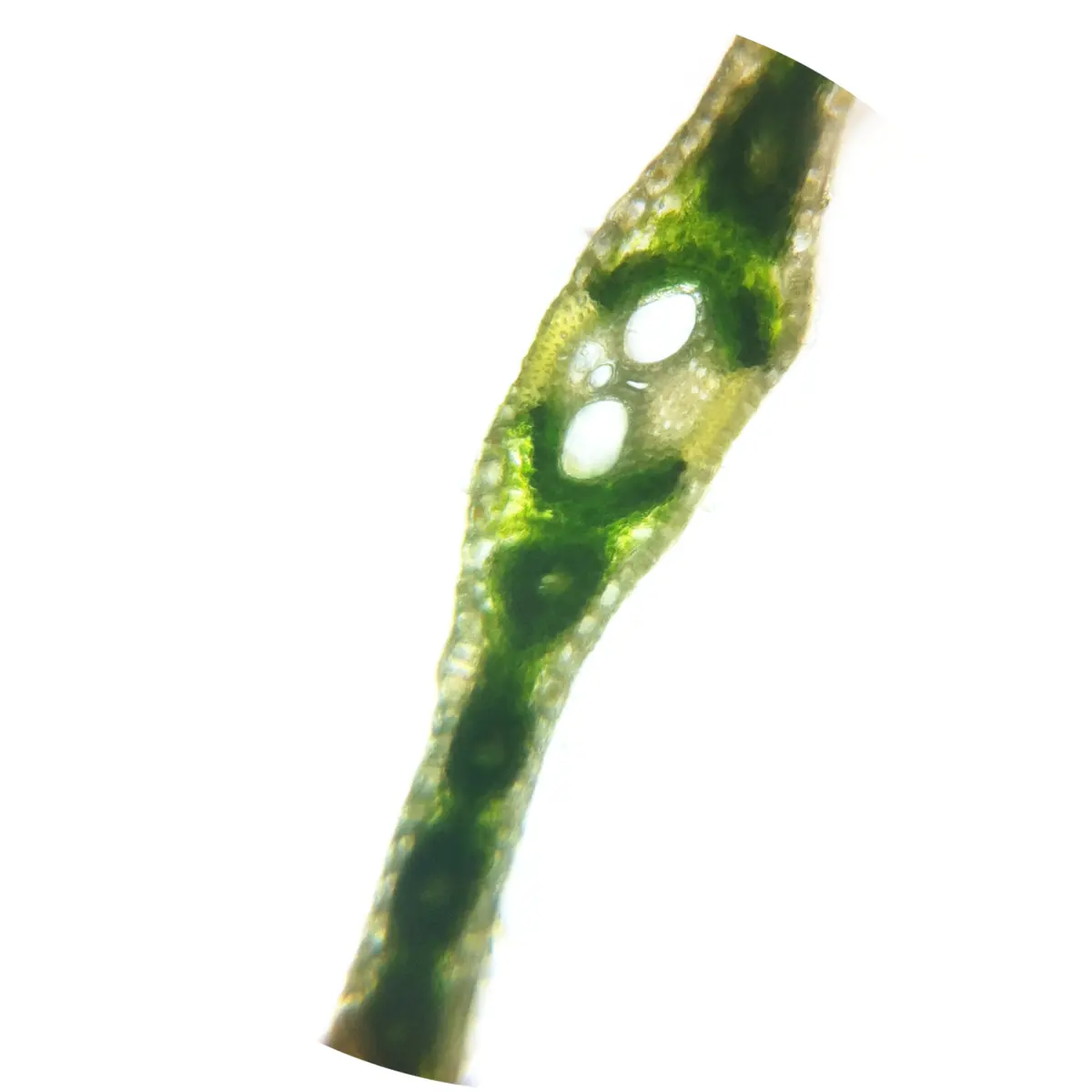
So in C₄ plants carbon dioxide is fixed twice: first by PEP carboxylase in the mesophyll, and again by RuBisCO in the bundle sheath.
The mechanism
(Figure 3.8)
In the mesophyll cell
i. Fixation of carbon dioxide. Carbon dioxide entering the mesophyll cell dissolves in its cytoplasm as bicarbonate (HCO₃⁻), helped by the enzyme carbonic anhydrase. PEP carboxylase, in the cytoplasm, joins the bicarbonate to a 3-carbon compound, phosphoenolpyruvic acid (PEP), making oxaloacetic acid (OAA), a 4-carbon acid.
ii. Reduction of OAA. In the mesophyll chloroplast, OAA is reduced by NADPH to malic acid (malate), also 4-carbon, by the enzyme malate dehydrogenase. The malic acid passes into the neighboring bundle sheath cell through the plasmodesmata.
In the bundle sheath cell
iii. Decarboxylation of malic acid. In the bundle sheath chloroplast, the NADP-malic enzyme removes carbon dioxide from malic acid (an oxidative decarboxylation), leaving pyruvic acid (3-carbon) and making NADPH. The carbon dioxide released is fixed again by RuBisCO and enters the Calvin cycle, which makes sugar here. Since malate keeps arriving, the carbon dioxide in the bundle sheath is kept 5 to 10 times as concentrated as in the air.
The pyruvic acid returns to the mesophyll cell by the same route.
In the mesophyll cell again
iv. Regeneration of PEP. In the mesophyll chloroplast, the enzyme pyruvate phosphate dikinase turns pyruvic acid back into PEP, using one ATP, which is broken down to AMP: that costs as much as two ATP. PEP is ready to catch more carbon dioxide.
The overall reaction for one glucose (the C₃ cycle’s 18 ATP plus 2 ATP for each of the 6 PEP regenerated):
(Here “30 ATP” counts each ATP broken to AMP in step iv as two.)
Why it pays. PEP carboxylase has a very strong grip on carbon dioxide (as bicarbonate) and never takes up oxygen by mistake. So a C₄ leaf can go on fixing carbon dioxide even when it is very scarce inside the leaf, down to 0–10 ppm, as when the stomata are nearly closed on a hot day; and with carbon dioxide concentrated round RuBisCO in the bundle sheath, photorespiration (below) is almost nil. For this, C₄ plants spend more ATP for each glucose, but in hot, bright, dry places they are much more efficient: they make more sugar for each liter of water lost.
Differences between C₃ and C₄ plants
| C₃ plants | C₄ plants | |
|---|---|---|
| 1.Pathway | Calvin cycle only | Hatch–Slack pathway, then Calvin cycle |
| 2.First stable product | 3-carbon PGA | 4-carbon OAA |
| 3.Carbon dioxide acceptor | RuBP (5C) | PEP (3C) in mesophyll; RuBP in bundle sheath |
| 4.Carbon-fixing enzyme | RuBisCO | PEP carboxylase, then RuBisCO |
| 5.Leaf anatomy | no Kranz anatomy; bundle sheath cells without chloroplasts or with few | Kranz anatomy: large bundle sheath cells with chloroplasts |
| 6.Chloroplasts | one kind, all with grana | two kinds: with grana (mesophyll), without grana (bundle sheath, as in maize) |
| 7.Carbon dioxide fixed | once | twice |
| 8.ATP per glucose | 18 | 30 |
| 9.Photorespiration | high, especially in heat | almost nil |
| 10.Carbon dioxide compensation point | high, about 40–100 ppm | low, 0–10 ppm |
| 11.Best temperature | about 15–30 °C | about 30–40 °C |
| 12.Efficiency in hot, bright, dry places | lower | higher |
| 13.Examples | rice, wheat, potato, beans, mustard, most trees | maize, sugarcane, sorghum, kodo, amaranth, dubo |
Crassulacean acid metabolism (CAM)
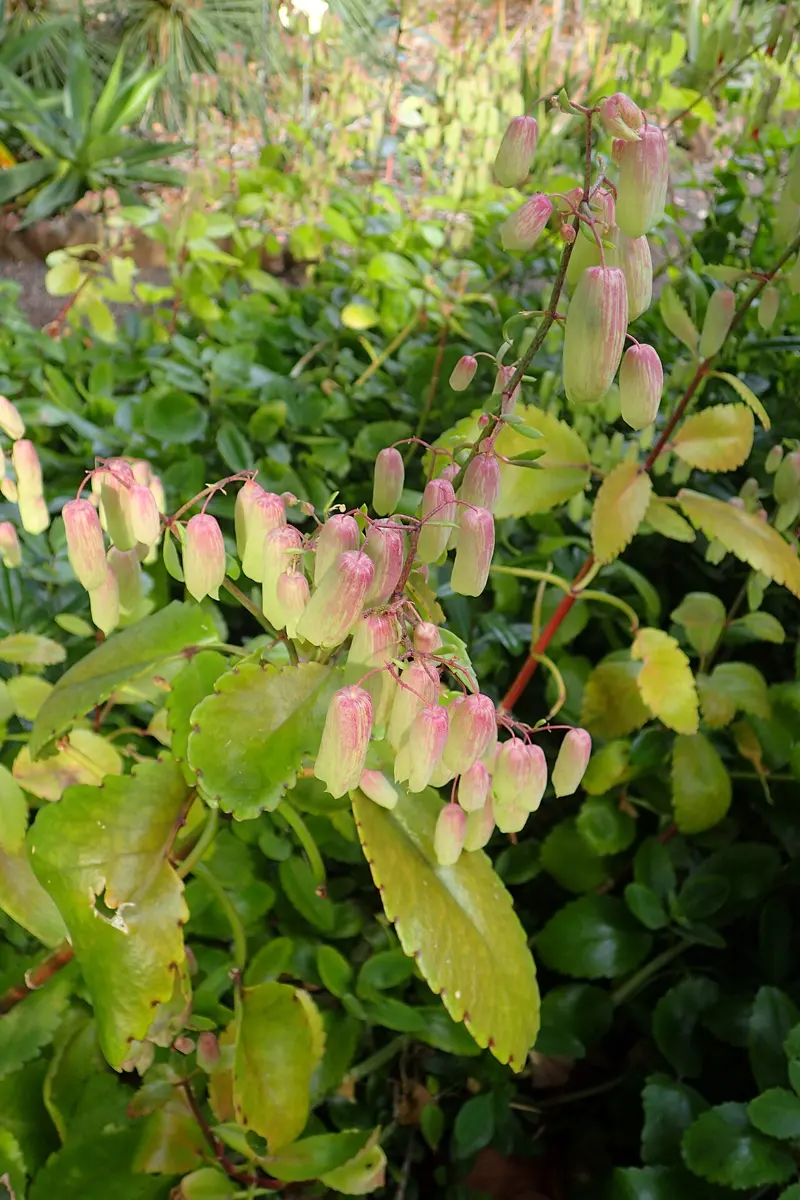
Many plants of very dry places, such as cacti (Opuntia), Aloe (ghiukumari), Agave (ketuki), pineapple and Kalanchoe, of the family Crassulaceae from which the name comes, solve the water problem another way. They separate the two fixations not in space, as C₄ plants do, but in time.
- At night, when it is cool and humid, they open their stomata. Carbon dioxide is fixed by PEP carboxylase into OAA and then malic acid, which is stored in the large vacuoles: the leaves become sour by morning.
- By day, they keep their stomata closed, saving water. The stored malic acid is broken down, releasing carbon dioxide inside the leaf, and the Calvin cycle fixes it in the light.
CAM plants lose very little water, but they grow slowly, since they can store only as much carbon dioxide each night as their vacuoles hold.
Photorespiration
RuBisCO has a flaw. Its full name, ribulose bisphosphate carboxylase/oxygenase, says it: it can fix oxygen onto RuBP instead of carbon dioxide. Oxygen and carbon dioxide compete for the same site. In today’s air, with about 21% oxygen and 0.04% carbon dioxide, RuBisCO takes up oxygen in roughly one reaction in four at 25 °C, and more often when it is hot (oxygen then dissolves relatively better, and RuBisCO favors it more) and when the stomata close and carbon dioxide inside the leaf runs low. When RuBisCO fixes oxygen, RuBP splits into one PGA and one 2-carbon phosphoglycolic acid, which is of no use to the Calvin cycle. (Some books say RuBisCO acts as an oxygenase only when carbon dioxide falls below about 100 ppm. It takes up oxygen at any level; at very low carbon dioxide the losses simply outweigh the gains.)
Photorespiration is the light-dependent uptake of oxygen and release of carbon dioxide that follows. It is a wasteful process: it makes no sugar and no ATP; it uses ATP and NADPH, and loses carbon that had been fixed. It is an unwelcome sidetrack from the dark reaction. Because its first product, phosphoglycolic acid, has two carbons, it is also called the C₂ cycle. It runs through three organelles: the chloroplast, the peroxisome and the mitochondrion (Figure 3.11).
- Chloroplast: RuBisCO adds oxygen to RuBP: one PGA and one phosphoglycolic acid (2C). The phosphate is removed, leaving glycolic acid, which goes to the peroxisome.
- Peroxisome: glycolic acid is oxidized by oxygen to glyoxylic acid, making hydrogen peroxide (broken down by catalase), and glyoxylic acid takes an amino group to become the amino acid glycine, which goes to the mitochondrion.
- Mitochondrion: two glycines make one serine (3C), releasing carbon dioxide and ammonia. Serine goes back to the peroxisome.
- Peroxisome: serine becomes hydroxypyruvic acid and then, reduced by NADH, glyceric acid, which goes back to the chloroplast.
- Chloroplast: glyceric acid takes a phosphate from ATP and becomes PGA, which rejoins the Calvin cycle.
So of every two phosphoglycolic acids (four carbons), three carbons come back as PGA and one is lost as carbon dioxide. On hot days a C₃ crop such as rice or wheat can lose a quarter or more of the carbon it fixes this way.
C₄ plants hardly photorespire, because their RuBisCO sits in the bundle sheath bathed in concentrated carbon dioxide, which wins the competition with oxygen. That is why they are more efficient in hot places.
Why are C₄ plants more efficient than C₃ plants in hot, bright places?
Pick an answer to see why.
A plant opens its stomata at night and keeps them closed by day. Its leaves taste sour in the morning. It is most likely
Pick an answer to see why.
2.2.5 Factors affecting photosynthesis
The light reaction depends on light, water and the pigments; the dark reaction on temperature and on the carbon dioxide available. So the rate of photosynthesis depends on many factors, outside the plant and inside it.
Blackman’s law of limiting factors. In 1905 the English plant physiologist F. F. Blackman stated a principle that explains how they work together: when a process depends on several factors, its rate is limited by the factor that is in shortest supply (the limiting factor). Increasing that factor speeds the process; increasing any other does nothing, until a different factor becomes the one in short supply. A leaf in dim light can’t use more carbon dioxide; a leaf in bright light with little carbon dioxide can’t use more light.
External factors
1. Light. In photosynthesis, light energy is changed into the chemical energy of food.
i. Light intensity. In dim light the rate rises in proportion to the light. In the dark a leaf only respires, giving out carbon dioxide; as the light grows, photosynthesis catches up, and at the light compensation point the carbon dioxide fixed equals that given out in respiration: no net exchange. As the light increases further, the rate rises more slowly and at last levels off: the light intensity beyond which more light gives no more carbon dioxide uptake is the light saturation point. (In very strong light the chlorophyll may even be damaged, and the rate falls: solarization.) Shade plants reach both points at lower light than sun plants.
ii. Light quality. Red and blue light are the most effective; the highest rate is in red light, with a second peak in blue (Engelmann’s experiment). Green light is the least effective, because chlorophyll absorbs little of it, but it is not useless (some books call it inhibitory; it isn’t): the green light that passes through the top layers of a leaf is absorbed deeper down and drives photosynthesis there.
iii. Light duration. The total photosynthesis in a day depends on how long the plant is lit, but the rate doesn’t depend on the duration. Interestingly, for the same total amount of light, short flashes with dark gaps between them give more photosynthesis than continuous light, because the dark reaction has time to use the products of each flash.
2. Carbon dioxide. Carbon dioxide is only about 0.04% of the air (about 424 ppm, the 2024 average, up from about 0.03% in 1960), and in bright light it is the commonest limiting factor. Raising it increases the rate of a C₃ plant considerably, up to about 0.1% (1000 ppm), which is why some greenhouses add carbon dioxide; much higher concentrations, around 1% and above, make the stomata close and harm the plant, and the rate falls. C₄ plants are already nearly saturated at today’s level.
3. Water. Water is a raw material, but only a tiny part of the water a plant takes in is used in photosynthesis. Lack of water slows photosynthesis mostly indirectly: the plant loses turgor and closes its stomata, so less carbon dioxide gets in, and the dehydrated protoplasm works less well.
4. Temperature. The dark reaction is a chain of enzyme reactions, so temperature affects it strongly. In most plants the rate is best between about 15 °C and 35 °C (C₄ plants towards the top of this range). When other factors are not limiting, the rate about doubles for every 10 °C rise in temperature, up to the optimum; above it, photorespiration rises and the enzymes begin to be denatured, and the rate falls. The limits are wide: evergreen conifers of cold mountains and lichens can photosynthesize slowly at several degrees below freezing, and some cyanobacteria of hot springs at about 70 °C.
5. Oxygen. Raising the oxygen concentration lowers the rate of photosynthesis in C₃ plants, because oxygen competes with carbon dioxide for RuBisCO and drives photorespiration. This inhibition of photosynthesis by oxygen is the Warburg effect, after the German biochemist Otto Warburg, who found it in algae in 1920.
6. Mineral elements. Several minerals are needed for chlorophyll and for the reactions themselves: magnesium at the center of each chlorophyll; iron to make chlorophyll and in the cytochromes and ferredoxin; manganese, calcium and chloride for splitting water; copper in plastocyanin; nitrogen in chlorophyll and every enzyme. A shortage of any of them lowers the rate, and leaves short of magnesium, iron or nitrogen turn yellow (chlorosis).
Internal factors
1. Chlorophyll. Chlorophyll absorbs the light energy that drives the whole process. In 1929 Robert Emerson found a direct relation between the chlorophyll content of algae and their rate of photosynthesis. Mutant seedlings without chlorophyll (albinos) can’t photosynthesize, and die once the food in the seed is used up.
2. Leaf anatomy. The structure of the leaf matters: a thick cuticle and epidermis let less light in; many stomata and large air spaces let carbon dioxide in easily; much palisade tissue, packed with chloroplasts, means more photosynthesis; and C₄ plants have Kranz anatomy.
3. Leaf age. A young, growing leaf photosynthesizes slowly; a fully grown leaf fastest; an old, yellowing leaf slowly again, as its chlorophyll and enzymes break down.
4. End products. If the sugars made are not carried away quickly enough, they build up in the leaf and slow photosynthesis down. When the products are moved away fast, to growing fruits or tubers, the rate rises.
5. Protoplasmic factors. Photosynthesis needs well-hydrated protoplasm and active enzymes. If the protoplasm loses much water, its enzymes stop working and photosynthesis stops.
A plant in strong light gives out no more oxygen when the light is made even brighter, but does when carbon dioxide is added. What was limiting the rate?
Pick an answer to see why.
At the light compensation point,
Pick an answer to see why.
Exercise
A. Tick the correct alternatives
- What is true about photosynthesis?
Pick an answer to see why.
- Which organisms show anoxygenic (non-oxygenic) photosynthesis?
Pick an answer to see why.
- During photosynthesis, green plants use sunlight, water and carbon dioxide, make organic food and give out oxygen. Where does the oxygen come from?
Pick an answer to see why.
- Which statement is true about the chloroplast?
Pick an answer to see why.
- Which is the light-dependent stage of photosynthesis?
Pick an answer to see why.
- In which parts of white light does chlorophyll absorb most effectively?
Pick an answer to see why.
- In which part of a photosystem does the absorbed light energy finally arrive?
Pick an answer to see why.
- What is the reaction center of PSII?
Pick an answer to see why.
- Which is the correct order of electron carriers between PSII and PSI?
Pick an answer to see why.
- What is true about cyclic photophosphorylation?
Pick an answer to see why.
- Which of the following makes ATP during the light reaction?
Pick an answer to see why.
- Which is the first stable compound of the C₃ cycle?
Pick an answer to see why.
- What does RuBisCO stand for?
Pick an answer to see why.
- In which step of the Calvin cycle is sugar made?
Pick an answer to see why.
- In the C₃ cycle, how many ATP are needed to fix 6 CO₂?
Pick an answer to see why.
- Under what condition can a C₃ plant not carry out net photosynthesis?
Pick an answer to see why.
- Which of the following is a C₄ plant?
Pick an answer to see why.
- Which plant has Kranz leaf anatomy and dimorphic chloroplasts?
Pick an answer to see why.
- Which cells of the leaf take part in the C₄ cycle?
Pick an answer to see why.
B. Answer the following questions
Write about photosynthesis in plants.
Answer
Write the balanced equation of photosynthesis. Mention its significance.
Answer
Briefly describe the photosynthetic pigments.
Answer
Study the figure of a photosystem and answer the questions.
- a.Where is it found in the chloroplast?
- b.Its reaction center is P700. Which photosystem is it?
- c.What is the role of the reaction center?
- d.Can it carry out photophosphorylation on its own? If yes, which kind?
Answer
Give a short account of the mechanism of light absorption in a photosystem.
Answer
Draw a flowchart of non-cyclic photophosphorylation.
Answer
Mention the differences between cyclic and non-cyclic photophosphorylation.
Answer
Briefly write about the Hatch–Slack pathway.
Answer
Differentiate between C₃ and C₄ plants.
Answer
Why are C₃ plants less efficient in photosynthesis than C₄ plants?
Answer
How do light and temperature affect photosynthesis?
Answer
Define photosynthesis. Write about chlorophyll and its types.
Answer
Write the mechanism of the light reaction. How does it differ from the dark reaction?
Answer
Discuss the Calvin cycle with a diagram.
Answer
Discuss the various factors affecting photosynthesis.
Answer
Project work
Printable PDFs
- Study notes 4 pages
- Worksheet 4 pages Answer key
Quiz yourself: Life Processes and the Human Body, Grades 5–12 →
Practice every question in the book, and keep track of the ones you miss →
A companion to your textbook, not a replacement for it: study from the book your school uses, and where the two differ, follow your teacher. Found a mistake? Please tell us.