
Every time one of your cells divides, it copies about six billion letters of DNA. It does this astonishingly well, with about one mistake in every billion letters copied, but not perfectly: you were born with about 50 to 70 new changes in your DNA that neither of your parents had. Most do nothing at all. A few, over thousands of generations, have given us everything from the ability of some people to digest milk as adults to the bright colors of a new rose. A very few cause disease.
These changes are mutations. This unit sorts them by size: one letter of a gene, a whole piece of a chromosome, a whole chromosome, and finally whole sets of chromosomes, polyploidy, which has given us bread wheat, the banana and the seedless watermelon.
3.4.1 General introduction
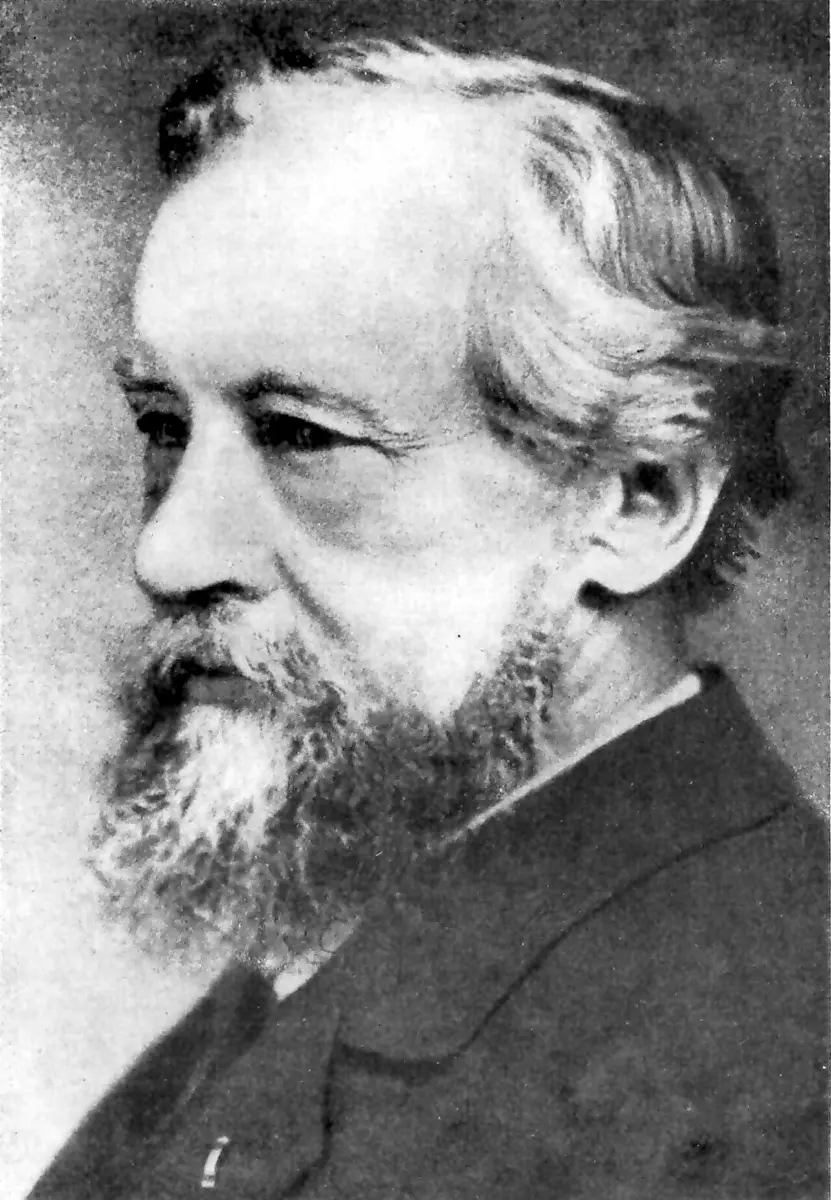
In 1886 the Dutch botanist Hugo de Vries noticed, in a field near Amsterdam, plants of the evening primrose (Oenothera lamarckiana) that were quite unlike the rest: taller or dwarf, with different leaves and flowers. Grown in his garden, the new forms bred true. In 1901 he called such sudden, inherited changes mutations (Latin mutare, to change), and argued in The Mutation Theory that new species arise by them in a single step.
Ten years later Thomas Hunt Morgan’s white-eyed fly Grade 12: 3.3.2 showed where mutations happen: a new form of a character appeared because a gene on a chromosome had changed. In 1927 Hermann Muller, one of Morgan’s students, showed that X-rays cause mutations in fruit flies, about 150 times more often than they happen by themselves.
Mutation is a sudden, heritable change in the genetic material of an organism: in the sequence of bases of its DNA (or RNA, in some viruses), or in the structure or number of its chromosomes. A mutation may change the organism’s appearance or working, or have no effect at all. An organism showing the effect of a mutation is a mutant.
- Mutations happen spontaneously, mostly as mistakes in copying DNA before a cell divides, or are induced by outside agents, mutagens: radiation (X-rays, gamma rays, ultraviolet light), chemicals (in tobacco smoke, for example), and some viruses.
- A mutation in a body cell affects only that cell and the cells that come from it (it can lead to cancer); only a mutation in a cell that makes gametes can be inherited.
- Most mutations are harmless or neutral, some are harmful and cause genetic disorders or cancer, and a few are useful, such as resistance to a disease.
- Mutations are the only source of new alleles: they are the raw material of evolution, which recombination Grade 12: crossing over then shuffles into new combinations. They are also used in genetic research, medicine and biotechnology.
Which mutation can be passed to a person’s children?
Pick an answer to see why.
3.4.2 Types of mutation
By the size of the change, mutations are of two main types: gene mutations, in a single gene, and chromosomal mutations, in the structure or number of chromosomes.
1. Gene mutation (point mutation, micro mutation)
A gene mutation is a change in the sequence of bases within a single gene: a small-scale change, often of only one base pair. Its main cause is a mistake in copying DNA (replication) that the cell’s repair enzymes miss. Gene mutations are of three types.
a) Substitution mutation
In a substitution, one base is replaced by another. The bases are of two kinds (Figure 10.2): purines, adenine (A) and guanine (G), with two rings in their molecules, and pyrimidines, cytosine (C) and thymine (T), with one ring.
i. A transition replaces a purine with the other purine, or a pyrimidine with the other pyrimidine:
- purine to purine: A ↔ G;
- pyrimidine to pyrimidine: C ↔ T.
ii. A transversion replaces a purine with a pyrimidine, or a pyrimidine with a purine:
- purine to pyrimidine: A or G → C or T;
- pyrimidine to purine: C or T → A or G.
There are twice as many possible transversions as transitions (each base has one transition partner and two transversion partners), yet transitions happen about twice as often in DNA. A swap between two bases of the same shape is an easier mistake to make, and to miss. Many changes to the third base of a codon, which are often transitions, don’t change the amino acid at all, because most amino acids have more than one codon (the code is degenerate: 3.1.6).
A substitution changes at most one codon, so it has one of three effects on the protein:
- silent: the new codon means the same amino acid (CAT and CAC both mean histidine), and the protein is unchanged;
- missense: the new codon means a different amino acid, and one amino acid of the protein changes;
- nonsense: the new codon is a stop codon, and the protein is cut short (c, below).
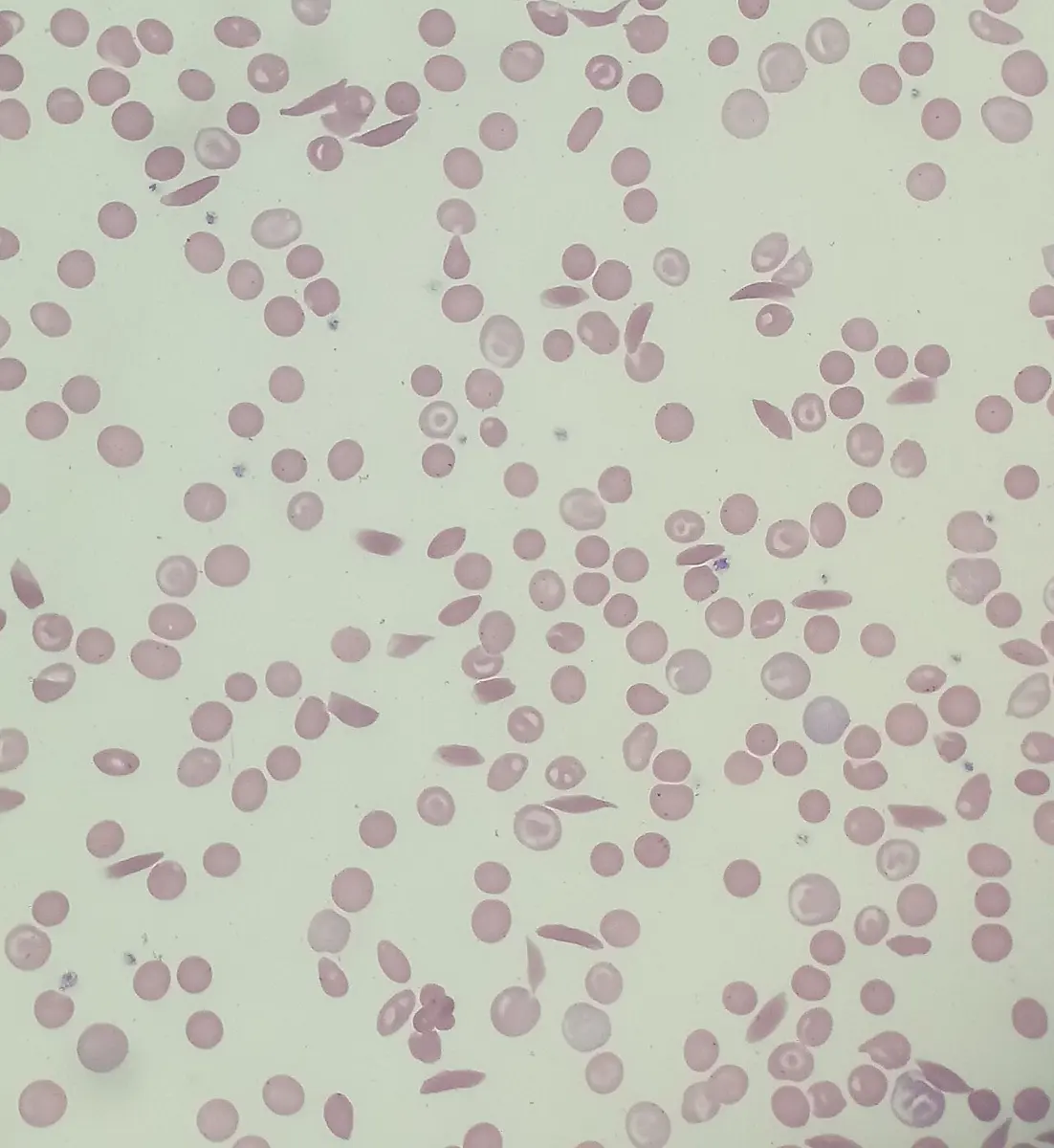
The best-known missense mutation causes sickle-cell anemia. In the gene for the β chain of hemoglobin, the sixth codon, GAG (glutamic acid), becomes GTG (valine): A is replaced by T in the coding strand, a transversion. Hemoglobin with valine there sticks together into long fibers when it gives up its oxygen, bending the red blood cells into stiff sickle shapes that block small vessels and burst early.
b) Frameshift mutation
A gene is read in codons, three bases at a time, from a fixed starting point Grade 12: 3.1.6 Genetic code: the reading frame. An insertion or a deletion of one or two bases (or any number that is not a multiple of three) shifts the reading frame from that point on, so every codon after it is read wrongly. This is a frameshift mutation. The amino acids after it are all changed, and a stop codon usually turns up early, so the protein formed is completely different and doesn’t work.
Example. A short gene and the amino acids it codes for:
| DNA, read in codons | Amino acids | |
|---|---|---|
| Original | ATG CAT GTA TGA | Met–His–Val–Stop |
| Insertion of A after ATG | ATG ACA TGT ATG A… | Met–Thr–Cys–Met… |
| Deletion of the C | ATG ATG TAT GA… | Met–Met–Tyr… |
After the change, not one codon after it is the same: the stop codon is lost in both, and the protein runs on into whatever follows.
An insertion or deletion of three bases (or a multiple of three) doesn’t shift the frame: it adds or removes whole amino acids and leaves the rest as they were. The commonest allele causing cystic fibrosis is of this kind: three bases are missing, and the protein lacks one amino acid (phenylalanine number 508), enough to stop it working. Huntington’s disease is caused by a different kind of change: a run of CAG codons in its gene grows longer (a repeat expansion), in frame, adding extra glutamines to the protein. A true frameshift is the commonest allele of Tay–Sachs disease: four extra bases in the HEXA gene shift the frame, and no working enzyme is made.
c) Nonsense mutation
Three codons, UAA, UAG and UGA in mRNA (TAA, TAG and TGA in the coding strand of DNA), are stop (nonsense) codons: they code for no amino acid and tell the ribosome to stop. A nonsense mutation is a substitution that turns a codon for an amino acid (a sense codon) into a stop codon. Protein synthesis stops early (premature termination), and the short protein made almost never works. Some cases of Duchenne muscular dystrophy are caused this way: the muscle protein dystrophin is cut short.
Example. The template strand of DNA, and the mRNA made from it:
| Template DNA | mRNA | Amino acids | |
|---|---|---|---|
| Original | TAC AAA GCT GTC CTA ATT | AUG UUU CGA CAG GAU UAA | Met–Phe–Arg–Gln–Asp–Stop |
| Mutated (G → A) | TAC AAA ACT GTC CTA ATT | AUG UUU UGA CAG GAU UAA | Met–Phe–Stop |
One base of the template, G, has become A, so the mRNA’s CGA (arginine) becomes UGA, a stop codon, and the protein ends after two amino acids instead of five.
In a gene, the codon TTA (leucine) changes to TTG, which also means leucine. What is this mutation?
Pick an answer to see why.
Which change would most likely do the most harm to a protein?
Pick an answer to see why.
2. Chromosomal mutation (macro mutation)
A chromosomal mutation is a large-scale change in the structure or the number of chromosomes, affecting a long stretch of DNA and often many genes at once. Changes in structure come from breaks in chromosomes that are wrongly rejoined (radiation and some chemicals make breaks more likely, and so can crossing over between misaligned chromosomes); changes in number come mostly from non-disjunction, the failure of chromosomes to separate in cell division. Their effects range from nothing noticeable to serious disorders (Down syndrome) or death, depending on the genes involved and how much is changed.
There are two types of chromosomal mutation.
a) Structural changes in chromosomes (chromosomal aberrations)
These change the arrangement of a chromosome’s parts. Changes within one chromosome (or between homologous chromosomes) are intrachromosomal: deletion, duplication and inversion. Changes between two non-homologous chromosomes are interchromosomal: translocation (Figure 10.4).
i. Deletion: a piece of a chromosome, with its genes, is lost. Its effect depends on how large the piece is and which genes it carried: a small deletion may do nothing, a large one is usually harmful or lethal, since the genes it held are now present only once. Cri-du-chat syndrome, the loss of a piece of the short arm of chromosome 5, gives a baby a high, cat-like cry and slow development.
ii. Duplication: a piece of a chromosome is present twice, so the genes on it are doubled. Too many copies can upset the balance of the cell’s genes and cause disorders, but a duplicated gene is also raw material for evolution: one copy keeps the old job while the other is free to change. Our genes for the red and green light pigments of the eye Grade 12: 3.3.2 arose from one gene this way, which is how our ancestors came to see red and green apart.
iii. Inversion: a piece of a chromosome breaks off at two points and is rejoined the other way round. No genes are lost or gained, so the person is usually normal, unless a break falls inside a gene. But in meiosis the inverted piece can’t pair straight with its partner; it must form a loop, and a crossover inside the loop gives gametes with pieces missing or doubled, so carriers may have reduced fertility or affected children.
iv. Translocation: a piece of a chromosome moves to a non-homologous chromosome. It is reciprocal when two non-homologous chromosomes exchange pieces, and non-reciprocal when a piece moves one way only. If nothing is lost, the carrier is usually normal (a balanced translocation), but some of their gametes carry too much or too little of the chromosomes involved, leading to repeated miscarriages, infertility, or a child with a disorder. A small number of Down syndrome cases are inherited this way, from a parent who carries chromosome 21 joined to chromosome 14. A translocation in a body cell can also cause cancer: the Philadelphia chromosome, a swap between chromosomes 9 and 22, joins two genes into one that drives a kind of leukemia.
b) Genomic mutation (change in the number of chromosomes)
A genomic mutation changes the number of chromosomes in a cell. The word ploidy means the number of sets of chromosomes. The most common cause is non-disjunction in meiosis (or mitosis): a pair of homologous chromosomes (in meiosis I) or two sister chromatids (in meiosis II, or mitosis) fail to separate, so one daughter cell gets both and the other none. A gamete with one chromosome too many (n + 1) or too few (n − 1) then gives a zygote with 2n + 1 or 2n − 1. Failure of a whole division gives a gamete with all its chromosomes doubled (2n), the start of polyploidy.
Changes in chromosome number are of two kinds (Figure 10.5): aneuploidy, in which one or more single chromosomes are lost or gained, and euploidy, in which whole sets are lost or gained.
i. Aneuploidy
Aneuploidy is the loss or addition of one or more particular chromosomes from the diploid set. An organism with it is an aneuploid. The cell’s genes are thrown out of balance, so aneuploids often die before birth, are less fertile, or have genetic disorders.
Hypoploidy is the loss of one or more chromosomes from the diploid set:
- Nullisomy (2n − 2): both chromosomes of a pair are missing. It is lethal in animals; a few polyploid plants survive it, bread wheat among them, because their other sets carry similar genes.
- Monosomy (2n − 1): one chromosome of a pair is missing. Monosomy of an autosome is lethal in humans. Monosomy of the sex chromosome X gives Turner syndrome, 44 + XO (45 chromosomes, written 45,X): a girl who is short and doesn’t go through puberty without treatment.
Hyperploidy is the addition of one or more chromosomes to the diploid set:
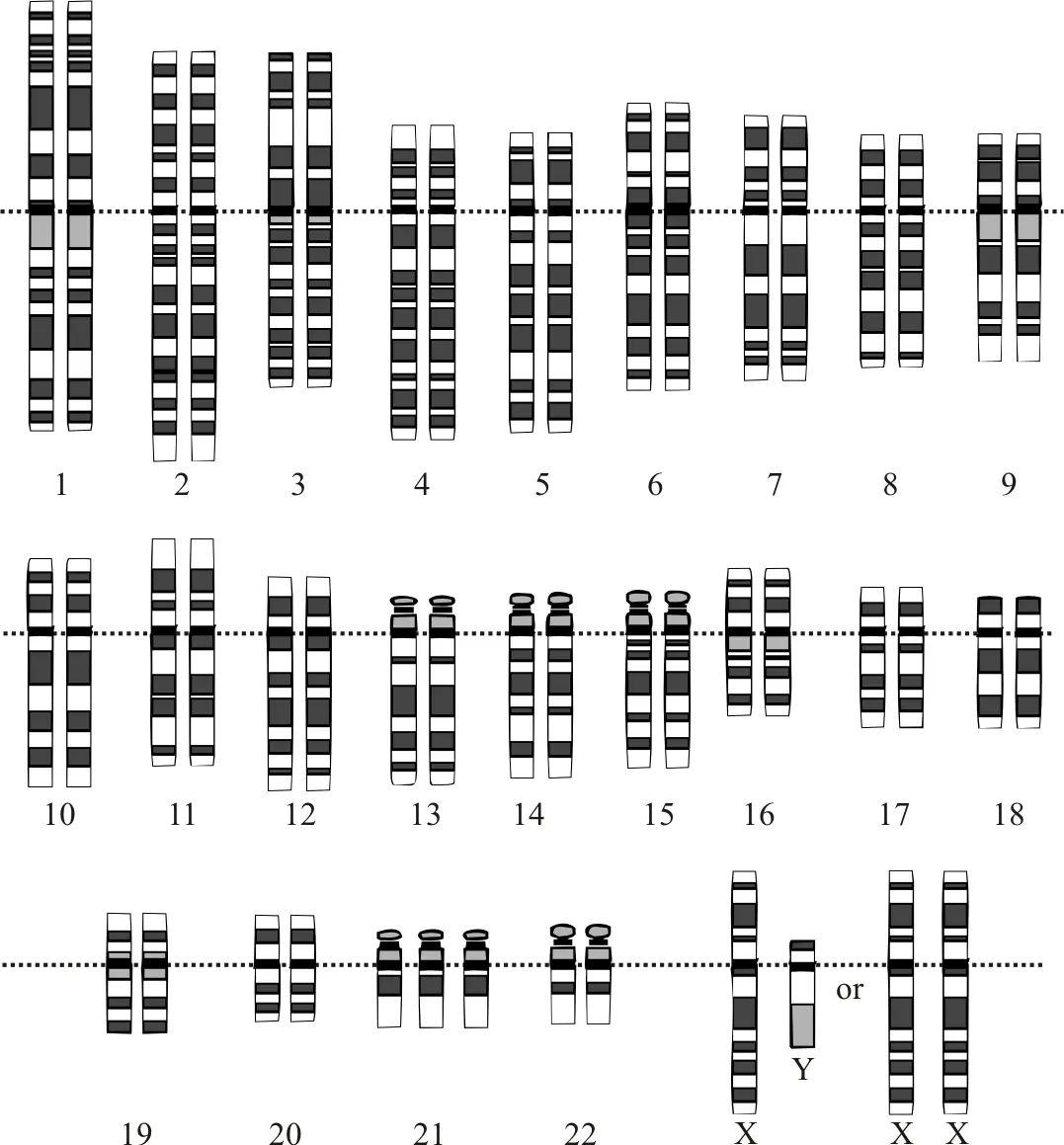
- Trisomy (2n + 1): one chromosome is present three times. Trisomy of an autosome causes Down syndrome (trisomy 21, 47 chromosomes), and the rarer, more serious Edwards syndrome (trisomy 18) and Patau syndrome (trisomy 13). Trisomy of the sex chromosomes causes Klinefelter syndrome (44 + XXY), a tall man who is usually infertile.
- Tetrasomy (2n + 2): one chromosome is present four times. It is rarer than trisomy. A well-documented example in the sex chromosomes is tetrasomy X, 48,XXXX, a woman with four X chromosomes. (In tetrasomy 18p, often given as an example, the extra copies are of only the short arm of chromosome 18, joined into one small extra chromosome, not of the whole chromosome.)
- Pentasomy (2n + 3): one chromosome is present five times, three more than normal. It is very rare: pentasomy X, 49,XXXXX, causes severe problems of development.
- Hexasomy (2n + 4): one chromosome is present six times. It is so rare that it is hardly known in living people.
ii. Euploidy
Euploidy is the loss or addition of complete sets of chromosomes. Organisms with whole sets, in any number, are euploids. Unlike aneuploids, euploids keep their genes in balance, so they are often healthy, especially in plants: euploidy is common in plants and rare in animals.
- Monoploidy: the organism has only one set of chromosomes (2n − n = n). A monoploid is usually smaller and weaker than the diploid, and sterile. Breeders grow monoploid plants from pollen grains on purpose, then double their chromosomes to get, in one step, a plant with two identical sets (pure-breeding). (Male honey bees, wasps and ants, the drones, also have one set, but that is their normal way of life, not a mutation: they hatch from unfertilized eggs.)
- Polyploidy: the organism has more than two sets: triploid (3n), tetraploid (4n), pentaploid (5n), hexaploid (6n), and so on (3.4.3).
A person has 47 chromosomes: three copies of chromosome 18 and two of every other. What is this?
Pick an answer to see why.
3.4.3 Polyploidy
Most organisms are diploid, with two sets of chromosomes. Organisms with more than two sets are polyploids, and the condition is polyploidy. It arises from errors in meiosis (a gamete that keeps all the chromosomes of a cell, 2n instead of n) or in fertilization (two sperm fertilizing one egg), or when the chromosomes of a cell double without the cell dividing. Breeders cause it on purpose with colchicine, a drug from the autumn crocus that stops the spindle forming, so chromosomes that have copied themselves stay in one cell.
Polyploidy is very common in plants: a large share of flowering plants, ferns and grasses have polyploidy somewhere in their ancestry, and many of our crops are polyploid. In animals it is rare and usually harmful (a triploid human embryo doesn’t survive), though there are polyploid fish and frogs, and some fish and oysters are made triploid on farms, so that they grow without spending energy on breeding.
Types of polyploidy
1. Autopolyploidy
Autopolyploidy is an increase in the number of chromosome sets of the same species. Write a diploid species’ two similar sets as AA. If one set is doubled, it becomes an autotriploid, AAA; if both are doubled, an autotetraploid, AAAA.
- Banana: the Cavendish and other sweet bananas of its group are triploid, AAA, all three sets from one wild species. Their three sets can’t pair evenly in meiosis, so they set no seeds, and are grown from suckers. (Plantains and some other bananas are triploid too, but with sets from two wild species, AAB or ABB.)
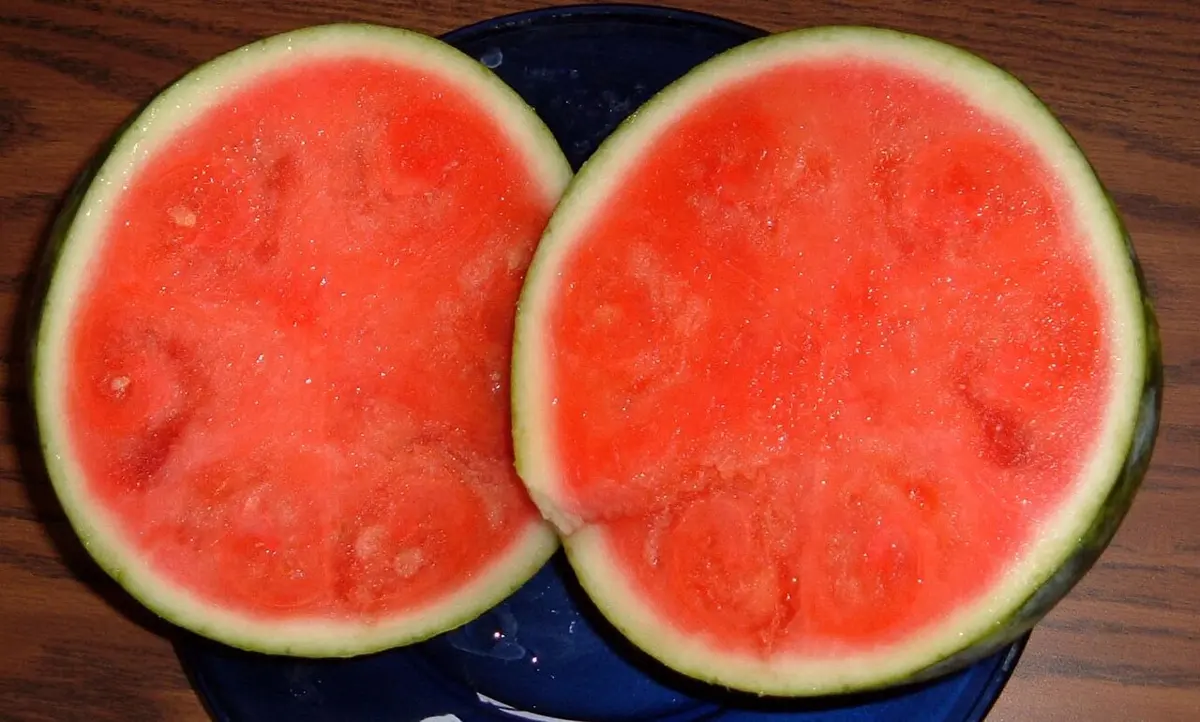
- Seedless watermelon: a tetraploid (4n) watermelon, made with colchicine, is crossed with a normal diploid (2n). The seeds of the cross grow into triploid (3n) plants, whose fruits have no hard seeds, only small, soft, empty seed coats.
- Potato: the common potato, Solanum tuberosum, is an autotetraploid, 2n = 4x = 48.
- Some apples, and grapes with very large berries, are polyploid too. (Most seedless grapes, though, are ordinary diploids: their seeds start to form and then stop growing.)
2. Allopolyploidy
Allopolyploidy arises in a hybrid between two different species, when its chromosome sets are doubled: the hybrid AB becomes AABB. An allopolyploid has two or more sets each of two (or more) different genomes. A plain hybrid AB is usually sterile, because its A and B chromosomes are not homologous and can’t pair in meiosis. After doubling, every chromosome has a partner, meiosis works, and the plant is fertile. It can breed with its own kind but not with either parent: it behaves as a new species.
The classic example is Raphanobrassica, made by the Russian geneticist Georgii Karpechenko in 1927–1928 by crossing two plants of different genera, the radish (Raphanus sativus, 2n = 18, sets RR) and the cabbage (Brassica oleracea, 2n = 18, sets CC) (Figure 10.8).
Karpechenko hoped for a plant with a radish’s root and a cabbage’s leaves. He got the opposite: a radish’s leaves and a cabbage’s thin root. But it was one of the first new species made by people, and it showed how many wild species have arisen.
Allopolyploids we eat every day:
- Bread wheat, Triticum aestivum, is a hexaploid, AABBDD (2n = 6x = 42), from three wild grasses that crossed and doubled about 8,000–10,000 years ago in western Asia.
- Rayo (Indian mustard, Brassica juncea), the leafy green of Nepal’s winter gardens, is an allotetraploid, AABB (2n = 36), from tori (Brassica rapa, AA, 2n = 20), whose seed gives mustard oil, and black mustard (Brassica nigra, BB, 2n = 16).
- Cotton grown for its long fibers is an allotetraploid, and triticale, a man-made cross of wheat and rye, is grown as a crop and animal feed.
Significance of polyploidy
- Polyploidy helps the evolution of new plant species: an allopolyploid is cut off from its parents at once, in a single generation.
- Polyploid plants often have larger cells, and so larger leaves, flowers and fruits (the “gigas” effect).
- Triploidy gives seedless fruits, such as the banana and the seedless watermelon.
- Polyploids are often more vigorous and adaptable, so polyploidy can raise crop yields, and some polyploids resist diseases or harsh conditions better than their diploid relatives.
- Breeders use it to make new crops (triticale) and to make sterile hybrids fertile, by doubling their chromosomes.
- Scientists use polyploids to study how genes and chromosomes work, and how much a gene’s dose matters.
A plant hybrid between two species is sterile. Why can doubling its chromosomes make it fertile?
Pick an answer to see why.
3.4.4 Importance of mutation
Positive importance:
- Mutations create the genetic variation that evolution needs: they are the only source of new alleles.
- They can bring useful characters that help organisms adapt to a changing environment, such as resistance to a disease or to a poison.
- Useful mutations in crops and animals improve food production: many varieties grown today, of rice, barley and wheat among them, were bred from mutants made with radiation.
- Mutants help scientists understand genes, diseases and how cells work: finding what goes wrong when a gene is broken shows what the gene does.
- Breeders use induced mutations to develop disease-resistant and high-yielding crop varieties.
Negative importance:
- Some mutations cause genetic disorders, such as Down syndrome or sickle-cell anemia.
- Mutations in body cells can lead to cancer.
- They can reduce fertility or cause birth defects in humans and animals.
- Harmful mutations may produce weak or non-viable organisms, in nature or on farms.
- Mutations in germs can make them resistant to medicines, such as bacteria resistant to antibiotics.
Exercise
A. Tick the correct alternatives
- What is the cause of sickle cell anemia?
Pick an answer to see why.
- Which type of gene mutation replaces a purine with another purine?
Pick an answer to see why.
- Which type of euploidy involves only one set of chromosomes?
Pick an answer to see why.
- Which of the following sets of chromosomes does a girl with Turner syndrome have?
Pick an answer to see why.
- What is the chromosome set of an autotetraploid organism if the original diploid set is AA?
Pick an answer to see why.
- The sequence of bases in a DNA is ATG AAA GGG CCC TTT. Which one of the following is a frameshift mutation?
Pick an answer to see why.
B. Answer the following questions
What is mutation? Compare the characters of gene mutation and chromosomal mutation.
Answer
A plant species normally has 14 chromosomes (2n = 14). What would be the chromosome number in its tetraploid and hexaploid forms?
Answer
Write the positive and negative importance of mutation.
Answer
What is polyploidy? Describe its types and also mention its significance.
Answer
A cell was found to have 45 chromosomes instead of the normal 46. Predict which type of chromosomal mutation has occurred, and discuss its possible phenotypic outcomes.
Answer
Printable PDFs
- Study notes 3 pages
- Worksheet 4 pages Answer key
Quiz yourself: Heredity and Evolution, Grades 5–12 →
Practice every question in the book, and keep track of the ones you miss →
A companion to your textbook, not a replacement for it: study from the book your school uses, and where the two differ, follow your teacher. Found a mistake? Please tell us.