
You have about 20,000 genes, and only 23 kinds of chromosome to carry them. So each chromosome carries hundreds or thousands of genes, strung along it like beads on a thread. Mendel’s peas never showed him this: by luck, the seven characters he chose behaved as if each pair of genes moved on its own. But genes on one thread ought to travel together, from parent to child. Do they? And if they always did, why are two brothers never quite alike?
This unit is the answer to both questions: linkage, which keeps genes on one chromosome together, and crossing over, which breaks them apart again. In between comes a special case of linkage with a story of its own: the genes on the X chromosome, which pass differently to sons and daughters, and the white-eyed fruit fly that showed it.
3.3.1 Linkage
A gene is the basic unit of heredity: a length of DNA that controls a character of an organism. Genes are carried on chromosomes. An organism has thousands of characters (eye color, height, blood group, skin color…) and so thousands of genes, but only a few chromosomes. So each chromosome must carry many genes.
Genes on the same chromosome are called linked genes. As long as the chromosome stays whole, they go into the same gamete and so pass together into the same offspring. Linkage is the tendency of genes on the same chromosome to be inherited together, in the same combination as in the parent.
This breaks one of Mendel’s rules. Mendel’s law of independent assortment says that the alleles of two genes go into the gametes independently of each other (3.2.3, in the last unit). That is true for genes on different chromosomes, because each pair of chromosomes lines up at metaphase I without regard to the others. Two genes on the same chromosome can’t move independently: they are tied together. Linked genes don’t follow the law of independent assortment.
All the genes on one chromosome form a linkage group. Both chromosomes of a homologous pair carry the same genes, so they make one linkage group, and the number of linkage groups equals the haploid number of chromosomes (n):
| Organism | 2n | Linkage groups |
|---|---|---|
| Fruit fly, Drosophila melanogaster | 8 | 4 |
| Garden pea, Pisum sativum | 14 | 7 |
| Maize, Zea mays | 20 | 10 |
| Human | 46 | 23 |
(Strictly, a human male has 24: his X and Y carry different genes, so they count as two groups. The number usually given, and asked for in exams, is 23.)
A plant has 2n = 24 chromosomes. How many linkage groups does it have?
Pick an answer to see why.
Types of linkage
Whether linked genes always stay together depends on what happens to their chromosome in meiosis. In prophase I the two homologous chromosomes of a pair can swap matching pieces (crossing over, 3.3.3). If the swap happens between two linked genes, it separates them, and the gamete gets a new combination of their alleles: a recombinant gamete. Gametes with the parent’s combinations are parental gametes.
So there are two kinds of linkage.
1. Complete linkage
When linked genes are never separated by crossing over, only parental gametes are formed, and the offspring show only the parents’ combinations of characters, generation after generation. No new combinations appear. This is complete linkage. It is rare. It happens when the genes are so close together that a crossover between them is almost never seen, or in the few organisms that make no crossovers at all in one sex: male fruit flies (and female silkworms) form no chiasmata in meiosis.
The classic example is the fruit fly’s body color and wing shape. The two genes are on the same chromosome (chromosome 2):
- G, gray body, is dominant over g, black body;
- N, normal (long) wings, is dominant over n, vestigial (short, crumpled) wings.
A male with a gray body and normal wings (GGNN) is crossed with a female with a black body and vestigial wings (ggnn). The male’s gametes all carry GN, the female’s gn, so every F₁ fly is GgNn, with GN on one chromosome and gn on the other: all gray with normal wings.
Now a test cross: an F₁ male is crossed with a black, vestigial female (ggnn), whose eggs all carry gn. If the genes assorted independently, the F₁ male would make four kinds of sperm (GN, Gn, gN, gn) in equal numbers, and the offspring would come in four kinds, 1 : 1 : 1 : 1. Instead there are only two kinds, in equal numbers:
- gray body, normal wings (GgNn), half;
- black body, vestigial wings (ggnn), half.
The F₁ male made only two kinds of sperm, GN and gn, the combinations on his two chromosomes (Figure 9.1).
2. Incomplete linkage
When linked genes lie some distance apart on the chromosome, a crossover between them happens in some of the cells making gametes. Then both parental and recombinant gametes are formed, the parental ones in larger numbers. This is incomplete linkage, much the more common kind. It gives new combinations of characters along with the parents’ ones, and so more variety.
The classic example is in maize, studied by C. B. Hutchinson in 1922. Two genes on chromosome 9 control the seed (the kernel):
- C, colored seed, is dominant over c, colorless seed;
- Sh, full (plump) seed, is dominant over sh, shrunken seed. (Some books write F and f for full and shrunken.)
A plant with colored, full seeds (CC ShSh) is crossed with one with colorless, shrunken seeds (cc shsh). All the F₁ have colored, full seeds (Cc Shsh), with C Sh on one chromosome and c sh on the other.
The F₁ is then test-crossed with a colorless, shrunken plant (cc shsh). Four kinds of seed appear. Hutchinson counted 8,368:
| Seeds | Genotype | Kind | Number | Share |
|---|---|---|---|---|
| colored, full | Cc Shsh | parental | 4,032 | 48.2% |
| colorless, shrunken | cc shsh | parental | 4,035 | 48.2% |
| colored, shrunken | Cc shsh | recombinant | 149 | 1.8% |
| colorless, full | cc Shsh | recombinant | 152 | 1.8% |
If the genes were on different chromosomes, the four kinds would come about 25% each. Instead the parental kinds make up 96.4%, and the recombinants only 3.6%. The genes are linked, but not completely: in a few of the F₁’s cells a crossover fell between C and Sh, giving gametes C sh and c Sh (Figure 9.2).
So the share of recombinant gametes tells you how far apart two linked genes are: the closer the genes, the less often a crossover falls between them. This is the idea behind gene maps. One map unit (or centimorgan, after Morgan) is the distance that gives 1% recombinant gametes. C and Sh in maize are about 3.6 map units apart.
This works best for genes close together. Between genes far apart, two crossovers can fall in the same cell, and the second swaps the alleles back into the parents’ combination, so that pair of crossovers leaves no recombinant to count. The recombinant share then falls a little below the true distance, and it can never pass 50%. That is why distances between genes far apart are found by adding up the distances between genes close together.
| Complete linkage | Incomplete linkage | |
|---|---|---|
| Crossing over between the genes | doesn’t happen | happens in some cells |
| Gametes | parental only | parental (more) and recombinant (fewer) |
| Test cross of a double heterozygote | 2 kinds of offspring, 1 : 1 | 4 kinds, parental ones more common |
| New combinations | none | some |
| How common | rare | common |
| Example | gray/black body and normal/vestigial wings, F₁ male Drosophila | colored/colorless and full/shrunken seed in maize |
In a test cross of a double heterozygote, the offspring come in two kinds only, in a 1 : 1 ratio. What does this show?
Pick an answer to see why.
3.3.2 Sex-linked inheritance
The chromosomes of a cell are of two kinds. The sex chromosomes decide whether the organism is male or female; all the others are autosomes (somatic chromosomes), which carry the genes for the body’s other characters. A human body cell has 23 pairs: 22 pairs of autosomes and 1 pair of sex chromosomes. A woman is 44 + XX, a man 44 + XY. The fruit fly has 4 pairs: 3 pairs of autosomes and one pair of sex chromosomes (XX in the female, XY in the male).
Genes on the autosomes are autosomal genes. Genes on the sex chromosomes are sex-linked genes, and the inheritance of the characters they control is sex-linked inheritance: characters passed from parents to offspring by genes on a sex chromosome, so passed differently to sons and daughters. Examples are hemophilia and red–green color blindness in humans, and eye color in the fruit fly. They are all on the X chromosome, which is large and carries about 800 genes for proteins, most of them nothing to do with sex; the Y is small, with a few dozen.
The features of sex-linked (X-linked) inheritance:
- Sex-linked genes are on the sex chromosomes, nearly all of them on the X.
- Most sex-linked disorders are caused by recessive alleles.
- An X-linked recessive character appears more often in males than in females. A male has only one X: a single recessive allele shows, as there is no second X to hide it (he is hemizygous). A female needs the allele on both X’s.
- A father can’t pass an X-linked character to his son, because he gives his son his Y; a son’s X always comes from his mother.
- A mother can pass an X-linked character to both sons and daughters.
- Criss-cross inheritance: an X-linked recessive character typically passes from an affected father to his daughter, who is a carrier (she shows nothing), and from her to her son. So it goes from grandfather to grandson through a daughter, skipping a generation.
A man with hemophilia marries a woman with no hemophilia allele. Which of their children can have hemophilia?
Pick an answer to see why.
1. Sex-linked inheritance in humans: color blindness
Color blindness (red–green color blindness) is the inability to tell red, green, or both, from other colors. In the retina, light is caught by three kinds of cone cells, with pigments most sensitive to red, green and blue light. The genes for the red and green pigments lie side by side on the X chromosome. The allele for normal vision is dominant; color blindness is caused by a faulty recessive allele on the X. It affects about 1 man in 12 of Northern European ancestry, but only about 1 woman in 200.
Write the X with the normal allele as (or just X) and the X with the color-blindness allele as . Then:
| Normal | Carrier | Color-blind | |
|---|---|---|---|
| Woman | |||
| Man | none |
There are four kinds of marriage in which the allele is present.
a. A color-blind man and a normal woman ( × ).
| Gametes | (egg) | (egg) |
|---|---|---|
| (sperm) | , carrier daughter | , carrier daughter |
| Y (sperm) | , normal son | , normal son |
All the children have normal vision. Every daughter is a carrier (heterozygous, so not color-blind herself); no son is color-blind, since each son’s X comes from his normal mother.
b. A carrier woman and a normal man ( × ).
| Gametes | (egg) | (egg) |
|---|---|---|
| (sperm) | , normal daughter | , carrier daughter |
| Y (sperm) | , normal son | , color-blind son |
Of all the children, 25% are normal daughters, 25% carrier daughters, 25% normal sons and 25% color-blind sons. So half the sons are color-blind, and half the daughters are carriers; no daughter is color-blind.
c. A color-blind woman and a normal man ( × ).
| Gametes | (egg) | (egg) |
|---|---|---|
| (sperm) | , carrier daughter | , carrier daughter |
| Y (sperm) | , color-blind son | , color-blind son |
Every daughter is a carrier and every son is color-blind: half the children are carrier daughters and half color-blind sons.
d. A carrier woman and a color-blind man ( × ).
| Gametes | (egg) | (egg) |
|---|---|---|
| (sperm) | , carrier daughter | , color-blind daughter |
| Y (sperm) | , normal son | , color-blind son |
25% carrier daughters, 25% color-blind daughters, 25% normal sons and 25% color-blind sons. This is the only one of the four marriages that gives a color-blind daughter.
From these crosses we conclude:
- The color-blindness allele is on the X chromosome.
- A woman has two X’s, so she must be homozygous recessive to be color-blind; a man has one X, so a single recessive allele makes him color-blind. That is why color blindness is much more common in men than in women.
- A father passes the allele only to his daughters; a mother can pass it to both sons and daughters.
- A father can’t pass an X-linked character to his son: a son’s X comes from his mother.
- Only women can be carriers (one normal and one faulty X). A man either has the allele and shows it, or doesn’t have it.
- A color-blind woman always has a color-blind father (one of her two came from him), and all her sons are color-blind (each gets one of her X’s).
- A color-blind woman has color-blind daughters only if her husband is color-blind too.
2. Sex-linked inheritance of eye color in Drosophila
Thomas Hunt Morgan (1866–1945), an American zoologist, studied the inheritance of eye color in the fruit fly Drosophila melanogaster with his students in a small laboratory at Columbia University, New York, known as the Fly Room. The work showed that genes are carried on chromosomes, and Morgan was awarded the Nobel Prize in Physiology or Medicine in 1933 “for his discoveries concerning the role played by the chromosome in heredity”. If genes are on chromosomes, a sudden change in a character (a mutation) must be a change in a gene on a chromosome; Morgan’s mutant flies became the way to find out which.
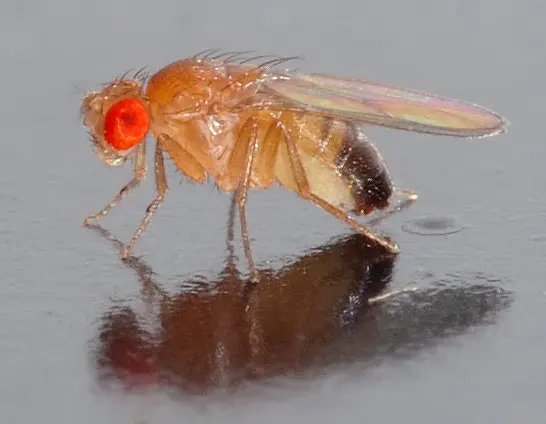
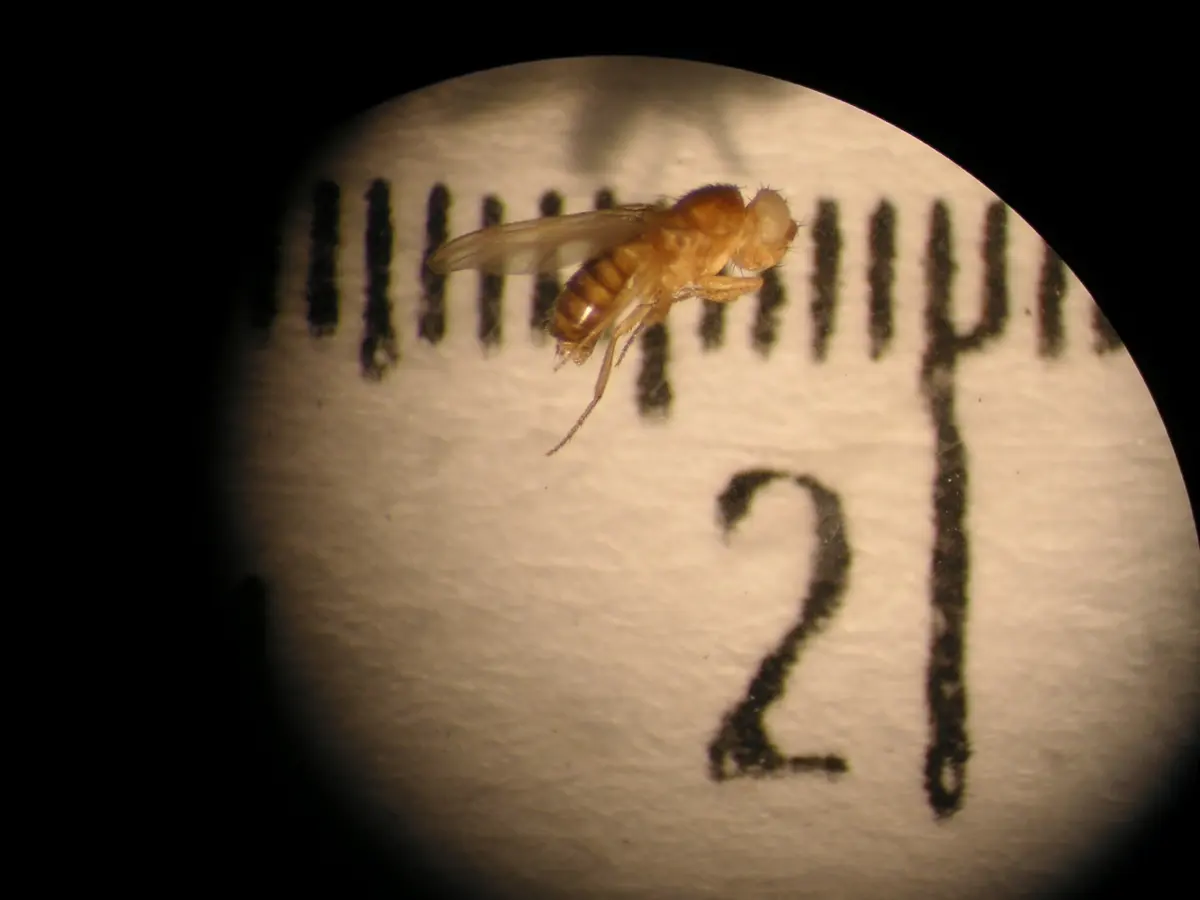
The fruit fly is a small fly, about 2–3 mm long, often seen hovering over ripe fruit. Morgan chose it because:
- It is easy to keep in bottles on a cheap food (banana or other fruit, sugar and yeast).
- It breeds quickly and in large numbers: one pair can give hundreds of offspring.
- Its life cycle is short, about 10–15 days (10 at 25 °C), so many generations can be studied in a year.
- It breeds all through the year.
- It has only 4 pairs of chromosomes, so the sex chromosomes are easy to tell apart under a microscope.
- Males and females are easy to tell apart: the male is smaller, with a rounded abdomen whose tip is dark, and has a small comb of bristles (the sex comb) on each front leg; the female is larger, with a longer, pointed abdomen striped to its tip.
Morgan’s experiments
In 1910 Morgan found, among his red-eyed flies, one male with white eyes. White eye was a new, mutant form. He crossed red-eyed and white-eyed flies in different ways, and saw that how eye color was inherited depended on the sex of the parents. The gene for eye color is on the X chromosome. Write for an X with the red allele, for white.
Cross I: a red-eyed female and a white-eyed male. Morgan crossed a normal red-eyed female with his white-eyed male. All the F₁, males and females, were red-eyed: red is dominant over white.
He then crossed the F₁ red-eyed males with the F₁ red-eyed females. In the F₂:
- all the females were red-eyed;
- half the males were red-eyed;
- half the males were white-eyed;
- overall, red-eyed to white-eyed was 3 : 1.
The 3 : 1 ratio is Mendel’s, but with a twist: every white-eyed fly was a male. (Morgan counted 2,459 red-eyed females, 1,011 red-eyed males and 782 white-eyed males: fewer white-eyed flies than 3 : 1 predicts, because white-eyed flies survive less well.)
Cross II: F₁ red-eyed females and white-eyed males. Morgan crossed the F₁ red-eyed females with white-eyed males. Red-eyed and white-eyed females and males appeared in equal numbers, 1 : 1 : 1 : 1. So white eye is not limited to males: a female with two white alleles has white eyes.
Cross III: a white-eyed female and a red-eyed male. This is the reciprocal of Cross I: the same two characters, the sexes swapped. If the gene were on an autosome, the result would be the same as Cross I. It wasn’t: all the males were white-eyed and all the females red-eyed.
From Crosses I, II and III Morgan concluded that:
- White eye in Drosophila is a sex-linked character, found more often in males than in females.
- Red eye is dominant over white eye.
- The gene for eye color is on the X chromosome, and the white allele is recessive. The Y carries no allele for it.
- The white allele passes from a white-eyed male, through his F₁ daughters, to half of his grandsons: criss-cross inheritance.
- A male passes a sex-linked character only to his daughters.
Why did Morgan’s reciprocal cross (Cross III) give a different result from Cross I?
Pick an answer to see why.
3.3.3 Crossing over
Crossing over is the exchange of matching pieces between the non-sister chromatids of two homologous chromosomes, while they are paired in meiosis, producing new combinations of genes. The chromatids that come out of the exchange, each part one parent’s and part the other’s, are recombinant chromatids (recombinants). The term crossing over was given by Morgan (with his student Eloise Cattell, 1912).
Crossing over happens in prophase I of meiosis. Its stages follow the sub-phases of prophase I (see Grade 11 Biology, meiosis):
- Zygotene: the homologous chromosomes pair (synapsis), held together by the synaptonemal complex.
- Pachytene: the actual exchange of pieces between non-sister chromatids happens.
- Diplotene: the homologs begin to separate, but stay joined where they exchanged: these X-shaped joins are chiasmata (singular chiasma), where crossing over is seen.
- Diakinesis: the chiasmata slide towards the chromosomes’ ends (terminalization), and the homologs separate at anaphase I.
Notice that only two of the four chromatids take part in one crossover. So even when a crossover falls between two genes in every cell, only half the gametes are recombinant: that is why recombination never goes above 50%.
Kinds of crossing over
By the number of chiasmata formed between a pair of homologs, crossing over is:
- single: one chiasma;
- double: two chiasmata;
- multiple: more than two chiasmata.
Long chromosomes usually form more chiasmata than short ones, and nearly every pair forms at least one: in human meiosis there are a few dozen crossovers in each cell (about 26 in a man’s and over 40 in a woman’s, by large family studies).
Significance of crossing over
- It increases genetic variation, by exchanging pieces between homologous chromosomes: new combinations of alleles appear in the offspring.
- So offspring are genetically different from their parents and from one another (except identical twins): each person is an individual.
- It gives natural selection more variety to act on, so it supports evolution.
- It helps populations adapt: with more variation, some individuals are more likely to survive a change in their surroundings, such as a new disease.
- Recombination keeps a population varied in the genes that matter for fighting disease, so no one infection finds everyone alike. (Some books say crossing over “increases immunity”; it does so only in this sense, for the population, not by making any one person’s immune system stronger.)
- Plant and animal breeders use it to bring useful characters together: a new crop variety that yields well and resists disease is often a recombinant of two parents, each with one of the characters.
- The frequency of crossing over between genes shows how far apart they are, so it is used to make gene maps (linkage maps) of chromosomes.
Two genes are 3 map units apart on a chromosome. About what percentage of gametes are recombinant for them?
Pick an answer to see why.
Exercise
A. Tick the correct alternatives
- What is the number of linkage groups in man?
Pick an answer to see why.
- Which of the given laws is not followed by linked genes?
Pick an answer to see why.
- In Drosophila, how many pairs of chromosomes are autosomes?
Pick an answer to see why.
- A mother is a carrier for color blindness and the father has normal vision. What is the probability that their son will be color-blind?
Pick an answer to see why.
- Which chromosome carries the gene for eye color in Drosophila?
Pick an answer to see why.
- Why can males transmit sex-linked traits only to their daughters and not to their sons?
Pick an answer to see why.
- In which stage of meiosis does the actual exchange of genetic material take place?
Pick an answer to see why.
- What is the point at which crossing over occurs called?
Pick an answer to see why.
- Why is crossing over during meiosis important in the long-term survival of a species?
Pick an answer to see why.
- Name the process shown in the picture above, and label A, B and C.
Pick an answer to see why.
B. Answer the following questions
What is linkage? What are the different types of linkage?
Answer
Describe complete linkage with an example.
Answer
Describe incomplete linkage in maize.
Answer
Why is Drosophila selected for the study of sex-linked inheritance?
Answer
What is sex-linked inheritance? Describe it with reference to eye color in Drosophila.
Answer
Explain the sex-linked inheritance of color blindness in man.
Answer
What is crossing over? Mention its significance.
Answer
Explain the role of crossing over in creating genetic variation.
Answer
A red-eyed female fruit fly, heterozygous for the eye color gene, is crossed with a white-eyed male. What will be the expected phenotypic ratio of the offspring? Explain your answer with a Punnett square.
Answer
A color-blind man marries a woman with normal vision. Their children have normal vision. Draw a genetic diagram to suggest an explanation for this.
Answer
Fruit flies can have normal wings or vestigial wings. The allele for normal wings, N, is dominant, and the allele for vestigial wings, n, is recessive.
- a.Write down the three possible genotypes and their phenotypes.
- b.Construct a complete genetic diagram to show the offspring produced when a heterozygous fly mates with a fly homozygous for the normal-wing allele.
Answer
Printable PDFs
- Study notes 4 pages
- Worksheet 4 pages Answer key
Quiz yourself: Heredity and Evolution, Grades 5–12 →
Practice every question in the book, and keep track of the ones you miss →
A companion to your textbook, not a replacement for it: study from the book your school uses, and where the two differ, follow your teacher. Found a mistake? Please tell us.