
Every saffron crocus growing in the world today is, in a sense, the same plant. The saffron crocus (Crocus sativus, kesar) has three sets of chromosomes instead of two, so its pollen and eggs come out unbalanced and it almost never sets a seed. For thousands of years farmers have kept it going by digging up its corms, splitting off the small new ones and planting them. Each new corm carries exactly the genes of the corm it grew from, so the crocuses in Kashmir, Iran and Spain are one ancient individual, copied again and again. Garlic is the same: every clove you plant grows into a copy of the plant it came from.
Plants are very good at copying themselves without sex. A broken willow twig pushed into wet ground grows roots; a potato left in the kitchen sprouts from its eyes; a single leaf of pattharchatta lying on soil grows a row of tiny plants round its edge. This unit opens the part of the book called embryology, the study of how a new plant begins. It starts with the ways a plant makes offspring without fertilization, and why farmers and nurseries use them every day.
4.1.1 Asexual reproduction
Asexual reproduction is reproduction without the fusion of gametes: no fertilization, so no seed formed by fertilization. One parent alone produces the offspring, and because they arise by mitosis (or, in apomixis, from a cell that skipped the halving of meiosis), they are genetically identical to the parent.
That one fact gives asexual reproduction its strengths and its weakness:
- It lets a plant colonize a place quickly: one clump of dubo grass or one water hyacinth can cover a field or a pond.
- It needs no pollinators and no partner, so a single plant on its own can still reproduce.
- It keeps a combination of genes that works well in a stable environment.
- But the offspring have no genetic variation, so the plants are less able to adapt when the environment changes or a new disease arrives.
Apomixis
In flowering plants, asexual reproduction comes in two forms. Both are grouped under the name apomixis (Greek apo, away from; mixis, mixing), “reproduction without mixing”: that is, without meiosis and fertilization mixing the genes of two parents. The two forms are:
- Agamospermy: seeds formed without fertilization.
- Vegetative propagation: new plants from roots, stems, leaves or buds, with no seed at all.
1. Agamospermy: seeds without fertilization
In agamospermy (Greek a, without; gamos, marriage; sperma, seed) a plant forms seeds in the normal way, inside ovules in an ovary, but the embryo develops without fertilization. You will meet the ovule properly in the next unit; for now you need four of its parts. An ovule is a small body with a tissue called the nucellus inside one or two coats (integuments). Normally one nucellus cell, the megaspore mother cell (2n), divides by meiosis; one of its four haploid products grows into the embryo sac, which holds the egg (n). A pollen grain’s male gamete (n) fertilizes the egg, giving a zygote (2n) that grows into the embryo.
In agamospermy the embryo comes from some cell that was never fertilized. There are three ways:
a. Adventive embryony (nucellar embryony). The embryo grows from an ordinary diploid body cell of the nucellus or the integument, outside the embryo sac. It is not even made from an egg. Such embryos often grow beside a normal sexual embryo, so one seed may hold several embryos (polyembryony). A citrus seed sown in a nursery often sends up two or three seedlings. Seen in Citrus (orange, lemon, junar), the prickly pear cactus (Opuntia), and some varieties of mango (Mangifera indica).
b. Recurrent agamospermy. The embryo grows from a diploid egg cell in an embryo sac that never went through meiosis (or whose meiosis was skipped), without fertilization, so it is a form of parthenogenesis (“virgin birth”). The diploid embryo sac arises in one of two ways:
- Diplospory: the megaspore mother cell itself skips meiosis and grows straight into a diploid embryo sac.
- Apospory: some other diploid cell of the nucellus grows into a diploid embryo sac (and the normal one usually dies).
It is called recurrent because it can repeat generation after generation: the egg is diploid, so the embryo is diploid with exactly the mother’s genes, and when it grows up it does the same again, with no recombination. Seen in the dandelion (Taraxacum officinale, tuki phul or dudhe jhar, common on lawns and roadsides in the hills; diplospory), Kentucky bluegrass (Poa pratensis; apospory) and many brambles of the blackberry group (Rubus).
c. Non-recurrent agamospermy. The embryo grows from a haploid egg (n), formed by normal meiosis, without fertilization. The new plant is haploid: it has only half its parent’s chromosomes, and it is not identical to its parent (meiosis has shuffled the genes). Haploid plants are usually weak and sterile, since a single set of chromosomes can’t pair in meiosis, so this can’t repeat in the next generation: it is non-recurrent. It is rare, and it has been seen in some species of Solanum, Lilium and Nicotiana (tobacco). Plant breeders value haploids: doubling a haploid’s chromosomes with a chemical gives in one step a plant whose every gene pair is identical (a pure line).
In adventive (nucellar) embryony, which cell grows into the embryo?
Pick an answer to see why.
Why is agamospermy from a haploid egg called “non-recurrent”?
Pick an answer to see why.
2. Vegetative propagation
Vegetative propagation (vegetative reproduction) is the form of asexual reproduction in which a new plant grows from a vegetative part of a plant, a root, stem, leaf or bud, without fertilization and without forming a seed. The new plants are genetically identical to the parent and to each other. A group of such offspring, all from one parent and all with the same genes, is called a clone (Greek klon, a twig: the word was first used, in 1903, for plants grown from cuttings, buds and tubers).
4.1.2 Vegetative propagation
Vegetative propagation happens naturally, when a plant spreads by its own roots, stems or leaves, and artificially, when people cut, bend, join or culture parts of a plant to make new ones.
1. Natural vegetative propagation
In natural vegetative propagation a new plant grows by itself from a root, stem or leaf of the parent, without a seed. The part that does it is usually a store of food (a swollen root or stem) or a spreading stem, and it carries buds that can grow into shoots, and the ability to make adventitious roots (roots growing from a stem or leaf, not from the radicle).
a. Vegetative propagation through roots
Some roots form adventitious buds, which sprout under favorable conditions into leafy shoots; when the shoot and its piece of root are separated from the parent, they grow as a new plant. A sweet potato (a swollen root) sends up shoots (slips) from its surface, and farmers plant these slips, not seeds. Guava and the shisham tree (Dalbergia sissoo) send up shoots called root suckers from roots near the surface, so a cut tree often comes up again round its stump. Asparagus (kurilo) stores food in a cluster of fleshy roots; gardeners divide the clump into pieces, each with some fleshy roots and a bud, and each grows into a new plant.
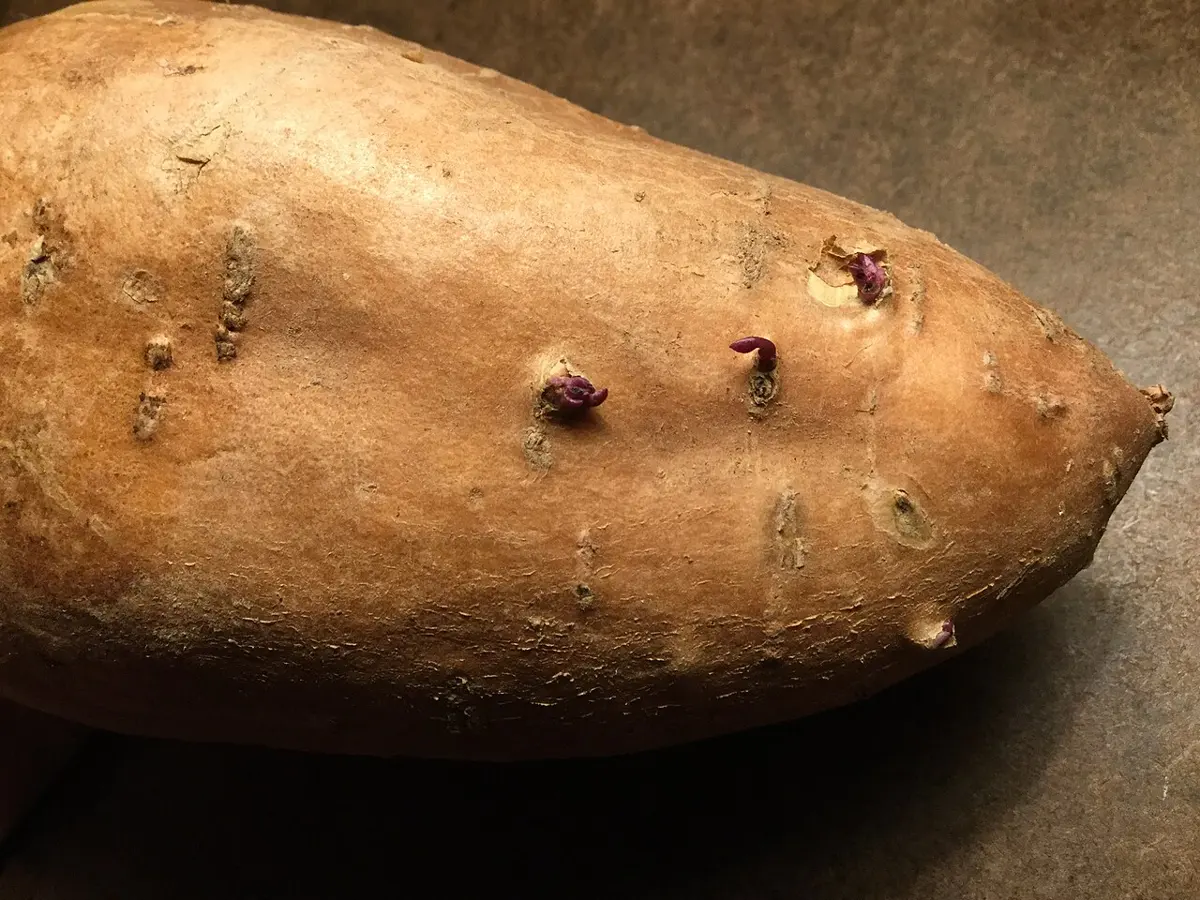
A swollen root such as the sweet potato is still a root: it has no nodes and no scale leaves, and its buds appear anywhere on it, not at fixed places. That is the quick way to tell it from a tuber, which is a stem.
b. Vegetative propagation through stems
Stems are made for this: every node has a bud that can grow into a shoot, and nodes readily grow roots. A stem may propagate the plant underground, along the surface (sub-aerial), or in the air.
i. Underground stems
Underground stems store food through the cold or dry season and send up new shoots when it ends. Each is still a stem, which you can tell by its nodes, internodes, scale leaves and buds.
- Rhizome: a stem growing horizontally under the ground, with clear nodes and internodes, scale leaves at the nodes, and buds in their axils. New shoots and roots come from the nodes, and any piece with a bud grows into a plant. Examples: ginger, turmeric, bamboo, and the lotus. Farmers plant ginger as pieces of rhizome, each with a bud or two.
- Tuber: the swollen tip of an underground branch (a stolon, in the potato) that stores food, mostly starch. Its eyes are nodes: each holds a bud in a dent under the scar of a tiny scale leaf, and under favorable conditions each bud grows into a new plant. Examples: potato and yam (Dioscorea, ghar tarul).
- Bulb: a very short, flat, disc-like stem with many fleshy scale leaves (leaf bases) packed round a central bud. The food is stored in the scale leaves, not in the stem. Buds in the axils of the scales grow into new bulbs, as the cloves of garlic do. Examples: onion, garlic, tulip, and the lily.
- Corm: a short, upright, solid, swollen stem, round or flattened, covered by dry papery scale leaves at its nodes, which leave rings round it. The food is stored in the stem itself. Buds at its nodes grow into new corms (cormels). Examples: Gladiolus, saffron (Crocus sativus, kesar), and taro (Colocasia esculenta, pindalu).
Ginger: F. M. Blanco, Flora de Filipinas (1880s), public domain
Potato plant: Rijksmuseum (RP-T-BR-2017-1-9-74), CC0
Potato: ZooFari, Wikimedia Commons, public domain
Garlic: Bentley and Trimen, Medicinal Plants (1880), public domain
Taro: R. A. Young, Promising Root Crops for the South (1910), public domain
A gardener cuts a potato into pieces to plant. Which pieces will grow?
Pick an answer to see why.
ii. Sub-aerial stems
Sub-aerial stems grow partly or wholly along the surface of the ground (or water), spreading the plant sideways. New plants form at their nodes and become independent when the connecting stem dies or breaks.
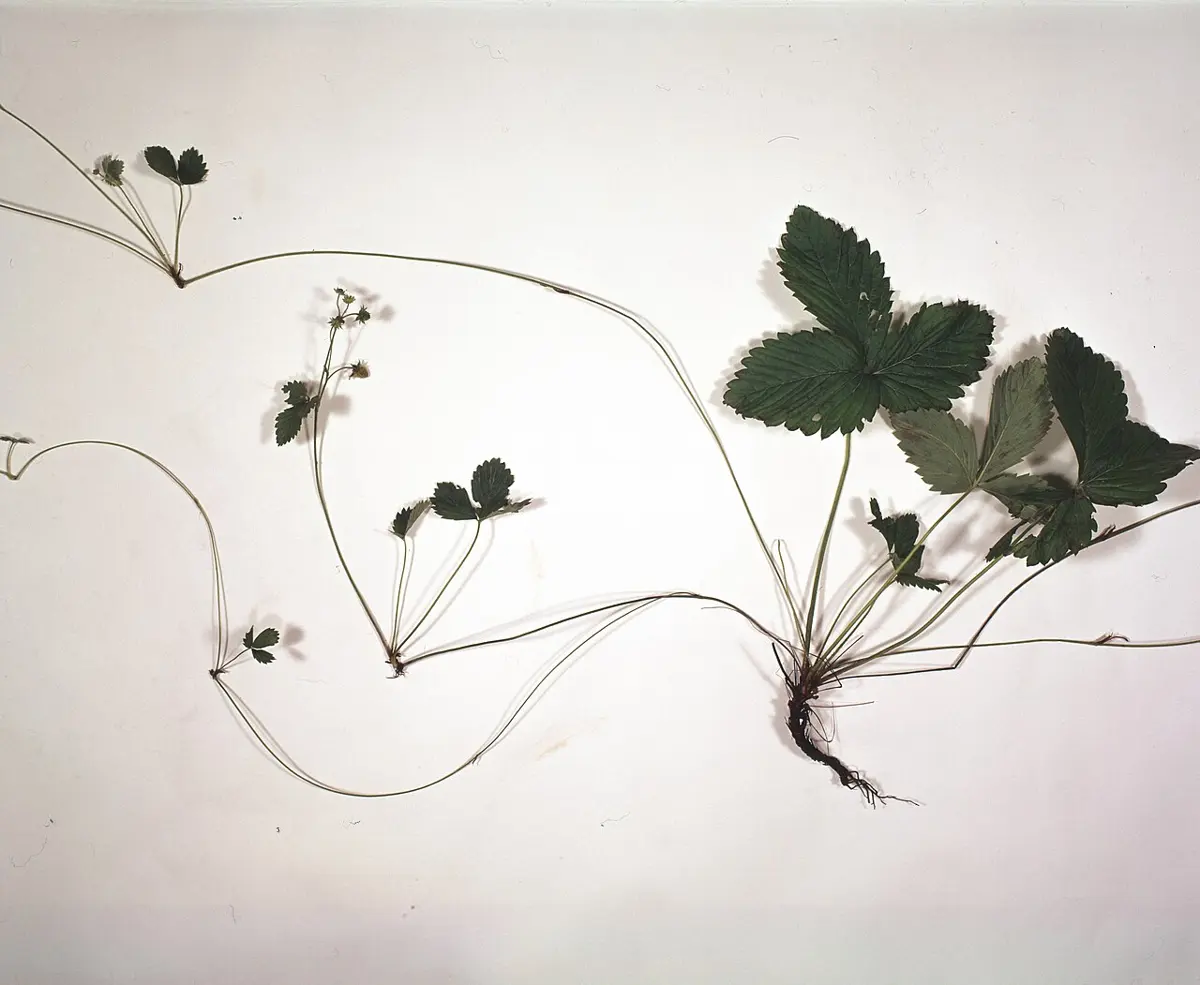
- Runner: a slender stem creeping along the surface of the ground, with long internodes, rooting at the nodes; a leafy shoot grows up from each node. Examples: dubo grass (Cynodon dactylon), Oxalis (chari amilo), and the long, leafless runners a strawberry sends out, each ending in a new plantlet.
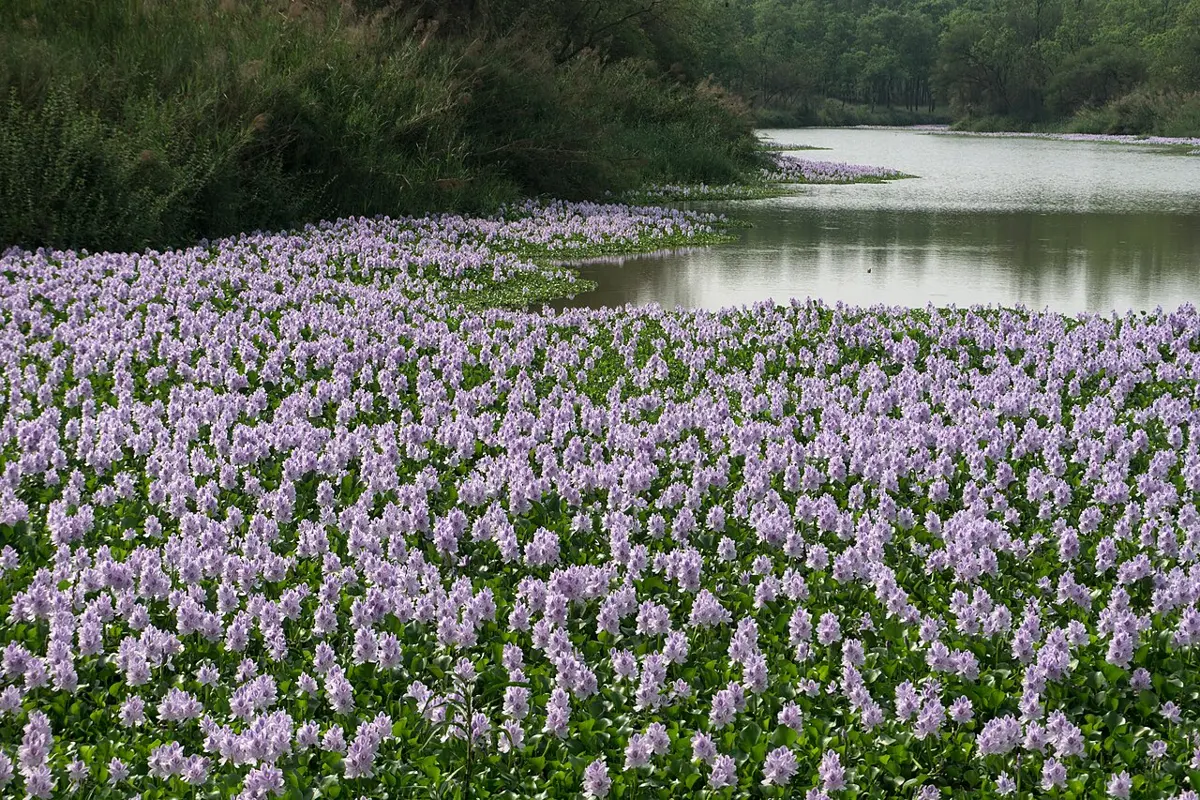
- Offset: a short, thick runner, one internode long, with a rosette of leaves and a tuft of roots at its end, found mostly in water plants with rosettes of leaves. The offset breaks off and floats away as a new plant. Examples: water hyacinth (Eichhornia crassipes, jalkumbhi) and water lettuce (Pistia).
- Stolon: a side branch from the base of the stem that grows up into the air for a while and then arches down, and roots where it touches the soil. A bud there grows into a new plant, which becomes independent when the arching branch breaks. Examples: mint (pudina) and jasmine. In some plants, such as mint, stolons also creep just under the soil.
iii. Aerial stems
Some stems above the ground can also give new plants. Pieces of the flat green stems (cladodes) of the prickly pear (Opuntia) that break off and fall on the ground grow roots and become new plants. Some plants make small bulb-like buds in the air, called bulbils, which fall and grow: the yam (Dioscorea bulbifera) in its leaf axils, and Agave in its flower stalk. And sugarcane and bamboo stems root readily at their nodes, which is why farmers plant them as stem pieces.
c. Vegetative propagation through leaves
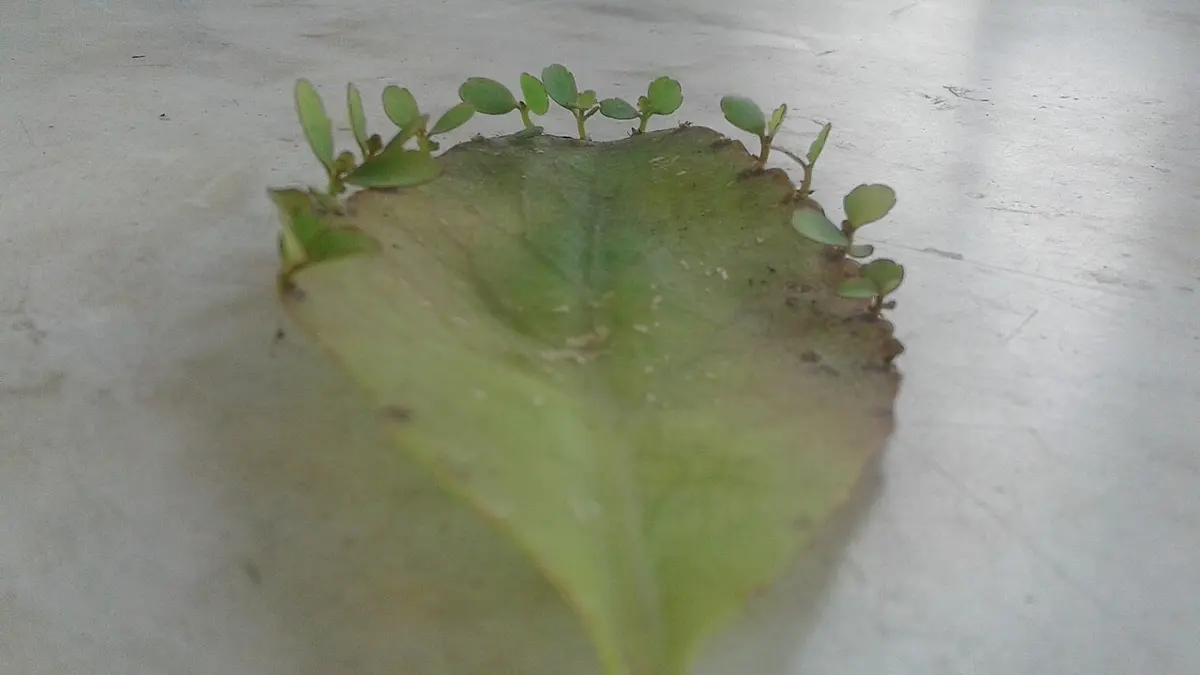
A few plants form adventitious buds on their leaves. While the leaf is on the plant the buds stay dormant; when the leaf falls on moist soil (or the plant is stressed) they grow into little plants with roots, which become independent. Examples:
- Bryophyllum (pattharchatta, Kalanchoe pinnata): buds in the notches of the leaf margin.
- Begonia: a leaf laid on moist soil, with its veins cut, grows plantlets where the veins were cut.
- The walking fern (Adiantum caudatum, common on shady walls and banks in the hills of Nepal): the tip of its long, whip-like frond bends down, touches the soil, roots and grows a new plant, so the fern “walks” across a bank.
Which of these is a sub-aerial stem with a short, thick internode and a rosette at its end, found in water plants?
Pick an answer to see why.
2. Artificial vegetative propagation
Artificial vegetative propagation is the making of new plants from parts of existing plants by people, by cutting, layering, grafting or micropropagation. The new plants are genetically identical to the parent, so a farmer or a nursery can multiply a good variety (a sweet mango, a disease-free potato, a beautiful rose) quickly and exactly. It is a common practice in horticulture (the growing of fruits, vegetables and flowers) and in agriculture.
a. Cutting
In cutting, a piece of a plant (usually a stem, sometimes a root or a leaf) is cut off and planted, and it grows into a new independent plant. A stem cutting is usually 15–25 cm long with several nodes. Its lower leaves are taken off, its base is pushed into moist soil or sand so that one or two nodes are buried, and the buried nodes grow adventitious roots while a bud above the soil grows into the shoot. Dipping the cut end in a rooting powder, a synthetic auxin such as IBA, makes roots form faster and in greater numbers (auxins start roots: Unit 5).
Plants grown from stem cuttings: rose, sugarcane (planted as stem pieces, setts, with two or three nodes), cassava, grapevine, Hibiscus, bougainvillea, chrysanthemum, and the willow. Root cuttings are used for a few plants such as horseradish and blackberry; leaf cuttings for Begonia and the snake plant.
b. Layering
Layering is making a branch grow roots while it is still attached to the parent plant, which feeds it meanwhile; only when it has rooted is it cut off. Usually the branch is wounded where the roots are wanted: a ring or a slanting cut through the bark interrupts the phloem, so sugars and auxin collect there and roots form. There are four common kinds:
- Simple layering: a low, soft, flexible branch is bent down to the ground, a cut is made in it up to the vascular region where it touches the soil, and that part is buried and pegged down, with the branch’s tip left above the soil. After some weeks the buried part grows roots; the rooted branch is then cut off from the parent and grows as a new plant. Used for jasmine, grapevine, Bougainvillea and lemon.
- Serpentine (compound) layering: a long, flexible branch is bent in and out of the soil like a snake, wounded at each buried part, so that many new plants form along one branch, one at each buried part, and a bud on each exposed part grows into its shoot. Used for climbers with long stems, such as jasmine, Clematis and grapevine.
- Mound (stool) layering: the parent plant is cut back to near the ground in the dormant season, so that it sends up many new shoots from its base. Soil is heaped up round the base of these shoots, deeper as they grow; they root inside the mound, and the next dormant season each rooted shoot is cut off as a new plant. Used for apple rootstocks, gooseberry and currants.
- Air layering (gootee): for branches too stiff or high to bend down. A ring of bark about 2–3 cm wide is removed from a branch, the wound is dusted with a rooting hormone, and it is wrapped in a ball of moist rooting material (moist soil and moss, often with cow dung) held in polythene tied at both ends so that it doesn’t dry out. After some weeks roots grow into the ball; the branch is then cut off below the ball and planted. Used for litchi, guava, lemon, pomegranate and many house plants.
Layering: Pearson Scott Foresman (public domain)
Grass: O. W. Thomé, Flora von Deutschland (1885), public domain
Shoot tip: L. H. Bailey, Beginners' Botany (1909), public domain
Why is a ring of bark removed in air layering?
Pick an answer to see why.
c. Grafting
Grafting is joining parts of two plants so that they grow together as one plant. It combines the good qualities of two plants: the upper part, the scion (a shoot or a bud), comes from the plant whose flowers, fruits or leaves are wanted, such as a sweet mango variety; the lower part, the stock (rootstock), with the roots, is chosen for strong roots, hardiness and resistance to diseases of the soil. The scion and stock are cut and fitted so that their cambium layers touch: the cambium of each grows new cells that knit the two together, and new xylem and phloem form across the joint. The joint is tied and sealed (with grafting tape or wax) to keep out water and germs. The scion and stock must be closely related, usually the same species or genus (mango on mango, apple on apple, lemon on other citrus).
The common kinds of grafting:
- Bud grafting (budding): the scion is a single bud with a small piece of bark. In T-budding, a T-shaped cut is made in the bark of the stock, the flaps of bark are lifted, the bud is slipped in, and the bark is tied over it with the bud left showing. When it has joined, the stock above the bud is cut off. Used for rose, citrus, peach and plum.
- Approach grafting (inarching): the scion is not cut off from its parent until the graft has joined. A potted stock is brought up beside the scion plant, a slice is cut from the side of each, and the two cut faces are tied together. When they have united, the scion is cut below the joint and the stock above it. Used for plants that are hard to graft any other way, such as mango and litchi.
- Tongue (whip-and-tongue) grafting: a stock and a scion of the same thickness are each cut with a long slanting cut, and a second cut (the tongue) in each face lets them lock into each other. Used for apple and pear.
- Crown grafting (rind grafting): an old tree is cut off and several scions, cut to a wedge on one side, are slipped between the bark and the wood round the cut top, like a crown. Used to change an old fruit tree to a better variety.
- Wedge (cleft) grafting: the stock is cut off and split down the middle; the scion, its base cut into a wedge, is pushed into the split so that its cambium meets the stock’s, then tied and sealed. Used for mango, apple and walnut seedlings and many other trees.
Cleft graft: Brett's Colonists' Guide (1883), public domain
In a grafted mango tree, which part decides the taste of the fruit?
Pick an answer to see why.
d. Micropropagation
Micropropagation is propagation by plant tissue culture: growing many identical plants from a tiny piece of a plant, the explant (a shoot tip, a bud, a piece of leaf or stem), on a nutrient medium with plant hormones, in sterile laboratory conditions. It works because almost every living plant cell can, with the right signals, divide and grow into a whole plant (this ability is called totipotency).
The steps:
- Choose and sterilize the explant. A small piece, often a shoot tip, is cut from a healthy plant and its surface is sterilized (with dilute bleach or alcohol), because germs would grow faster than the plant on the rich medium.
- Start the culture. The explant is placed on a jelly of agar with sugar, mineral salts, vitamins and hormones in a sterile glass tube or jar, which is kept closed in a warm, lit room.
- Multiply. With the right balance of hormones the explant either forms many small shoots directly or first grows into an undifferentiated lump of cells, the callus, which is then made to form shoots. A high ratio of cytokinin to auxin favors shoots; a high ratio of auxin to cytokinin favors roots Grade 12: Unit 5. Every few weeks the shoots are cut apart and subcultured onto fresh medium, and each multiplies again.
- Root. The shoots are moved to a medium richer in auxin, where they form roots and become plantlets.
- Harden. The plantlets, raised in damp, sterile jars, are moved step by step to pots in a greenhouse and then to the field.
The technique gives fast mass propagation of healthy, disease-free plants, within acceptable cost. A shoot tip (meristem) cut small enough is often free of the viruses that infect the rest of the plant, so plantlets from it are virus-free: this is how disease-free seed potatoes and banana plantlets are made. It is used in agriculture (potato, banana, sugarcane, strawberry), in horticulture (orchids, Gerbera, ornamental plants), in forestry, and in conservation, to multiply rare and endangered plants from a few pieces. In Nepal, government and private laboratories multiply potato, banana and orchids this way. The requirements, media and kinds of tissue culture are in Unit 13.
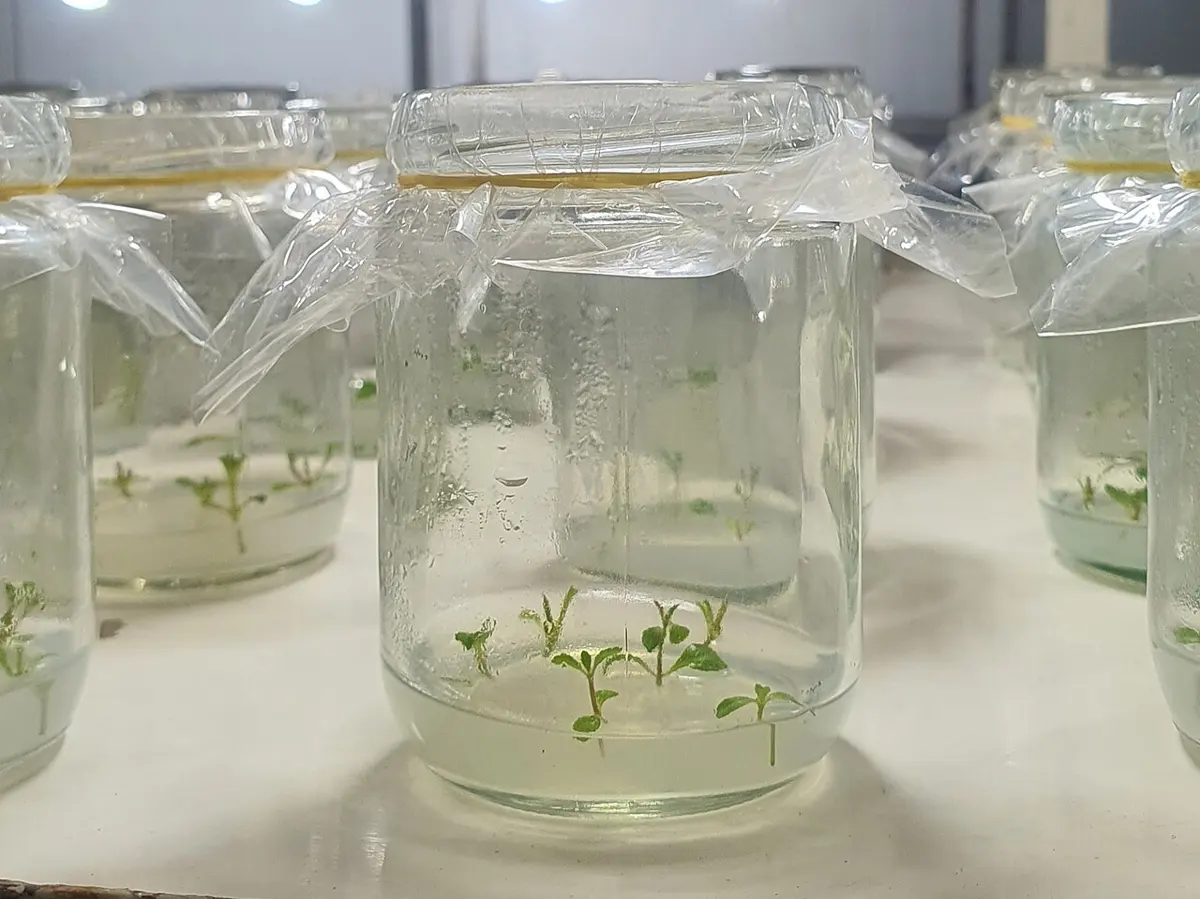
A rare orchid has only a few plants left. Why is micropropagation better than seeds or cuttings for saving it?
Pick an answer to see why.
Advantages of vegetative propagation
- It reproduces plants much faster than seeds: a plant from a cutting, tuber or graft grows quickly and flowers and fruits years sooner than a seedling (a grafted mango in 3–4 years, a seedling in 6–8 or more).
- The offspring are genetically identical to the parent, so the desired characters are kept exactly: every plant of a good variety is that variety.
- It allows the multiplication of plants that produce no seeds or no good seeds, such as banana, sugarcane, garlic, saffron and seedless grapes.
- It gives uniform growth and yield: all the plants grow, flower and ripen together, which makes farming and harvesting easier.
- It helps in producing disease-free plants, above all by micropropagation from shoot tips.
- It is highly efficient for large-scale commercial growing of high-value crops (potato, banana, sugarcane, apples, orchids, roses).
Disadvantages of vegetative propagation
- A plant makes far fewer pieces (cuttings, tubers, layers) than seeds, and they are bulky, heavy and spoil easily, so propagating by them needs more labor and space per plant, and they can’t be stored for years or carried far like seeds.
- It creates no genetic variation, so all the plants are equally open to the attack of diseases and insects: a disease that kills one can kill them all.
- Diseases spread with it: if the parent is infected, especially with a virus, every piece taken from it carries the infection to the new plants, and viruses build up over generations.
- Plants from cuttings and layers have no taproot, only adventitious roots, so they may be less firmly anchored and, in some trees, shorter-lived than seedlings.
- It can’t be used for every species: many plants (most cereals, for example) don’t propagate well by vegetative parts.
- Growing the same clones over large areas lowers the genetic diversity of farmland, making whole regions vulnerable at once.
Exercise
A. Tick the correct alternatives
- Which of the following is a method of asexual reproduction in angiosperms where embryos develop without fertilization?
Pick an answer to see why.
- In which type of apomixis does the embryo develop from diploid cells of the nucellus or integuments?
Pick an answer to see why.
- Which of the following is an example of a plant that reproduces through rhizomes?
Pick an answer to see why.
- What is the horizontal stem that grows along the ground and produces new plants at nodes called?
Pick an answer to see why.
- Which of the following is a disadvantage of vegetative propagation?
Pick an answer to see why.
- Name the small piece of plant used in micropropagation.
Pick an answer to see why.
- A strawberry plant sends out a long, thin stem along the ground, with a new plant rooted at its tip (as in the photo of the strawberry above). Name the method of vegetative propagation.
Pick an answer to see why.
- A rare orchid species is on the verge of extinction. Scientists plan to multiply it rapidly in the lab. Which of the following will help achieve this?
Pick an answer to see why.
- Why is it ecologically dangerous when aquatic weeds like Eichhornia propagate through offsets?
Pick an answer to see why.
B. Answer the following questions
What is vegetative propagation?
Answer
What is micropropagation?
Answer
What is layering? Describe the process of layering with a diagram.
Answer
Differentiate between cutting and grafting.
Answer
How can vegetative propagation be useful in preserving the genetic traits of a plant?
Answer
You have a healthy rose plant in your garden. How would you propagate more rose plants using vegetative methods? Describe the steps.
Answer
A nursery uses grafting to produce mango saplings. What could be the advantages of this method over growing mangoes from seeds?
Answer
Cleft graft: Brett's Colonists' Guide (1883), public domain
Observe the diagram above and answer the questions.
- a.What type of vegetative propagation is shown in the diagram?
- b.Label A and B.
- c.Name one plant that is propagated by this method.
- d.State two advantages of this method.
Answer
Why is vegetative propagation considered both a benefit and a risk in modern agriculture? Support your answer with real-world examples.
Answer
Printable PDFs
- Study notes 3 pages
- Worksheet 4 pages Answer key
Quiz yourself: Life Processes and the Human Body, Grades 5–12 →
Practice every question in the book, and keep track of the ones you miss →
A companion to your textbook, not a replacement for it: study from the book your school uses, and where the two differ, follow your teacher. Found a mistake? Please tell us.